LGBTQ Symbol Collection Vector Illustration Showing Pride Flags, Gender Icons, and Equality Signs Representing Diverse Identities
The LGBTQ community encompasses a broad spectrum of sexual orientations, gender identities, and expressions, advocating for inclusivity, acceptance, and equal rights. Representing this diversity visually requires the use of pride flags, gender icons, and equality symbols, each carrying cultural, social, and political significance. A vector illustration of LGBTQ symbols typically integrates various pride flags, universal gender icons, and equality signs, providing a comprehensive, educational, and visually engaging overview of LGBTQ representation. By combining labeled icons, color-coded flags, and universally recognizable symbols, such illustrations allow viewers to understand and celebrate diverse identities while highlighting the principles of equality and inclusion.
At the center of the illustration is a collection of pride flags, each arranged in a visually balanced layout. The most recognizable is the rainbow pride flag, representing the diversity of the LGBTQ community. Labels identify each color’s significance—red for life, orange for healing, yellow for sunlight, green for nature, blue for harmony, and violet for spirit. Adjacent to the rainbow flag, vector representations of other pride flags are displayed, including the transgender pride flag (blue, pink, and white stripes), the bisexual pride flag (pink, purple, and blue), the pansexual pride flag (pink, yellow, and blue), the asexual pride flag (black, gray, white, and purple), and other specific identity flags. Arrows or labels may indicate each flag’s meaning, promoting recognition of diverse sexual and gender identities. Color coding ensures that each flag is visually distinct while maintaining a cohesive, vibrant palette.
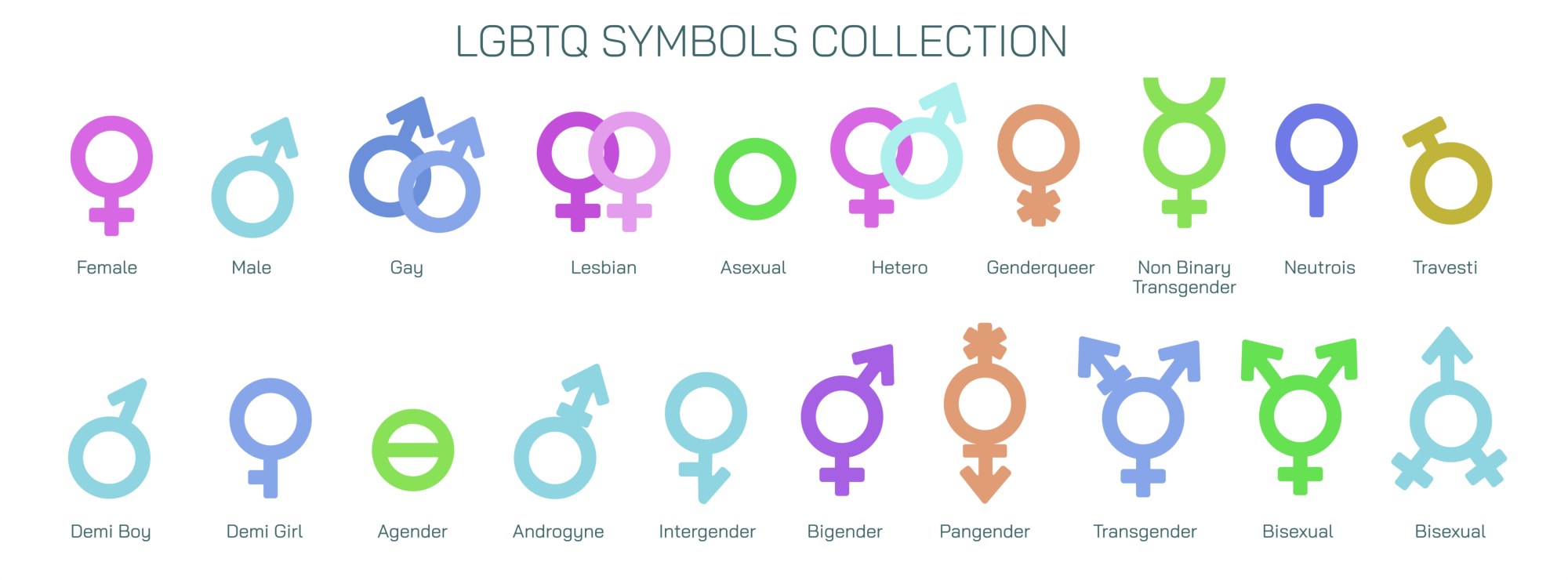
Gender icons are depicted alongside the flags to represent individual identities and gender diversity. Traditional male (♂) and female (♀) symbols are included, along with combined, non-binary, genderqueer, agender, and intersex icons, showing inclusivity of gender expressions beyond binary definitions. Labels identify each icon, and arrows may illustrate variations or intersections between gender identity and expression. These vector icons are often designed with bold outlines and color accents matching or complementing associated pride flags, reinforcing visual association between identity symbols and color-coded representation.
Equality signs ( = ) are included throughout the illustration to emphasize the community’s advocacy for equal rights, legal recognition, and social acceptance. Arrows or callouts may connect equality symbols to specific groups or flags, visually linking the concept of equality with representation. Colorful overlays may integrate equality signs with rainbow or trans flag motifs, creating a cohesive visual message of unity and inclusivity.
Vector illustrations often include symbol arrangements in clusters or patterns, such as circular layouts, grids, or cascading banners, to show interconnectivity among identities. For instance, rainbow-colored circular arcs may encompass multiple flags and icons, reinforcing the collective nature of the LGBTQ community. Arrows and labels highlight relationships between sexual orientation and gender identity symbols, illustrating the diversity within the broader umbrella of LGBTQ identities.
Magnified insets or callouts may provide explanatory text or historical context. For example, a magnified rainbow flag may include labels explaining its origin by Gilbert Baker and the cultural significance of each stripe. Other flags may include short descriptions of the communities they represent, reinforcing educational value. Symbols for transgender, non-binary, and intersex individuals may be annotated with inclusive definitions, promoting awareness and understanding.
Additional features often include decorative accents, such as stars, hearts, or abstract geometric shapes, emphasizing pride, celebration, and visibility. These elements can be integrated around flags and icons to create a vibrant, visually engaging layout suitable for educational, social, and promotional purposes. Color-coded arrows may indicate how multiple flags and symbols intersect, showing overlapping identities and shared advocacy for acceptance.
By combining pride flags, gender icons, equality symbols, explanatory labels, and decorative accents, a vector illustration of LGBTQ symbols provides a comprehensive, inclusive representation of diverse identities. Color coding, directional arrows, and labeled icons allow viewers to immediately recognize and understand each identity while emphasizing unity, equality, and representation. Comparative panels or clustered arrangements make the diversity within the community visually clear, reinforcing both individuality and collective advocacy.
Ultimately, a vector illustration of LGBTQ symbols demonstrates the celebration of diversity, the affirmation of identity, and the promotion of equality. Through pride flags, inclusive gender icons, equality signs, and informative labels, the diagram transforms abstract social and cultural concepts into a visually engaging, educational, and intuitive tool for awareness, inclusivity education, and community recognition.