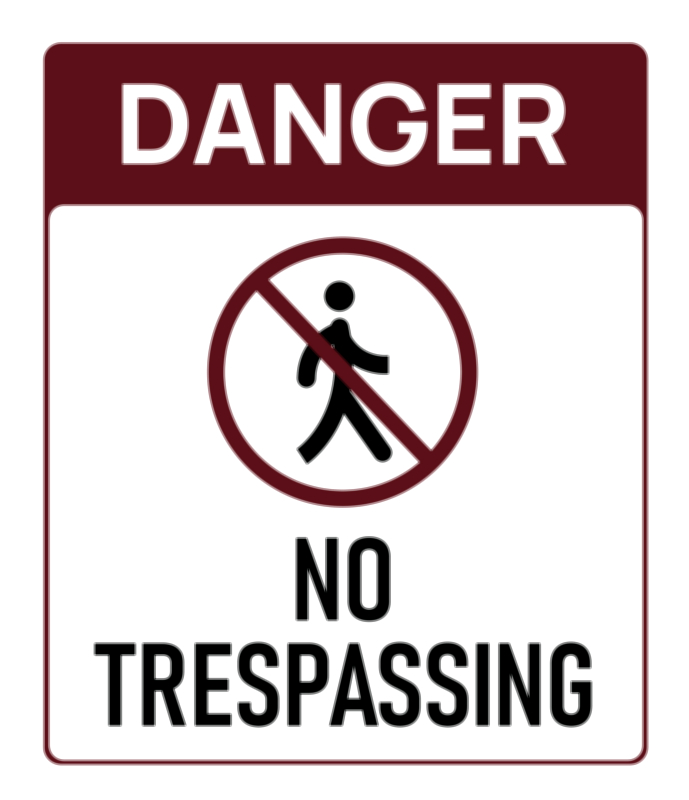
Entry Restricted — No Trespassing: Safety and Security Warning Sign
An Entry Restricted — No Trespassing safety and security warning sign, especially when presented as a clean and sharply defined vector illustration featuring strong prohibition icons, high-contrast safety colors, and bold uppercase text, represents one of the most assertive forms of boundary communication used to protect both people and property from harm. Although its design is visually simple, consisting of few words and universal symbols, its meaning is powerful because it tells anyone approaching that the area beyond the sign is not open to public access under any circumstance. The term Entry Restricted establishes an immediate access limitation, while No Trespassing reinforces that unauthorized presence is not only unsafe but also prohibited legally. Together, the message expresses a firm command — entry is stopped before it begins, not because the property is exclusive, but because crossing the boundary can expose individuals to danger, compromise ongoing operations, violate privacy, or trigger legal consequences. The sign communicates at the exact moment where misunderstanding would turn into violation, making awareness the first line of defense instead of confrontation.
The need for this sign arises from the way people naturally respond to physical space when boundaries are unclear. A doorway left open, a path without markings, a driveway without barriers, or a vacant-looking plot of land can easily be misinterpreted as an accessible route. When there is no visual indicator guiding movement, well-intentioned individuals may wander into restricted zones by mistake — visitors searching for a reception area, delivery personnel looking for an entry point, pedestrians cutting across land for convenience, surveyors and contractors approaching sites without checking access permissions, or even local residents exploring a structure that appears abandoned. These mistakes are innocent but can place both the individuals and the organization at risk. A clearly visible Entry Restricted — No Trespassing warning removes confusion before it creates confrontation. It tells people that they are not supposed to continue, not because someone dislikes their presence, but because entering without authorization would create danger, liability, or disruption. It protects both sides by ensuring that the boundary is understood without needing an uncomfortable or aggressive intervention.
At the heart of the sign is safety, because restricted areas often contain hazards that are not visible or predictable to the untrained observer. Construction zones may contain unstable flooring, falling-object risks, open trenches, demolition debris, and machinery that activates automatically. Industrial facilities may hide high-voltage electrical systems, chemical processing units, pressurized tanks, or automated conveyor systems that operate without human presence. Research and laboratory environments may house biohazards, toxic substances, harmful fumes, radiation sources, or temperature-controlled equipment where improper exposure could be lethal. Rail yards, seaports, power substations, mining zones, and manufacturing floors all contain operational environments that are safe only for trained personnel wearing protective gear and following strict safety procedures. The Entry Restricted — No Trespassing sign is therefore not designed to exclude out of superiority or secrecy — it exists because the area ahead is unsuitable or unsafe for unprepared individuals. The sign prevents tragedy before it can occur by telling people that intuition is not enough to detect the hazard waiting beyond the threshold.
The sign is also essential to security, because many restricted areas house equipment, materials, research, or information that must remain protected from unauthorized contact. Trespassing in these spaces may not only endanger individuals but also compromise important operations. A data center may contain sensitive servers, government facilities may house confidential documents, warehouses may carry expensive materials at risk of theft, and transportation hubs may operate under strict security guidelines to prevent sabotage or tampering. By reinforcing restricted access visually, the sign serves as a psychological deterrent to those who may consider unauthorized entry for malicious purposes. It informs them in advance that the space is actively protected and monitored, and that interaction is not casual or unnoticed. Even without physical fences or security personnel at the boundary, the sign projects authority by signaling that legal, institutional, or operational consequences exist beyond the line.
The legal aspect of the sign is equally crucial. In many jurisdictions, property owners and facility operators are obligated to warn outsiders clearly when a space contains danger or restricted access. If an individual enters such a space without signage and suffers injury, the owner may be held legally responsible for failing to inform. When a Entry Restricted — No Trespassing sign is posted visibly, the duty to warn has been fulfilled. If someone proceeds despite the warning, responsibility shifts to them rather than to the property owner. This protects organizations from liability, supports compliance with workplace safety codes, strengthens legal enforceability of trespassing rules, and provides clear documentation during inspections or accident investigations. The sign becomes a formal record that the risk and boundary were communicated in advance.
Alongside safety and legal protection, the sign supports operational continuity, which is crucial in environments where timing, sequencing, and precision determine workflow. A visitor walking into a restricted zone during equipment operation forces workers to pause machinery, stop processes, and divert focus toward crisis avoidance. In laboratories and medical environments, contamination concerns may require shutdowns of entire experiments. In broadcast or theater settings, unauthorized presence may interrupt recording or performance. In transportation facilities, wandering pedestrians may block vehicle movement or trigger emergency stops. The sign prevents such interruptions before they arise by ensuring that only trained and authorized individuals — individuals who understand how to move safely within the operation — enter the space.
The psychological effect of this signage is equally meaningful. When an access boundary is not clearly marked, the burden of enforcement falls on workers or security personnel, creating stress and potential conflict. Outsiders feel surprised or embarrassed when confronted, and insiders feel obligated to intervene, sometimes urgently or aggressively, to prevent danger. With the sign, the boundary becomes impersonal rather than interpersonal — no one needs to guess intentions, and no one needs to raise their voice. The decision to stay out comes from informed self-regulation rather than confrontation. When someone does cross the line anyway, the violation is intentional rather than accidental, making enforcement clearer and avoiding misunderstandings that damage trust.
The vector illustration format strengthens the sign’s authority and universality. Scalable graphics ensure complete clarity whether printed small on a laboratory door or oversized on a construction barrier or industrial fence. High-contrast colors such as red, white, black, and yellow demand visual attention and accelerate comprehension even from a distance, at night, or through harsh environmental conditions. Universal pictograms — such as the barred-entry icon, stop hand, or warning triangle — transcend language barriers, ensuring anyone, regardless of literacy or native language, understands the restriction immediately. Nothing in the design is ornamental; every element is optimized for visibility, readability, and reaction time because the purpose of the sign is to communicate instantly and decisively.
Emotionally, the sign protects comfort and professionalism. Workers inside restricted zones can focus on their tasks without worrying that strangers will wander into dangerous places. Visitors and passersby maintain dignity because they do not enter spaces where they would later be scolded or escorted out. Harmony is preserved between the public and the organization because the rule is communicated before confusion develops into interpersonal conflict. The sign helps create an environment where boundaries are respected not through intimidation, but through clarity.
Ultimately, the Entry Restricted — No Trespassing Vector Illustration: Safety and Security Warning Sign is a tool of prevention rather than punishment. It prevents an accident rather than recovering from one, prevents a legal dispute rather than arguing fault afterward, prevents operational disruption rather than trying to restart workflow later, and prevents confrontation rather than calming it down afterward. It protects property, privacy, operations, and — above all — people, simply by giving them the information they need at the very moment they need it most: right before they take a step toward a space where they do not belong. Through a small but authoritative message amplified by strong visual communication, the sign turns uncertainty into certainty, risk into awareness, and potential conflict into safety and respect.