No Trespassing Keep Out Sign Board — Private Property Restricted Access Warning
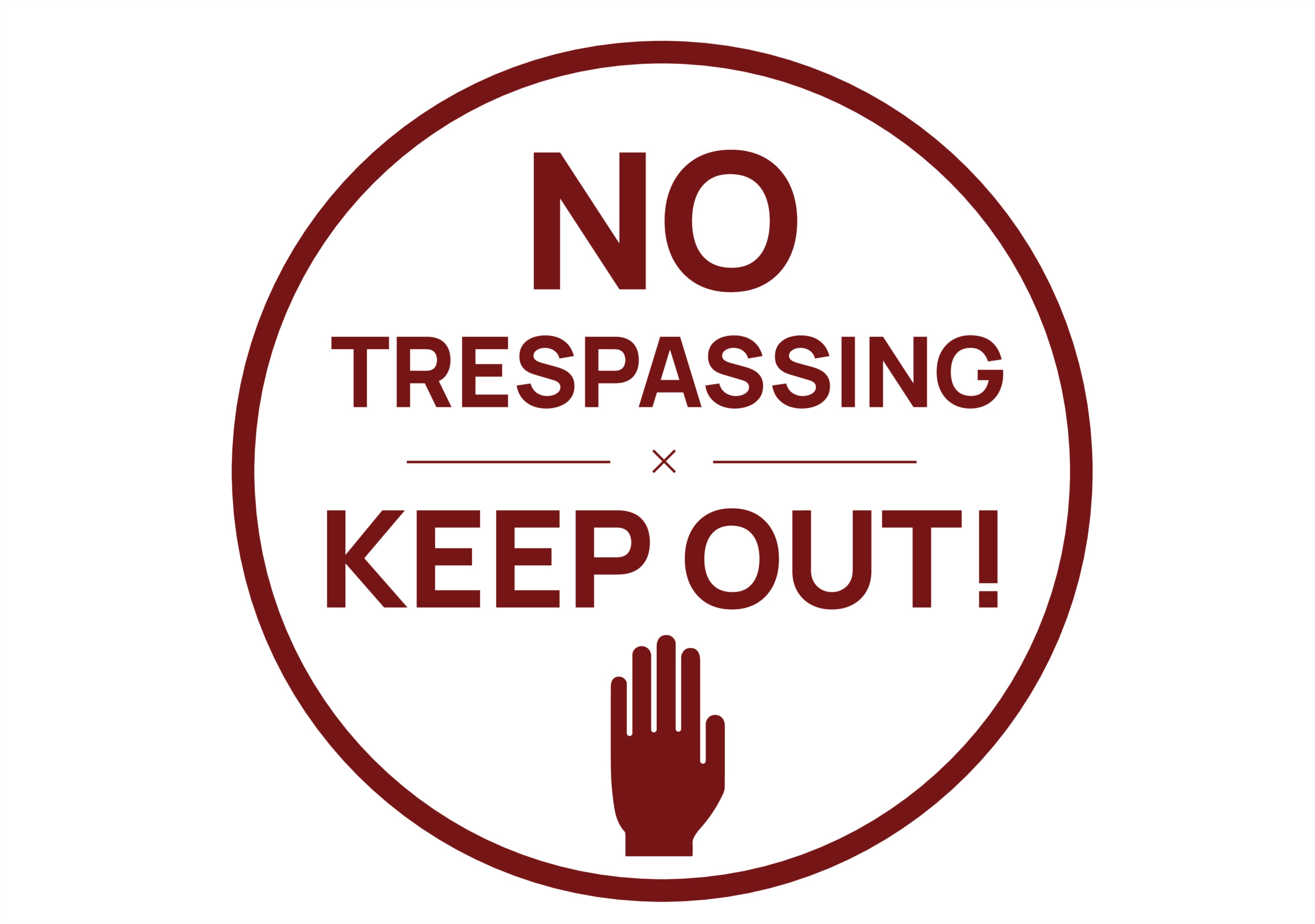
A No Trespassing Keep Out sign board, especially when portrayed as a crisp vector illustration featuring bold, high-contrast lettering alongside unmistakable warning imagery such as a stop hand, a blocked-entry symbol, or an octagonal red caution marker, represents one of the most powerful forms of communication in territorial management, safety awareness, and legal boundary declaration. Although the sign appears visually minimal, its meaning operates on multiple levels simultaneously. It tells people that the land, building, or fenced area ahead is private property, not open to public exploration, and that access without permission is strictly prohibited. In doing so, it protects ownership rights, prevents unwanted intrusion, shields people from hazards they cannot anticipate, and creates predictable behavioral patterns around restricted locations. The pairing of the phrases “No Trespassing” and “Keep Out” removes ambiguity and leaves no room for interpretation, ensuring that anyone who approaches the boundary understands instantly that the property ahead is off-limits. Instead of relying on physical force, confrontation, or security intervention to maintain control over private spaces, the sign accomplishes the task through clarity — it communicates the boundary before it is crossed, which is where protection matters most.
The sign exists because the landscape of modern spaces does not always make boundaries visually obvious. Not every private property is surrounded by tall fences, imposing walls, or locked gates. An open driveway may look like a public road, a quiet farm field may seem like open countryside, an unused industrial building may appear abandoned, and a construction area might be partially exposed to the public without a clear barrier. A passerby might wander in simply out of curiosity, habit, or misunderstanding rather than intentional wrongdoing. The No Trespassing Keep Out — Private Property Restricted Access Warning sign eliminates this confusion by providing a verbal and visual signal strong enough to stop movement before a line is crossed. The property owner is no longer forced to confront strangers or deal with uncomfortable interactions because the sign communicates the non-negotiable rule without direct human contact. The outside individual is spared embarrassment, anxiety, or conflict by seeing the warning early enough to turn away without confrontation. What emerges is a form of communication that protects dignity on both sides of the boundary.
Safety is an equally critical component embedded in the message of this sign. Private properties are often sealed not simply for privacy but because they contain hidden dangers that are not visible from the outside. Construction sites hold pits, scaffolding, live electrical cables, unstable structures, and sharp materials. Industrial yards contain forklifts, gas cylinders, conveyor belts, or hazardous chemicals that are not safe for untrained individuals. Farms may contain livestock that behave aggressively toward strangers, fields sprayed with pesticides, or irrigation canals that pose drowning or slipping risks. Residential and commercial spaces may contain unfinished floor areas, guard dogs, electrified gates, or sudden drop-offs that look harmless until someone steps into them unknowingly. The warning sign shields people from dangers they cannot detect on their own. Without verbal confrontation, it explains that entering the property exposes the outsider to a level of risk that does not exist in publicly accessible spaces. Rather than punishing outsiders, the sign protects them by ensuring that they do not wander into harm’s path.
The legal implications underlying the sign’s wording are equally significant. In many jurisdictions across the world, the presence of a No Trespassing Keep Out notice establishes clear legal intent: the property owner has communicated that access is restricted. If someone enters despite the sign, they do so knowingly, and legal accountability shifts onto the trespasser rather than the property owner. In the absence of signage, an outsider may later argue that they believed the land was open to the public or that no warning indicated that access was prohibited. This can create complicated liability disputes, especially if injury, theft, vandalism, animal disturbance, or property damage occurs. A posted warning removes ambiguity and provides evidence that the property owner acted responsibly by informing the public of the restriction. For this reason, insurance documentation, legal proceedings, and enforcement actions frequently treat signage as a crucial indicator of whether access boundaries were clear or unclear at the moment an intrusion took place.
The sign also serves a psychological purpose for those who live or work within the restricted area. Private property is meant to be a sanctuary — a space where people experience safety, autonomy, and peace. When strangers approach without permission, even without malicious intent, the atmosphere of safety and privacy is disrupted. Families become anxious when unknown individuals appear near their homes; construction workers feel vulnerable when unauthorized people walk near heavy machinery; research teams feel exposed when unmonitored visitors enter sensitive facilities. A No Trespassing Keep Out sign prevents such intrusions without the emotional intensity of forced confrontation. People inside the property are protected because outsiders learn early that they are not allowed forward. Outsiders are protected from embarrassment because the rule is stated publicly rather than delivered personally. The sign prevents fear and anger before either has the chance to develop.
The sign’s deterrent effect also supports security operations. Not all trespassing stems from confusion; some individuals test boundaries intentionally, looking for opportunities to steal, vandalize, occupy abandoned-looking property, or search for valuables. These attempts thrive in environments that look uncertain, unguarded, or unclaimed. A bold, visible No Trespassing Keep Out — Private Property message makes it clear that the space is monitored and defended by law. Even if no guards or cameras are visible, the warning sign signals risk and consequence, causing opportunistic intruders to abandon their plans before acting. It is one of the most effective security deterrents precisely because it removes ambiguity. When a warning is explicit, violations feel far riskier to commit — which drastically reduces intrusion before it begins.
The graphic structure of the sign plays a crucial role in this success. Vector illustration allows the design to be sharp, scalable, and authoritative. Bold uppercase lettering ensures urgency and visibility. High-contrast color combinations — most commonly red, black, yellow, and white — are chosen because they evoke human caution instincts instinctively, even from a distance or while in motion. Standard warning icons allow the message to transcend language barriers, so even individuals who cannot read the local language understand that the space ahead is restricted. The vector format allows the design to be printed on boards, poles, metal plates, plastic sheets, fences, gate panels, and digital displays without losing clarity. It ensures that the message remains visible in daylight, low-light, rain, dust, or nighttime illumination and continues to serve its purpose in every environmental condition where boundaries must stay recognizable.
Beyond legal and safety concerns, the sign also promotes harmony by reducing the likelihood of human conflict. Without clear signage, an outsider may unknowingly step onto private space and later feel unfairly scolded or humiliated when told to leave. The property owner, meanwhile, may feel threatened, invaded, or disrespected by the stranger’s presence. Both sides experience tension because their expectations were never aligned. The sign aligns expectations before behavior occurs: the rule is known, the boundary is obvious, and neither side is forced into confrontational dialogue. If an outsider decides to continue forward despite the sign, any resulting enforcement action is not based on misunderstanding but on deliberate violation. Information replaces conflict as the first mode of interaction.
Because of these layered roles — protection, privacy, hazard prevention, legal clarity, psychological reassurance, and conflict reduction — the No Trespassing Keep Out Sign Board — Private Property Restricted Access Warning becomes one of the most important tools for ensuring that private territory and public mobility coexist peacefully. It does not exist to intimidate but to communicate responsibility. It makes invisible risk visible, unspoken ownership clear, and uncertain boundaries unmistakable. It protects landowners from intrusion while protecting outsiders from harm and embarrassment. It strengthens security without force, and it reinforces respect without confrontation. Beneath its short message lies an organized structure of safety, lawfulness, dignity, and mutual respect that allows people to move through the world without confusion about where they are welcome and where they are not — simply because the rule has been written clearly where it matters most: at the boundary where public space ends and private property begins.