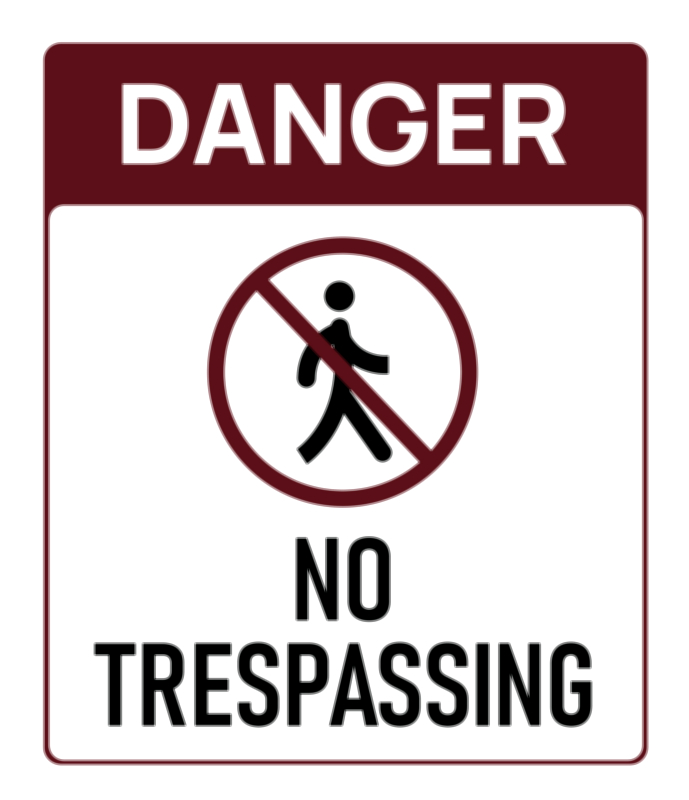
Danger — No Trespassing Vector Illustration: Restricted Area Warning Sign
A Danger — No Trespassing sign, especially when illustrated in a sharp, high-contrast vector format using bold typography and unmistakable hazard symbols such as a warning triangle, a stop hand, a barred-entry icon, or a red prohibition circle, stands as one of the strongest and most urgent forms of boundary communication. While many access-restriction signs convey rules, this one conveys life-safety consequences. The word Danger elevates the message beyond a general warning and informs anyone approaching that stepping beyond this point is not just unauthorized but physically unsafe or legally serious in nature. The addition of No Trespassing eliminates ambiguity about intentions — crossing the boundary is forbidden regardless of purpose, curiosity, or confusion. Together, these elements create a sign that does not request compliance; it demands it for the protection of both the property and the individual outside the boundary. It defines a line that is not symbolic but essential, where ignoring the sign could result in injury, legal action, or both.
The need for such a sign exists because danger is not always visually obvious. Many high-risk restricted areas appear calm from the outside, which falsely assures the untrained observer that continuing further is harmless. A silent industrial plant may hide energized equipment, toxic substances moving through sealed pipelines, or automated machinery capable of sudden movement. A deserted-looking construction zone may contain unstable floors, open shafts, or heavy loads suspended overhead. A seemingly abandoned research site or service yard might conceal radiation equipment, hazardous chemical residue, or gas pockets invisible to the naked eye. Even natural-appearing property, such as quarries and mines, can contain deadly vertical drops, water-filled pits, or shifting rock faces that offer no warning until the moment of collapse. Without clear signage, a passerby may innocently step into a lethal scenario. The Danger — No Trespassing sign prevents such mistakes before they happen — not by force, but through decisive information delivered at the last safe moment.
Safety is the core message behind the sign. It exists to protect people from entering environments that require specialized training, authorization, and personal protective equipment to navigate safely. Workers on the inside have knowledge of the hazards, protective clothing, radio communication, supervision systems, and procedural awareness. Outsiders do not. Entering a high-risk zone without such preparation is not only dangerous to the trespasser but also hazardous to the workers inside, who may be forced into emergency response situations because an unauthorized person has entered the space. The sign removes the possibility of accidental entry and ensures that life safety remains prioritized above curiosity, convenience, or assumption.
The sign is equally vital from a legal and regulatory standpoint. Many industries — such as construction, electrical power systems, chemical processing, research laboratories, water treatment plants, military bases, railways, and mining operations — are legally obligated to warn the public when an area contains risks. If someone enters and is harmed in a location without signage, the property owner or operator may be held accountable for inadequate notification. When a Danger — No Trespassing sign is posted in a clear and visible position, it establishes that the property owner fulfilled their legal responsibility to communicate the hazard and the boundary. If an individual chooses to ignore the warning, the liability shifts to them. The sign becomes vital evidence in safety audits, insurance evaluations, and accident investigations, helping to differentiate between unavoidable risk and negligent behavior.
Security is another essential purpose served by this signage. Properties containing hazardous materials, valuable equipment, research prototypes, confidential systems, or sensitive infrastructure cannot risk intrusion by unauthorized individuals. Even when danger is the primary reason for restricting the area, the security implications reinforce the need to prevent entry. Trespassing may lead to vandalism, theft, tampering, or deliberate sabotage — and in high-risk environments, such actions can become exponentially more dangerous. By emphasizing Danger rather than only No Trespassing, the sign communicates that this is not a territory that can be tested or entered casually. The risk is physical, operational, and legal. The sign therefore protects the space from outsiders and protects outsiders from the space.
Another major strength of the sign lies in its psychological effect on behavior. Human instincts elevate sharply when the word danger is seen. It activates self-preservation and caution in a way that softer warnings do not. Someone who might ignore a simple No Entry or Private Property sign is far less likely to ignore a sign explicitly warning of immediate danger. The message reframes the decision — entering becomes not simply a rule violation but an act of personal risk. This psychological shift dramatically reduces the number of intentional trespass attempts. The sign minimizes conflict by discouraging unwanted behavior long before security intervention becomes necessary.
The vector illustration format maximizes the sign’s effectiveness. Crisp, scalable graphics ensure that the sign remains sharp and legible whether printed on a gate, fence, wall, construction hoarding, industrial barrier, or security checkpoint. High-contrast colors enhance visibility from long distances and in poor lighting such as dusk, dust, rain, or nighttime spotlights. Universal hazard icons communicate the warning across language and literacy barriers, ensuring anyone — workers, passersby, tourists, delivery staff, contractors, or children — understands instantly that crossing the line is unsafe and prohibited. The layout of the sign is intentional: nothing is decorative. Every symbol, line weight, color, and word is engineered for speed of recognition, because in danger zones milliseconds matter.
Emotionally and socially, the sign plays an important role as well. It protects workers by ensuring they do not have to worry about outsiders wandering into their hazardous workspace. It protects families, neighbors, and pedestrians from inadvertently stepping into harm. It prevents uncomfortable or confrontational exchanges between property owners and intruders by making the rule clear in advance. It allows high-risk operations to continue without having to constantly guard the perimeter. The sign achieves order not through barriers or hostility, but through information and mutual respect.
Ultimately, the Danger — No Trespassing Vector Illustration: Restricted Area Warning Sign is a tool of prevention above all else. It protects lives without rescue, prevents legal disputes without conflict, stops accidents without alarms, and maintains secure operations without intimidation. It draws a clear boundary at the exact moment when clarity matters most — right before someone takes the next step. Through a brief but powerful message backed by authoritative visual design, this sign turns hidden risk into visible awareness, uncertainty into certainty, and potential tragedy into informed avoidance.