No Trespassing Keep Out Sign Board — Restricted Property Warning Design
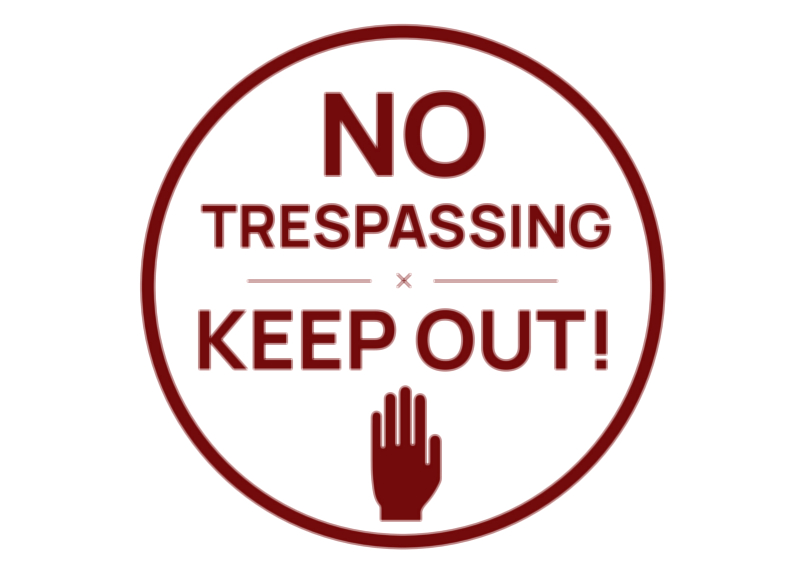
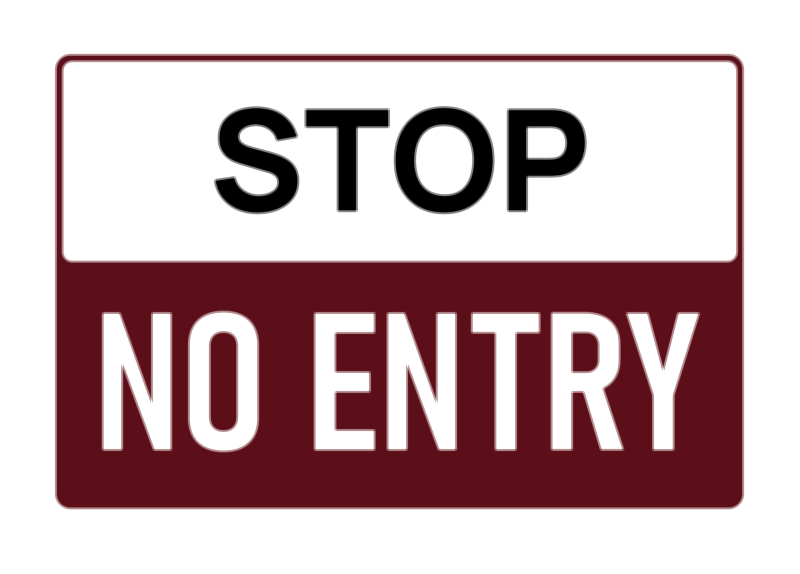
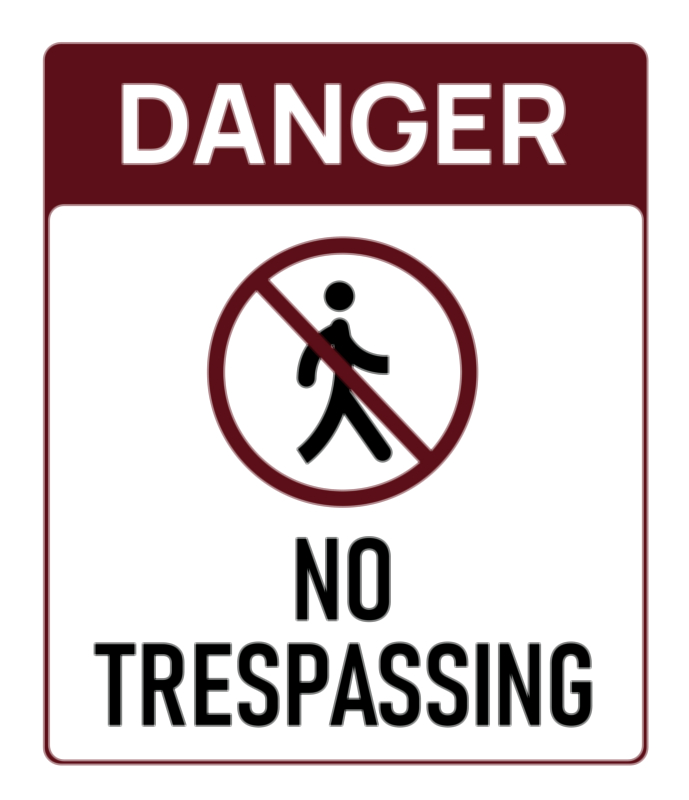
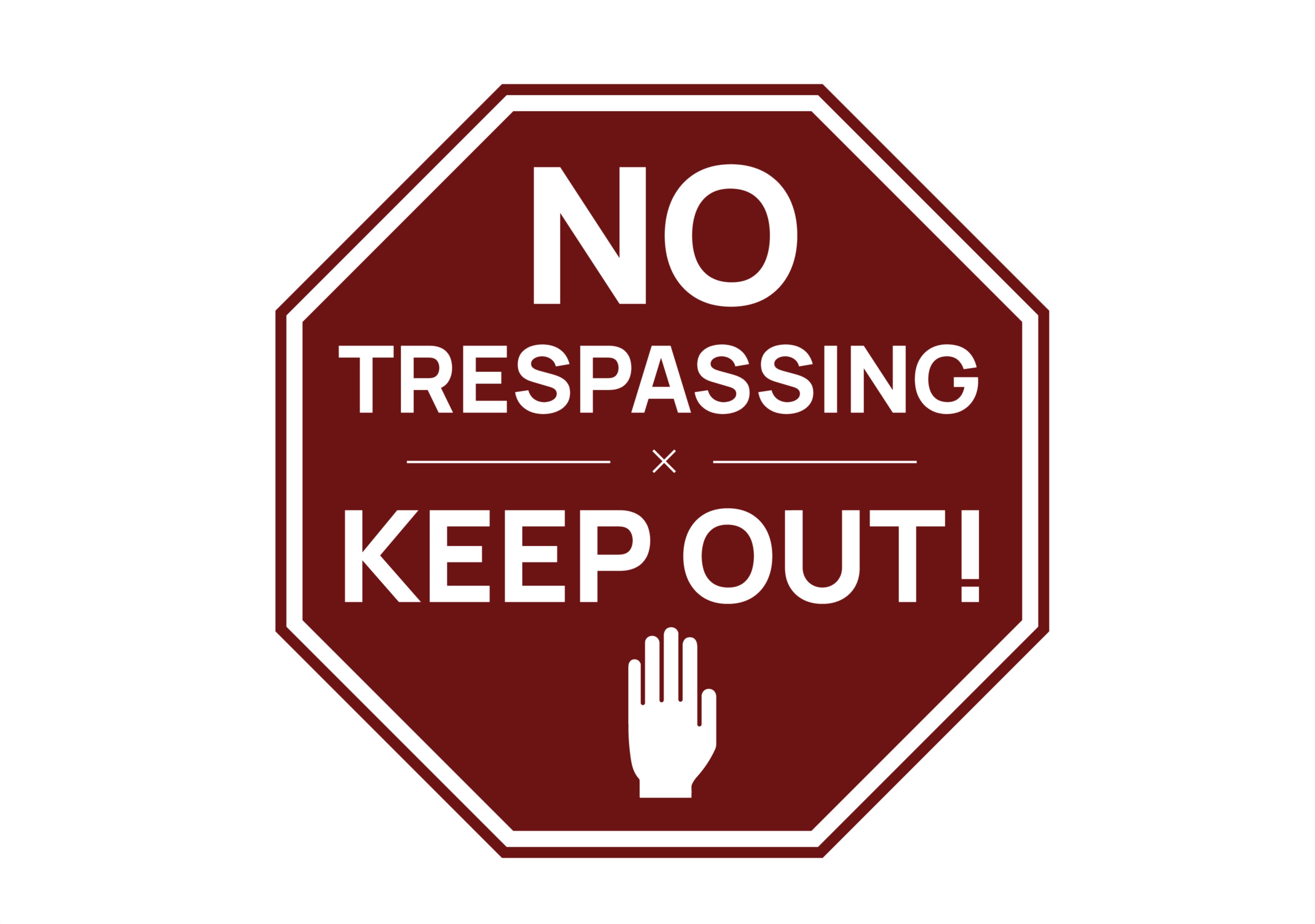
A No Trespassing Keep Out sign board, especially when illustrated in sharp, high-contrast vector artwork with assertive typography and bold warning symbols such as a raised stop hand or a prohibited-entry icon, may appear on the surface to be a simple message printed on metal or plastic, yet its purpose extends into many of the most important aspects of security, privacy, territorial clarity, and legal boundary communication. The pairing of the phrases No Trespassing and Keep Out delivers an uncompromising warning that the land or structure ahead is not open for public access, and that entry without permission is not merely discouraged but strictly forbidden. Although the sign contains only a few words, it acts as a strong verbal and visual barrier between safe, legal space and a zone where intrusion, personal risk, and legal consequences begin. It establishes that the property is restricted under ownership rights and that anyone proceeding past the boundary does so knowingly and against clear instruction. What the sign achieves is a rare combination of firmness and non-confrontational clarity: instead of requiring fences, locks, guards, or direct verbal enforcement to protect a space, the sign communicates prohibition in a way that allows the boundary to defend itself through information rather than conflict.
The need for this sign becomes evident when imagining the wide range of situations in which people enter places not because they intend harm, but because the land or structure appears open, accessible, or unmarked. A driveway leading into a residence may look like an extension of a public lane; a barn or storehouse door left ajar may look like neutral space; a field may be crossed by a casual shortcut; an empty warehouse may attract curiosity; a quiet industrial yard may look abandoned; a hiking trail may end where farmland begins without transition. In every one of these instances, the confusion arises not from bad intention but from a lack of visible boundary communication. The No Trespassing Keep Out — Restricted Property Warning Design sign eliminates this uncertainty before uninvited access takes place. It prevents accidental entry by giving explicit instruction from a distance rather than waiting for a confrontation to take place when someone has already crossed the line. Instead of forcing a property owner, resident, guard, or worker to react aggressively or demand that an outsider leave, the sign ensures that the outsider receives the warning long before the situation becomes awkward or dangerous. In this way, the sign protects both sides — the owner from intrusion and the outsider from embarrassment, vulnerability, or exposure to unknown hazards.
Safety concerns make the message even more important. Private or restricted zones are not always sealed because of secrecy or ownership alone; many of them contain hidden risk that is not obvious from the outside. Industrial storage lots contain forklifts, heavy machinery, cranes, suspended loads, and chemicals unsafe for untrained individuals. Active construction areas include open pits, jagged materials, uneven ground, electrical wiring, and scaffolding that simply cannot be walked into safely without proper gear and safety knowledge. Mines, quarries, and rural water reservoirs have drop-offs, loose soil, and drowning hazards without visible warnings. Private farmlands may contain aggressive livestock or areas treated with pesticides that are unsafe for public exposure. Even ordinary-looking residential settings may include steep slopes, partially built structures, active dog protection, or hazardous workshop equipment. The sign turns invisible danger into a visible warning. Instead of expecting outsiders to recognize risks by observation alone, it shields them by preventing access before harm can occur. What appears to be harsh wording at first glance — “No Trespassing, Keep Out” — is in many cases an act of responsibility to keep strangers safe from hazards they cannot anticipate.
Legal protection is another dimension woven into the message. With clearly posted signage, responsibility shifts from property owners to individuals who ignore the warning. In the absence of a sign, a trespasser might later argue that they believed the land was public or that no indication of restriction existed. This can create unfair liability where the owner may be held accountable for injuries, property damage, or disputes caused by the intruder’s presence. The sign acts as legal documentation that the boundary was visibly communicated. If a person crosses despite the posted warning, the individual becomes legally liable for their own actions, and the owner is empowered to involve law enforcement with clarity and confidence. For insurance claims, assault accusations, theft investigations, vandalism reports, or liability hearings, the posted warning strengthens the property owner’s legal standing. It demonstrates that the owner took reasonable and proactive steps to warn outsiders, and that any violation that followed was intentional rather than accidental.
Privacy and emotional security are also crucial elements reinforced by the sign. A home without clear signage may unintentionally allow strangers to approach windows, walk across yards, or stop near doors, creating fear or anxiety among residents who are startled by unfamiliar presence. A business that contains confidential work may experience interruptions or leaks simply because people wander into restricted areas without meaning to. A storage yard may attract unsolicited access because passersby reinterpret an unmarked gate as an open entrance. The No Trespassing Keep Out Sign Board prevents such invasions not by confrontation but by transparency. It maintains the psychological comfort of those who live or work within the boundary while avoiding harsh exchanges or emotional escalation that might arise if the warning were delivered verbally. Instead of telling someone to leave in anger, the sign informs them beforehand not to enter at all. It allows both sides to uphold dignity, comfort, and predictability.
Security personnel benefit greatly from signage that clearly marks access boundaries. When zones are not labeled, security teams are forced into inconsistent judgment calls each time someone wanders into restricted space. They may treat innocent confusion as hostile intrusion or fail to recognize a genuine threat because of lack of context. A sign changes that dynamic entirely. If an outsider breaches a zone that is marked with No Trespassing, Keep Out, that decision can be interpreted as deliberate rather than accidental. This helps security prioritize responses, improve patrol efficiency, and reduce preventable conflicts. In many cases, the existence of the sign alone is enough to deter opportunistic intrusion, preventing escalation long before it has a chance to develop. People interested in testing boundaries are much less likely to take the risk when the warning is visible and explicit.
Psychologically, firm boundary signage reduces temptation by eliminating ambiguity. When a space looks unguarded, curiosity takes root easily, whether in an abandoned building enthusiast exploring, a teenager looking for a hidden hangout spot, or an opportunistic intruder searching for easy access. When the space is marked with an authoritative sign, the mental calculation changes immediately — the individual becomes aware that the property is active, monitored, and protected. Even without cameras or personnel visible, the sign alone activates a deterrent effect because it signals the presence of consequences. For the same reason, the No Trespassing Keep Out message is often positioned not at the interior of a restricted space but at the thresholds where curiosity begins. The earlier the warning appears, the greater its power to prevent prohibited entry.
The sign’s effectiveness relies heavily on its graphic clarity, and vector illustration serves this purpose perfectly. High-contrast colors such as red, black, and white demand attention and can be recognized even from a moving vehicle or at night. Bold uppercase lettering indicates seriousness and urgency without requiring interpretation. Universal warning icons reduce language barriers and make comprehension instant even for individuals who do not speak or read the local language. Vector formatting ensures that the sign remains crisp and legible when printed at different scales — from small gate plates to large wall-mounted barricades — without loss of detail. The iconography is not decorative but strategic: the visual itself reinforces the urgency of the words and the authority of the boundary.
From a broader social perspective, the No Trespassing Keep Out sign helps maintain peace more than it creates separation. Without clear communication, accidental intrusion leads to confrontation, confrontation leads to resentment, and resentment leads to lasting tension. With signage, the rule is known by everyone before action occurs. The property owner does not need to guard the territory aggressively, and outsiders do not feel singled out or humiliated for crossing an unseen line. The sign turns what might have become a human conflict into a simple choice: respect the marker or face the consequence. It prevents legal disputes, misunderstandings, and emotional discomfort through nothing more than the clarity of language.
Ultimately, the No Trespassing Keep Out Sign Board — Restricted Property Warning Design is not just a sign; it is a framework of safety, legality, privacy, and respect. It prevents unauthorized access without physical confrontation, deters wrongdoing without aggression, shields outsiders from hidden danger, protects owners from legal vulnerability, and strengthens the psychological security of those living or working within the boundary. It preserves the meaning of private space by making that meaning visible. It prevents intrusion not through hostility but through information. Beneath its concise wording lies an entire architecture of trust, order, dignity, and protection — ensuring that private property stays private and that public movement remains respectful, safe, and predictable simply because the boundary was clearly communicated before anyone had a chance to cross it.