LED Bulb Brightness and Lumens — Light Output, Efficiency, Performance and Human Visual Perception
LED bulb brightness and lumens collectively represent one of the most important transitions in modern lighting technology, showcasing how illumination has shifted from the older idea of power consumption measured in watts to a more meaningful understanding of light output measured in lumens. For decades, households selected bulbs on the basis of wattage, assuming that a higher watt rating meant brighter light. This association was reliable in the era of incandescent bulbs because their technology directly linked electrical power to produced light through the heating of a filament. However, LED technology operates on a totally different principle. LEDs convert electrical energy directly into visible light using semiconductor materials rather than heat, drastically improving energy efficiency and making wattage almost irrelevant as a predictor of brightness. Instead of watts, lumens now represent the true measure of how much light a bulb produces, and understanding this distinction is key to evaluating lighting systems, comparing efficiency, purchasing the right bulbs for home or industrial settings, and interpreting the modern charts that relate lumens to watts and efficiency.
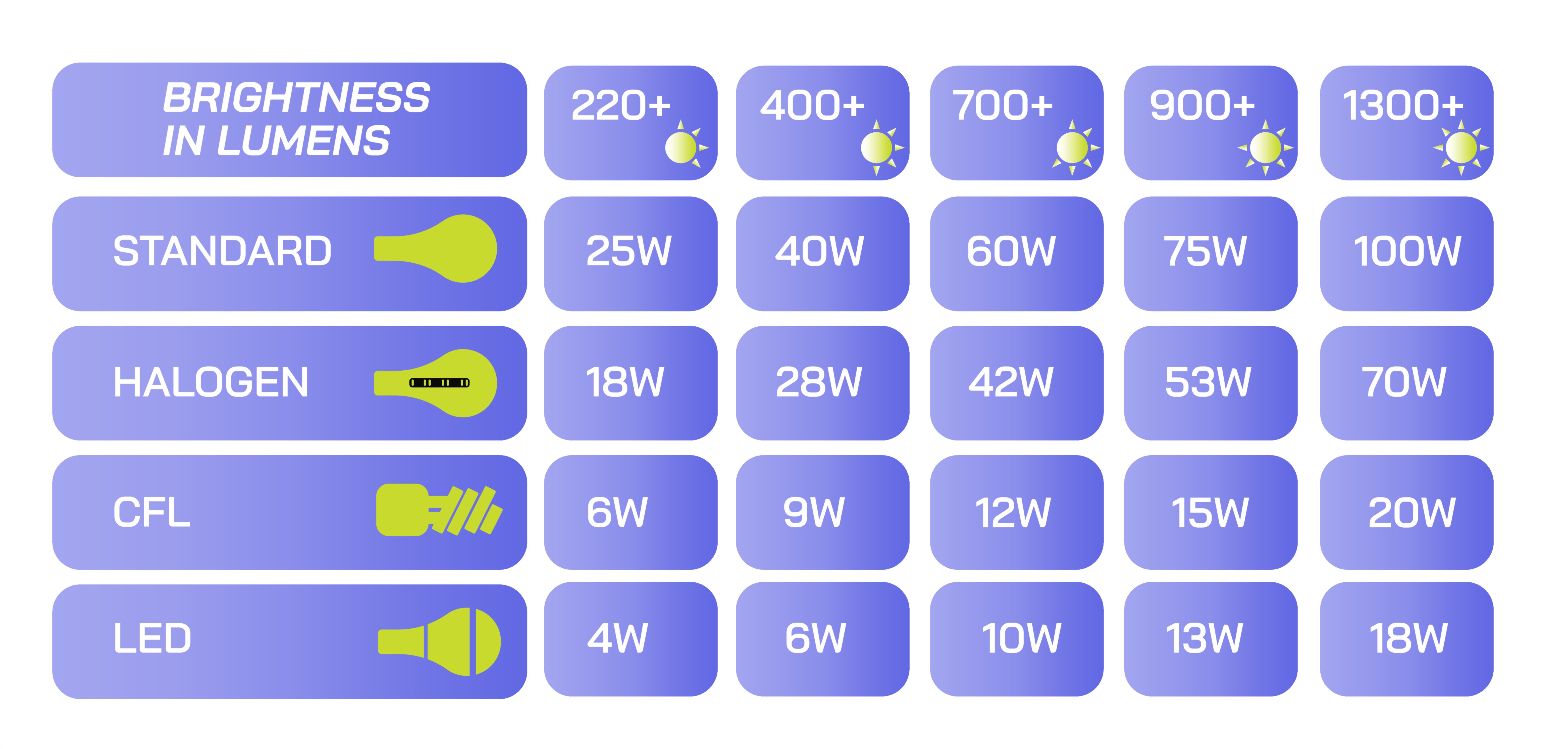
As LEDs entered mainstream lighting, the concept of lumens became essential because two bulbs with the same electrical power input can differ dramatically in brightness. Lumens measure the total amount of visible light emitted by a bulb regardless of how much power it consumes. A low-watt LED can easily outperform a high-watt incandescent bulb in light output because LED technology minimizes wasted heat and directs energy toward illumination rather than thermal radiation. For example, a traditional incandescent 60-watt bulb typically produces around 800 lumens, while a modern LED requires only 8–10 watts to produce the exact same light. The dramatic efficiency difference between incandescent, fluorescent, CFL and LED sources created the need for charts that compare lumens across technologies so that consumers and industries can determine what level of brightness they are actually receiving. In this context, a “brightness and lumens chart” or “efficiency chart” is not just an energy reference but a roadmap for translating old wattage expectations into modern lighting performance.
The shift from wattage to lumens dramatically reshaped how people evaluate lighting because brightness perception is not determined solely by numerical lumen levels but by how light interacts with interior spaces, colours, textures and human visual physiology. Although lumens quantify the amount of visible output radiated from a bulb in all directions, perceived brightness depends on beam angle, colour temperature, reflection from surfaces and the contrast between lit and unlit areas. For example, a 1000-lumen LED with a narrow beam angle can appear much brighter than a 1500-lumen LED dispersing light widely because the narrower beam concentrates illumination. Similarly, the same bulb can appear brighter in a room with white walls compared to a room with dark walls that absorb light. Lumens thus provide a reliable quantitative foundation while human perception adds subjective elements that explain why a lumens chart offers guidance but must be interpreted in context.
One of the great achievements of LED bulbs is their exceptional lumen-per-watt ratio, which refers to how efficiently electrical energy is converted into visible light. Incandescent bulbs convert most of their power into infrared radiation and heat, resulting in low lumen-per-watt performance. CFL bulbs improve on this but still lose energy in ballast heating and ultraviolet conversion. LEDs, in contrast, direct current through semiconductor junctions to create electroluminescence, producing visible light while generating minimal heat. This explains why LED bulbs can reach efficiency ratings far beyond anything achieved by older technologies. High-quality LEDs commonly achieve 80–120 lumens per watt, and next-generation LEDs in industrial and scientific use exceed 160–200 lumens per watt. This trend continues to evolve with innovations in chip architecture, thermal management, reflector design, phosphor conversion, optics and smart-lighting electronics.
Because light output and energy use are no longer linked in a simple ratio, lumens help consumers determine equivalencies when replacing older bulbs. A lumens-based brightness chart typically associates values such as 450 lumens with a 40-watt incandescent replacement, 800 lumens with a 60-watt replacement, 1100 lumens with a 75-watt replacement and 1600 lumens with a 100-watt incandescent equivalent. Such charts exist to prevent misunderstanding because a person replacing a 60-watt incandescent bulb with a 60-watt LED would be overwhelmed by excessive brightness and wasted energy, whereas misunderstanding lumens could lead to buying a bulb that is too dim for the intended environment. Future lighting design therefore depends on a deeper literacy in lumens rather than wattage.
Another important dimension of LED brightness involves colour temperature and how the human eye interprets illumination differently under warm or cool tones. Although lumens measure the amount of light emitted, the visual impression created by that light depends partly on colour temperature measured in kelvin. A 3000-lumen warm white LED bulb (around 2700–3000 K) used in a cozy dining room may feel softer and more comfortable than a cooler 3000-lumen bulb (around 5000–6500 K) used in an office or laboratory. The cooler bulb produces sharper contrasts, improves alertness and increases the impression of visual brightness even though the two bulbs emit the same lumens. This difference demonstrates how lumens define absolute light output while colour temperature influences the psychological perception of brightness, meaning that lumens and colour temperature must be understood together for effective lighting design.
Durability and long-term output stability further distinguish LED bulbs from earlier lighting types. Incandescent bulbs dim visibly as they age, halogen bulbs suffer from filament stress, CFL bulbs lose brightness due to phosphor decay and frequent switching, and fluorescent tubes degrade from electrode wear and mercury absorption. LEDs, when properly heat-managed, maintain a high percentage of their initial lumen output over thousands of operating hours. Instead of burning out suddenly, LEDs undergo gradual lumen depreciation, meaning their brightness decreases slowly and predictably over time. Because of this, the measure L70 is used to indicate how many hours of operation the bulb provides before brightness drops to 70% of original lumens. Many consumer LEDs exceed 20,000–30,000 hours of L70 life, while industrial models achieve 50,000–100,000 hours, drastically extending usability and reducing replacement costs.
Light output efficiency also links to environmental sustainability. Greater lumen output per watt means lower electricity demand, reducing energy production requirements and decreasing carbon emissions. LEDs generate minimal waste heat compared to incandescent bulbs, improving HVAC efficiency in homes and commercial spaces. Their long lifespan reduces landfill waste and decreases consumption of raw materials associated with bulb manufacturing. These advantages do not eliminate environmental challenges—LEDs require electronic drivers, circuit boards, and sometimes rare earth phosphors—but the overall energy and waste footprint is dramatically lower than historic lighting solutions. The global migration toward lumens-based selection and LED-based illumination represents one of the most impactful improvements in everyday sustainability.
LED brightness also interacts with smart-lighting systems that dynamically adjust lumen output for efficiency and comfort. Modern smart bulbs can dim automatically based on ambient daylight, user preference, room occupancy or circadian rhythm patterns. This approach uses controlled lumen management to improve mood, reduce eye strain, enhance productivity and lower power consumption by avoiding unnecessary brightness. The chart comparisons for lumens therefore play a role not only in bulb selection but in designing lighting systems that optimize health, efficiency and environmental responsibility.
Taken together, lumens, brightness and efficiency form a cohesive set of principles that govern the value and performance of LED lighting. Lumens quantify total visible light output; wattage quantifies energy consumption but no longer predicts brightness; lumens per watt quantify efficiency; colour temperature shapes the psychological perception of light; and beam angle shapes the distribution of light in physical space. These elements form the theoretical basis for the vector-style illustrated charts commonly used to explain LED lighting performance visually. Whether used in home lighting upgrades, office design, architectural illumination, industrial installations or sustainable technology planning, understanding lumens allows users to evaluate light intelligently, ensuring that lighting decisions deliver both visual satisfaction and energy efficiency.
The modern lighting era is therefore defined not by how much power a bulb consumes but by how effectively it converts that power into useful illumination. The shift from watts to lumens represents a major milestone in science and practical life, and LEDs stand at the forefront of that transition—offering bright light with minimal energy cost and redefining how humans measure, select and experience artificial illumination.