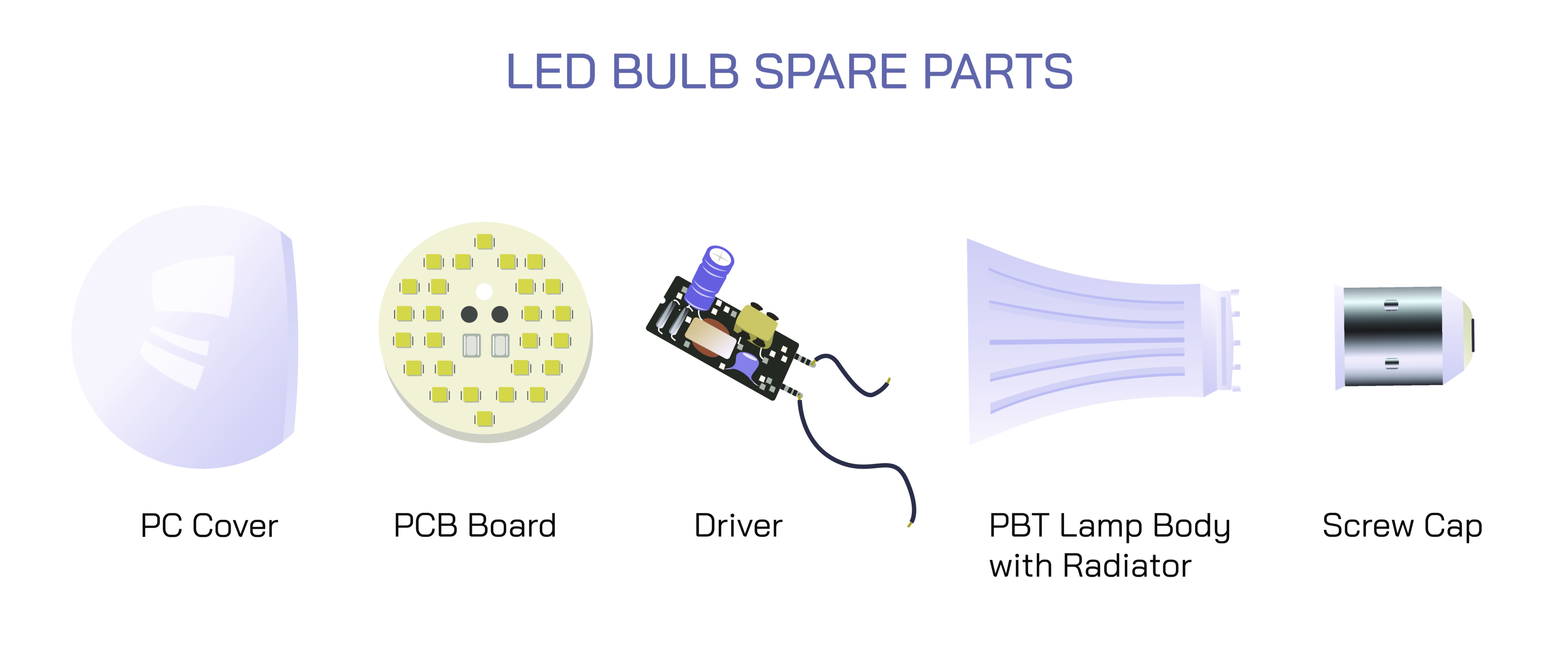
LED Bulb Spare Parts — Complete Breakdown of Internal Components, Structure, and Functional Roles in Modern Solid-State Lighting
An LED bulb may seem outwardly simple, but internally it is a highly engineered assembly designed to convert electrical energy into light with extreme efficiency, minimum heat loss, and long operational life. Unlike incandescent bulbs where a heated filament produces light through thermal radiation, or fluorescent lamps where gas excitation produces ultraviolet emission later converted into visible light, an LED bulb uses solid-state semiconductor physics to generate illumination through electroluminescence. Because this technology involves precise electrical regulation, optical diffusion, thermal management, and chemical control, an LED bulb contains multiple spare parts that work together as a unified system rather than an isolated light-emitting component. A complete breakdown of LED components reveals an intricate structure in which every layer is necessary for durability, brightness, safety, and energy savings, and where the failure of one part directly affects the performance of the others. Understanding these components provides insight into why LED bulbs achieve exceptional longevity and why repairing or modifying LEDs requires more than simply replacing a burned-out filament.
At the core of the bulb is the LED chip or semiconductor diode, often mounted in clusters on a carrier board. These chips are made from materials such as gallium nitride and are designed to emit light when electrons recombine with holes inside the p–n junction. The light output, colour temperature, and efficiency of the bulb depend heavily on the quality and design of these chips. In high-brightness household bulbs, there may be dozens of LED chips arranged on a circular surface or on a COB (Chip-on-Board) package to produce strong and uniform light. The chips release very little heat to the outside, but significant junction heat is generated internally and must be managed effectively to avoid degradation. Because LEDs do not tolerate overheating, the rest of the bulb structure is engineered primarily around supporting the optimal functioning of the LED junction.
Supporting the chips is the printed circuit board (PCB), often manufactured from aluminium or other thermally conductive materials. The PCB is both an electrical and thermal backbone: it connects the LED chips in a designed configuration while also transferring heat from the semiconductor junction to the heat sink. The aluminium core PCB is widely used because it spreads heat laterally, reducing thermal hotspots. The PCB also integrates pads, traces, solder points, and sometimes resistors or drivers in compact bulbs. Without efficient thermal conduction from the PCB, the LED junction temperature would rise quickly, causing lumen reduction, colour shift, and early component failure.
Fastened beneath the PCB is the heat sink, typically made from aluminium alloy, which is essential for cooling. The heat sink absorbs heat from the PCB and dissipates it into the surrounding environment by convection. To improve thermal dissipation, heat sinks are designed with fins, vents, or ribbed patterns that maximize surface area. The size and shape of the heat sink directly affect the expected lifespan of the bulb because LEDs last longest when junction temperature stays low. This is a major engineering difference between LED bulbs and glass incandescent bulbs, which rely on heat rather than fight it. In LED lighting, heat is the enemy, and the heat sink is the front-line defence.
To power the semiconductor light emitters correctly, LED bulbs include a driver, an electronic circuit that regulates current and ensures safe conversion of AC mains electricity to low-voltage DC. The LED driver contains rectifiers, voltage regulators, capacitors, inductors, filtering circuits, and sometimes integrated chips for dimming or smart-lighting control. Whereas incandescent bulbs connect directly to AC supply, LEDs require precise current control because even slight fluctuations can damage the chips. A high-quality driver prevents flicker, stabilizes brightness, filters out electrical noise, provides surge protection, and ensures that the bulb consumes energy efficiently. The driver is one of the first components to fail in poor-quality LEDs, which is why driver design is central to long-lasting performance.
Surrounding and protecting the internal parts is the bulb housing, a structural enclosure usually made of plastic, aluminium, ceramic, or a composite material. The housing provides mechanical stability, prevents contact with live electronics, and supports the weight of the heat sink. Many housings include ventilation features to assist airflow around the heat sink. The structural shape of the housing also contributes to shock resistance and helps prevent the bulb from cracking if dropped or struck. This enclosure ensures that the internal electronics are isolated from dust, moisture, and accidental handling, increasing both safety and product life.
On the front of the bulb sits the diffuser or globe, made from polycarbonate or acrylic rather than glass in most modern bulbs. This shell distributes light evenly and softens the otherwise directional beam emitted by the LED chips. The diffuser is engineered to maximize transmission of light while scattering it enough to reduce glare and eliminate bright spots. The design of the diffuser determines how a room feels under illumination, how shadows appear, and how comfortable it is to look at the bulb directly. In warm-white LEDs, the diffuser may include tinting or layered optical treatments to simulate the familiar glow of incandescent light. Without a diffuser, LEDs would produce harsh pinpoint brightness rather than smooth area lighting suitable for homes and workplaces.
A critical but often unnoticed part of the bulb is the phosphor coating, which plays a major role in white LEDs. Most LED chips emit blue or ultraviolet light originally. To generate white light suitable for general lighting, the chip or COB package is coated with phosphor materials that absorb part of the emitted light and re-emit a wide spectrum. The composition and thickness of the phosphor determine the colour temperature (warm, neutral, cool), CRI (colour rendering index), and even the feeling of brightness perceived by the human eye. If the phosphor layer degrades over thousands of hours of use, the bulb may appear dimmer or shift towards a bluish or greenish tint. The stability of this layer is therefore another pillar of long product life.
Some LED bulbs include optical reflectors or lenses to manipulate light flow. Reflectors redirect and shape the beam for wide-angle lighting, while lenses focus illumination for spotlights, track lighting, downlights or streetlamps. These optical components determine beam angle, visual intensity, and application suitability. For example, a work lamp may use a narrow beam to create concentrated task lighting, whereas a living room bulb needs a wide spread. The inclusion of optical elements allows bulbs based on the same fundamental LEDs to be optimized for drastically different environments.
At the base of the bulb, electrical connection to the power supply is provided by the cap or connector, such as E27 screw, E14 small screw, B22 bayonet, or GU10 twist-lock. Although this part appears simple, it must maintain secure contact over thousands of heating and cooling cycles and withstand mechanical stress when the bulb is installed or removed. Inside the cap is an insulation barrier that separates high-voltage contacts from internal electronics, ensuring user safety in case of internal component failure.
Altogether, these spare parts transform an LED bulb into a tightly coordinated system where optics, electronics, thermodynamics and structural engineering merge. If the driver malfunctions, the bulb flickers or burns out. If the heat sink is undersized, LEDs degrade prematurely. If the phosphor coating is unstable, colour quality declines. If the diffuser is poorly engineered, brightness becomes uncomfortable or uneven. This interdependence explains why LED bulb performance varies widely across manufacturers and why premium bulbs cost more—not because they contain more parts, but because every part must be optimized to support long life and stable, glare-free brightness.
The complete breakdown of LED parts reveals why LEDs revolutionized lighting. Instead of relying on wastage of energy as heat or ultraviolet radiation, an LED bulb uses semiconductor efficiency, controlled photonics, and engineered heat management to convert nearly all input power into usable illumination. It is this harmonized internal architecture that makes LED bulbs far more durable, energy-efficient, and environmentally responsible than any lighting technology before them. Understanding these components not only explains how LEDs work but also shows why they represent one of the most important achievements in everyday electrical engineering—delivering bright, comfortable light with minimal energy consumption through a carefully designed network of coordinated internal parts.