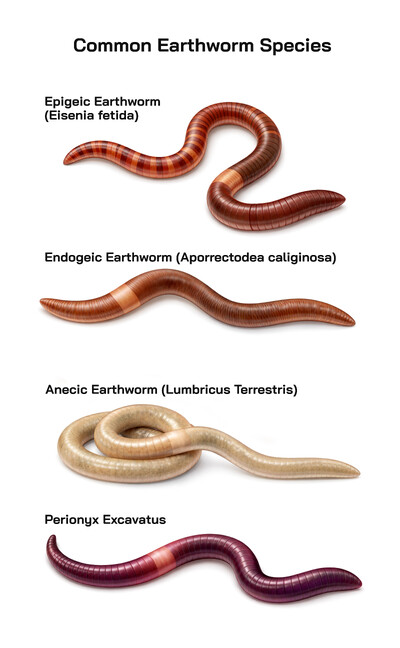
The common earthworm, scientifically known as Lumbricus terrestris, is one of the most influential soil-dwelling organisms found across temperate regions of the world. It is widely recognized for its role in improving soil structure, enhancing fertility, and supporting healthy terrestrial ecosystems. This earthworm species is commonly encountered in gardens, agricultural fields, grasslands, and forest soils, where it spends most of its life beneath the surface.
In terms of physical characteristics, the common earthworm has a long, cylindrical, and segmented body that is usually reddish-brown in color. Each segment contains muscles and tiny bristles that help the worm anchor itself and move efficiently through soil. The body surface is coated with mucus, which keeps the skin moist and facilitates respiration. Unlike animals with lungs, earthworms breathe through their skin, making damp soil conditions essential for survival. The body is flexible yet strong, allowing the earthworm to push through compact soil layers while creating stable tunnels.
The working mechanism of the common earthworm is closely linked to its feeding and movement behavior. Lumbricus terrestris is primarily a surface feeder that emerges at night to pull organic matter such as fallen leaves into its burrow. This plant material is consumed and mixed with soil particles during digestion. As the earthworm moves through the soil, it ingests large amounts of earth, extracting nutrients from decaying organic matter and microorganisms. The processed material is expelled as castings, which are rich in nutrients and beneficial microbes.
Earthworm burrowing activity plays a critical role in soil functioning. As the worm tunnels through different soil layers, it creates vertical and horizontal channels that improve soil aeration and water infiltration. These tunnels allow oxygen to reach plant roots and soil organisms while also helping rainwater penetrate deeper into the ground instead of running off the surface. This natural soil loosening process reduces compaction and enhances root expansion, supporting healthier plant growth.
The characteristics of Lumbricus terrestris also include its remarkable contribution to soil mixing. By constantly moving between surface and deeper layers, the earthworm transports organic material downward and mineral soil upward. This mixing action helps distribute nutrients evenly throughout the soil profile and supports the formation of stable soil aggregates. These aggregates improve soil texture, making it more resistant to erosion and better able to retain moisture.
From an ecological perspective, the common earthworm is often described as an ecosystem engineer. Its activities directly influence soil chemistry, structure, and biological activity. Earthworm castings increase the availability of essential nutrients such as nitrogen and phosphorus, making them accessible to plants. The presence of earthworms also stimulates microbial populations, which further enhances decomposition and nutrient cycling within the soil.
Growth and survival of the common earthworm depend heavily on environmental conditions. It thrives in soils that are rich in organic matter, moderately moist, and free from extreme temperatures. While it can tolerate cool climates, prolonged drought or waterlogged conditions can be harmful. The earthworm’s sensitivity to soil quality makes it an important indicator of environmental health and sustainable land management practices.
The common earthworm also exhibits a highly specialized nervous system that supports its underground lifestyle. Although simple compared to vertebrates, its nervous system is well adapted for sensing vibrations, pressure changes, and chemical cues within the soil. These sensory abilities allow the earthworm to detect approaching predators, changes in moisture levels, and suitable feeding conditions. Rapid withdrawal into deeper burrows when sensing surface disturbances is a direct result of this finely tuned sensitivity, which significantly increases survival chances.
Reproductive biology represents another important dimension of the common earthworm’s life that strongly influences population stability. Lumbricus terrestris is hermaphroditic, meaning each individual possesses both male and female reproductive organs. Despite this, reproduction typically occurs through mating with another earthworm, promoting genetic diversity. During mating, earthworms exchange sperm, which is later used to fertilize eggs within a cocoon secreted by a specialized body region. These cocoons are deposited in the soil, where developing juveniles remain protected from harsh surface conditions until emergence.
The developmental process of young earthworms is gradual and closely linked to soil conditions. Juveniles hatch as miniature versions of adults and immediately begin burrowing and feeding. Their growth rate depends on temperature, organic matter availability, and soil moisture. Unlike insects, earthworms do not undergo metamorphosis, but instead grow continuously through cell division and tissue expansion. This steady growth pattern allows populations to respond flexibly to favorable environmental conditions without relying on narrow seasonal windows.
Earthworms also play a significant role in regulating soil carbon dynamics. Through the consumption and redistribution of organic residues, they influence how carbon is stored or released within the soil. Some carbon is stabilized within soil aggregates formed by earthworm activity, while other portions are transformed into forms that microorganisms can further process. This interaction affects long-term carbon sequestration and contributes to soil’s role in moderating atmospheric carbon levels, linking earthworm activity to broader climate-related processes.
Interactions between earthworms and soil microorganisms are especially important for nutrient availability. Earthworm digestive systems create ideal conditions for microbial growth, as ingested material is fragmented and chemically altered during passage through the gut. The expelled castings provide a nutrient-rich, microbially active environment where bacteria and fungi thrive. This synergy accelerates decomposition rates and enhances the efficiency of nutrient cycling beyond what microbes alone could achieve.
Earthworms also influence soil pH and chemical balance over time. Their digestive processes can buffer acidic conditions by redistributing minerals from deeper layers toward the surface. This gradual chemical moderation creates more favorable conditions for plant roots and beneficial soil organisms. In agricultural soils, this effect can reduce the need for external soil amendments when earthworm populations are healthy and stable.
The spatial organization of earthworm burrows has important implications for soil resilience. Permanent vertical burrows created by species like Lumbricus terrestris act as long-term conduits for air, water, and root growth. These channels remain functional even after the worm relocates or dies, providing lasting benefits to soil structure. During heavy rainfall, such burrows reduce surface runoff and erosion by directing water downward, helping stabilize landscapes under variable weather conditions.
Earthworms also exhibit behavioral adaptations tied to daily and seasonal cycles. Their surface activity is typically nocturnal, reducing exposure to predators and desiccation. Seasonal depth migration allows them to escape temperature extremes, moving deeper during hot summers or freezing winters. This behavioral flexibility enables earthworms to persist across a wide range of climatic conditions while maintaining continuous ecological contributions.
From an agricultural perspective, earthworms indirectly influence crop productivity through root facilitation. Their burrows create pathways that roots can follow, reducing the energy required for penetration into compacted layers. Enhanced root access to deeper soil zones improves water uptake during dry periods and increases access to mineral nutrients, contributing to greater plant resilience and yield stability.
Earthworms also serve as a biological benchmark in soil assessment. Scientists and land managers often evaluate earthworm abundance, diversity, and activity levels to gauge soil health. Declines in earthworm populations may signal issues such as chemical contamination, compaction, or organic matter depletion. Conversely, thriving earthworm communities often indicate balanced soil systems capable of sustaining long-term productivity.
In ecological restoration projects, earthworms can accelerate soil recovery when introduced into degraded landscapes under appropriate conditions. Their burrowing and feeding activities help rebuild soil structure, stimulate microbial communities, and reintegrate organic matter into functional cycles. However, their introduction must be carefully managed, as earthworms can also alter native ecosystems when introduced outside their natural ranges.
Culturally and scientifically, earthworms have long influenced human understanding of soil processes. Their understated but continuous activity exemplifies how small organisms can produce large-scale environmental effects over time. The cumulative impact of millions of earthworms working unseen beneath the surface underscores the importance of biological processes in maintaining ecosystem stability.
The common earthworm also displays remarkable physiological efficiency in how it manages water balance within the soil. Because its skin must remain moist for respiration, the earthworm has evolved mechanisms to regulate water loss even while moving through varying soil textures. The mucus layer covering its body not only aids movement but also slows evaporation, allowing the worm to survive in soils that fluctuate between moist and moderately dry conditions. This adaptation enables sustained activity without constant exposure to surface moisture.
Another lesser-known aspect of the common earthworm is its role in redistributing soil microorganisms across depth layers. As it travels vertically through the soil profile, it carries bacteria, fungal spores, and organic particles on its body surface and within its digestive tract. This vertical transfer helps inoculate deeper soil layers with beneficial microorganisms that would otherwise remain concentrated near the surface. Over time, this process increases biological activity throughout the soil profile rather than limiting it to the upper layers.
Earthworms also influence soil mechanical strength in subtle but important ways. Their constant tunneling alters how soil particles pack together, creating a balance between firmness and porosity. This balance improves the soil’s load-bearing capacity while maintaining flexibility, which is particularly important in agricultural fields where heavy equipment is used. Soils with active earthworm populations often show greater resistance to surface crusting and compaction caused by rainfall or machinery.
The metabolic efficiency of the common earthworm allows it to process large volumes of soil relative to its body size. This high-throughput feeding strategy enables continuous nutrient transformation without exhausting food resources in a single area. Rather than depleting organic matter, earthworms redistribute and condition it, making nutrients more accessible to plants and microbes while maintaining long-term soil fertility. This steady, non-destructive feeding behavior distinguishes earthworms from many other soil-dwelling organisms.
Earthworms also contribute to soil temperature regulation. Their burrows facilitate heat exchange between the surface and deeper layers, moderating temperature extremes near plant roots. During warm periods, deeper burrows can remain cooler, while in cooler seasons they may retain residual warmth. This buffering effect creates a more stable microclimate for roots and soil organisms, supporting biological activity across a wider range of environmental conditions.
Another important contribution of earthworms lies in their influence on soil water retention patterns. While burrows improve drainage during heavy rainfall, they also help retain moisture during dry periods by allowing water to penetrate deeper and remain accessible to plant roots. This dual role reduces both waterlogging and drought stress, making earthworm activity especially valuable in climates with irregular precipitation.
Earthworms also interact with plant root systems in indirect but meaningful ways. Roots often grow preferentially along existing worm channels, using them as pathways of least resistance. This relationship enhances root depth and branching, improving nutrient uptake and anchorage. In return, plant roots contribute organic exudates that enrich the soil environment, indirectly benefiting earthworm populations. This reciprocal interaction strengthens overall soil–plant synergy.
From a biochemical perspective, earthworm digestion alters the form of nutrients rather than merely releasing them. Enzymatic activity within the gut converts complex organic compounds into simpler forms that plants and microbes can readily absorb. This transformation increases nutrient efficiency within the soil system, reducing losses through leaching and volatilization. As a result, soils with active earthworms often require fewer external inputs to remain productive.
Earthworms also demonstrate behavioral learning within their ecological limits. Over time, individuals tend to establish preferred burrow systems that they maintain and reuse. These long-term burrows become structural features of the soil, persisting even after the original worm has moved or died. Such continuity enhances soil stability and ensures that the benefits of earthworm activity extend beyond individual lifespans.
In natural ecosystems, earthworms help regulate the accumulation of surface litter. By incorporating leaf litter into the soil, they prevent excessive buildup that could otherwise inhibit seed germination or alter soil moisture dynamics. This regulation supports balanced nutrient cycling and maintains suitable conditions for plant regeneration, particularly in grasslands and deciduous forests.
Earthworms also influence soil acoustics and vibration transmission, an emerging area of ecological study. Their burrows change how vibrations move through the soil, affecting how roots, insects, and other organisms perceive disturbances. This altered transmission may indirectly influence predator–prey interactions and root growth patterns, adding another layer to the earthworm’s ecological impact.
In long-term soil formation processes, earthworms contribute to horizon development. By mixing organic and mineral components, they blur sharp boundaries between soil layers, creating gradual transitions that improve overall soil functionality. This mixing supports the development of fertile topsoil over geological timescales, emphasizing the earthworm’s role not just in short-term fertility but in landscape evolution.
Earthworms also play a part in mitigating the effects of human land use. In managed landscapes such as farms, gardens, and urban green spaces, their activity helps counteract soil degradation caused by construction, tillage, and foot traffic. By restoring porosity and biological activity, earthworms act as natural repair agents within disturbed soils.
Ultimately, the common earthworm exemplifies how biological simplicity can generate complex environmental benefits. Through water regulation, nutrient transformation, soil stabilization, and long-term structural modification, it continuously enhances the living soil system. These additional dimensions reveal that the earthworm’s value lies not only in visible improvements like castings and tunnels, but in a network of subtle, interconnected processes that sustain soil health over time. By maintaining balance beneath the surface, earthworms quietly uphold the productivity, resilience, and sustainability of terrestrial ecosystems on which all land-based life depends. The common earthworm represents a powerful example of ecological efficiency. Its nervous coordination, reproductive strategy, microbial interactions, and structural influence on soil all contribute to a system that supports plant life, regulates nutrients, and stabilizes landscapes. By operating quietly below ground, earthworms sustain the foundation upon which terrestrial ecosystems and human agriculture depend, making them indispensable partners in the functioning of healthy soils.
In summary, the common earthworm Lumbricus terrestris is a vital component of healthy soil ecosystems. Its physical characteristics enable efficient burrowing and respiration, while its working mechanism supports decomposition, nutrient recycling, and soil aeration. Through continuous underground activity, this earthworm enhances soil fertility, promotes plant growth, and contributes to long-term ecological balance, making it one of the most beneficial organisms in terrestrial environments.