Understanding What a Compound Eye Is
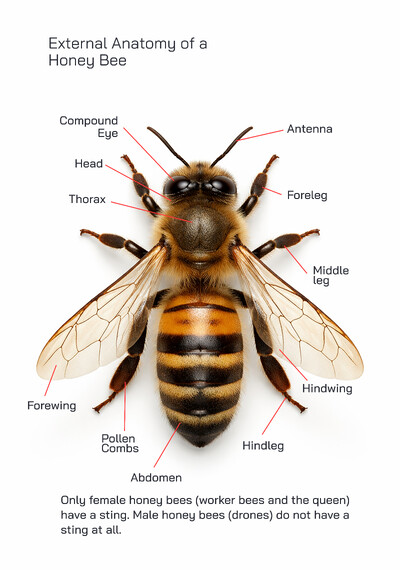
A compound eye is a highly specialized visual organ found primarily in insects and other arthropods. Unlike the single-lens eye of humans, a compound eye is made up of numerous tiny visual units called ommatidia. Each ommatidium functions as an individual light-detecting structure, and together they form a complex visual system capable of detecting movement, light intensity, direction, and broad shapes. This type of eye is perfectly adapted to the survival needs of insects, enabling rapid response to environmental changes and threats.
The compound eye is usually positioned prominently on the head and often appears as a large, rounded, or oval structure. Its surface is divided into many small hexagonal or circular facets, each corresponding to one ommatidium. The number of ommatidia varies widely among species, depending on lifestyle and habitat. Flying insects that rely heavily on vision often possess thousands of ommatidia, while ground-dwelling species may have fewer.
Structure of the Compound Eye
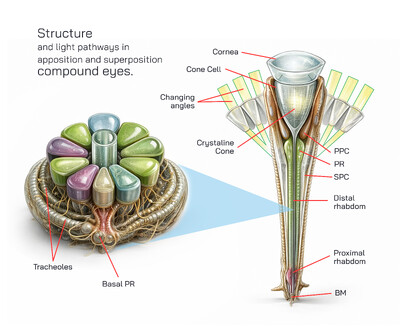
Each ommatidium is a complete light-sensing unit. At the outermost surface is a tiny lens that focuses incoming light. Beneath the lens lies a transparent cone that directs light inward toward the light-sensitive cells. These photoreceptor cells convert light energy into electrical signals. At the center of the ommatidium is a specialized structure that receives and processes the incoming light before sending information to the nervous system.
The ommatidia are separated by pigment cells that absorb stray light. This separation prevents light entering one unit from interfering with neighboring units. As a result, each ommatidium responds only to light coming from a specific direction. This directional sensitivity is the foundation of how compound eyes form images.
How Image Formation Occurs in a Compound Eye
Image formation in a compound eye differs fundamentally from image formation in a single-lens eye. Instead of producing one continuous image, a compound eye forms a mosaic-like representation of the environment. Each ommatidium captures a small portion of the visual field, similar to a pixel in a digital image. The brain then combines signals from all ommatidia to create a complete visual perception.
This mosaic vision is not designed for fine detail but excels at detecting motion and changes in light. Even slight movements can be detected almost instantly because multiple ommatidia respond simultaneously. This makes compound eyes especially effective for identifying predators, navigating through complex environments, and coordinating rapid movements such as flight.
Light Detection and Signal Processing
When light enters the lens of an ommatidium, it travels through the internal structures and reaches the photoreceptor cells. These cells contain light-sensitive pigments that react when photons strike them. This reaction generates electrical signals that travel along nerve fibers to the insect’s brain. The brain processes signals from thousands of ommatidia at once, allowing the insect to interpret its surroundings in real time.
The speed of signal processing in compound eyes is exceptionally high. Insects can detect changes in visual input far more rapidly than humans. This fast processing is essential for flying insects, which must constantly adjust their movements to avoid obstacles and maintain stability.
Field of Vision and Motion Sensitivity
One of the greatest advantages of compound eyes is their wide field of vision. Because ommatidia are arranged in a curved surface, insects can see in nearly all directions without moving their heads. This panoramic vision significantly reduces blind spots and increases awareness of approaching threats.
Compound eyes are also highly sensitive to motion. Even small, fast-moving objects can trigger a visual response. This ability helps insects escape predators, capture prey, and navigate through cluttered environments. While the resolution of a compound eye is lower than that of a human eye, its ability to detect movement is superior.
Adaptation to Environment and Lifestyle
The structure of compound eyes varies according to ecological needs. Day-active insects often have ommatidia optimized for bright light conditions, while night-active species have adaptations that increase sensitivity to low light. Some insects possess compound eyes capable of detecting ultraviolet light, which helps them locate flowers and navigate using environmental cues invisible to humans.
The number, size, and arrangement of ommatidia reflect evolutionary adaptation. Predatory insects tend to have more forward-facing ommatidia for better depth perception, while prey species benefit from wider visual coverage.
Advantages and Limitations of Compound Eyes
Compound eyes offer several advantages, including wide-angle vision, rapid motion detection, and high temporal resolution. These features make them ideal for fast-moving animals that rely on quick reactions. However, compound eyes have limitations. They cannot produce highly detailed images, and fine visual discrimination is limited compared to single-lens eyes.
Despite these limitations, compound eyes are exceptionally efficient for the needs of insects. Their design represents a balance between speed, coverage, and energy efficiency.
Biological Importance of Compound Eyes
Compound eyes play a critical role in insect survival and ecological interactions. They enable insects to find food, avoid danger, communicate visually, and navigate complex environments. Pollinators rely on compound vision to locate flowers, while predators depend on it to track moving prey. In social insects, visual cues help coordinate group behavior and movement.
From an evolutionary perspective, compound eyes demonstrate how biological systems can achieve remarkable functionality through modular design. Their study has influenced modern optical technologies, inspiring innovations in imaging systems and motion detection devices.
A compound eye represents one of the most fascinating solutions evolution has produced for visual perception. Rather than relying on a single lens to focus light onto one surface, the compound eye divides visual input across thousands of small, repeated units. This design allows insects and other arthropods to interpret their surroundings in a way that prioritizes speed, awareness, and survival over fine visual detail. The compound eye is not simply an alternative to the human eye, but a completely different visual strategy shaped by millions of years of adaptation to fast movement, predation, and complex environments.
The external appearance of a compound eye immediately reflects its internal organization. Its faceted surface is not decorative but functional, with each facet acting as the entry point for light into an individual ommatidium. This arrangement creates a rigid yet efficient visual dome that can capture information from multiple directions at once. Because compound eyes are often positioned on the sides of the head, insects gain a nearly panoramic view of their surroundings, which is especially important for detecting predators or navigating while flying.
Internally, the compound eye is a highly ordered system where repetition creates efficiency. Each ommatidium operates independently, collecting light from a narrow angle of the environment. The lens at the surface ensures that light enters at the correct orientation, while internal structures guide it precisely to the photoreceptor cells. These cells are specialized to respond rapidly to changes in light, allowing insects to react almost instantaneously to movement. The pigment cells that separate ommatidia play a crucial role in maintaining clarity by preventing light scattering, ensuring that each visual unit contributes accurate directional information.
The way compound eyes form images reflects their purpose. Instead of producing sharp, detailed pictures, compound eyes generate a composite view made from many small visual samples. This mosaic-like perception allows insects to detect patterns of movement and contrast with exceptional speed. While fine details may be blurred, motion stands out clearly. This trade-off is advantageous for animals that must respond quickly to threats, track fast-moving prey, or maintain stable flight through unpredictable environments.
Signal processing in compound eyes is optimized for speed rather than precision. When light stimulates the photoreceptor cells, electrical signals are generated and transmitted almost immediately to the brain. The nervous system of insects is adapted to handle this constant stream of information efficiently, integrating inputs from thousands of ommatidia at once. This rapid processing enables insects to react faster than many larger animals, giving them a significant survival advantage despite their small size.
The wide field of vision provided by compound eyes is one of their defining strengths. Because ommatidia are arranged across a curved surface, insects can monitor their surroundings without turning their heads. This constant awareness reduces vulnerability and allows for quick directional changes. For flying insects, this is particularly important, as it helps maintain balance, avoid collisions, and navigate complex landscapes filled with obstacles such as plants, branches, and other insects.
Motion sensitivity is another defining feature of compound vision. Even minimal movement can activate multiple ommatidia simultaneously, triggering an immediate response. This makes compound eyes extremely effective at detecting predators approaching from any direction. It also allows predatory insects to track moving targets with remarkable accuracy, even if the image itself lacks fine detail. In dynamic environments, speed of detection is often more important than visual clarity.
Compound eyes also show remarkable adaptability to different ecological conditions. Species active during the day tend to have ommatidia optimized for bright light, while nocturnal insects often possess larger ommatidia that capture more light, improving sensitivity in low-light conditions. Some compound eyes are capable of detecting ultraviolet wavelengths, revealing visual patterns on flowers that are invisible to humans. This ability plays a key role in pollination, guiding insects toward nectar sources with precision.
Evolution has shaped compound eyes according to lifestyle and behavior. Predators often have regions of the compound eye with higher ommatidial density facing forward, improving depth perception and target tracking. Prey species, on the other hand, benefit from broader coverage, allowing them to detect danger from multiple directions. These variations demonstrate how the same basic eye structure can be fine-tuned to meet very different survival needs.
Despite their many advantages, compound eyes do have limitations. Their resolution is inherently lower than that of single-lens eyes because each ommatidium captures only a small portion of the visual field. This makes it difficult to perceive fine details or recognize complex shapes at a distance. However, for insects, this limitation is outweighed by the benefits of speed, coverage, and energy efficiency. The compound eye provides exactly what is needed for survival in a fast-paced world.
The biological importance of compound eyes extends beyond individual survival. They influence how insects interact with their environment, locate food, communicate visually, and maintain social organization. Pollinators depend on compound vision to identify flowers and navigate between them, supporting plant reproduction and ecosystem stability. Social insects use visual cues alongside chemical signals to coordinate movement and behavior within groups.
From a broader scientific perspective, compound eyes offer valuable insight into alternative ways of processing visual information. Their modular design has inspired technological developments in imaging, robotics, and motion detection systems, where wide-angle vision and rapid response are more important than high resolution. Studying compound eyes helps scientists understand how nature solves complex problems efficiently using simple, repeated units.
The compound eye can be understood as a visual system built for constant awareness rather than detailed inspection. Its design reflects the realities of insect life, where survival often depends on reacting within fractions of a second. In open environments filled with predators, obstacles, and competitors, insects cannot afford slow visual processing. The compound eye solves this challenge by dividing visual responsibility among thousands of independent units, each contributing a small but crucial piece of information. Together, these units allow insects to remain alert to changes in their surroundings at all times.
One of the most remarkable aspects of compound eyes is their ability to function efficiently without requiring complex internal movement. Human eyes rely on moving eyeballs, focusing muscles, and adjustable lenses to gather visual information. In contrast, compound eyes are fixed structures. Their wide coverage and sensitivity eliminate the need for constant movement, reducing energy expenditure while maintaining visual awareness. This static yet powerful design is especially beneficial for small animals with limited energy resources.
The geometry of a compound eye plays a vital role in how insects perceive space. Because ommatidia are arranged across a curved surface, each one points in a slightly different direction. This creates a natural division of the visual field into many overlapping angles. As a result, insects can detect changes occurring anywhere around them almost simultaneously. This spatial arrangement enhances orientation and balance, particularly during flight, when rapid adjustments are required to maintain direction and stability.
Temporal resolution is another strength of compound eyes. Insects can perceive rapid flickering and fast movements that humans cannot easily detect. This means that actions such as wing beats, sudden predator movements, or shifting light patterns are processed with extraordinary speed. High temporal resolution allows insects to react to danger almost instantly, giving them a significant evolutionary advantage in environments where hesitation can be fatal.
Compound eyes also contribute to depth perception, though in a different way than human binocular vision. While insects may not perceive depth with the same clarity as humans, the overlapping visual fields of neighboring ommatidia provide sufficient spatial information to judge distance during flight or landing. Combined with motion cues, this allows insects to approach flowers, surfaces, or prey with impressive accuracy despite limited image detail.
Environmental light conditions strongly influence compound eye function. In bright environments, pigment cells tightly regulate incoming light, preventing overstimulation and maintaining clarity. In low-light conditions, these pigment cells may allow more light to reach the photoreceptors, increasing sensitivity. This adaptability enables insects to remain visually functional across a wide range of lighting situations, from direct sunlight to twilight and nighttime conditions.
Color perception in compound eyes adds another layer of complexity. Many insects can see wavelengths beyond the human visible spectrum, particularly ultraviolet light. This ability reveals patterns on flowers that guide insects toward nectar and pollen. These visual cues are invisible to humans but play a crucial role in plant–insect interactions. Compound eyes therefore support not only individual survival but also broader ecological processes such as pollination and plant reproduction.
The relationship between compound eyes and behavior is deeply interconnected. Visual input directly influences feeding, mating, navigation, and social interaction. Courtship displays, territorial movements, and group coordination often rely on visual signals detected through compound eyes. In social insects, vision works alongside chemical communication to create a highly coordinated system of behavior that benefits the entire colony.
From a developmental perspective, compound eyes also demonstrate biological efficiency. Their modular structure allows growth through repetition rather than complexity. Adding more ommatidia increases visual coverage without redesigning the entire system. This modularity explains why compound eyes can vary so widely in size and capability across species while maintaining the same basic structural plan.
In technological research, compound eyes continue to inspire innovation. Engineers study their structure to design artificial vision systems capable of wide-angle monitoring and rapid motion detection. Cameras inspired by compound eyes are being explored for use in robotics, drones, and surveillance, where panoramic vision and fast response are more valuable than high-resolution imagery. This shows how biological solutions can guide human technology toward more efficient designs.
Ultimately, the compound eye represents a different philosophy of vision. Instead of focusing on detail, it emphasizes awareness, speed, and adaptability. This makes it ideally suited to the fast-paced and unpredictable lives of insects. By understanding compound eyes, we gain insight not only into insect biology but also into the diverse ways vision can evolve to meet specific environmental demands. The compound eye stands as a powerful reminder that there is no single perfect way to see the world, only designs perfectly matched to the needs of life itself.
In essence, the compound eye is a powerful example of how biological systems are shaped by function rather than appearance. Its design emphasizes awareness, speed, and adaptability, allowing insects to thrive in environments that demand constant vigilance and rapid response. While fundamentally different from human vision, compound vision is no less sophisticated, representing an elegant and highly effective solution to the challenges of seeing and surviving in a dynamic world.
Conclusion
Honey is far more than a sweet substance. It is a natural gift shaped by bees, plants, and ecosystems, refined through time and tradition. From ancient remedies to modern wellness practices, honey continues to serve humanity as a source of nourishment, healing, and balance. Understanding what honey is, how it is used, and why it holds priority helps reinforce its importance in daily life and encourages mindful appreciation of this remarkable natural resource.