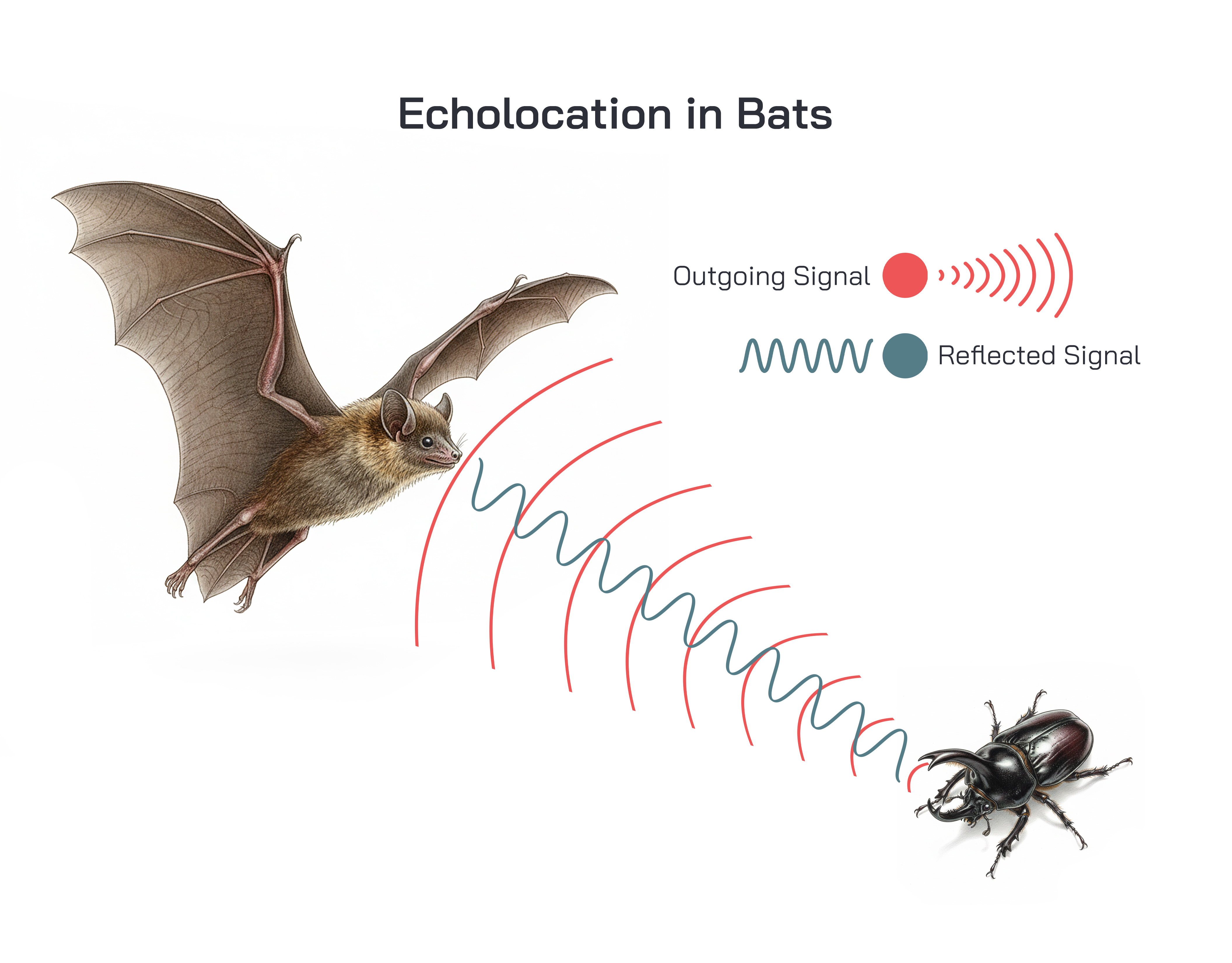
Echolocation in bats is one of the most remarkable sensory adaptations found in the animal kingdom and represents a highly specialized biological navigation and hunting system. This ability allows bats to move, hunt, and survive in complete darkness by using sound instead of sight. Echolocation enables bats to emit high-frequency sound waves and interpret the returning echoes to build a detailed mental map of their surroundings. This extraordinary skill is central to the survival of many bat species, particularly those that are active at night and rely on insects or small prey for food.
The basic principle of echolocation in bats involves the production of ultrasonic sounds that are beyond the range of human hearing. These sounds are emitted in short bursts or pulses, which travel through the air until they strike an object. When the sound waves hit an obstacle, such as an insect, tree branch, or cave wall, they bounce back as echoes. The bat’s highly sensitive ears detect these returning echoes, allowing the animal to determine the object’s location, size, shape, texture, and movement.
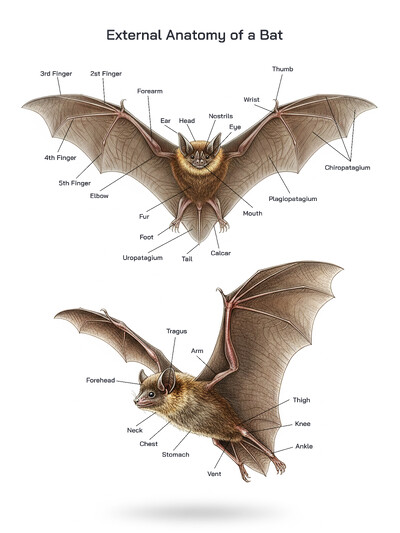
Sound production in echolocating bats occurs mainly through the mouth or the nose, depending on the species. Some bats emit sound pulses through an open mouth, while others produce sounds through specialized nasal structures. These calls can vary in frequency, duration, and intensity based on the bat’s environment and activity. When navigating open spaces, bats may emit slower, longer pulses. During hunting, the pulse rate increases rapidly, allowing the bat to track fast-moving prey with extreme precision.
The frequency of echolocation calls is a critical factor in how bats perceive their environment. High-frequency sounds provide detailed information about small objects, such as insects, but travel shorter distances. Lower-frequency sounds travel farther but provide less detail. Bats dynamically adjust the frequency of their calls to balance range and resolution. This flexibility allows them to function effectively in diverse habitats, including open skies, dense forests, and confined caves.
Once echoes return to the bat, they are processed by an exceptionally advanced auditory system. Bat ears are large, sensitive, and often equipped with complex folds that enhance sound reception. The inner ear and auditory cortex of the brain are highly specialized for interpreting subtle differences in echo timing, intensity, and frequency. By comparing echoes received by each ear, bats can pinpoint the exact direction and distance of objects with astonishing accuracy.
Echolocation is especially important for hunting. Insect-eating bats use this system to detect, track, and capture prey mid-air. As a bat approaches an insect, it increases the rate of sound emission, producing what is known as a feeding buzz. This rapid sequence of calls allows the bat to continuously update information about the prey’s movement, ensuring successful capture even when the insect changes direction suddenly. This hunting efficiency makes bats some of the most effective nocturnal predators in nature.
Beyond hunting, echolocation plays a crucial role in navigation and obstacle avoidance. Bats use echoes to detect walls, branches, and other environmental features while flying at high speeds in darkness. This ability allows them to maneuver through complex environments without collision. In caves, echolocation helps bats locate roosting sites and maintain orientation within large colonies. In forests, it enables precise flight through narrow spaces between trees and foliage.
Echolocation also supports social interaction in bats. While its primary function is navigation and hunting, variations in echolocation calls can convey information to other bats. Some species adjust their calls to avoid signal interference when flying in groups, a phenomenon known as acoustic jamming avoidance. This demonstrates the sophistication of echolocation as both a sensory and communicative system.
Not all bats rely equally on echolocation. Microbats depend heavily on this ability due to their nocturnal lifestyle and insect-based diet. Megabats, or fruit bats, generally rely more on vision and smell, although some species use a simpler form of echolocation for navigation. This difference highlights the evolutionary diversity within bat species and the adaptation of echolocation to specific ecological roles.
From an evolutionary perspective, echolocation represents a major survival advantage. It allows bats to exploit nocturnal niches with reduced competition and predation. By feeding at night, bats avoid many predators and access abundant insect populations. Echolocation also reduces reliance on vision, which can be limited in low-light conditions. This sensory adaptation has contributed significantly to the evolutionary success and global distribution of bats.
Echolocation also has important environmental implications. By enabling bats to efficiently hunt insects, it supports natural pest control and reduces the need for chemical pesticides in agriculture. This ecological service benefits ecosystems and human activities alike. The decline of echolocating bat populations due to habitat loss or environmental change can lead to increased insect populations and ecological imbalance.
Scientific study of bat echolocation has influenced human technology as well. Research into this biological sonar system has inspired developments in navigation technology, medical imaging, and acoustic engineering. Echolocation demonstrates how natural systems can achieve remarkable efficiency and precision using simple physical principles.
Echolocation in bats can be understood even more deeply by examining how this sensory system integrates physics, neurobiology, behavior, and evolution into a single, highly efficient survival mechanism. Far from being a simple process of sending and receiving sound, echolocation is a dynamic, adaptive system that changes moment by moment based on context, experience, and environmental complexity. It represents one of the most refined examples of active sensing in the natural world, where the animal continuously modifies its own signals to extract the most useful information from its surroundings.
One of the most extraordinary aspects of bat echolocation is its temporal precision. Bats can detect differences in echo return times that are separated by fractions of a millisecond. This allows them to judge distance with extreme accuracy, even while flying at high speeds. The brain of a bat contains specialized neural circuits that act almost like biological timing instruments, measuring echo delays and translating them into spatial awareness. This time-based processing is so refined that bats can detect objects only a few millimeters apart, even in complete darkness.
Echolocation is also highly adaptable to environmental noise. In natural settings, bats often hunt in acoustically complex environments filled with echoes from leaves, branches, rocks, and other bats. To cope with this, bats constantly adjust the structure of their calls. They may change pitch, alter call duration, or shift the angle at which sound is emitted. Some bats shorten their calls in cluttered spaces to reduce overlapping echoes, while others lengthen calls in open areas to increase detection range. This flexibility demonstrates a level of sensory control that rivals advanced human-made sonar systems.
Another remarkable feature of echolocation is frequency modulation. Many bats emit calls that sweep through a range of frequencies rather than remaining constant. These frequency-modulated calls improve the bat’s ability to detect motion through a phenomenon similar to the Doppler effect. When an insect is moving, the frequency of the returning echo changes slightly. Bats can interpret these shifts to determine the speed and direction of their prey. This ability allows them not only to detect insects but to predict their future position, enabling highly precise interception during flight.
Some bat species have evolved echolocation calls that are so finely tuned they can distinguish between edible and inedible insects. By analyzing echo patterns, bats can detect differences in wing shape, body texture, and movement style. This allows them to ignore prey that may be toxic or energetically inefficient. In this way, echolocation contributes not only to hunting success but also to energy optimization, ensuring that bats invest effort only in worthwhile targets.
Echolocation also plays a critical role in spatial memory. Bats do not simply react to echoes in real time; they integrate echo information into long-term mental maps of their environment. Many bats remember the layout of caves, forest paths, and feeding areas with remarkable accuracy. Over repeated flights, they rely less on constant echolocation and more on learned spatial memory, reducing energy expenditure. This combination of echolocation and memory allows bats to navigate efficiently across familiar landscapes while still detecting sudden changes or new obstacles.
The development of echolocation begins early in a bat’s life. Young bats are born without fully developed echolocation abilities. As they grow, they practice emitting calls and interpreting echoes, gradually refining their skills. This learning process involves both instinct and experience. Juvenile bats often make mistakes during early flights, but through repetition and feedback, their auditory system becomes finely calibrated. This learning component highlights that echolocation is not purely automatic but involves neural plasticity and adaptation.
Social dynamics further influence echolocation behavior. When many bats forage together, their echolocation calls can interfere with one another. To avoid confusion, some bats shift their call frequencies when flying near others, ensuring that their echoes remain distinguishable. This ability to modify signals in response to social context demonstrates advanced auditory awareness and cooperation, even among large groups.
Echolocation also varies significantly between species, reflecting different ecological niches. Bats that hunt in open spaces often use long-range, lower-frequency calls that travel far but provide less detail. Bats that hunt in dense vegetation use short-range, high-frequency calls that provide fine detail but limited range. Some bats alternate between call types depending on whether they are navigating, searching for prey, or actively pursuing a target. This versatility allows bats to exploit a wide variety of habitats.
Interestingly, echolocation is not limited to aerial hunting. Some bats use echolocation to locate prey on surfaces such as leaves, water, or the ground. These bats emit calls at angles that help detect subtle surface reflections. Fishing bats, for example, can detect ripples on water surfaces caused by moving fish. This demonstrates how echolocation has been adapted beyond simple obstacle detection to serve highly specialized feeding strategies.
From an evolutionary standpoint, echolocation likely developed gradually, starting as a simple navigation aid and later becoming a sophisticated hunting tool. As nocturnal niches expanded and insect populations diversified, bats that could better interpret sound gained a significant advantage. Over millions of years, natural selection refined echolocation into the precise system observed today. This adaptation allowed bats to dominate the nocturnal sky with little competition from other mammals.
Echolocation also influences bat physiology in subtle ways. Producing high-intensity sound repeatedly requires strong respiratory muscles and precise control of airflow. Bats have evolved specialized laryngeal structures and breathing patterns that allow them to emit calls without interrupting flight. Some species even synchronize echolocation calls with wingbeats, conserving energy and improving efficiency.
Beyond biology, echolocation has reshaped scientific understanding of sensory perception. It challenges the notion that vision is the dominant sense for spatial awareness and demonstrates how sound can be used to construct highly detailed mental representations of the environment. The study of bat echolocation has influenced fields such as neuroscience, robotics, and artificial intelligence, where engineers attempt to replicate similar active sensing systems.
In ecological terms, echolocation underpins the role of bats as keystone species. Their ability to hunt efficiently at night allows them to regulate insect populations that would otherwise grow unchecked. This has cascading effects on plant health, agriculture, and disease control. Without echolocation, bats would not be able to fulfill these roles, and ecosystems would lose a major stabilizing force.
In conclusion, echolocation in bats is far more than a simple navigation tool. It is a complex, adaptive sensory system that integrates sound production, auditory processing, memory, learning, and behavior into a seamless whole. This ability allows bats to perceive the world in ways entirely different from humans, enabling survival in darkness, mastery of flight, and efficient exploitation of nocturnal resources. Echolocation stands as one of nature’s most sophisticated evolutionary innovations, highlighting the incredible diversity of sensory solutions that life has developed to meet environmental challenges. Echolocation in bats is a highly advanced sensory system that enables navigation, hunting, and survival in darkness. Through the emission and interpretation of ultrasonic sound waves, bats gain detailed awareness of their surroundings. This ability supports their nocturnal lifestyle, ecological roles, and evolutionary success. Echolocation is not only a defining characteristic of many bat species but also a powerful example of nature’s ingenuity in solving complex survival challenges.