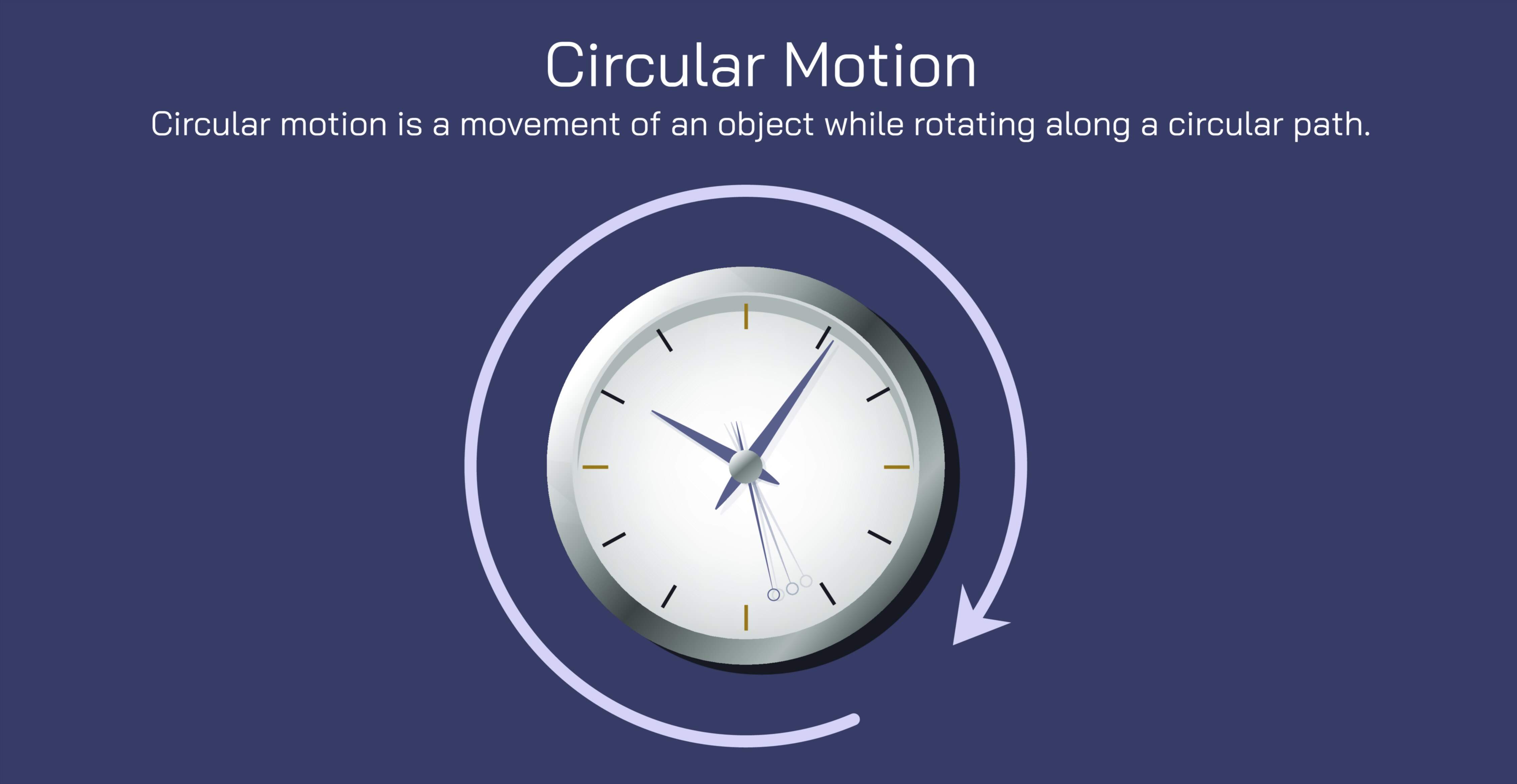
Circular Motion Showing Centripetal Force, Tangential Velocity, and Rotational Path of an Object in Physics — Explained Using the Example of a Clock
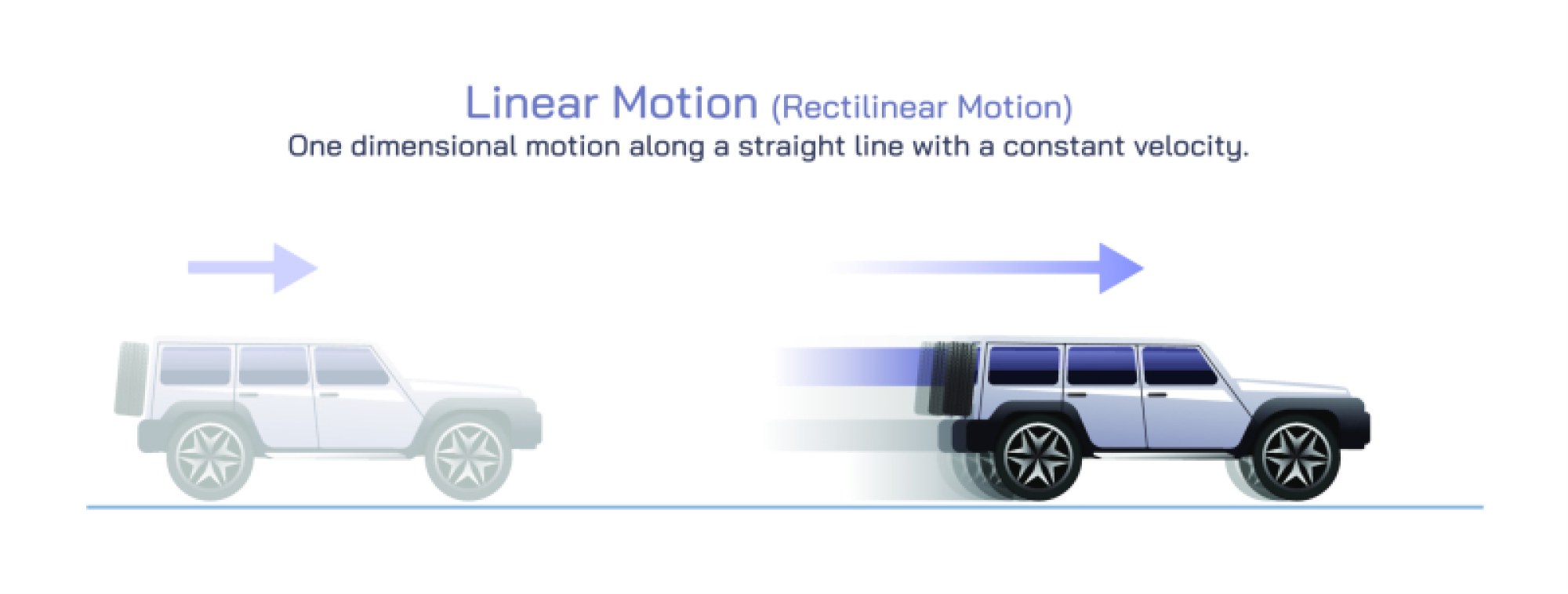
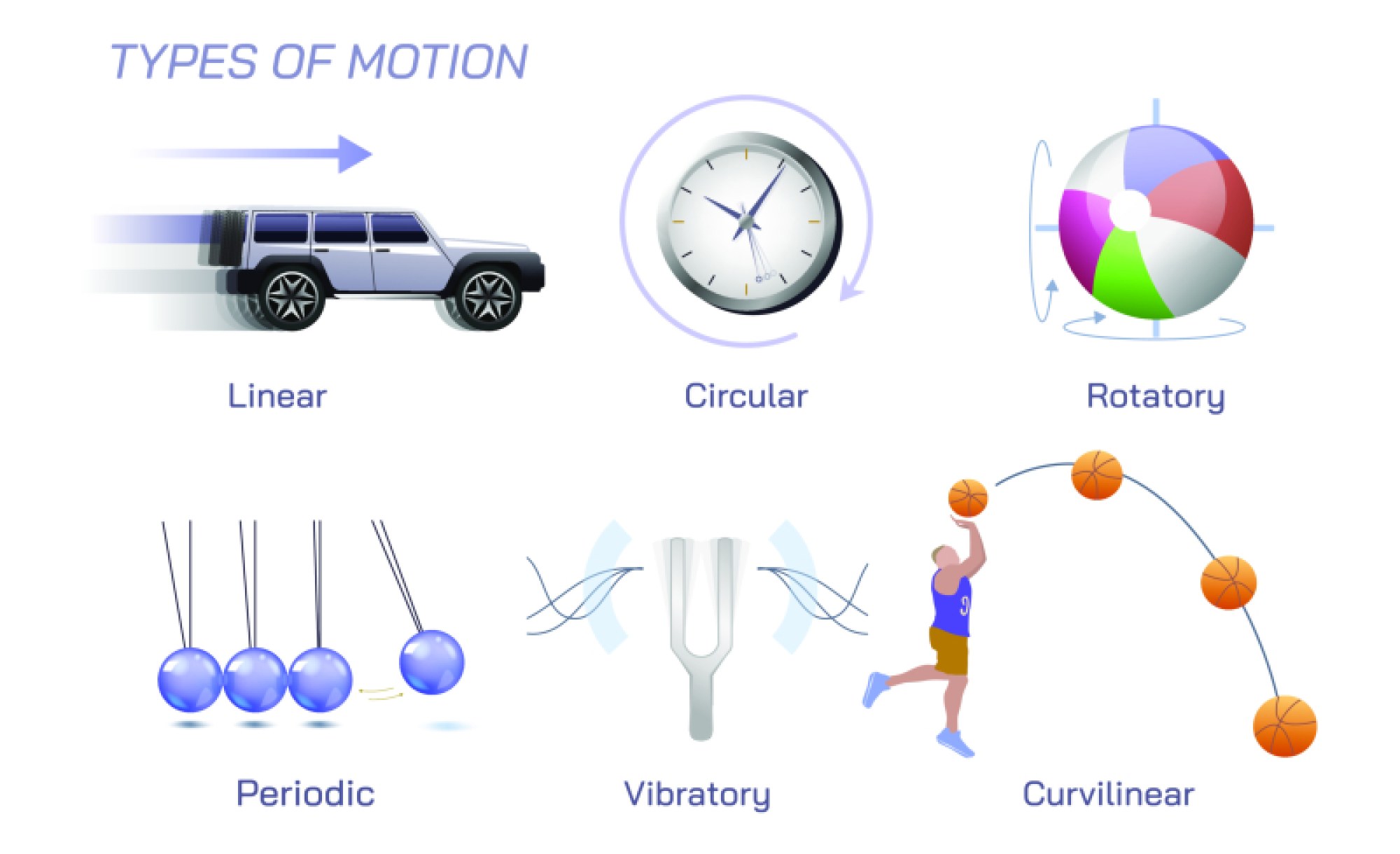
Circular motion is one of the most visually intuitive yet scientifically rich forms of motion in physics, revealing how an object can continue moving at a constant speed while constantly changing its direction. Unlike linear motion, which progresses in a straight path, circular motion follows a curved pathway around a central point. What makes this phenomenon fascinating is that even when the speed of the moving object does not change, the motion itself is still classified as accelerated, because the direction of velocity shifts with every moment along the circular path. A vector illustration showing circular motion often highlights three foundational ideas at once: the centripetal force that pulls the object toward the center, the tangential velocity that pushes the object along the curve rather than toward the center, and the continuous rotational trajectory around a fixed axis. Although these principles apply equally to spinning planets, rotating amusement rides, and orbiting electrons, a simple and relatable example of circular motion emerges from everyday life — the rotation of a clock hand around its center.
When viewing the second hand, minute hand, or hour hand of a clock, the motion appears slow, steady, and predictable, yet the physics beneath it is the same as that governing much faster circular systems. Each hand of a clock follows a perfect circular path around the central pivot. The tip of the hand moves constantly along this curved path even though the distance from the pivot never changes. This constant distance forms what physicists call the radius of rotation — the invisible line from the center to the moving object. The tip of the second hand travels the fastest of the three hands because it completes a full rotation in the shortest time, while the hour hand moves the slowest because it completes a full revolution every twelve hours. Through this simple contrast of speeds, the clock beautifully demonstrates that the time taken to complete one round determines how quickly the tip of the hand moves along its circular trajectory.
Now imagine the tip of a clock’s second hand as an object tracing its path across the dial. Its motion is directed along the tangent of the circle, meaning that if the central pivot were suddenly removed and no force continued pulling it inward, the moving point would rush off in a straight line, not a curved one. This immediate shift toward a straight path highlights the role of tangential velocity, the directional component of motion that touches the circle at a single point and has no inward tendency by itself. In a vector illustration, this tangential velocity is shown using an arrow that points along the direction in which the tip would travel if freed. The constant tug-of-war happening in circular motion becomes clear: the object continually attempts to fly away tangentially, propelled by its momentum, but something keeps bending its path inward again and again to preserve the circular motion.
The invisible agent that keeps the object from escaping is the centripetal force — an inward-directed force that continuously redirects the object toward the center of the circle. Without this inward pull, circular motion could not exist; motion would immediately become linear. In a clock, mechanical constraints within the gears and shaft supply the needed inward force, ensuring that the hand does not stray from its circular path. Centripetal force does not speed up the motion or slow it down; its only function is to change direction. That is why the magnitude of this inward force depends on three simple realities of rotational motion: the mass of the rotating object, how fast it moves, and how close or far it is from the central pivot. When the clock’s second hand rotates rapidly, the inward force needed to keep the tip following the tight circular path becomes greater; when the motion slows, the inward force needed becomes smaller. This is why spinning objects — from bicycle wheels to orbital satellites — require stronger inward forces when moving faster and weaker inward forces when moving slower, even though their paths remain circular.
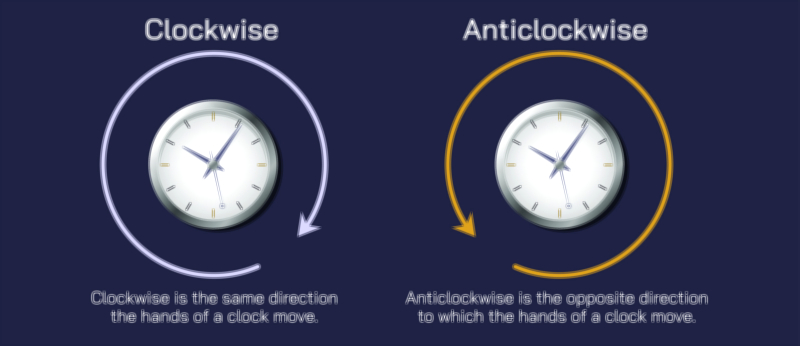
The rotation of a clock hand also helps illustrate the difference between period of rotation and instantaneous motion. Each hand completes revolutions at a different pace, yet at every instant the direction of movement is changing. The second hand sweeps across sixty markings in one minute, meaning the direction of the tip pivots slightly every fraction of a second. The motion is smooth rather than jerky because physics regulates this change in direction continuously; the inward force bends the tangential velocity constantly rather than sharply. The illustration of this cycle often shows multiple curved arrows around the clock face to emphasize the trajectory, while straight tangential arrows and inward-pointing centripetal arrows reveal the dual influences that shape the rotational motion.
Inside the mechanism of circular motion lies a deep relationship between physical intuition and everyday experience. Every time someone swings an object around on a string, rides a car around a curve, travels on a spinning amusement ride, or observes the hands of a clock, they experience centripetal effects. Even though the tension in a string, friction of car tires on the road, contact force of a rotating platform, or the engineering of clock gears may seem very different on the surface, each plays exactly the same role — providing the inward pull that prevents the moving object from escaping along the tangent. The feeling of being pushed outward on a fast curve is not the result of a real outward force; it is simply the tendency of the body to move in a straight line while the centripetal force forces a curved path instead. Circular motion therefore reshapes our intuitive understanding of forces by revealing that the sensation of “being thrown outward” is actually the resistance to being pulled inward.
The clock example also highlights how uniform circular motion differs from more complex rotational motion. In a perfect clock mechanism, the speed of the rotating hand remains constant, meaning that the size of the inward force stays constant as well. But outside this ideal situation, circular motion may involve speeding up, slowing down, wobbling, spiraling, or changing radius — all variations that add complexity to rotational systems. The second hand of a well-constructed clock strips away that noise and shows the simplest possible case: a clean, predictable rotation governed by a single balance between centripetal pull and tangential momentum.
A vector illustration of circular motion featuring a clock captures multiple fundamental ideas in a single frame. The circular arrow around the edge demonstrates the continuous rotational path. The tangential arrow shows the momentary direction of motion at any single point. The centripetal arrow points inward toward the pivot, symbolizing the force needed to keep the motion circular. The radius line marks the unchanging distance between center and object, and the curved track reflects the uninterrupted movement of the rotating point. Together, these elements turn an abstract set of physical principles into a vivid and memorable image of motion — simple enough for anyone to understand, yet rooted in scientific depth that applies to countless real-world systems.
Circular motion therefore becomes much more than an object rotating around a center. It embodies the perpetual interplay between direction and redirection, between the natural desire of motion to continue straight and the guidance of an inward pull that forces curvature. The clock hand is a daily reminder of this delicate balance — ticking steadily along its path, tracing the physics of rotation in plain sight while marking the flow of time. Through the example of the clock and the concepts of tangential velocity, centripetal force, and rotational pathway, circular motion stands revealed not only as a foundational topic in physics but also as an elegant expression of how motion can curve, accelerate, and remain constant all at once.