Distance vs Displacement – Understanding Motion and Measurement Through a Vector Illustration of Physical Movement
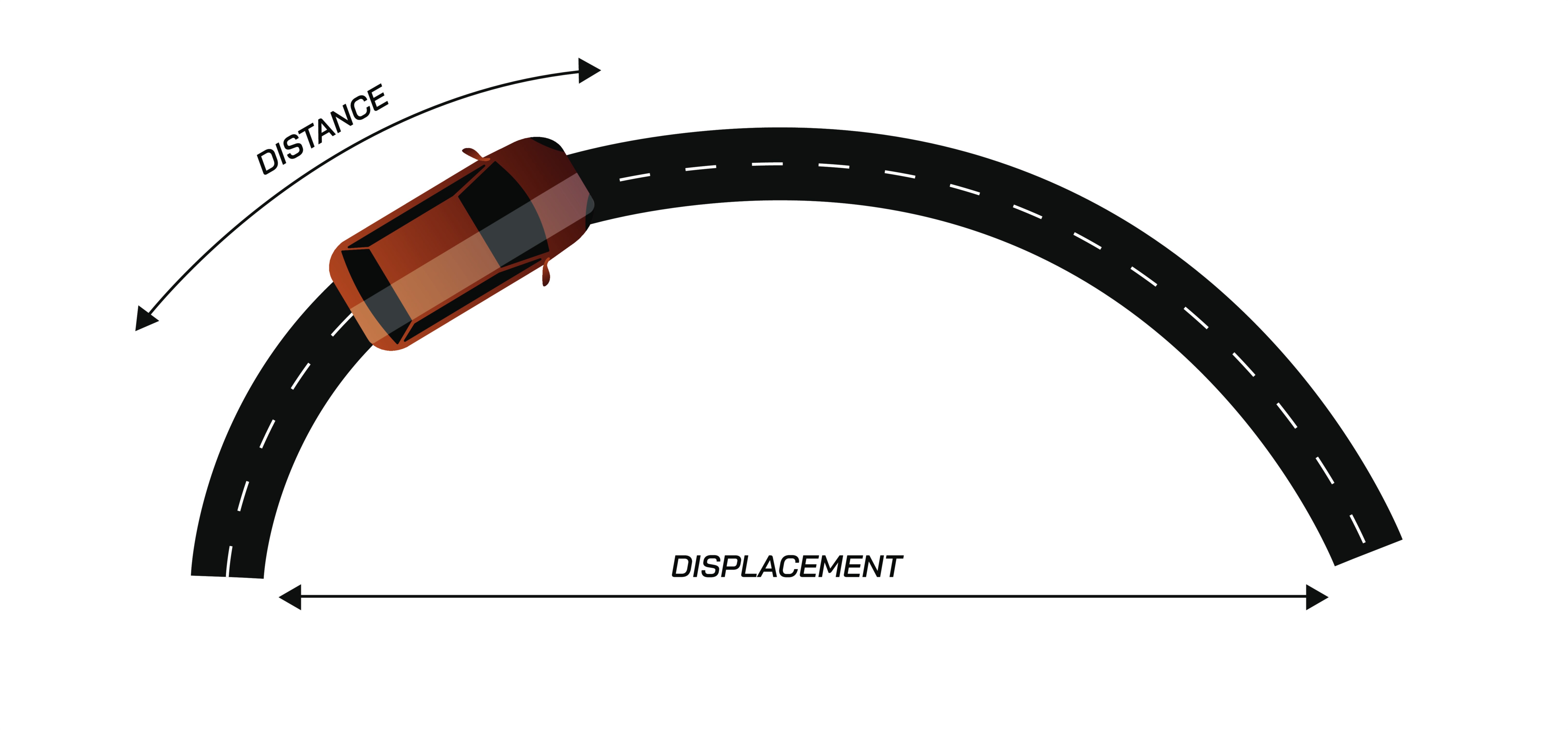
The concept of distance and displacement is one of the most foundational ideas in physics because it defines how motion is interpreted, not only mathematically but visually and conceptually. A vector illustration of distance versus displacement becomes a powerful tool in expressing this contrast because it shows, with clarity and intuition, how movement through space can be measured in two fundamentally different ways. Distance refers to the total path traveled, taking into account every curve, turn, and segment covered by an object, while displacement refers to the shortest straight-line direction from the starting point to the ending point, representing a direct change in position. When both are depicted visually, the difference becomes impossible to ignore. If an object moves along a curved or zigzag route, the distance line traces every detail of this journey, appearing longer and more complex, while the displacement vector is shown as a straight arrow linking the start and end positions. The illustration uses visual storytelling to explain a principle that can be difficult to grasp through words alone: distance measures how much ground was covered, while displacement measures how far the object ended up from where it started.
In the context of physics and real-world motion, understanding this difference matters deeply because distance describes the effort of motion, while displacement describes the result of motion. Consider a person walking around a park along a looping pathway. The distance they travel includes every stretch of pavement along their walk. But displacement depends only on where they ended relative to their starting point. If they return to the same place where they started, their displacement becomes zero, even though their distance walked could be very large. This duality reveals something important about measuring physical change: distance is a cumulative account of movement, while displacement is a positional comparison between two points in space. A vector illustration brings this contrast to life with a winding route drawn in one color to represent distance and a bold arrow drawn from start to finish to represent displacement. Even without text or explanation, the viewer instantly recognizes that the object’s traveled path is longer than the direct connection between its start and end points.
The difference between distance and displacement shapes the way motion is analyzed, both scientifically and practically. In fields such as biomechanics, sports science, automotive research, aerospace navigation, robotics, and athletics training, distance helps evaluate how much movement occurred, while displacement reveals how far—and in which direction—the object or person has relocated. For example, a sprinter running in a curved track lane covers a longer distance than their straight-line displacement from the starting line to the finishing line. A sensor tracking the motion of a robotic arm measures distance traveled to calculate mechanical workload, while displacement determines whether the arm reached a specific target position. A vehicle moving through traffic might travel a long distance due to detours and turns, but its displacement simply reflects the geographic separation between origin and destination. These examples show that distance describes energy output, travel effort, and motion complexity, whereas displacement describes net positional change and directional result. The vector illustration, with curved paths contrasted against straight vectors, becomes a condensed visual summary of this difference.
In educational settings, the movement of an object on a two-dimensional plane is often mapped through a diagram where a path is represented by colored or dashed lines, and displacement is represented by a single arrow drawn between the starting and ending points. When animated or digitally stylized, the illustration becomes even more intuitive. The arcs, zigzags, or curved paths emphasize the complexity of total travel, while the straight arrow reinforces the idea that displacement is independent of the route taken. Students learning the fundamentals of motion find that this visual aid helps them break away from the common misconception that more travel should always mean more displacement. The illustration teaches that a circular motion around a track leads to significant accumulated distance but zero displacement, and that a path filled with twists and turns can result in a displacement that is surprisingly small. The beauty of vector-based artwork lies in its clarity—smooth curves, precision lines, and clean directional arrows eliminate visual ambiguity while scaling perfectly across textbooks, digital screens, classroom projectors, and interactive simulations.
Beyond physics classrooms, this distinction has philosophical undertones that make the visual representation even more impactful. Distance reflects the journey, the steps taken, and the energy spent, while displacement reflects the outcome, the actual progress made toward a goal or destination. A runner training at the gym might run several kilometers on a treadmill without changing their final position relative to where they started; their distance is significant, but their displacement is zero. This reality mirrors experiences far outside science: sometimes incredible effort does not result in a change of position, and sometimes rapid progress happens with minimal effort when direction is clear. The vector illustration silently carries this metaphorical message as well—an object can move a lot without ending up somewhere new, and even small movement can produce dramatic change if direction aligns with the destination. Although rooted in physics, the symbolism of the visual leaves a lasting psychological impression.
The vector format of the illustration is crucial to its effectiveness. Because vector graphics are based on geometric paths rather than pixels, they can be enlarged or reduced without losing sharpness or accuracy. The curves representing distance remain smooth and continuous, while the displacement arrow stays straight and bold regardless of screen size or printing scale. This matters for scientific communication because misalignment, blurriness, or distortion can change how information is perceived. In a vector-rendered version, the start and end points are crisp, reference markers are readable, and the contrast between the route and the displacement arrow is unmistakable. On posters, websites, scientific presentations, physics exercises, mobile learning apps, and engineering schematics, the illustration remains visually perfect and conceptually powerful.
Even in professional environments where precision matters—such as aviation, marine navigation, spacecraft trajectory planning, geolocation systems, and athletic performance analytics—the conceptual and visual difference between distance and displacement is critical. Pilots track displacement to monitor changes in geographical position and distance to measure route length. Runners and cyclists measure distance to judge physical performance and displacement to analyze progress across a mapped course. In Earth–satellite communication, signal travel distance matters for transmission time, while displacement matters for position tracking. The vector illustration becomes an educational reference not only for students but also for professionals who rely on accurate interpretation of movement and direction.
Ultimately, the Distance vs Displacement Vector Illustration is much more than a graphic representation. It is a visualization of how motion is understood, measured, and interpreted across scientific, academic, technological, and real-life contexts. Distance captures the total effort involved in movement. Displacement captures the net positional change achieved through movement. One represents everything that happened along the way; the other represents where the object ended up. The winding path and the straight arrow in the illustration do not just display information—they communicate a deeper understanding of motion: effort does not always equal progress, and progress does not always require complexity. Through a simple yet elegant representation of path and vector, the illustration teaches the essence of motion, direction, and measurable change with absolute clarity.