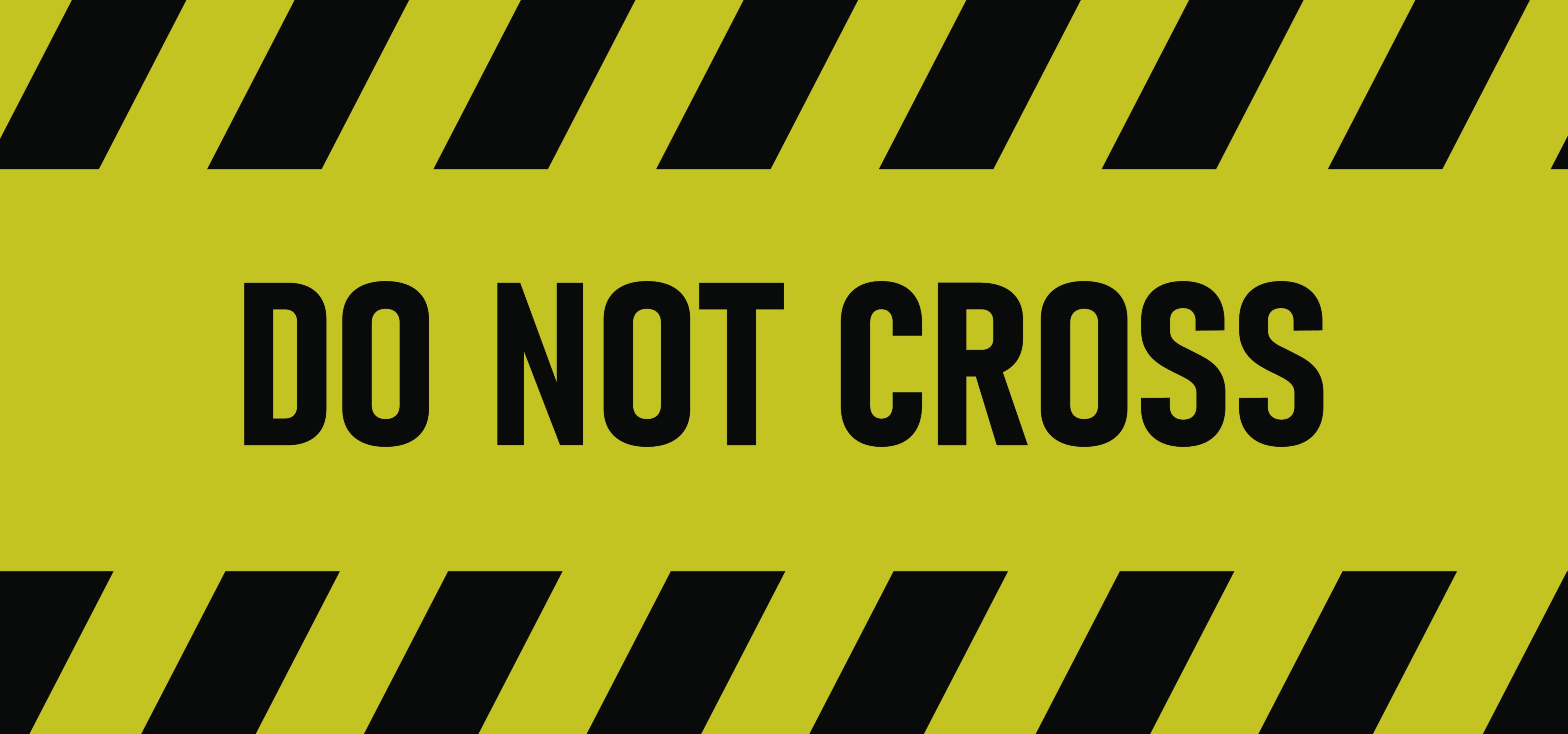
Do Not Cross Sign Vector Illustration — Safety Barrier Warning Board
A Do Not Cross sign, especially when illustrated as a clean, high-contrast vector graphic incorporating bold typography, a prominent prohibition bar, and vivid caution colors, stands as one of the most essential visual tools in public and industrial safety communication. The meaning behind this sign extends far deeper than a simple instruction to stop movement; it signals that crossing the marked boundary exposes individuals to serious danger, disrupts safe operational flow, or violates restricted-access protocols designed to protect both people and property. The sign is not a suggestion or advisory reminder but a mandatory stop point, placed precisely where stepping beyond the boundary could result in immediate physical harm, legal consequences, or interference with controlled environments. Vector formatting reinforces this authority because every geometric line, warning icon, and color contrast remains perfectly crisp at any scale, ensuring that the message is instantly recognizable whether printed on a small indoor placard, displayed on a roadside safety barrier, mounted near construction fencing, or shown digitally in workplace safety handbooks and training modules. The moment a person sees the sign, it delivers not ambiguity but certainty: the space beyond this point is not safe to enter and movement must stop here.
The need for a Do Not Cross sign becomes clear when observing how the human mind interprets physical spaces. People often move according to what appears accessible rather than what is safe, especially in places that are partially open, under construction, or temporarily modified. When a rope barrier is loose, when a walkway appears empty, when the absence of personnel creates a false sense of permission, or when urgency causes someone to look for the shortest route, individuals may be tempted to walk into zones that are not safe to access. Without a clear sign, a passerby might step beyond a barrier thinking they are taking a shortcut, a pedestrian might enter a construction area because it looks idle for the moment, a spectator might cross into an athletic field or racetrack believing the event has paused, or a worker might attempt to retrieve an object from the other side of a restricted industrial platform. These actions are rarely malicious; they come from curiosity, assumption, stress, or misunderstanding. The Do Not Cross sign is therefore placed not to restrict freedom but to intercept decision-making at the very moment when an unsafe step could happen and replace assumption with information before risk develops.
The most urgent purpose of the sign is protection from life-threatening physical hazards. Many areas that appear harmless from a distance conceal dangers that are invisible to the untrained eye or that become dangerous only under specific circumstances. In construction zones, sharp debris, unstable structures, power tools in motion, exposed metal, overhead loading, and open trenches may exist in an area that looks calm at first glance. In railway and metro walkways, a seemingly quiet track can become fatal within seconds when a train approaches silently at high speed. In manufacturing plants, robotic arms, conveyor systems, molten metals, or rotating equipment in restricted lanes can cause catastrophic injury to anyone who crosses into their operating path. At docks, airports, and logistics hubs, heavy vehicles move along specialized lanes where operators are focused on their tasks rather than on pedestrians. Even in environments like sporting arenas or amusement parks, crossing into performance or ride zones can result in severe injury because humans and machines are not prepared for unexpected presence. The Do Not Cross sign protects individuals by warning them in the exact moment when instinct to move forward must be replaced with restraint for the sake of survival.
The sign also supports operational continuity and workflow stability, because crossing into a restricted path does not merely endanger an individual; it can disrupt an entire system. One person crossing into an industrial handling zone can force machinery to shut down due to emergency sensors triggering, halting production that may be operating on tight schedules and precision workflows. A person walking across a film set, stage, sports arena, or broadcast studio can interrupt procedures that depend on continuous flow and timing. In transportation networks, a pedestrian crossing into vehicle zones can delay buses, ferries, planes, or trains, resulting in systemic delays across tightly scheduled networks. In airport tarmac operations, an unauthorized step into a designated path can require emergency protocols and clearance resets that affect hundreds of people. For those working behind the scenes, the Do Not Cross sign is a silent protective partner, helping team members stay concentrated on their responsibilities without the constant need to police physical boundaries or verbally intervene against unauthorized entry.
Security is another critical dimension of the sign’s meaning. Restricted zones often house confidential equipment, sensitive information, valuable materials, hazardous substances, or mission-critical systems that must remain isolated from unauthorized individuals. People who cross into these zones — even by accident — could compromise privacy, damage controlled environments, or create breaches with legal and technological consequences. Whether in research centers, data facilities, medical laboratories, military installation boundaries, corporate confidentiality zones, server rooms, energy distribution facilities, or emergency command stations, the Do Not Cross barrier is not only a physical safety measure but a security shield that preserves the integrity of protected spaces. Individuals do not need to understand the full reason behind the restriction; they only need to receive a clear signal that crossing would violate safety and security structure.
Legal responsibility adds another essential layer of meaning behind the existence of the sign. Regulatory bodies in construction, public safety, property management, industrial operations, entertainment venues, transportation hubs, and government facilities require clear signage to prevent accidental intrusion into restricted or hazardous areas. If someone crosses into a dangerous zone without signage, responsibility can fall on the organization because the environment failed to communicate the danger. When a Do Not Cross sign is clearly displayed, responsibility becomes transparent: the hazard was disclosed, the boundary was marked, and crossing beyond the limit constitutes a knowing violation rather than an innocent misunderstanding. This protects both the public and the organization — ensuring that the environment fulfills its duty of informing, while giving individuals the knowledge they need to protect themselves.
The sign also carries important social and emotional value because it prevents conflict and embarrassment in shared spaces. Without clear signage, staff are forced to confront individuals verbally when they cross boundaries unknowingly, which can lead to tension, defensiveness, and feelings of disrespect — even though both sides may have good intentions. The sign eliminates this burden by letting the environment deliver the message rather than a person, enabling individuals to correct themselves privately without conflict. It supports dignity on both ends: those who follow the rule maintain confidence that they are behaving appropriately, and those responsible for safety are spared the stress of repeatedly enforcing boundaries through confrontation.
The vector-illustration format enhances all of these benefits because recognition must happen instantly — from a distance, through distraction, or under low-visibility conditions. Thick stroke lines, crisp prohibition symbols, and high-contrast shapes activate the brain’s hazard-recognition pathways faster than written language. Even individuals who do not speak the posted language — tourists, children, temporary workers, international visitors, and people with low literacy — can grasp the meaning simply by seeing the prohibition circle and barrier graphic. Vector quality guarantees that the imagery does not blur when enlarged across construction fencing or reduced for workplace signage, ensuring that its power is not diminished by scale. The uniform designality across different environments reinforces familiarity, leading to instant reflexive obedience rather than hesitation.
Seen from a wider perspective, the Do Not Cross warning symbolizes a key principle of modern safety and public responsibility: prevention is more powerful than reaction. Barriers, guardrails, instructions, and human supervision cannot protect everyone everywhere — but information can. The sign gives individuals the awareness needed to avoid danger without struggle, conflict, or enforcement. It transforms uncertainty into certainty and impulse into informed choice. It empowers people to take control of their own wellbeing by providing clarity at the exact location where mistakes are most likely to occur.
Ultimately, the Do Not Cross Sign Vector Illustration — Safety Barrier Warning Board acts as a silent but profoundly protective boundary marking the point at which an ordinary action becomes dangerous. It prevents injury before panic arises, prevents operational disruption before systems collapse, prevents security breaches before damage is done, and prevents interpersonal conflict before frustration develops. It replaces assumption with understanding, impulse with caution, and risk with awareness. Its presence ensures that every person reaching a controlled boundary has the knowledge they need to stop — not out of punishment, but out of protection. Through its powerful visual language and direct instruction, the sign stands as a guardian of safety, order, and respect in environments where one step beyond the line would turn certainty into harm.