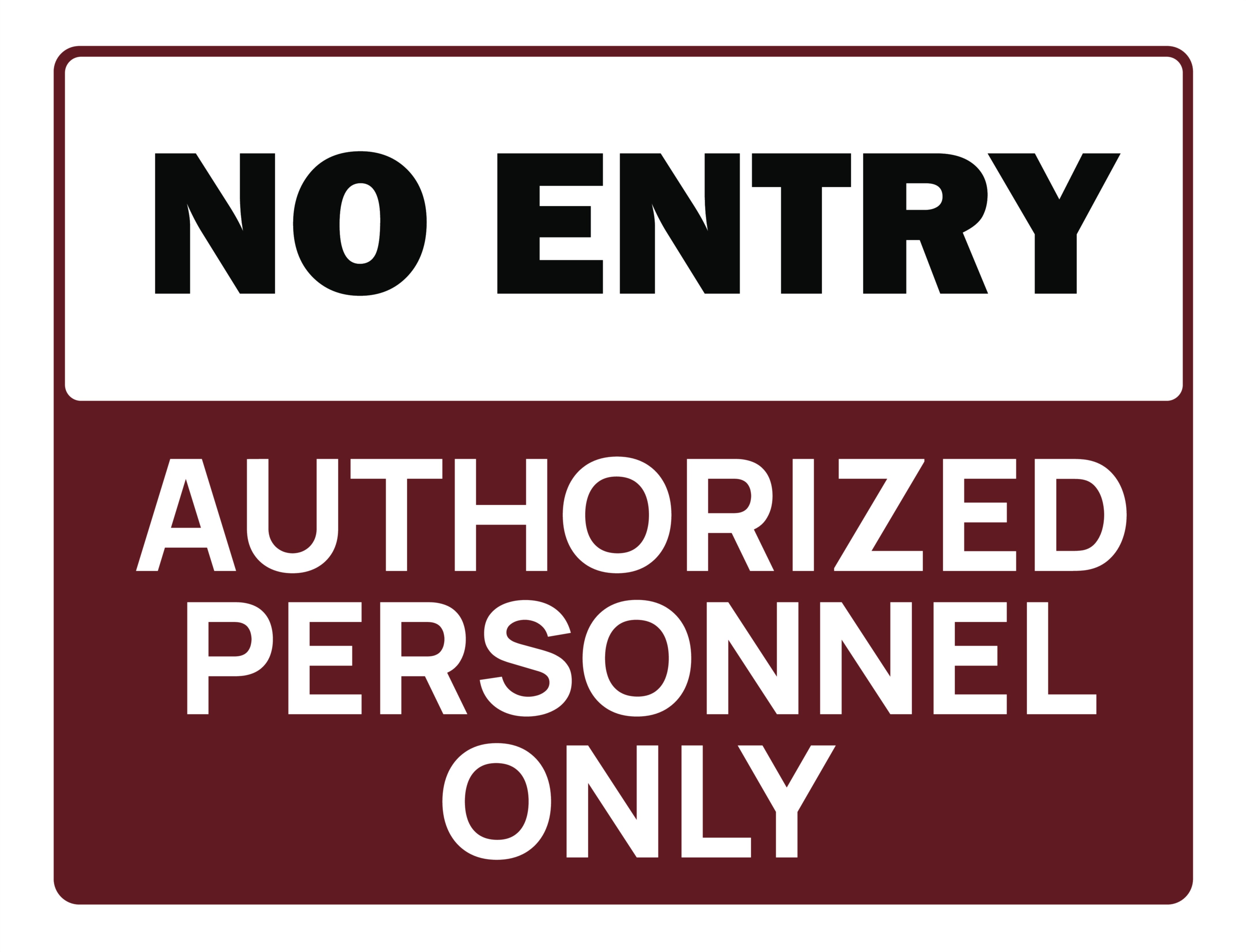
No Entry Authorized Personnel Only Sign Board — Restricted Access Safety Warning
A No Entry Authorized Personnel Only sign board, especially when illustrated in a polished vector format with a bold prohibition symbol, high-contrast colors such as red, white, yellow, or black, and strong uppercase lettering designed to be visible even from a distance, carries a meaning that extends far beyond a simple graphic. It represents a structured and uncompromising form of communication that establishes safety boundaries, enforces legal and operational restrictions, and protects both people and property. The message may seem short and direct, yet the effect is profound: access to the area ahead is not permitted to the general public, and entry is limited exclusively to individuals who have specific training, clearance, authorization, or essential purpose. Where the boundary stands, so does responsibility. Instead of relying on fences, armed personnel, or verbal intervention to maintain control over sensitive zones, the sign accomplishes the task through clarity, alerting anyone who approaches that the space is intentionally protected and that crossing it without permission constitutes a violation of safety protocol, legal authority, or secure operations.
Understanding why such a sign exists begins with the way people interpret space in everyday environments. When an area is not visibly blocked, the human mind often assumes accessibility. A door left partially open, a hallway that continues without a physical barrier, an outdoor zone with no fence, or an industrial section connected to public walkways can easily be misunderstood as areas that anyone may enter. Many security problems and safety incidents begin not with malicious intention, but with confusion. Someone searching for a restroom, reception desk, meeting space, or shortcut may take a wrong turn and suddenly find themselves in a sensitive workplace, a dangerous construction zone, a chemical handling area, or a control room where even a moment of unauthorized presence destabilizes the environment. A No Entry Authorized Personnel Only warning replaces uncertainty with certainty before such situations unfold. It stops accidental entry before it causes embarrassment for the outsider, stress for the occupant, or disruption for the organization. In a single graphic, it explains that this direction is not meant for public movement, and that only individuals who meet specific criteria are allowed inside.
Safety is at the core of the sign’s purpose. Many restricted areas are off-limits not because of secrecy, but because the environment contains hazards invisible to an untrained observer. Industrial plants hold massive automated machinery that can activate without warning, conveyor systems that pull in clothing or limbs, furnaces and molten materials capable of severe burns, laser or electromagnetic equipment with exposure risk, and pressurized tanks or gas storage units that require specialized handling. Construction sites contain unstable flooring, drilling equipment, deep pits, scaffolding, high-voltage wires, and heavy objects that pose life-threatening danger to someone unaware of safety protocols. Laboratories and research facilities may contain biohazards, chemical fumes, radiation zones, controlled substances, or delicate sterile environments that must not be contaminated. Data centers and electronic testing units may have high-current power systems, battery rooms, or sensitive hardware where electrical failure can result from unauthorized physical presence. In all of these examples, the sign is not meant to exclude people unfairly; it is meant to protect them from consequences that could become irreversible within seconds. It safeguards those inside the restricted zone by minimizing distraction and interruption, and it protects those outside by preventing them from entering without the knowledge and equipment needed to remain unharmed.
The message also plays an integral role in maintaining operational integrity. Many of the environments requiring restricted access cannot function effectively when unauthorized people are present. A production line cannot halt every time a visitor wanders into a controlled section. A clean-room laboratory cannot maintain sterile conditions if personnel without protective clothing enter the chamber. A broadcast studio cannot preserve recording quality if someone opens the door during an active session. A cargo loading bay cannot safely maneuver forklifts and heavy crates if pedestrians walk across operating lanes. A server room cannot afford the risk of temperature fluctuation or unplugged cables if someone enters without understanding the equipment layout. The No Entry Authorized Personnel Only sign ensures that only individuals who have a reason to be inside — and understand how the space operates — are allowed access. It keeps workflow predictable, minimizes operational risks, and prevents delay, contamination, shutdowns, or damage caused by accidental interference.
From a legal and compliance perspective, the sign acts as a protective shield. Many industries and institutions are required by law to place clearly visible access-control signage to warn the public about restricted areas. Workplaces governed by occupational safety standards, chemical handling regulations, electrical safety protocols, nuclear material regulations, medical privacy policies, and national security laws cannot rely on informal or verbal boundaries. The absence of warning signage can make the organization legally responsible if an unauthorized individual enters a dangerous or confidential area and is harmed as a result. A No Entry Authorized Personnel Only warning board demonstrates due diligence: the facility communicated the risk, the restriction, and the boundary in a way that could not be misunderstood. If someone proceeds past such a warning despite the clarity of the sign, the responsibility shifts to the intruder rather than the property owner. When considered in disputes, insurance claims, liability cases, or workplace safety investigations, posted signage becomes essential evidence that the organization took proper measures to warn outsiders.
Psychologically, the sign affects behavior before intervention becomes necessary. Human beings act differently when they know that crossing a boundary has explicit consequences. If an area lacks signage, people may justify entering with curiosity or assumption. But when a clear warning appears, the decision becomes intentional rather than accidental, and most individuals choose not to violate the rule. The sign therefore prevents most infractions from happening before security personnel or staff ever need to respond. It reduces confrontation, anger, and confusion because the reason for rejection is not personal — it is written on the wall long before someone reaches the restricted zone. When a person respects the message, they avoid embarrassment. When someone ignores the message, the violation is unambiguous and can be addressed accordingly. This predictable dynamic makes workplaces calmer and significantly safer.
The power of the sign also lies in the strength of its visual language. A vector-designed warning board carries clarity across all conditions — distance, motion, weather, lighting, and multilingual environments. The bright color schemes are not chosen for style; they are chosen because the human brain instinctively responds to them with caution. The prohibition symbol communicates instantly, even for individuals who cannot read the written language. Simple uppercase text removes the possibility of misinterpretation and ensures that no guesswork is necessary. Scalability allows the design to be printed as a small label on a laboratory door or as a large outdoor safety board on a construction boundary without losing sharpness or authority. Every element — from the placement of the symbol to the thickness of the lettering — is engineered to catch attention, slow movement, and trigger compliance before someone crosses into the wrong environment.
Ultimately, the No Entry Authorized Personnel Only sign board is a tool of prevention rather than reaction. It prevents accidents before they occur, prevents legal battles before they begin, prevents unauthorized access before conflict arises, prevents operational disruption before damage is done, and prevents emotional discomfort between security staff and visitors by removing the need for confrontation. It protects life, equipment, workflow, confidentiality, privacy, and boundaries using communication rather than force. It reinforces structure in environments where structure is essential, and it gives both insiders and outsiders the assurance that safety is not assumed but actively managed.
Through one short message strengthened by strong visual authority, the Restricted Access Safety Warning sign creates order where disorder could be dangerous, clarity where confusion could be costly, and respect where unspoken assumptions could lead to conflict. It draws the line exactly where it needs to be drawn — not after entry, but before it — giving every person who sees it the knowledge needed to stay safe, remain compliant, and move confidently through the world without unknowingly stepping into a space where they do not belong.