Center of Gravity — Balance and Stability in Physics
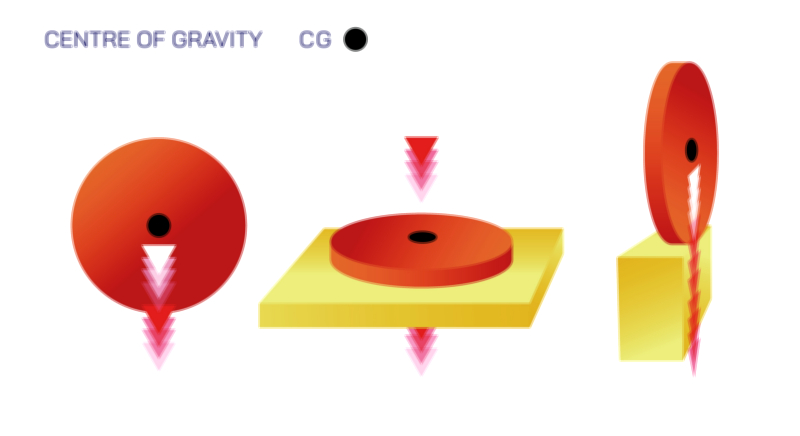
The center of gravity is one of the most essential and intuitively meaningful concepts in physics when understanding how objects balance, move, and respond to external forces. It refers to the specific point within a body or system where the total weight appears to be concentrated, even though that weight is actually distributed across the entire mass. Whether it is a simple object like a ball, a tall structure like a skyscraper, or a living being like a human attempting to stand upright, the center of gravity plays a dominant role in determining how stable the body is and how easily it may tip, fall, or remain balanced. Every object, regardless of its shape or material distribution, has a center of gravity, and this point acts as the focal position through which gravitational influence can be considered to pass. When a force is applied toward this point, the body tends to move smoothly without rotation, but if a force is applied away from it, the body may tilt or topple. Understanding this central point allows physicists, engineers, athletes, and everyday people to predict how objects behave in real situations, revealing why some bodies stand firmly while others collapse under even a slight disturbance.
The location of the center of gravity depends profoundly on how mass is arranged within a body. In objects where mass is evenly distributed, such as a perfectly symmetrical sphere, the center of gravity lies exactly in the middle of the object. However, for irregular shapes such as a hammer, where one end is heavy and the other is light, the center of gravity lies closer to the dense end rather than the midpoint. If mass distribution changes, the center of gravity shifts accordingly. For instance, when someone stretches their arms outward while standing, the body’s center of gravity moves slightly upward and forward. If the person bends toward the ground, the center of gravity shifts downward. This shifting is constant and dynamic because weight distribution continuously changes with movement or modifications in shape. Even when a person is sitting, walking, lifting objects, or leaning, their center of gravity is never fixed but adjusts precisely to maintain balance. This explains why an object or body behaves differently depending on posture, orientation, and contact surface, and why precision in managing the relative position of the center of gravity is crucial for safety and performance.
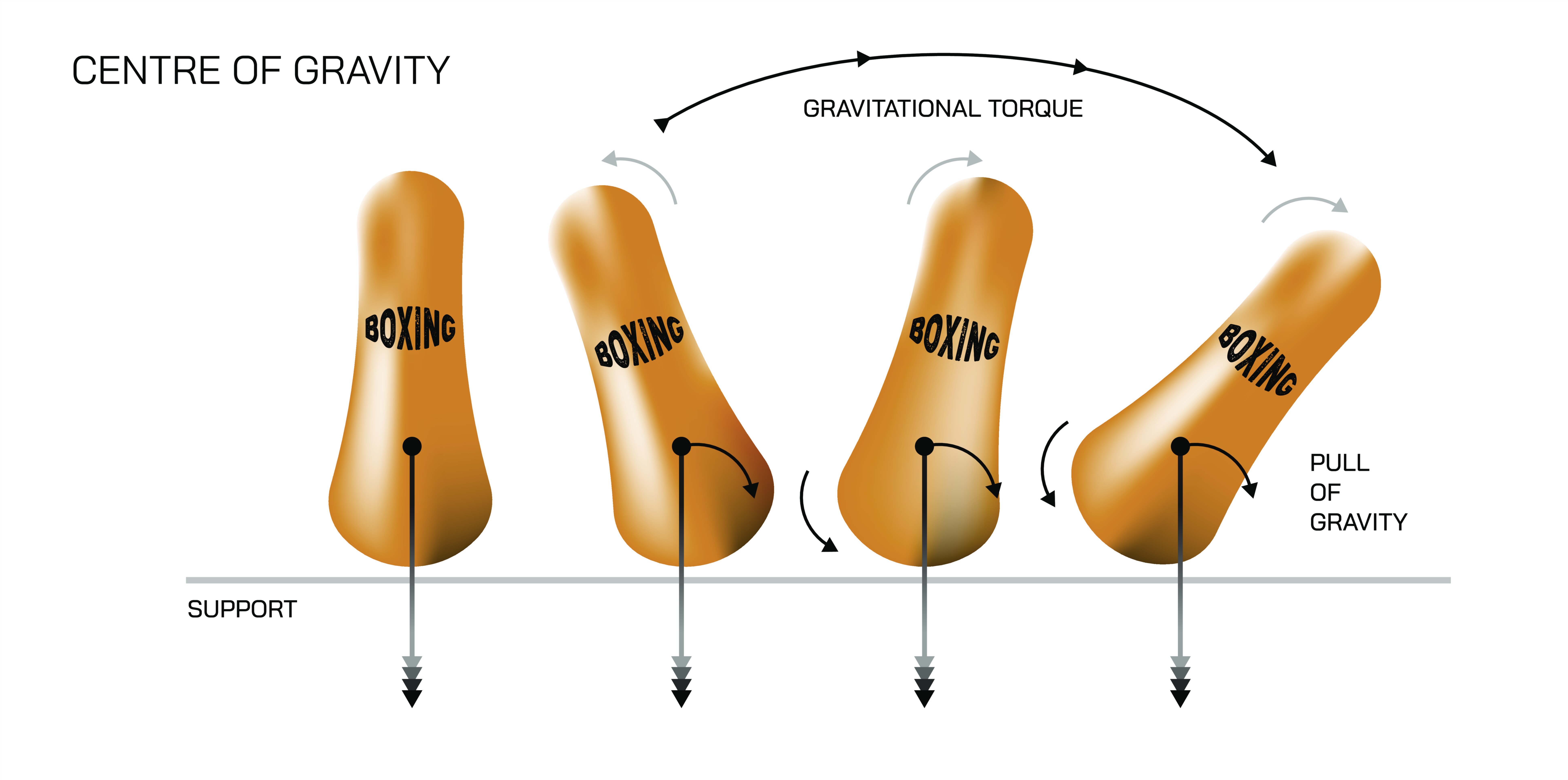
The stability of an object is closely tied to the relationship between its center of gravity and its base of support. The base of support is the region on the ground or supporting surface directly beneath the object that helps keep it upright. If a vertical line drawn from the center of gravity falls within this base of support, the object tends to remain stable. However, if this imaginary line falls outside the support base, the object begins to topple because it can no longer maintain equilibrium. Wider bases of support make it easier to remain balanced because they allow greater shifts of the center of gravity without crossing the boundary of stability. For example, a wide-bottomed glass is far less likely to tip over than a tall, narrow one because the broad base offers a larger safety zone in which the center of gravity can move without causing tipping. The height of the center of gravity also influences balance. Lower centers of gravity promote stability because they provide a longer margin before the weight vector crosses the boundary of support. This is why race cars are built low to the ground, and why athletes bend their knees to improve balance in physically demanding activities.
Human motion and body posture provide a vivid demonstration of the principles of the center of gravity. In everyday life, humans constantly shift their center of gravity without consciously thinking about it. When walking, the center of gravity oscillates from side to side and up and down to maintain controlled forward motion. When standing upright, the body subtly engages muscle groups to keep the center of gravity within the area of the feet. When a person tries to lean forward drastically, they instinctively move part of their body backward to prevent falling, which is why lifting heavy objects requires the body to bend the knees and place the load close to the torso to prevent the center of gravity from moving too far forward. Activities like gymnastics, yoga, dance, and martial arts are deeply connected to mastering the center of gravity, as expert performers manipulate posture, distribute weight strategically, and maintain balance even in extreme body positions. A gymnast walking on a beam keeps the body aligned vertically above the narrow base of support, while a dancer spinning must maintain the center of gravity exactly above the pivot point to remain graceful and controlled.
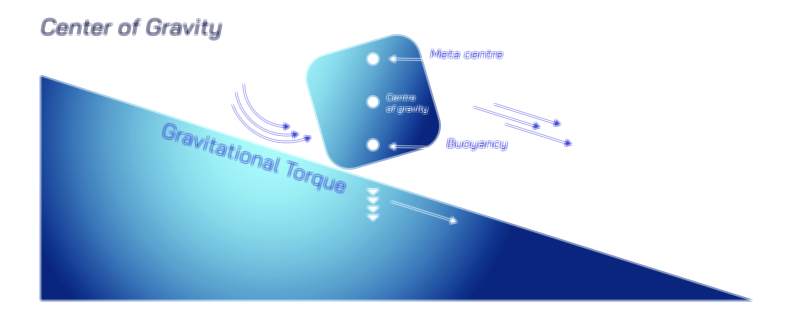
The center of gravity also has profound implications in engineering and modern technology. Architects and structural designers consider the center of gravity of buildings and bridges to ensure that they remain stable against wind, earthquakes, and external loads. A tall structure can be designed to resist tipping by ensuring that its center of gravity is low or centered in a way that aligns with expected forces acting on it. Vehicles such as bicycles, buses, aircraft, and ships are engineered with great care to position their center of gravity optimally. For example, a cargo ship must load containers carefully to keep the center of gravity at a safe height; otherwise, even small waves may cause it to roll dangerously. Airplanes must balance fuel, passengers, and cargo so that the center of gravity stays within a specific permissible zone; otherwise, flight performance can become unstable or unsafe. In robotics, the center of gravity determines whether a robot can stand or move without falling, which is why legged robots are designed with posture control systems that constantly update the internal gravitational balance.
The concept also applies in ergonomics and product design, where maintaining comfort and safety requires a clear understanding of how weight is distributed and how users interact with objects. Chairs, ladders, shoes, helmets, backpacks, and even baby strollers are designed with careful attention to their center of gravity to prevent tipping and to ensure natural handling. Sports equipment like bicycles, surfboards, skateboards, and skis rely heavily on gravity management. A skateboarder distributes weight to control acceleration and turning, and a surfer adjusts posture continuously to keep the center of gravity aligned with the moving surface of a wave. In lifting sports such as weightlifting or powerlifting, success depends on maintaining the barbell’s center of gravity directly over the lifter’s base of support, demonstrating once again how physical performance is tied to gravitational dynamics.
Although the center of gravity originates from physical science, it also provides a deeper understanding of balance in nature, biology, and even behavior. Animals instinctively adjust their bodies to maintain optimal balance, whether a bird lands gently on a tree branch or a cat twists its body during a fall to ensure its feet hit the ground first. The incredible agility of mountain goats standing on steep cliff faces can be attributed to their low and well-controlled center of gravity that remains aligned within narrow footholds. The same principle governs the strategic movement of predators during rapid chases and the coordinated weight shifting observed in human infants learning to stand and walk. Every instance highlights the universal influence of the center of gravity across living and nonliving systems.
Understanding the center of gravity builds an appreciation for how stability is achieved, how motion begins, how accidents happen, and how balance can be consciously controlled. The concept explains why carefully shifting body position prevents falls, why athletic performance improves with posture training, and why engineered systems remain safe under diverse conditions. Whether applied to everyday life, competitive sports, structural design, or technological innovation, the center of gravity remains a guiding foundation that connects physical movement with gravitational forces in an elegant and deeply practical way.