Center of Gravity — Stability and Balance Physics
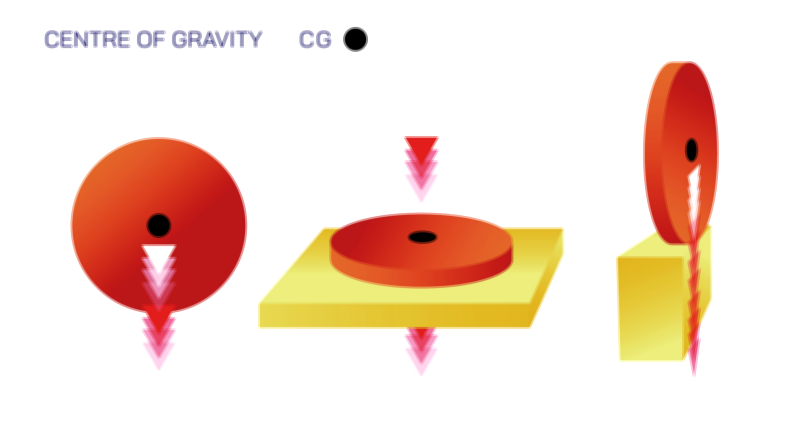
The center of gravity lies at the heart of how objects stand, move, topple, resist forces, and maintain equilibrium, and it represents one of the most foundational ideas in stability and balance physics. Although gravity acts on every particle within an object, its countless microscopic pulls can be represented by one single point—the center of gravity—from which the object’s entire weight is understood to act. This conceptual simplification gives physicists, engineers, athletes, architects, and designers a powerful tool for predicting how bodies behave under the influence of gravity. Whether analyzing the posture of a walking human, the stance of a towering skyscraper, the tilt of a ship at sea, or the maneuvers of a gymnast midair, the center of gravity governs whether an object remains upright, falls over, or transitions smoothly through motion. Understanding this point allows us to decode the mechanics of balance in living organisms, the design logic behind stable structures, and the subtle interplay between mass distribution and gravitational force.
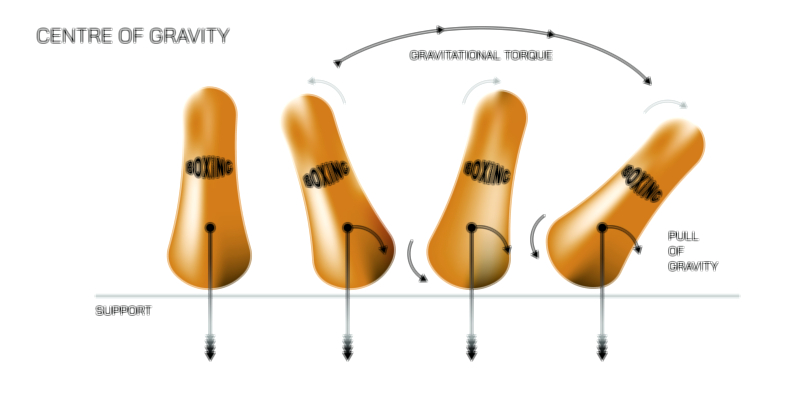
The idea of stability begins with the relationship between an object’s center of gravity and its base of support. When the vertical projection of the center of gravity falls within the boundaries of the base of support, the object remains stable. When it shifts outside that boundary, gravity creates a turning effect that causes the object to tip over. This principle explains why wide-based objects—like drinking glasses, sculptures, or heavy machinery—resist toppling more effectively than narrow-based ones. It also reveals why tall structures require deep foundations and why mountaineers widen their stance on steep slopes. In simple terms, stability improves when the center of gravity is lower and the base of support is larger. This interplay is so fundamental that nearly every act of balance humans perform, from standing to sprinting to dancing, involves unconscious adjustments that continually reposition the center of gravity relative to the base of support.
The center of gravity does not remain static in living organisms. In the human body, for example, it shifts with posture, movement, and changes in limb position. While standing upright, the center of gravity usually lies near the pelvis, but as a person leans, bends, extends their arms, or lifts heavy objects, it moves accordingly. This dynamic behavior is essential for locomotion and coordination. When walking, the center of gravity follows a smooth oscillating path, and the body counterbalances each step through coordinated shifts in weight. When running, the center of gravity rises and falls slightly with each stride, contributing to forward propulsion. In activities requiring precise balance—such as gymnastics, yoga, pole vaulting, or martial arts—athletes learn to consciously control this shifting point, aligning it with the base of support or temporarily manipulating it to achieve otherwise impossible movements. Mastery of balance essentially means mastery of the center of gravity.
In engineering, stability and center of gravity form the bedrock of structural safety. Buildings are designed such that their centers of gravity fall well within their foundation footprint, even when subjected to wind, earthquakes, or uneven loading. Engineers calculate how far a building can tilt before its center of gravity crosses the pivot point, which would trigger collapse. Vehicles also rely heavily on this concept. A car with a low center of gravity handles curves more safely and resists rollovers better than one with a high center of gravity. Sports cars adopt a flat, low design to improve stability at high speeds, while cargo trucks must carefully distribute weight to avoid shifting the center of gravity dangerously upward or sideways. Tanks, trains, airplanes, and ships all incorporate design strategies that ensure the center of gravity remains in a region that encourages stability and minimizes the risk of tipping, overturning, or uncontrolled rotation.
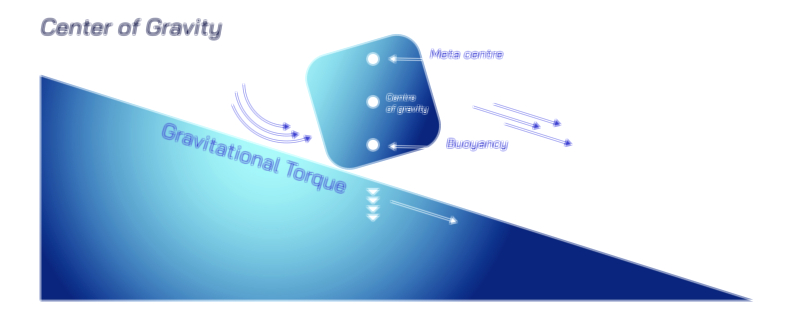
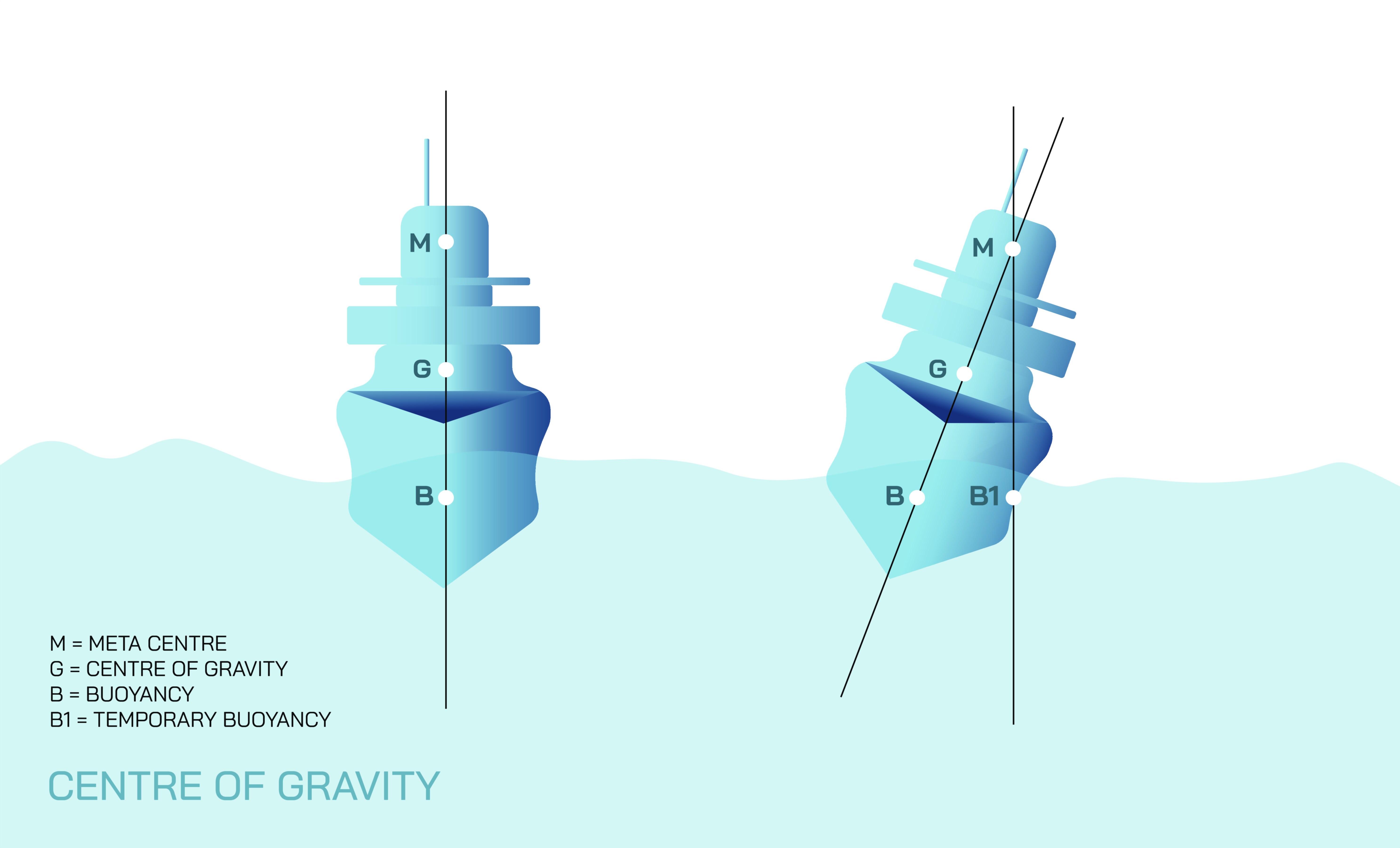
Ships and boats provide one of the clearest demonstrations of the center of gravity’s influence on stability. When a ship leans to one side due to waves, wind, or uneven loading, its center of gravity moves relative to its buoyant force. The relationship between these forces determines whether the ship will right itself or continue tilting until capsizing occurs. Naval architects analyze the metacentric height—a measure linked directly to the center of gravity’s position—to determine how stable a vessel will be under different sea conditions. A low center of gravity can enhance stability, while a high one can make even a large vessel surprisingly vulnerable. This explains why cargo must be loaded carefully, why passengers on smaller boats are instructed to sit low and avoid sudden movements, and why ballast tanks are used in submarines and certain ships to fine-tune stability conditions.
The center of gravity also governs rotational behavior. When an object spins freely, it rotates around its center of gravity. This is true whether the object is a baton twirling in the air, a stone thrown into a parabolic path, or a high diver executing a rotation during descent. Even when a gymnast or figure skater performs spins, the tightness of their body configuration shifts the moment of inertia, but the center of gravity remains the pivot around which rotation occurs. Objects do not tumble randomly; they tumble in predictable ways dictated by the fixed position of their center of gravity. This principle also explains why it is easier to spin a pencil when gripping it at its midpoint, why acrobats curl into compact shapes during flips, and why spacecraft use reaction wheels and thrusters arranged symmetrically around their center of gravity for orientation and maneuvering.
In the design of consumer products, the center of gravity influences how objects feel in the hand and how stable they are during use. Tools like hammers, screwdrivers, or kitchen knives are weighted so that their center of gravity enhances control and efficiency. Furniture such as chairs and bookshelves is engineered to prevent tipping by keeping the center of gravity low and centered. Child safety products, appliances, lamps, and entertainment devices all incorporate weight distribution considerations to ensure they remain stable during normal use. Even portable electronics like cameras, game controllers, and smartphones are designed with specific internal weight arrangements to prevent awkward handling or accidental drops.
In robotics, the physics of stability and balance govern how robots walk, climb, or mimic human motion. Humanoid robots require constant adjustments to their center of gravity to avoid falling, requiring sensors that detect shifts and algorithms that counteract instability. Quadrupedal robots adjust their center of gravity depending on terrain, lifting one limb while shifting body weight toward the remaining supporting limbs. Warehouse robots maintain low centers of gravity to handle loads safely and ensure efficiency when navigating corners or elevating cargo. Balance in robotics is a direct extension of center-of-gravity principles applied through sensors, motors, and control systems that continuously assess and correct dynamic positioning.
The psychological and perceptual dimensions of balance add another layer of complexity. Humans rely on three primary systems—visual cues, inner ear vestibular functions, and proprioceptive feedback—to keep the center of gravity aligned with the base of support. Athletes refine all three systems to perform coordinated and complex motions. Disorders affecting any of these systems can shift the perceived center of gravity or make it difficult to align properly, leading to dizziness, instability, or falls. Physical therapy often involves retraining the body to maintain or restore proper center-of-gravity control.
Nature itself demonstrates masterful use of center-of-gravity principles across countless species. Birds adjust their center of gravity during flight by repositioning their wings. Cats exhibit remarkable balance due to their flexible spine and ability to reposition their limbs instantly to keep their center of gravity aligned during jumps or falls. Mountain goats maintain stability on steep cliffs by keeping their center of gravity low and directly above their small hoof placements. Predators such as cheetahs maintain balance at high speeds through rapid tail adjustments, shifting their center of gravity during sudden turns. Every movement in the natural world—running, climbing, leaping, perching—implicitly incorporates this principle.
In the arts, particularly dance, circus performance, sculpture, and choreography, the center of gravity becomes an expressive tool. Dancers manipulate their center of gravity to create the illusion of weightlessness, dramatic off-balance poses, or fluid transitions. Circus performers juggle, balance objects, and maintain improbable positions by mastering the internal shifting of their center of gravity. Sculptors create pieces that appear to defy gravity by carefully positioning their center of gravity over tiny supports, giving the impression of precarious equilibrium while achieving genuine stability.
Ultimately, the center of gravity serves as a universal concept that unifies the study of balance in all forms—mechanical, biological, architectural, athletic, and artistic. It represents the fundamental truth that stability is not simply a matter of weight or shape, but of how weight is distributed and how an object aligns itself with the forces acting upon it. To understand stability and balance in physics is to understand the center of gravity. It is the key that unlocks why objects stand or fall, how bodies move with grace or struggle, how structures withstand their environment, and how the physical world maintains coherence amid constant forces. Through this concept, physics connects the behavior of everyday objects with the profound principles governing motion and equilibrium throughout the universe.