Cellulose — Organic Polymer Structure
Cellulose stands as one of the most abundant and essential organic polymers on Earth, forming the structural backbone of the plant kingdom and reinforcing the physical integrity of countless natural materials. Although it may appear simple at the macroscopic scale—present in wood, cotton, paper, and plant fibers—its molecular architecture reveals a remarkable combination of strength, flexibility, and biological importance. The structure of cellulose, derived from long chains of linked glucose units, gives rise to a rigid polymer capable of forming organized networks that plants use to construct cell walls. These networks support trees that reach towering heights, blades of grass that sway but resist tearing, and microscopic algae that maintain their shape against environmental pressures. Cellulose is more than just a polymer; it is a structural strategy, an evolutionary achievement, and a chemical foundation that sustains ecosystems, industries, and human civilization.
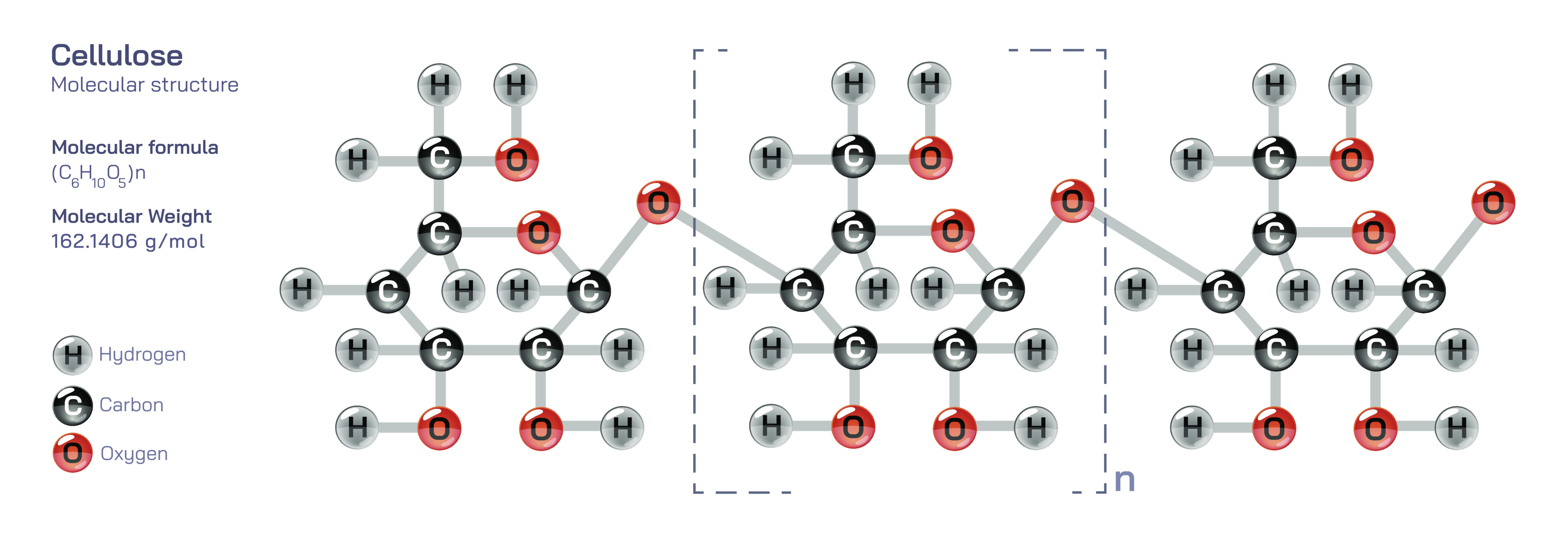
At the molecular level, cellulose is composed of repeating units of glucose, but not in the same arrangement that appears in starch or glycogen. Instead, cellulose molecules are formed from glucose units connected by bonds that orient each sugar residue in a linear, extended conformation. This linearity allows thousands of glucose units to link into exceptionally long chains that do not coil or bend easily. These chains align alongside one another, forming bundles held together by a dense network of hydrogen bonds. When multiple bundles further associate and crystallize, they create microfibrils—thin, cable-like structures that contribute enormous tensile strength to plant cell walls. The microscopic order and rigidity of cellulose microfibrils give plants their characteristic stiffness, allowing even delicate plants to resist collapse. This crystalline arrangement is also largely responsible for the molecule’s resistance to chemical breakdown, making cellulose robust against many solvents and enzymes.
The structural integrity provided by cellulose is central to plant physiology. Every plant cell is surrounded by a wall rich in cellulose that determines its shape, protects it from physical damage, and prevents excessive expansion when the cell fills with water. This resistance to expansion allows plants to maintain internal pressure, known as turgor, which is essential for maintaining upright posture. Without cellulose, plants would lack the mechanical framework needed to hold their bodies against gravity, wind, or rain. The verticality of forests, the rigidity of stems, and the resilience of leaves all arise from the interplay between cellulose-based structures and the cells that produce them. Through this combination, plants create sustainable, self-repairing building materials directly from sunlight, carbon dioxide, and water.
The biological significance of cellulose extends far beyond its structural role. It forms a major component of the global carbon cycle, locking away atmospheric carbon dioxide as plant biomass. When plants grow, they convert carbon dioxide into cellulose, storing carbon in a long-term and biologically stable form. Forests, grasslands, and agricultural crops hold vast quantities of cellulose, making them some of the Earth’s largest carbon reservoirs. When cellulose-rich materials decompose, burn, or undergo industrial processing, this stored carbon re-enters the atmosphere, participating in the natural balance of carbon exchange. The cycling of cellulose through ecosystems shapes climate patterns, soil fertility, and the availability of nutrients for countless organisms.
Although most animals cannot digest cellulose directly, the compound remains vital to many food webs. Herbivores ranging from tiny insects to massive ruminants rely on symbiotic microorganisms—bacteria, fungi, and protozoa—to break down cellulose into usable nutrients. These microorganisms produce specialized enzymes that cleave the tough glucose linkages, releasing energy and carbon that the host animal can absorb. This symbiosis enables herbivores to extract nourishment from grass, leaves, and wood, forming the foundation of terrestrial food chains. Termites feeding on wood, cows grazing on pasture, and deer browsing on shrubs all depend on the microbial breakdown of cellulose. Without this partnership, the ecological roles of herbivores and the biodiversity they support would collapse.
In human history and industry, cellulose has shaped civilizations. Paper, one of the earliest and most influential human inventions, is composed primarily of plant-based cellulose fibers. Papermaking, traditionally from wood pulp or cotton linters, transforms the natural fibers into sheets that carry ideas, preserve records, and support global communication. Cotton textiles, equally essential to human culture, derive their softness, durability, and absorbency from cellulose-rich fibers. Wood, another cellulose-dominant material, serves as one of the oldest building resources, valued for its strength, availability, and renewable nature. In all these materials, the inherent properties of cellulose—its fiber structure, tensile strength, and resistance to stretching—enable the creation of products that withstand daily use while remaining biodegradable.
Modern technology harnesses cellulose in increasingly sophisticated ways. Chemists and engineers have developed derivatives such as cellulose acetate, cellulose nitrate, and carboxymethyl cellulose, each with unique properties. Cellulose acetate contributed to the early development of photographic film, textiles, and plastics. Cellulose nitrate, historically used in early motion picture film, formed one of the first synthetic plastics before safer alternatives were developed. Soluble cellulose derivatives often appear in pharmaceuticals as binders, stabilizers, or controlled-release agents. In the food industry, cellulose-based compounds help stabilize sauces, thicken beverages, and improve the texture of baked goods. The versatility of cellulose chemistry allows it to span fields as diverse as printing, packaging, filtration, adhesives, and biomedical science.
Nanocellulose, a more recent innovation, has opened new frontiers by isolating the tiniest structural components of cellulose. These nano-sized fibers possess remarkable mechanical strength—stronger than steel by weight—and can be incorporated into advanced composites, biodegradable plastics, flexible electronics, and medical scaffolds. Their high surface area, low density, and renewable origin make them promising materials for sustainable technologies. From lightweight automotive parts to medical implants designed to support tissue growth, nanocellulose demonstrates how a natural polymer can be adapted for cutting-edge applications. Its biodegradability aligns with global efforts to reduce reliance on petroleum-based plastics and create environmentally friendly materials.
Environmental science also benefits from cellulose’s unique properties. Its ability to interact with water, filter particles, and bind contaminants makes it valuable in water purification systems and environmental remediation projects. Cellulose-based filters can trap pollutants, microplastics, bacteria, and heavy metals. In soil, cellulose contributes to organic matter that improves water retention, supports microbial life, and sustains agricultural productivity. The natural decay of cellulose-rich materials replenishes nutrients and reinforces the cyclical processes that maintain fertile ecosystems.
Culturally and historically, cellulose has served as both a tool and a resource for human progress. Paper enabled written communication, education, governance, and artistic expression. Textiles shaped economies, trade routes, and cultural identities. Wood influenced architecture, craftsmanship, and the development of tools. Every instance of cellulose use reflects the interplay of nature’s chemistry and human creativity.
Ultimately, cellulose represents a profound natural design—simple in its repeating structure yet astonishingly versatile in function. Its organic polymer structure gives rise to strength, resilience, and adaptability across scales ranging from microscopic to monumental. It supports plant life, underpins ecosystems, fuels industrial innovation, and enriches human culture. To understand cellulose is to appreciate how the molecular architecture of a humble plant polymer has shaped the biological, environmental, technological, and cultural landscapes of our world.