Syringes are among the most essential medical instruments used in healthcare settings worldwide. They play a critical role in administering medications, withdrawing fluids, irrigating wounds, and supporting diagnostic and therapeutic procedures. Although syringes may appear similar at first glance, they are available in several specialized types, each designed for specific clinical purposes. Understanding the different types of syringes and their uses is vital for safe medical practice, accurate drug delivery, and effective patient care.
At a fundamental level, a syringe consists of a cylindrical barrel, a plunger that moves inside the barrel, and a tip through which fluids enter or exit. The design of the syringe tip is what differentiates one type from another. Each syringe type is engineered to suit particular medical needs, ensuring precision, safety, and compatibility with needles, catheters, or tubing systems.
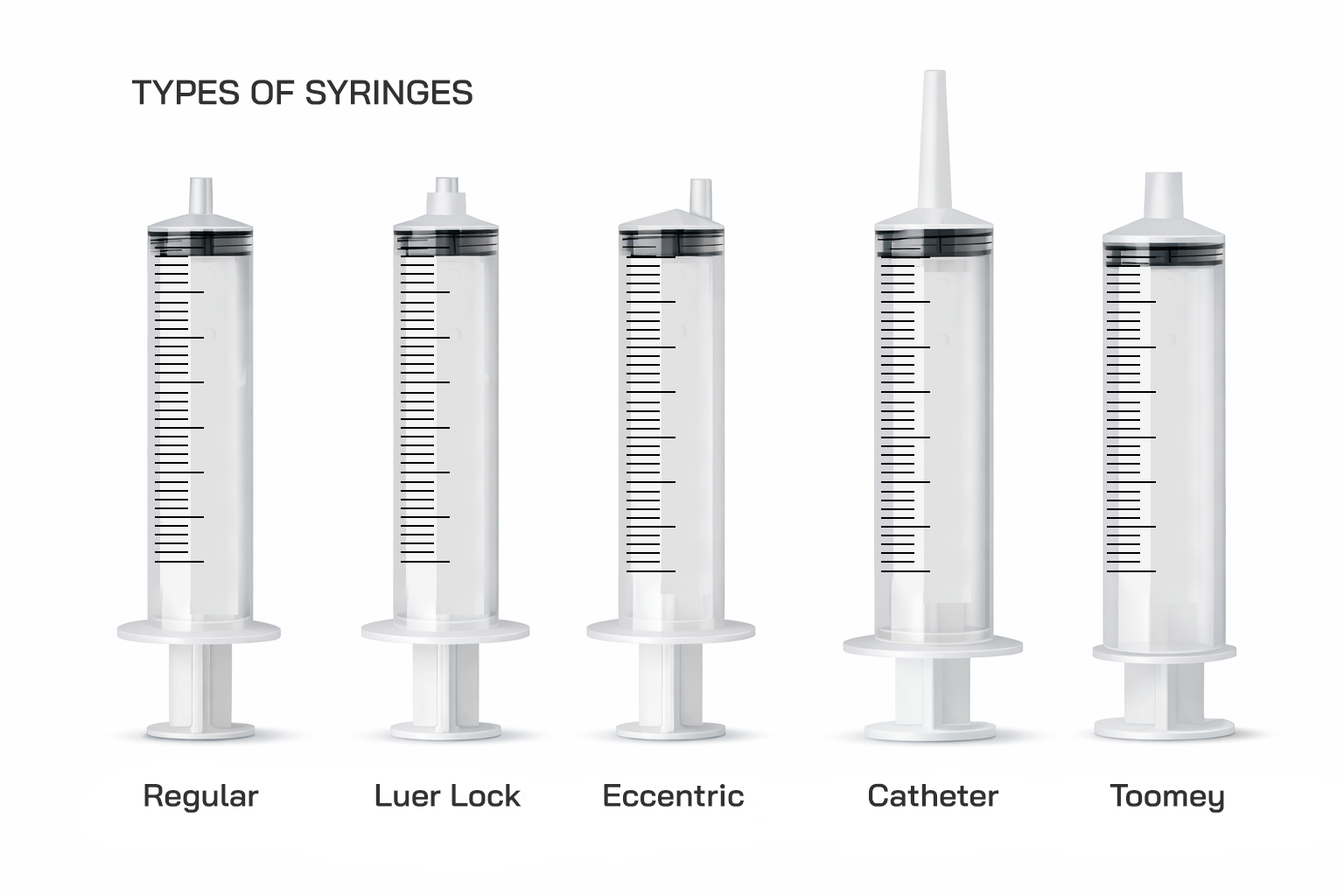
The regular syringe, also known as a slip-tip syringe, is one of the most commonly used syringe types. It features a smooth tip onto which a needle can be easily pushed and removed. This type of syringe is widely used for routine injections, medication preparation, and fluid aspiration. Its simplicity makes it suitable for general medical use, especially when rapid needle attachment and removal are required. However, because the needle is held in place by friction alone, it may not be ideal for high-pressure injections.
The luer lock syringe is designed to enhance safety and stability during injections. Instead of a smooth tip, it has a threaded tip that allows the needle to be securely twisted and locked into place. This locking mechanism prevents accidental needle detachment during medication administration. Luer lock syringes are commonly used in intravenous therapy, high-pressure injections, and procedures where secure needle attachment is essential. Their reliability makes them a preferred choice in hospitals and critical care environments.
The eccentric syringe is specifically designed with an off-center tip. This unique feature allows the syringe to be placed flat against the skin while still maintaining effective fluid withdrawal or injection. Eccentric syringes are particularly useful in procedures that involve shallow areas or veins close to the surface, such as aspiration of superficial fluids or injections at a low angle. The design improves precision and reduces discomfort during certain medical procedures.
The catheter tip syringe has a longer, tapered tip compared to standard syringes. This design allows it to connect easily to catheters, feeding tubes, and other medical tubing. Catheter tip syringes are commonly used for irrigation, wound cleaning, tube feeding, and fluid flushing. They are especially important in procedures that require the movement of larger volumes of fluid at lower pressure. Their wide opening supports efficient fluid flow without the need for needles.
The Toomey syringe is a large-capacity syringe characterized by a wide nozzle tip. It is primarily used for irrigation and aspiration rather than injections. Toomey syringes are frequently used in surgical procedures, wound care, and oral feeding support. The wide tip allows thick fluids or debris to pass easily, making it ideal for cleaning wounds, flushing body cavities, or administering nutrition through feeding tubes.
Each type of syringe is selected based on the clinical requirement, fluid type, volume, and method of administration. For example, injections into muscle or veins typically require syringes compatible with needles, while irrigation procedures demand syringes that can handle large fluid volumes without high pressure. Choosing the correct syringe type helps reduce complications, ensures accurate dosing, and improves patient comfort.
Syringes also differ in size, measured in milliliters, allowing healthcare professionals to administer precise amounts of medication. Smaller syringes are used for accurate dosing, while larger syringes are reserved for irrigation or aspiration. Graduated markings on the barrel help ensure dosage accuracy, which is critical for patient safety.
Infection control is another important aspect of syringe use. Most modern syringes are designed for single use and are disposed of after one procedure. This practice prevents cross-contamination and reduces the risk of infection transmission. Sterility, material quality, and proper disposal are essential considerations in syringe selection and use.
In nursing and medical education, understanding syringe types is a foundational skill. Healthcare professionals are trained to identify and use the appropriate syringe for each procedure. Proper handling techniques, including secure needle attachment and controlled plunger movement, ensure effective and safe outcomes.
Syringes also play a vital role beyond injections. They are used in diagnostic sampling, medication preparation, flushing intravenous lines, and supporting enteral feeding. Their versatility makes them indispensable tools in hospitals, clinics, and home care settings.
From a design perspective, syringe evolution reflects advances in medical safety and efficiency. Locking mechanisms, ergonomic plungers, and specialized tips have been developed to address specific clinical challenges. These innovations enhance control, reduce errors, and improve overall patient care.
Syringes are far more than simple tools for pushing or pulling fluid; they are precision instruments whose design reflects decades of clinical experience, safety innovation, and biomechanical refinement. Each syringe type exists because medical practice demanded a specific solution—whether for accuracy, safety, comfort, or compatibility with other medical devices. When examined closely, syringes reveal how small structural differences can significantly influence clinical outcomes.
One of the most important but often overlooked aspects of syringes is fluid control. The resistance felt when pushing the plunger is intentionally engineered. In regular and luer lock syringes, this resistance allows controlled delivery of medication, preventing sudden pressure surges that could damage tissue or cause pain. In contrast, catheter tip and Toomey syringes are designed with minimal resistance to allow large volumes of fluid to flow smoothly, which is essential during irrigation or flushing procedures. This difference in flow dynamics directly affects how safely and effectively a procedure can be performed.
The tip design of a syringe is central to its function. Regular slip-tip syringes rely on friction to hold the needle in place, making them quick and convenient for low-pressure tasks. However, this same simplicity limits their use in procedures involving viscous fluids or high injection pressure. Luer lock syringes solve this limitation by introducing a threaded locking system. This mechanical connection ensures that the needle or connector remains firmly attached, even when significant pressure is applied. This is especially critical in intravenous therapy, where accidental needle detachment could lead to medication loss, air entry, or patient injury.
Eccentric syringes demonstrate how subtle design changes improve clinical precision. By shifting the tip off-center, the syringe allows clinicians to keep the barrel nearly parallel to the skin. This design reduces the need to angle the wrist awkwardly and improves visibility at the injection or aspiration site. Such ergonomic considerations reduce hand fatigue and improve accuracy, particularly during repeated procedures or when working with fragile veins.
Catheter tip syringes highlight the importance of system compatibility in healthcare. Their tapered tip is designed not for needles, but for direct connection to tubing systems. This eliminates the need for adapters, reducing potential leakage points and contamination risks. In wound irrigation, for example, a catheter tip syringe can deliver a steady stream of fluid that cleans tissue effectively without causing trauma. The wide opening also allows thicker solutions to pass through without clogging.
Toomey syringes represent the extreme end of volume handling. Their wide nozzle and large capacity make them ideal for tasks where precision dosing is less critical than efficient fluid movement. In surgical settings, Toomey syringes are often used to remove debris, blood, or irrigation fluid from operative fields. Their design prioritizes durability and flow capacity, reflecting their use in demanding clinical environments.
Another critical aspect of syringe design is barrel transparency and graduation accuracy. Clear barrels allow clinicians to visually confirm medication type, volume, and the absence of air bubbles. Accurate graduations are essential for dosing, especially in pediatrics, anesthesia, and critical care, where even small errors can have serious consequences. Syringe calibration is therefore a regulated manufacturing process, ensuring consistency and reliability across healthcare systems.
Material choice also plays a key role in syringe performance. Most modern syringes are made from medical-grade plastics that balance strength, flexibility, and chemical resistance. The plunger seal is designed to maintain an airtight and watertight fit while moving smoothly within the barrel. Poor seal quality can lead to leakage, inaccurate dosing, or jerky movement, all of which compromise patient safety.
Infection control has strongly influenced syringe evolution. The widespread adoption of single-use, disposable syringes has dramatically reduced the transmission of bloodborne infections. Some syringes now incorporate safety features such as retractable needles or protective shields, further reducing the risk of needlestick injuries. While these safety syringes may resemble standard types externally, their internal mechanisms represent significant advancements in occupational safety.
Syringe selection also affects patient comfort. The smoothness of plunger movement, the stability of needle attachment, and the ability to control injection speed all influence pain perception. A well-chosen syringe allows medication to be delivered steadily, minimizing tissue trauma and discomfort. This is particularly important in repeated injections, long-term therapies, or pediatric care.
From an educational standpoint, syringes are foundational tools for healthcare training. Learning to identify syringe types, match them with appropriate needles or tubing, and use them correctly builds clinical competence. Errors in syringe selection can lead to inaccurate dosing, device failure, or procedural complications, underscoring the importance of this knowledge in daily practice.
Syringes also play a crucial role in non-injection applications. They are used to reconstitute powdered medications, draw up precise doses, flush intravenous lines, collect diagnostic samples, and deliver nutrition through feeding tubes. This versatility explains why syringes are among the most frequently used medical devices across all levels of care.
In modern healthcare systems, syringe design continues to evolve in response to emerging needs. Advances focus on improving ergonomics, reducing waste, enhancing safety, and increasing compatibility with complex medical equipment. Even small design refinements can lead to meaningful improvements in efficiency and patient outcomes.
In conclusion, syringes are highly specialized instruments whose form is closely tied to function. Regular, luer lock, eccentric, catheter tip, and Toomey syringes each exist to meet distinct clinical demands. Their differences in tip design, capacity, flow characteristics, and safety features directly influence how medical procedures are performed. Understanding these distinctions allows healthcare professionals to choose the most appropriate syringe for each task, ensuring precision, safety, and high-quality patient care.
In summary, syringes are not one-size-fits-all devices. Regular syringes, luer lock syringes, eccentric syringes, catheter tip syringes, and Toomey syringes each serve distinct purposes in medical practice. Their design differences directly influence their function, safety, and effectiveness. Understanding the types of syringes and their uses enables healthcare professionals to select the right tool for each procedure, ensuring accurate treatment, patient safety, and optimal clinical outcomes.