Introduction to Fiber Optic Technology
Fiber optic technology is one of the most significant advancements in modern communication systems, forming the backbone of global data transfer, internet connectivity, and digital communication. Unlike traditional electrical cables that transmit information using electrical signals, fiber optics transmit data in the form of light. This fundamental difference allows fiber optic systems to achieve extremely high speeds, minimal signal loss, and reliable long-distance communication. The effectiveness of fiber optic technology lies in its precise internal structure and the physical principles that govern the behavior of light within it.
Fiber optics are widely used in telecommunications, medical imaging, industrial sensing, broadcasting, and internet infrastructure. Their ability to carry vast amounts of data over long distances with minimal interference has transformed how information is shared across the world.
Basic Structure of a Fiber Optic Cable
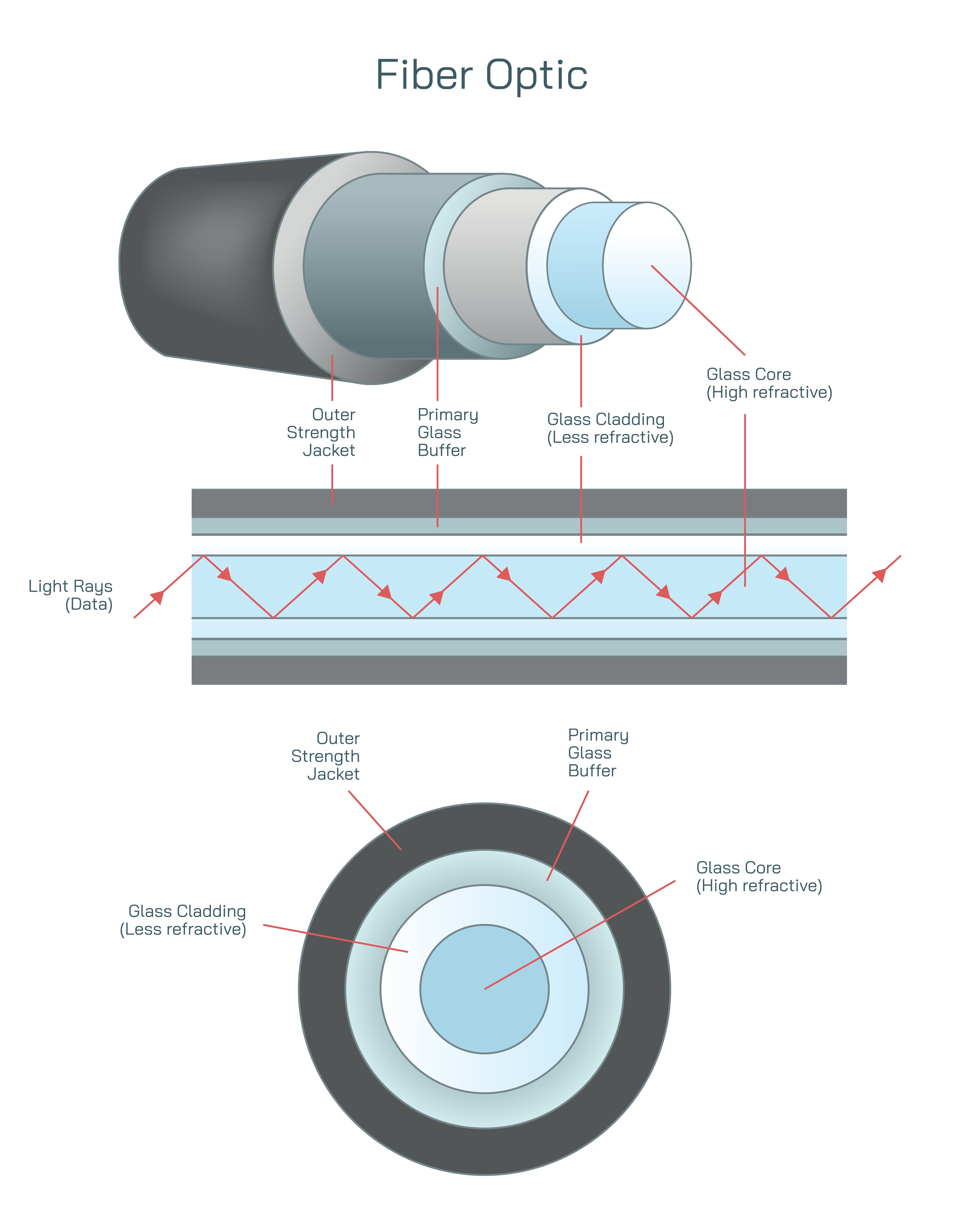
The structure of a fiber optic cable is simple in appearance but highly sophisticated in function. At its center lies the core, which is the primary pathway through which light travels. The core is made of extremely pure glass or plastic and is designed to allow light to pass through with minimal distortion. The diameter of the core varies depending on the type of fiber, but it is always engineered to guide light efficiently.
Surrounding the core is the cladding, which is also made of glass or plastic but with a slightly different optical property. The cladding has a lower light-transmitting capacity than the core. This difference between the core and cladding is essential for keeping light confined within the core. The boundary between these two layers enables the light to reflect inward rather than escaping outward.
Outside the cladding is a protective coating that shields the delicate internal components from physical damage, moisture, and environmental stress. Additional layers may be added to improve strength, flexibility, and durability, especially in cables used for outdoor or industrial applications. Together, these layers ensure that the fiber remains functional even under challenging conditions.
How Fiber Optics Function Using Light Transmission
The functioning of fiber optics is based on the controlled transmission of light through the core. Data is converted into light signals by a transmitting device, often using specialized light sources. These light signals enter the core of the fiber and travel along its length. As the light moves through the fiber, it repeatedly reflects off the boundary between the core and the cladding. This reflection keeps the light confined within the core, allowing it to travel long distances without significant loss.
The light signals are sent in rapid sequences, representing digital information. At the receiving end, a detector converts the light signals back into electrical signals that can be processed by computers, servers, or communication devices. This process allows information to be transmitted at extremely high speeds with remarkable accuracy.
The efficiency of fiber optic transmission depends on the purity of the materials used and the precision of the fiber’s structure. Even small imperfections can affect signal quality, which is why fiber optics are manufactured under strict quality standards.
Types of Optical Fibers and Their Functional Differences
Optical fibers are designed to serve different communication needs. Some fibers are optimized for long-distance transmission, while others are suited for shorter connections. The internal structure of the core plays a key role in determining how light travels through the fiber. Certain designs allow light to follow a single, direct path, resulting in very high signal clarity over long distances. Other designs allow multiple light paths, which can be beneficial for short-distance data transmission within buildings or local networks.
These variations in structure influence how data is transmitted, how much information the fiber can carry, and how far the signal can travel without degradation. Selecting the appropriate fiber type is essential for building efficient communication systems.
Advantages of Fiber Optic Communication
Fiber optic technology offers numerous advantages over traditional copper-based systems. One of the most important benefits is its ability to transmit data at extremely high speeds. Fiber optics support much higher bandwidth, enabling the transfer of large volumes of data simultaneously. This capability is essential for modern internet services, cloud computing, and high-definition media streaming.
Another major advantage is low signal loss. Light signals in fiber optics can travel much farther than electrical signals in metal cables without requiring frequent amplification. This makes fiber optics ideal for long-distance communication, including undersea cables that connect continents.
Fiber optics are also immune to electromagnetic interference, which can disrupt electrical signals in conventional cables. This immunity ensures stable and reliable data transmission even in environments with strong electrical noise. Additionally, fiber optic cables are lighter and thinner than copper cables, making them easier to install and manage.
Role of Fiber Optics in Modern Infrastructure
Fiber optic networks form the foundation of modern digital infrastructure. They support internet connectivity, telephone services, television broadcasting, and data centers. Without fiber optics, the speed and scale of global communication would be severely limited. As demand for data continues to grow, fiber optic systems provide the capacity needed to support emerging technologies such as smart cities, autonomous systems, and advanced digital services.
Fiber optics are also used in medical fields for imaging and diagnostics, where precise light transmission is essential. In industrial applications, fiber optic sensors monitor conditions such as temperature and pressure in environments where electronic sensors may fail.
Durability and Longevity of Fiber Optic Systems
Despite their delicate appearance, fiber optic cables are designed for long-term use. Protective coatings and external jackets enhance durability, allowing fibers to function reliably for decades when properly installed. Their resistance to corrosion and environmental damage contributes to their longevity, reducing maintenance requirements and long-term costs.
Future Importance of Fiber Optic Technology
As digital communication continues to evolve, fiber optics will remain a critical component of global connectivity. Advancements in fiber design and light transmission techniques are continually increasing data capacity and efficiency. Fiber optics are expected to play a central role in future communication systems, supporting faster speeds, greater reliability, and expanded access to information.
Fiber optic communication is also distinguished by its exceptional signal security. Because data is transmitted as light confined within a closed fiber pathway, it is extremely difficult to intercept without physically accessing and damaging the cable. Unlike electrical signals, light does not radiate outward, which significantly reduces the risk of signal leakage. This makes fiber optics a preferred choice for secure communication networks used by governments, financial institutions, and data-sensitive industries. The integrity of transmitted information remains intact over long distances, ensuring confidentiality and data protection.
Another important aspect of fiber optic systems is signal amplification and regeneration. Over extremely long distances, even light signals gradually weaken. To address this, optical amplifiers are used at strategic intervals along fiber routes. These devices strengthen the light signal directly without converting it back into electrical form, preserving transmission speed and quality. This approach is especially critical for undersea fiber cables that span thousands of kilometers across oceans, connecting continents and enabling global internet traffic.
Environmental resilience is another strength of fiber optic technology. Fiber cables are not affected by temperature fluctuations, moisture, or chemical exposure to the same extent as metal cables. They do not corrode and are resistant to harsh environmental conditions. This makes fiber optics suitable for deployment in underground networks, underwater routes, and extreme industrial settings. Their reliability in such conditions reduces downtime and ensures consistent performance over extended periods.
Fiber optic systems also support scalability, which is essential for future technological growth. As data demand increases, existing fiber networks can often be upgraded by improving transmission equipment rather than replacing the physical cables. Advances in signal encoding and light modulation allow more data to be sent through the same fiber strand. This scalability makes fiber optics a cost-effective long-term solution for expanding communication capacity without major infrastructure changes.
In smart infrastructure and urban development, fiber optics play a central role. Smart cities rely on real-time data exchange between sensors, traffic systems, surveillance networks, and public services. Fiber optic networks provide the speed and reliability required to manage such interconnected systems efficiently. High-capacity fiber links enable rapid decision-making, improved public safety, and optimized resource management in modern urban environments.
Education and research sectors also benefit significantly from fiber optic connectivity. High-speed networks enable remote learning platforms, virtual laboratories, and global academic collaboration. Researchers can share large datasets, access cloud-based computing resources, and conduct real-time experiments across continents. Fiber optics remove geographical barriers, allowing knowledge to flow freely and accelerating innovation.
In healthcare, fiber optics extend beyond communication into diagnostic and therapeutic applications. Fiber-based imaging tools allow doctors to view internal organs with high precision. These tools rely on the same principles of light transmission used in communication fibers. Fiber optics also support telemedicine by enabling high-quality video consultations, remote monitoring, and rapid transmission of medical data between healthcare facilities.
From an energy efficiency perspective, fiber optic systems consume less power than traditional copper-based networks for transmitting the same amount of data. Lower power consumption reduces operational costs and environmental impact. As sustainability becomes a global priority, fiber optics contribute to greener communication infrastructure by minimizing energy usage while maximizing performance.
The manufacturing precision of fiber optics is another remarkable aspect. Fibers are produced with extreme accuracy to ensure uniform diameter, purity, and optical consistency. Even microscopic imperfections can affect performance, which is why production occurs under controlled conditions. This precision manufacturing ensures reliable signal transmission and long service life.
Looking ahead, fiber optic technology continues to evolve alongside advancements in photonics and materials science. New fiber designs aim to increase capacity, reduce signal distortion, and improve flexibility. Emerging applications such as high-speed quantum communication and advanced sensing systems rely heavily on fiber optics. These developments indicate that fiber optics will not only support current communication needs but also drive future technological breakthroughs.
In summary, fiber optic technology is far more than a communication medium. It is a foundational technology that supports global connectivity, economic development, healthcare innovation, scientific progress, and digital transformation. Its combination of speed, reliability, security, scalability, and durability ensures its continued dominance in modern and future communication systems.
Conclusion
Fiber optic technology represents a powerful combination of precise structure and advanced functionality. By guiding light through a carefully designed core and cladding system, fiber optics enable rapid, reliable, and high-capacity data transmission. Their advantages in speed, efficiency, and stability have made them essential to modern communication and will continue to shape the future of global connectivity.