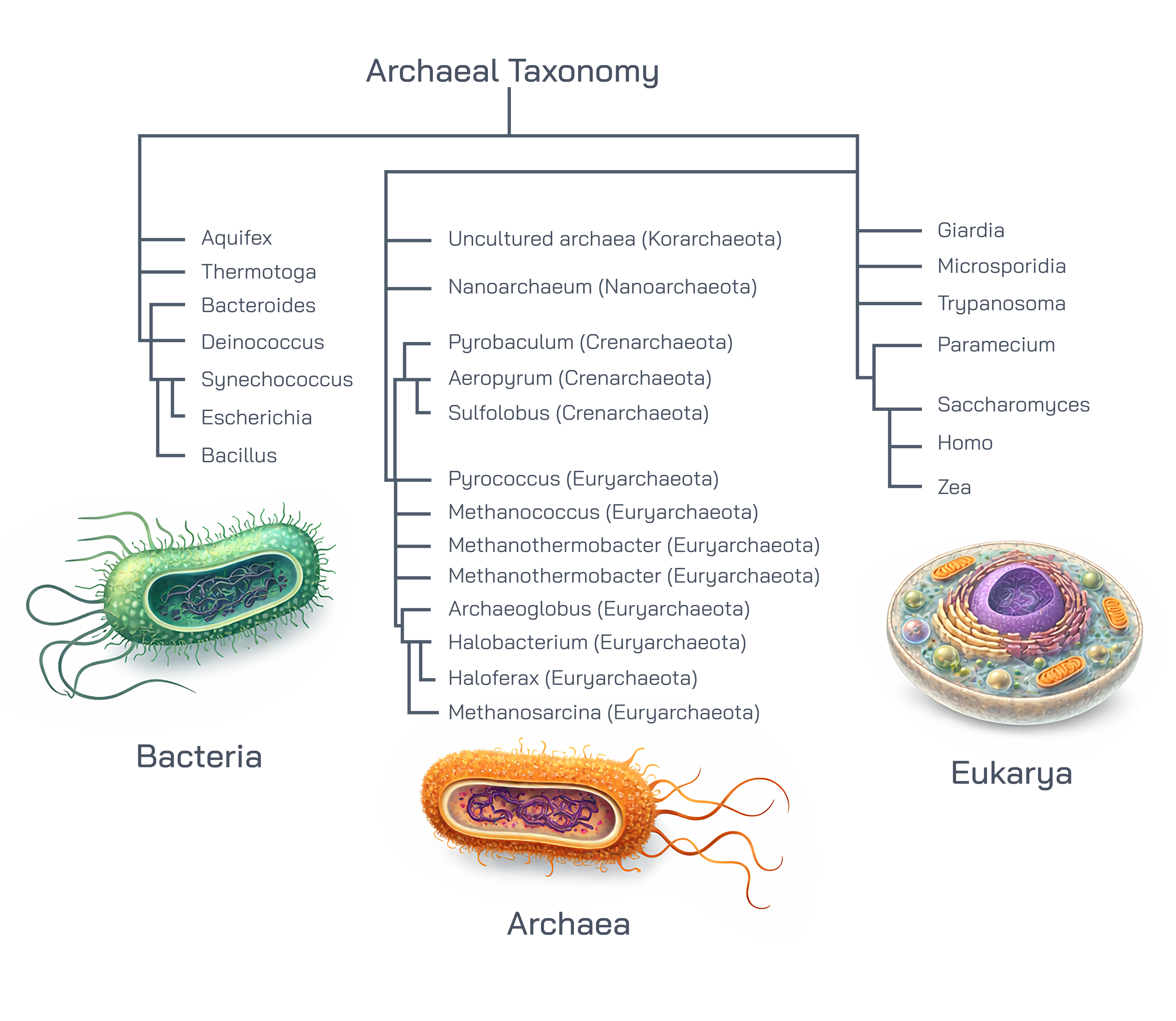
Archaeal taxonomy refers to the scientific classification and organisation of organisms belonging to the domain Archaea. Archaea are a distinct group of microscopic, single-celled organisms that are prokaryotic in nature, meaning they lack a true nucleus and membrane-bound organelles. Although archaea were once grouped together with bacteria due to their similar size and cellular simplicity, advances in molecular biology and genetic analysis revealed that archaea form a separate and fundamentally distinct domain of life. Understanding archaeal taxonomy is essential for appreciating microbial diversity, evolutionary biology, and the classification of life on Earth.
The modern system of classification places all living organisms into three major domains: Bacteria, Archaea, and Eukarya. This three-domain system was proposed based on comparisons of ribosomal RNA sequences, which provided deep insights into evolutionary relationships. Archaea emerged as a unique lineage that is genetically and biochemically distinct from bacteria, despite superficial similarities in cell structure. Archaeal taxonomy is therefore rooted in molecular phylogeny rather than solely on physical characteristics.
Archaea are prokaryotic organisms, but their genetic machinery shows closer resemblance to eukaryotes than to bacteria. For example, archaeal processes such as transcription and translation share similarities with those of eukaryotic cells. At the same time, archaea possess unique features that set them apart from both bacteria and eukaryotes. Their cell membranes contain unusual lipids with ether linkages instead of ester linkages, and their cell walls lack peptidoglycan, a hallmark of bacterial cell walls. These biochemical differences play a major role in archaeal taxonomy.
The domain Archaea is divided into several major taxonomic groups or phyla based on genetic, metabolic, and ecological characteristics. One of the most well-known archaeal phyla is Euryarchaeota. This group includes a wide range of organisms with diverse metabolic strategies. Methanogens, which produce methane as a metabolic byproduct, belong to this phylum. Methanogens are strictly anaerobic and are commonly found in environments such as wetlands, digestive tracts of animals, sewage sludge, and deep-sea sediments. Euryarchaeota also includes halophiles, which thrive in extremely salty environments such as salt lakes and salt flats, and some thermophiles that live in high-temperature conditions.
Another major archaeal phylum is Crenarchaeota. Members of this group are often found in extreme environments, particularly those with high temperatures and acidic conditions. Many crenarchaeotes are thermophilic or hyperthermophilic, living in hot springs, volcanic vents, and hydrothermal systems. These organisms possess enzymes that function efficiently at temperatures that would denature proteins in most other life forms. Crenarchaeota play a significant role in understanding the limits of life and the adaptability of biological systems.
Thaumarchaeota is a more recently recognized archaeal phylum and includes organisms that are widespread in moderate environments such as oceans, soils, and freshwater systems. Unlike many archaea previously thought to be restricted to extreme habitats, thaumarchaeotes are abundant in non-extreme conditions. Many members of this group are involved in the nitrogen cycle, particularly in ammonia oxidation. Their ecological importance has reshaped the understanding of archaeal distribution and challenged the idea that archaea are limited to harsh environments.
Korarchaeota is a small and less well-understood archaeal phylum. Members of this group have been identified primarily through genetic sequencing rather than direct cultivation. They are often found in high-temperature environments such as hot springs. Korarchaeota exhibit characteristics that appear intermediate between different archaeal lineages, making them important for studying archaeal evolution and early diversification.
Nanoarchaeota represents another unique and intriguing archaeal phylum. Members of this group are extremely small and have highly reduced genomes. Nanoarchaeota are often symbiotic, living attached to other archaeal cells and relying on them for many metabolic functions. This unusual lifestyle provides insight into symbiosis, genome reduction, and evolutionary adaptation within archaea.
In addition to these major phyla, ongoing research continues to identify new archaeal lineages through environmental DNA sequencing and metagenomics. Many archaeal groups are known only from genetic material recovered from environmental samples, highlighting the vast and largely unexplored diversity of archaea. As a result, archaeal taxonomy is a dynamic and evolving field that continues to change as new data become available.
Archaeal taxonomy is closely linked to ecology, as different archaeal groups occupy distinct habitats and perform specialized metabolic roles. Archaea are found in a wide range of environments, including extreme habitats such as high-temperature vents, acidic springs, and hypersaline lakes, as well as more common environments like soil, oceans, and the human microbiome. Their metabolic diversity includes methanogenesis, sulfur metabolism, ammonia oxidation, and organic compound degradation.
From an evolutionary perspective, archaea are of great significance. They are believed to represent some of the earliest forms of life on Earth, and their study provides clues about the conditions under which life originated. The genetic similarities between archaea and eukaryotes have led to hypotheses suggesting that eukaryotic cells may have evolved through symbiotic relationships involving archaeal ancestors. Archaeal taxonomy therefore contributes to understanding the evolutionary history of complex life.
The classification of archaea relies heavily on molecular techniques such as ribosomal RNA sequencing, whole-genome analysis, and comparative genomics. Traditional methods based on morphology are less useful because archaea often lack distinctive physical features. Molecular taxonomy allows scientists to identify relationships based on evolutionary history rather than superficial traits, making archaeal taxonomy more accurate and informative.
In applied science, archaeal taxonomy has practical importance. Archaeal enzymes are widely used in biotechnology due to their stability under extreme conditions. For example, enzymes from thermophilic archaea are used in industrial processes that require high temperatures. Understanding archaeal classification helps identify organisms with useful biochemical properties and supports advances in medicine, industry, and environmental technology.
In education, archaeal taxonomy helps students understand the diversity of life beyond plants and animals. It highlights the importance of microorganisms in ecosystems and emphasizes that life on Earth is far more diverse than what is visible to the naked eye. Diagrams of archaeal classification and phylogenetic trees are commonly used to illustrate the three-domain system and evolutionary relationships.
In conclusion, archaeal taxonomy is the scientific framework used to classify and understand organisms within the domain Archaea. Based on molecular and genetic evidence, archaea are recognized as a distinct domain of life, separate from bacteria and eukaryotes. Major archaeal phyla such as Euryarchaeota, Crenarchaeota, Thaumarchaeota, Korarchaeota, and Nanoarchaeota reflect the immense diversity, metabolic specialization, and ecological importance of this group. Archaeal taxonomy not only enhances understanding of microbial life and evolution but also provides valuable insights into the origins of life, ecosystem functioning, and biotechnological innovation.