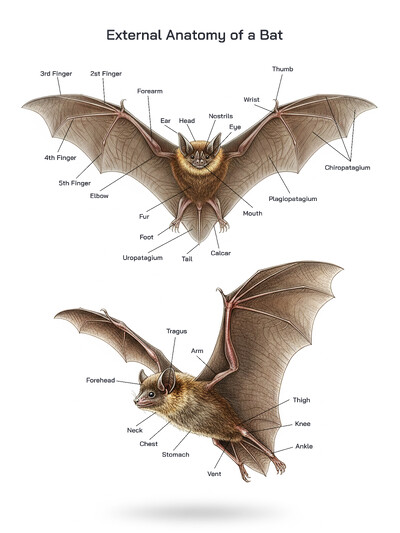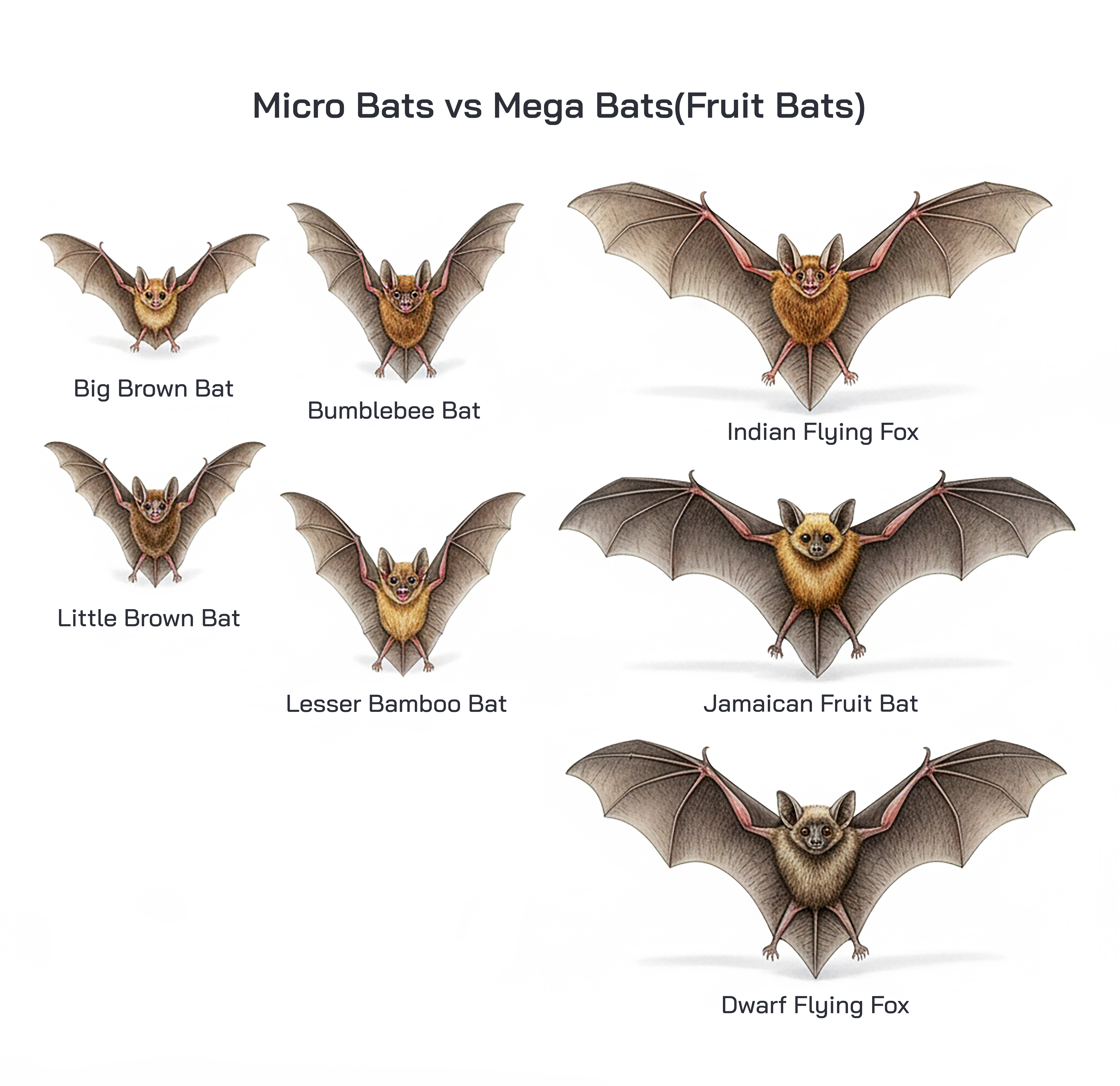
Bats are a unique group of mammals that belong to the order Chiroptera, distinguished by their ability to achieve true powered flight. Within this order, bats are broadly classified into two major groups commonly referred to as microbats and megabats. These two groups differ significantly in size, sensory adaptations, feeding habits, habitat preferences, and ecological roles. Understanding the types, origin, habitat, and differences between microbats and megabats provides valuable insight into bat evolution and their importance in maintaining environmental balance.
The evolutionary origin of bats dates back more than fifty million years, making them one of the oldest groups of flying mammals. Fossil evidence suggests that early bats already possessed wings and flight capability, indicating rapid evolutionary specialization. Over time, bats diversified into multiple lineages, adapting to different ecological niches. This diversification eventually led to the development of microbats and megabats, each following a distinct evolutionary pathway shaped by diet, environment, and sensory needs.
Microbats are generally small to medium-sized bats and represent the majority of bat species worldwide. They evolved primarily as nocturnal insect hunters, developing advanced sensory systems to survive in darkness. One of the defining characteristics of microbats is their use of echolocation. Echolocation is a biological sonar system in which bats emit high-frequency ultrasonic sounds that bounce off objects and return as echoes. By analyzing these echoes, microbats can determine the size, shape, distance, and movement of prey and obstacles with remarkable precision. This adaptation allows microbats to hunt insects in complete darkness and navigate through complex environments such as forests and caves.
Bats are traditionally grouped into Microbats (Microchiroptera) and Megabats (Megachiroptera). Below is a clear, exam-friendly list with examples from each group.
Microbats (Microchiroptera) Characteristics:
Small to medium size, use echolocation, mostly insect-eaters (some eat fruit, fish, or blood).
Common Microbat Examples
Little brown bat (Myotis lucifugus)
Indian pipistrelle (Pipistrellus tenuis)
Big brown bat (Eptesicus fuscus)
Horseshoe bat (Rhinolophus ferrumequinum)
Free-tailed bat (Tadarida brasiliensis)
Vampire bat (Desmodus rotundus)
Bulldog bat (Noctilio leporinus)
Leaf-nosed bat (Hipposideros spp.)
Megabats (Megachiroptera) Characteristics:
Large size, do not use echolocation (except some), fruit or nectar feeders, large eyes.
Common Megabat Examples (Flying Foxes)
Indian flying fox (Pteropus medius)
Large flying fox (Pteropus vampyrus)
Grey-headed flying fox (Pteropus poliocephalus)
Rodrigues flying fox (Pteropus rodricensis)
Straw-colored fruit bat (Eidolon helvum)
Egyptian fruit bat (Rousettus aegyptiacus)
The habitat of microbats is extremely diverse. They are found on every continent except Antarctica and occupy environments ranging from dense forests and grasslands to deserts, caves, and urban areas. Many microbats roost in caves, rock crevices, hollow trees, or man-made structures such as bridges and abandoned buildings. Their ability to adapt to different habitats has contributed to their wide distribution. Microbats are highly sensitive to environmental conditions and often select roosting sites that provide stable temperatures and protection from predators.
In terms of diet, microbats are primarily insectivorous, feeding on a wide variety of insects including mosquitoes, moths, beetles, and flies. This makes them extremely valuable for natural pest control, as a single microbat can consume hundreds or even thousands of insects in one night. Some microbat species have specialized diets, feeding on small vertebrates, fish, or even blood, though these are relatively rare. Their feeding behavior plays a crucial role in regulating insect populations and supporting agricultural productivity.
Megabats, commonly known as fruit bats or flying foxes, represent a distinct group within the bat family. They are generally larger than microbats, with long wingspans and robust bodies. Megabats evolved primarily as fruit and nectar feeders, adapting to life in tropical and subtropical environments. Unlike microbats, megabats rely more on vision and smell rather than echolocation for navigation and foraging. Their large eyes provide excellent low-light vision, enabling them to locate fruiting trees and flowering plants at night.
The origin of megabats is closely linked to tropical ecosystems, where fruit and nectar resources are abundant year-round. Megabats are most commonly found in regions such as Southeast Asia, Australia, Africa, and island ecosystems of the Pacific and Indian Oceans. Their habitats include rainforests, mangroves, orchards, and coastal woodlands. Many megabats roost in trees, forming large colonies that may include thousands of individuals hanging upside down from branches.
The diet of megabats consists mainly of fruits, nectar, and pollen. Through their feeding behavior, megabats play a vital role in pollination and seed dispersal. As they travel long distances in search of food, they spread seeds across wide areas, contributing to forest regeneration and plant diversity. Many plant species rely heavily on megabats for reproduction, making these bats essential to the health of tropical ecosystems.
Communication and social behavior also differ between microbats and megabats. Microbats use echolocation primarily for navigation and hunting, but they also produce social calls to communicate with colony members. Megabats, on the other hand, use a variety of vocal sounds, body movements, and scent cues to communicate within colonies. Both groups exhibit strong social structures, particularly in roosting behavior, where individuals gather for warmth, protection, and breeding.
One of the most significant differences between microbats and megabats lies in their sensory adaptations. Microbats depend heavily on echolocation and have highly developed auditory systems, while megabats rely more on eyesight and olfactory senses. Structurally, microbats tend to have more complex ear shapes designed to capture sound waves, whereas megabats have simpler ear structures but larger eyes. These differences reflect their distinct evolutionary strategies for survival.
Reproductive behavior in both groups shows similarities as well as differences. Most bats give birth to a single pup at a time, and maternal care is strong. Female bats form maternity colonies where they raise their young in safe roosting environments. Megabats often have longer gestation periods and slower reproductive rates, which makes them more vulnerable to population decline when habitats are disturbed.
From an environmental perspective, both microbats and megabats are essential to ecosystem health. Microbats contribute significantly to insect control, reducing crop damage and limiting the spread of insect-borne diseases. Megabats support plant reproduction, forest regeneration, and biodiversity through pollination and seed dispersal. The loss of either group would have serious ecological consequences.
Bats can be understood in even greater depth by examining how the divergence between microbats and megabats represents two fundamentally different evolutionary solutions to nocturnal life, resource exploitation, and survival. Although both groups share the defining trait of powered flight, their anatomical structures, neurological development, ecological strategies, and interactions with ecosystems reveal a remarkable example of adaptive radiation within a single mammalian order.
One of the most profound differences between microbats and megabats lies in the way their brains process sensory information. In microbats, a large portion of the brain is devoted to auditory processing and spatial mapping. Echolocation requires not only sound production but also rapid interpretation of returning echoes, sometimes within milliseconds. This has led to the evolution of highly specialized neural circuits capable of constructing three-dimensional maps of the environment in real time. Microbats can detect prey size, movement speed, and even surface texture, allowing them to select suitable prey while flying at high speeds in darkness. This sensory precision enables microbats to exploit insect-rich niches that are inaccessible to most other predators.
Megabats, in contrast, evolved in environments where visual cues were more reliable due to abundant moonlight, open forest canopies, and stationary food sources such as fruiting trees. Their brains emphasize visual and olfactory processing rather than auditory specialization. Large optic lobes and keen smell allow megabats to locate ripe fruit and flowering plants over long distances. This difference in brain organization reflects a dietary and ecological shift rather than a lack of complexity. Megabats demonstrate excellent spatial memory, often returning to the same feeding trees night after night and remembering seasonal fruiting cycles across landscapes.
Wing morphology also differs subtly between the two groups. Microbats typically have shorter wings with broader surface areas, giving them enhanced maneuverability. This is ideal for navigating cluttered environments such as forests, caves, and urban structures. Megabats usually have longer, narrower wings optimized for sustained flight over open areas. This allows them to travel long distances efficiently between roosts and feeding sites. These differences illustrate how flight mechanics evolved in response to feeding strategy and habitat structure.
Energy use and metabolism further highlight the contrast between microbats and megabats. Insect-eating microbats rely on prey that may fluctuate dramatically in availability. To cope with this, many microbats have developed flexible metabolic strategies, including daily torpor and seasonal hibernation. These physiological states reduce energy consumption when food is scarce, allowing survival in temperate regions with harsh winters. Megabats, living mostly in tropical environments, generally do not hibernate but instead depend on continuous food availability. Their metabolism is adapted for long-distance flight and frequent feeding rather than extreme energy conservation.
Social organization also differs in subtle but important ways. Microbat colonies often form in enclosed spaces such as caves, where temperature stability and predator protection are critical. These colonies may include thousands or even millions of individuals, creating complex acoustic environments where individuals must recognize specific calls among constant background noise. Megabat colonies, often roosting in trees, rely more on visual recognition and scent cues. Their colonies may be highly visible and exposed, which has influenced the development of strong social hierarchies and coordinated group behavior to reduce predation risk.
Reproductive timing reflects ecological specialization as well. Microbats in temperate regions synchronize reproduction with insect abundance, ensuring that lactation coincides with peak food availability. Delayed fertilization or delayed implantation occurs in some species, allowing mating to occur before winter while pregnancy resumes only when conditions improve. Megabats often time reproduction with flowering or fruiting seasons, ensuring that pregnant females and nursing pups have access to energy-rich food. These reproductive strategies demonstrate precise evolutionary tuning to environmental cycles.
The ecological impact of microbats and megabats extends far beyond their immediate feeding habits. Microbats influence insect population genetics by selectively preying on certain species or individuals, indirectly shaping insect evolution. Their predation pressure can alter insect behavior, migration patterns, and breeding success. Megabats influence plant evolution by favoring fruits with specific sizes, colors, or scents, encouraging traits that enhance dispersal by bats. Over millions of years, this mutual influence has shaped entire ecosystems.
Human interaction with bats has historically differed between the two groups. Microbats, often hidden and misunderstood, have been associated with superstition and fear. Megabats, being larger and more visible, have sometimes been hunted for food or viewed as agricultural pests. However, scientific research has revealed that both groups provide immense economic and ecological benefits. The loss of microbats can lead to explosive insect population growth, while the decline of megabats can disrupt forest regeneration and food security in tropical regions.
Modern threats affect microbats and megabats differently. Microbats are particularly vulnerable to cave disturbance, pesticide exposure, and diseases such as fungal infections that spread rapidly in hibernating populations. Megabats are more affected by deforestation, hunting, and conflicts with fruit growers. Climate change poses a shared threat, altering food availability, migration patterns, and reproductive timing for both groups.
Conservation strategies must therefore be tailored to the biological differences between microbats and megabats. Protecting cave systems, maintaining insect diversity, and reducing chemical pollution are crucial for microbat survival. For megabats, preserving forest habitats, protecting roosting trees, and promoting coexistence with agriculture are essential. Public education plays a vital role in reducing fear and encouraging appreciation of bats as keystone species.
From an evolutionary perspective, the split between microbats and megabats demonstrates how a single mammalian lineage can diversify into radically different forms while retaining a shared foundation. Their differences in sensory systems, diet, habitat use, and ecological roles highlight the adaptability of mammals when faced with environmental opportunity and selective pressure.
The distinction between microbats and megabats becomes even clearer when their evolutionary constraints, anatomical refinements, ecological pressures, and long-term survival strategies are examined in a broader biological context. Although traditionally grouped together under Chiroptera, modern scientific understanding increasingly recognizes that these two bat groups represent deeply divergent evolutionary solutions to flight, feeding, and nocturnal life. Their differences extend into skeletal structure, sensory trade-offs, disease tolerance, migration behavior, and their influence on entire food webs.
From an anatomical perspective, skull structure provides critical insight into the divergence between microbats and megabats. Microbats typically possess shorter snouts and complex nasal or oral structures adapted for sound emission during echolocation. Some species emit sound through the mouth, while others use highly specialized nose leaves that help focus ultrasonic calls. These facial adaptations are absent in megabats, whose skulls are elongated and shaped to support strong jaw muscles for biting into fruit. The dental structure also differs significantly: microbats have sharp, pointed teeth suited for piercing insect exoskeletons, whereas megabats have broader molars designed to crush fruit and extract juices.
Sensory trade-offs are another key evolutionary theme. Microbats invested heavily in echolocation, which allowed them to exploit nocturnal insect prey with minimal reliance on vision. Over evolutionary time, this reduced the selective pressure for advanced visual systems, resulting in smaller eyes in many species. Megabats followed the opposite path, evolving enhanced night vision and color perception to identify ripe fruit and flowers. This divergence illustrates how energy and neural resources are allocated differently depending on ecological opportunity.
Thermal regulation strategies also differ between the two groups. Microbats, especially those in temperate regions, experience wide seasonal temperature fluctuations. To survive, they evolved torpor and hibernation as adaptive responses. During these states, metabolic activity drops dramatically, heart rate slows, and body temperature approaches ambient levels. Megabats, living mostly in stable tropical climates, do not rely on hibernation but instead manage heat through behavioral strategies such as wing fanning, shade-seeking, and roost selection. These differences reflect how climate shaped physiological evolution within Chiroptera.
Flight endurance and migration behavior further separate microbats and megabats. Many microbats travel relatively short distances nightly between roosts and feeding sites, relying on local insect abundance. Some species do migrate seasonally, but usually over moderate distances. In contrast, several megabat species undertake long-distance migrations following flowering or fruiting cycles across regions. These migrations allow megabats to act as long-range seed dispersers, connecting ecosystems that would otherwise remain isolated.
The reproductive investment of megabats is generally higher than that of microbats. Megabat pups are often born larger and require longer periods of maternal care. Mothers may carry pups during flight for extended periods, which increases energetic demands but enhances offspring survival. Microbats typically leave pups in maternity roosts while foraging, relying on thermal clustering and vocal recognition to maintain maternal bonds. These contrasting strategies highlight different approaches to balancing reproduction with flight efficiency.
Disease ecology offers another important dimension. Microbats often live in dense cave colonies, which increases the risk of disease transmission. However, they have evolved immune systems capable of tolerating pathogens with minimal symptoms. Megabats, roosting in exposed tree colonies, face different disease pressures, including parasites and environmental stressors. Their immune responses are shaped by constant exposure to plant-based diets and environmental microbes. Understanding these differences is critical for wildlife health management and conservation planning.
Human-induced environmental change affects microbats and megabats in distinct ways. Artificial lighting disproportionately impacts microbats by altering insect behavior and disrupting hunting efficiency. Megabats are more affected by deforestation and agricultural expansion, which reduce fruit availability and roosting trees. Wind energy infrastructure poses collision risks primarily to migratory microbats, while megabats face greater threats from hunting and persecution due to perceived crop damage. These differing vulnerabilities require species-specific conservation approaches.
Culturally and economically, the roles of microbats and megabats differ across regions. In agricultural landscapes, microbats are silent allies, reducing pest populations without human intervention. Their economic value is often underestimated because their work occurs at night and out of sight. Megabats, being more visible, are sometimes seen as competitors for fruit crops, yet their contribution to forest regeneration ultimately supports long-term agricultural stability. Education and coexistence strategies are essential to balance these perceptions.
Evolutionarily, the divergence between microbats and megabats demonstrates how a single ancestral lineage can split into radically different ecological specialists. One branch mastered darkness through sound, agility, and insect predation, while the other mastered low-light environments through vision, scent, and plant-based feeding. Both strategies proved successful, leading to global distribution and remarkable species diversity.
From a planetary perspective, microbats and megabats function as ecological regulators. Microbats control insect populations that influence crop health, disease transmission, and ecosystem balance. Megabats maintain plant diversity, forest structure, and genetic exchange across landscapes. The disappearance of either group would create cascading ecological effects, disrupting food webs and reducing ecosystem resilience.
In conclusion, microbats and megabats are not merely size-based categories but represent two highly specialized evolutionary trajectories within Chiroptera. Their differences in anatomy, sensory systems, metabolism, reproduction, and ecological roles reveal the extraordinary adaptability of mammals to flight and nocturnal life. Together, they illustrate how evolutionary divergence can produce complementary ecological functions, making bats indispensable architects of natural balance across the globe.
In summary, microbats and megabats represent two major types of bats with distinct evolutionary origins, habitats, and biological characteristics. Microbats are smaller, echolocating insect hunters found in diverse environments worldwide, while megabats are larger, visually oriented fruit and nectar feeders primarily found in tropical regions. Their differences in sensory systems, diet, habitat, and ecological roles highlight the remarkable adaptability of bats and underscore their importance in maintaining environmental balance across ecosystems. Microbats and megabats represent two complementary branches of bat evolution, each shaped by distinct ecological demands. Microbats dominate nocturnal insect control through echolocation and agile flight, while megabats sustain tropical ecosystems through pollination and seed dispersal guided by vision and smell. Together, they illustrate the extraordinary versatility of bats and underscore their irreplaceable role in maintaining ecological balance across the planet.