Elephants are the largest living land mammals on Earth and are among the most intelligent, socially complex, and ecologically important animals in the natural world. They belong to the family Elephantidae and are easily recognized by their massive bodies, long trunks, thick pillar-like legs, broad ears, and in many cases, prominent tusks. Elephants have fascinated humans for centuries due to their size, strength, memory, and emotional behavior. Studying elephants provides deep insight into mammalian anatomy, social organization, adaptation, and the balance of ecosystems.
There are two main living species of elephants: the African elephant and the Asian elephant. African elephants are generally larger, with bigger ears and more curved tusks, while Asian elephants are slightly smaller with rounded ears and a more domed head shape. Despite these differences, both species share many anatomical and behavioral characteristics that define elephants as a unique group of mammals.
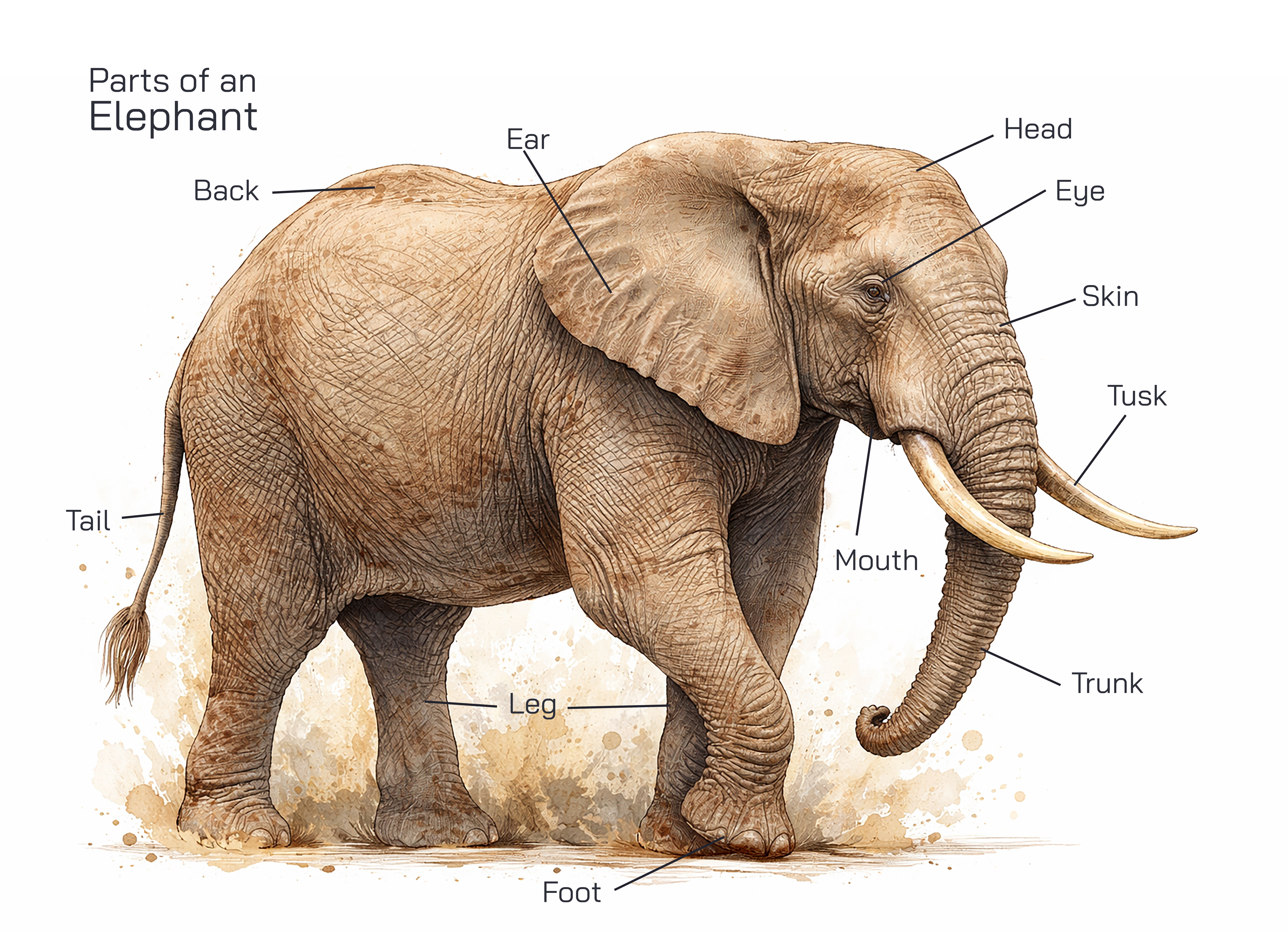
The body structure of an elephant is specially adapted to support its enormous size and weight. An adult elephant can weigh several thousand kilograms, yet it moves with surprising grace and stability. The skeleton is strong and dense, providing structural support, while the muscles are highly developed to allow movement, lifting, and complex trunk actions. The legs are straight and column-like, positioned directly beneath the body to efficiently bear weight. The feet contain thick pads of fatty tissue that act as shock absorbers, reducing pressure on bones and joints while walking.
One of the most distinctive features of an elephant is its trunk. The trunk is an elongated fusion of the nose and upper lip and contains tens of thousands of muscles, making it extremely flexible and powerful. Elephants use their trunks for breathing, smelling, touching, grasping objects, lifting food and water, drinking, bathing, and even social interactions. The trunk functions as a multipurpose organ, replacing the need for hands in many activities. It is also highly sensitive and capable of performing delicate tasks, such as picking up small objects.
Tusks are another prominent feature of elephants. Tusks are elongated incisors made of ivory and continue to grow throughout the elephant’s life. Elephants use tusks for digging for water, stripping bark from trees, moving heavy objects, and defending themselves. Tusks also play a role in social dominance and mating displays. Unfortunately, tusks have made elephants a target for illegal hunting, leading to serious conservation challenges.
Elephants have large ears that serve multiple purposes. The ears help regulate body temperature by dissipating heat. Blood vessels near the surface of the ears release heat when the ears are flapped, helping cool the body in hot climates. In African elephants, the ears are especially large, reflecting adaptation to warmer environments. Ears also play a role in communication and visual signaling within the herd.
The skin of an elephant is thick and tough, providing protection against injuries, insect bites, and harsh environmental conditions. Despite its thickness, elephant skin is sensitive and requires regular care. Elephants often cover themselves with mud or dust, which helps protect against sunburn, parasites, and moisture loss. The wrinkled texture of the skin increases surface area, aiding in temperature regulation and moisture retention.
Elephants are herbivorous animals, meaning they feed exclusively on plant material. Their diet includes grasses, leaves, bark, roots, fruits, and shrubs. Due to their large size and high energy requirements, elephants spend a significant portion of their day feeding. They use their trunks to gather food and place it into their mouths. Their teeth are specially adapted for grinding tough plant material. Elephants have large molars that move forward in the jaw as older ones wear out, a unique adaptation among mammals.
Digestion in elephants is relatively inefficient compared to some other herbivores. As a result, elephants consume large quantities of food daily to meet their nutritional needs. This feeding behavior plays a crucial role in shaping the environment. By breaking branches, uprooting plants, and dispersing seeds through dung, elephants significantly influence vegetation structure and promote biodiversity.
Elephants are highly social animals and live in complex social groups. Typically, elephant herds are led by an older female known as the matriarch. The matriarch possesses extensive knowledge about food sources, water locations, migration routes, and threats. Herds usually consist of related females and their young, while adult males often live alone or form small bachelor groups.
Communication among elephants is sophisticated and includes vocalizations, body language, touch, and even low-frequency sounds known as infrasound. These low-frequency calls can travel long distances and allow elephants to communicate across vast areas. Elephants also use their trunks and ears to express emotions, greet one another, and reinforce social bonds.
Elephant intelligence is widely recognized and studied. They exhibit advanced cognitive abilities such as problem-solving, learning, memory, and emotional awareness. Elephants can recognize themselves in mirrors, display empathy toward injured or distressed individuals, and remember locations and individuals for many years. Their strong memory is essential for survival, especially in environments where water and food availability change seasonally.
Reproduction in elephants involves a long gestation period, lasting about twenty-two months, which is the longest of any land mammal. Elephant calves are born relatively large and depend heavily on their mothers and other herd members for care and protection. Calves learn social behaviors, feeding techniques, and survival skills by observing adults in the herd.
Elephants play a critical ecological role and are often referred to as keystone species. Their activities help maintain the balance of ecosystems. By creating clearings in forests, digging water holes, and dispersing seeds, elephants support a wide variety of plant and animal species. The absence of elephants from an ecosystem can lead to significant environmental changes.
Despite their importance, elephants face numerous threats, including habitat loss, human-wildlife conflict, and illegal hunting. Conservation efforts focus on protecting habitats, enforcing anti-poaching laws, and promoting coexistence between humans and elephants. Education and awareness are essential for ensuring the long-term survival of these remarkable animals.
In educational contexts, elephants are often used as examples to teach concepts related to mammalian anatomy, social behavior, intelligence, and conservation biology. Their complex behavior and ecological impact make them ideal subjects for understanding the interconnectedness of life on Earth.
Elephants also exhibit highly specialized physiological adaptations that allow them to survive in diverse and often challenging environments. One such adaptation is their exceptional water management strategy. Elephants require large quantities of water daily, not only for drinking but also for bathing and thermoregulation. When water is scarce, elephants are capable of locating underground water sources by detecting subtle cues such as vegetation patterns, soil moisture, and even vibrations through their feet. Their ability to dig deep water holes with their tusks and feet provides access to water not only for themselves but also for many other animals, making them vital facilitators of survival during dry seasons.
Another remarkable aspect of elephant biology is their advanced sensory perception. Elephants possess an extraordinary sense of smell, which is far more developed than that of most mammals. This heightened olfactory ability helps them identify food sources, recognize individuals, detect predators, and sense reproductive readiness in mates. Their auditory system is also uniquely adapted to perceive low-frequency vibrations transmitted through the ground. Elephants can communicate and detect distant movements through seismic signals, a capability that enhances group coordination and early threat detection.
Elephant skin physiology reveals further complexity beyond its protective role. The skin hosts a diverse community of microorganisms that contribute to immune defense and overall skin health. Mud wallowing not only protects against heat and parasites but also supports this microbial balance. Additionally, the skin’s ability to absorb moisture slowly helps elephants remain hydrated for longer periods in arid environments. The interaction between skin texture, environmental elements, and behavior reflects a finely tuned survival strategy developed over millions of years.
Elephants demonstrate unique sleep patterns that differ significantly from most mammals. They require surprisingly little sleep, often resting for only a few hours per day. Much of their sleep occurs while standing, with brief periods of lying down for deeper rest. This behavior is thought to reduce vulnerability to predators and allows quick responsiveness to environmental changes. Sleep duration and patterns can vary depending on habitat conditions, social stability, and seasonal factors.
The role of elephants in shaping landscapes extends deeply into geological and ecological timescales. Through their constant movement and feeding activity, elephants influence soil compaction, nutrient redistribution, and water flow patterns. Trails created by elephants often become pathways for other animals and can later develop into natural corridors or drainage channels. Over long periods, these modifications contribute to ecosystem resilience and landscape diversity.
Elephant migration behavior is another complex phenomenon influenced by environmental memory, climate variability, and resource availability. Migration routes are not random but are learned and passed down through generations. These routes often span hundreds of kilometers and are critical for accessing seasonal food and water sources. Disruption of migration pathways due to human development can lead to increased stress, conflict, and reduced survival rates, highlighting the importance of landscape connectivity in elephant conservation.
From a genetic perspective, elephants possess relatively low reproductive rates, which makes population recovery slow after declines. This biological constraint underscores their vulnerability to rapid environmental changes and human pressures. Genetic diversity within elephant populations is essential for disease resistance and long-term adaptability. Conservation genetics plays a growing role in monitoring population health and guiding breeding and relocation programs.
Elephants also exhibit complex emotional processing that extends beyond basic survival instincts. Observations have documented behaviors that suggest grief, such as prolonged attention to deceased companions, gentle touching of bones, and changes in group behavior following a loss. These responses indicate deep social bonds and emotional awareness, reinforcing the understanding that elephants experience a rich internal life.
In terms of learning and cultural transmission, elephants show evidence of socially learned behaviors. Young elephants acquire skills such as foraging techniques, migration navigation, and social etiquette by observing older members of the herd. This transfer of knowledge creates what can be described as elephant culture, where experience and memory play a crucial role in group survival. Loss of older individuals can therefore have long-lasting impacts on herd knowledge and stability.
Elephants have also played significant roles in human history and culture across many civilizations. They have been used in transportation, agriculture, ceremonial practices, and warfare, often symbolizing strength, wisdom, and royalty. In many cultures, elephants hold spiritual and religious significance, representing protection, prosperity, and endurance. This deep cultural connection has influenced art, mythology, and traditions across continents.
Modern scientific research on elephants extends into fields such as neuroscience, biomechanics, and conservation technology. Studies of elephant brains have provided insights into memory, cognition, and social behavior. Research into their locomotion has inspired designs in robotics and engineering, particularly in creating stable structures capable of supporting heavy loads. Tracking technologies such as GPS collars and acoustic monitoring are now used to study elephant movement and reduce human-elephant conflict.
Elephants also face emerging challenges related to climate change. Altered rainfall patterns, increased drought frequency, and shifting vegetation zones affect food availability and migration timing. These changes require elephants to adapt rapidly, often bringing them into closer contact with human settlements. Understanding elephant responses to climate stress is becoming increasingly important for developing effective conservation strategies.
In managed environments such as wildlife reserves and sanctuaries, elephant welfare requires specialized care that accounts for their physical, social, and psychological needs. Enrichment activities, social grouping considerations, and habitat design are essential to maintain health and reduce stress. Ethical discussions around elephant captivity have intensified, emphasizing the importance of naturalistic environments and conservation-focused management.
Elephants also serve as powerful flagship species for conservation. Protecting elephants often leads to the preservation of large habitats that support countless other species. Conservation programs centered on elephants therefore have far-reaching ecological benefits, making elephants central to broader environmental protection efforts.
In summary, beyond their physical presence and basic biology, elephants represent a convergence of advanced physiology, emotional intelligence, cultural learning, environmental engineering, and ecological influence. Their interactions with landscapes, climate, other species, and humans reveal a level of complexity that few animals match. Expanding knowledge about elephants not only enhances understanding of wildlife biology but also reinforces the importance of coexistence, ethical stewardship, and long-term conservation planning for sustaining Earth’s natural systems.
Elephants are among the most extraordinary animals to ever walk the Earth. They are not only the largest land mammals but also among the most socially advanced, emotionally complex, and intelligent creatures known in the animal kingdom. Their long evolutionary history, diverse species, deep social bonds, advanced communication systems, and profound ecological influence make elephants unique in both biology and behavior. Understanding elephants in detail reveals how size, intelligence, emotion, and cooperation can coexist in a single species and shape entire ecosystems.
There are three living types of elephants recognized today: the African savanna elephant, the African forest elephant, and the Asian elephant. The African savanna elephant is the largest of all, inhabiting open grasslands and savannas across sub-Saharan Africa. The African forest elephant is smaller and more elusive, living in dense tropical forests of Central and West Africa. The Asian elephant is found across South and Southeast Asia, occupying forests, grasslands, and agricultural landscapes. These types differ in size, skull shape, ear structure, tusk development, and behavior, reflecting adaptation to different environments.
The origin of elephants traces back millions of years to ancient mammalian ancestors that lived during prehistoric times. Early elephant-like animals were much smaller and inhabited swampy environments. Over time, through gradual evolutionary changes, elephants developed larger bodies, longer limbs, trunks, and complex teeth suited for grinding vegetation. Fossil evidence shows that elephants once had many relatives, including mammoths and mastodons, which lived in colder regions and eventually became extinct. Modern elephants are the last surviving members of a once-diverse evolutionary lineage.
Elephants live highly social lives built around strong family bonds. Female elephants remain with their natal herd for life, forming tightly knit groups led by a matriarch, usually the oldest and most experienced female. The matriarch plays a central role in decision-making, guiding the herd toward food, water, and safety based on decades of accumulated knowledge. This leadership is not based on physical dominance but on experience, memory, and social intelligence. Male elephants typically leave the herd upon reaching maturity and live solitary lives or form loose associations with other males.
Daily life for elephants revolves around feeding, traveling, social interaction, and caring for young. They are active for most of the day and night, often adjusting their routines according to temperature and human activity. In hotter regions, elephants may feed during cooler hours and rest during the heat of the day. Their daily movements are purposeful, following known routes that connect feeding grounds, water sources, and resting areas.
Elephants are exceptional travelers, capable of covering vast distances over time. Their movement patterns are not random but structured and learned. Migration routes are shaped by seasonal changes, rainfall patterns, and vegetation cycles. Elephants remember these routes for decades and pass this knowledge across generations. Their ability to navigate complex landscapes relies on memory, environmental cues, and social coordination. Even young elephants learn routes by following elders, ensuring continuity of movement knowledge.
Emotionally, elephants display a depth of feeling rarely observed outside humans and some primates. They form strong attachments to family members and show clear signs of joy, distress, empathy, and grief. Elephants comfort one another through touch, vocalizations, and close proximity. When a herd member is injured or distressed, others often stay close, offering protection and reassurance. Responses to death are particularly striking, with elephants showing prolonged attention to deceased individuals, indicating emotional awareness and social bonding.
Elephant intelligence is multifaceted and highly developed. They demonstrate problem-solving skills, tool use, self-recognition, and long-term memory. Elephants can learn from experience, adapt behavior to new challenges, and cooperate to achieve shared goals. Their brains are large and highly complex, supporting advanced cognition and emotional processing. Memory plays a crucial role in survival, allowing elephants to recall distant water sources, recognize individuals after long separations, and anticipate seasonal changes.
Communication among elephants is one of the most sophisticated systems in the animal world. They use a combination of vocal sounds, body language, tactile signals, chemical cues, and seismic communication. One of the most remarkable aspects of elephant communication is the use of low-frequency sounds known as infrasound. These sounds travel long distances through air and ground, enabling elephants to communicate across several kilometers. Through infrasound, elephants coordinate movement, signal danger, and maintain contact between separated groups.
Physical power is another defining aspect of elephants. Their immense strength allows them to move trees, reshape landscapes, and access resources unavailable to other animals. Despite this power, elephants are generally gentle and controlled in their movements. Strength is used primarily for survival tasks such as digging, feeding, and protecting the herd rather than aggression. When threatened, however, elephants can become formidable defenders, capable of charging with incredible force and speed.
Elephant behavior is shaped by cooperation and social awareness. They rely on collective decision-making and mutual support rather than individual competition. Calves are cared for not only by their mothers but also by other females in the herd, a behavior known as allomothering. This shared care strengthens social bonds and improves survival rates for young elephants. Discipline and learning occur through observation, correction, and imitation rather than force.
Diet is central to elephant life and behavior. Elephants are strict herbivores and consume a wide variety of plant materials, including grasses, leaves, bark, fruits, roots, and shrubs. Their dietary choices vary by season and habitat, allowing them to adapt to changing conditions. Because digestion is relatively inefficient, elephants eat for many hours each day, processing enormous quantities of vegetation. This feeding behavior significantly influences plant communities and landscape structure.
Elephants play a critical ecological role through their feeding and movement. By uprooting plants, dispersing seeds, and creating clearings, they shape habitats and promote biodiversity. Their dung spreads seeds over long distances, aiding forest regeneration and grassland maintenance. Many ecosystems depend on elephant activity to maintain balance, making them essential to environmental health.
In summary, elephants are complex beings shaped by millions of years of evolution. They exist in distinct types adapted to different regions, live in deeply social communities guided by experience and memory, travel intelligently across vast landscapes, communicate through advanced multi-sensory systems, and express rich emotional lives. Their intelligence, strength, cooperative behavior, and ecological influence place them among the most remarkable animals on Earth. Understanding elephants in such depth reveals not only their biological significance but also their role as living symbols of memory, connection, and coexistence within the natural world.
In conclusion, elephants are extraordinary mammals characterized by their massive size, unique anatomy, advanced intelligence, and strong social bonds. Their trunk, tusks, ears, skin, and skeletal structure are all specialized adaptations that support survival in diverse environments. Elephants play a vital role in maintaining ecosystem health and demonstrate remarkable cognitive and emotional capacities. Understanding elephants not only deepens knowledge of animal biology but also highlights the importance of conservation and respect for wildlife in maintaining ecological balance.