Curvilinear Motion Showing Object Path, Tangential Velocity, and Direction Change in Physics Concept
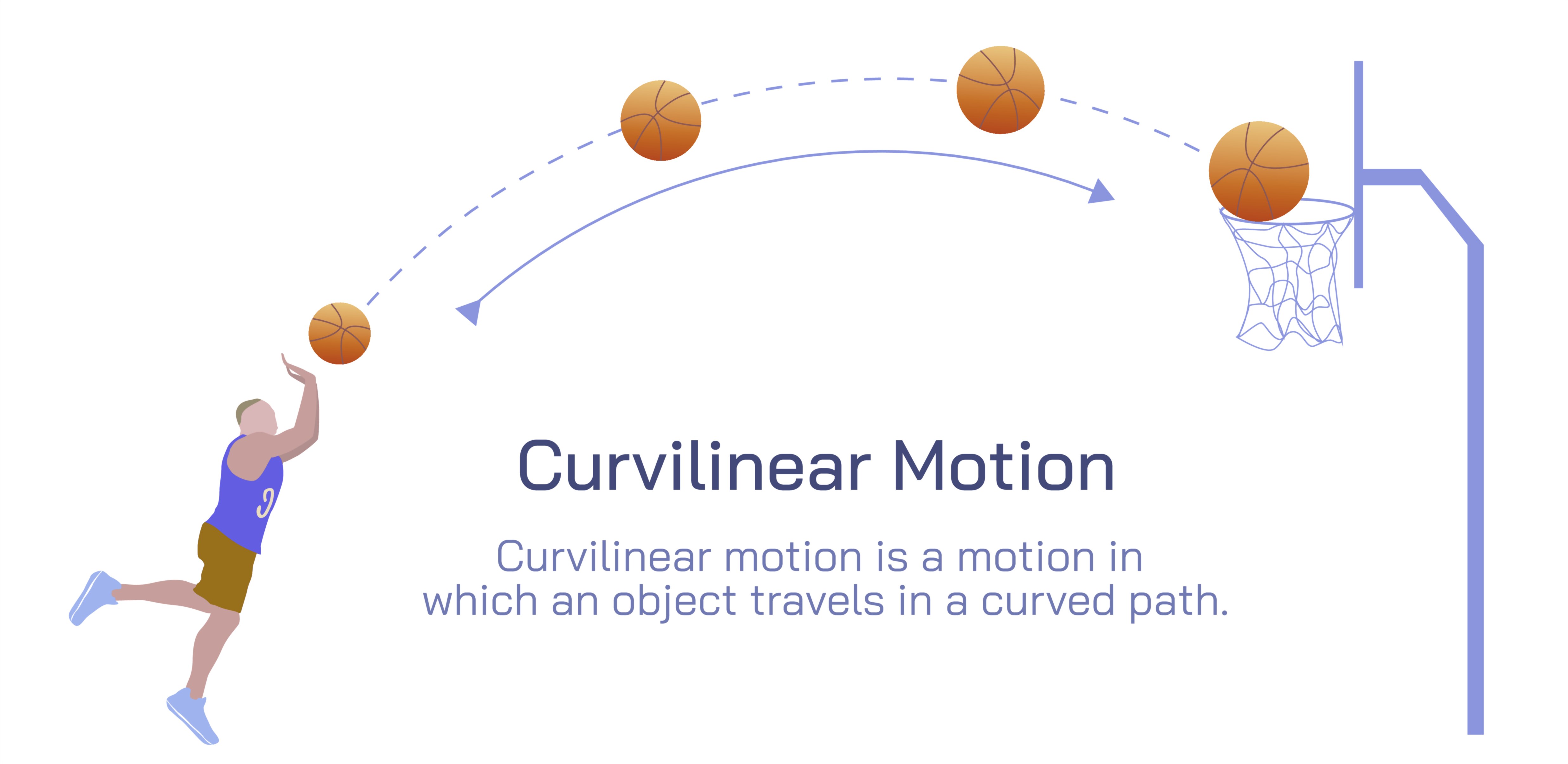
Curvilinear motion refers to the movement of an object along a curved path rather than a straight line, making it one of the most visually striking and conceptually rich forms of motion in physics. While motion in a straight line involves changes only in speed or displacement, curvilinear motion introduces a continuous change in direction, meaning that the velocity of the object is constantly being redirected even if its speed remains the same. A vector illustration depicting curvilinear motion captures this process clearly by tracing the object’s curved trajectory, marking tangential velocity along the path, and showing how the direction of motion shifts from point to point. Through these graphical elements, the concept reveals how an object maintains forward motion while its path bends due to forces acting upon it.
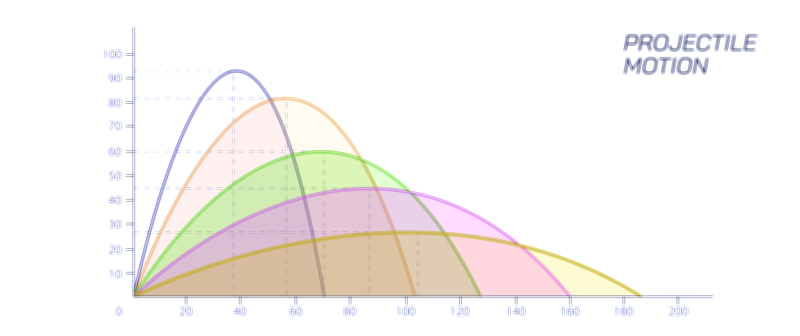
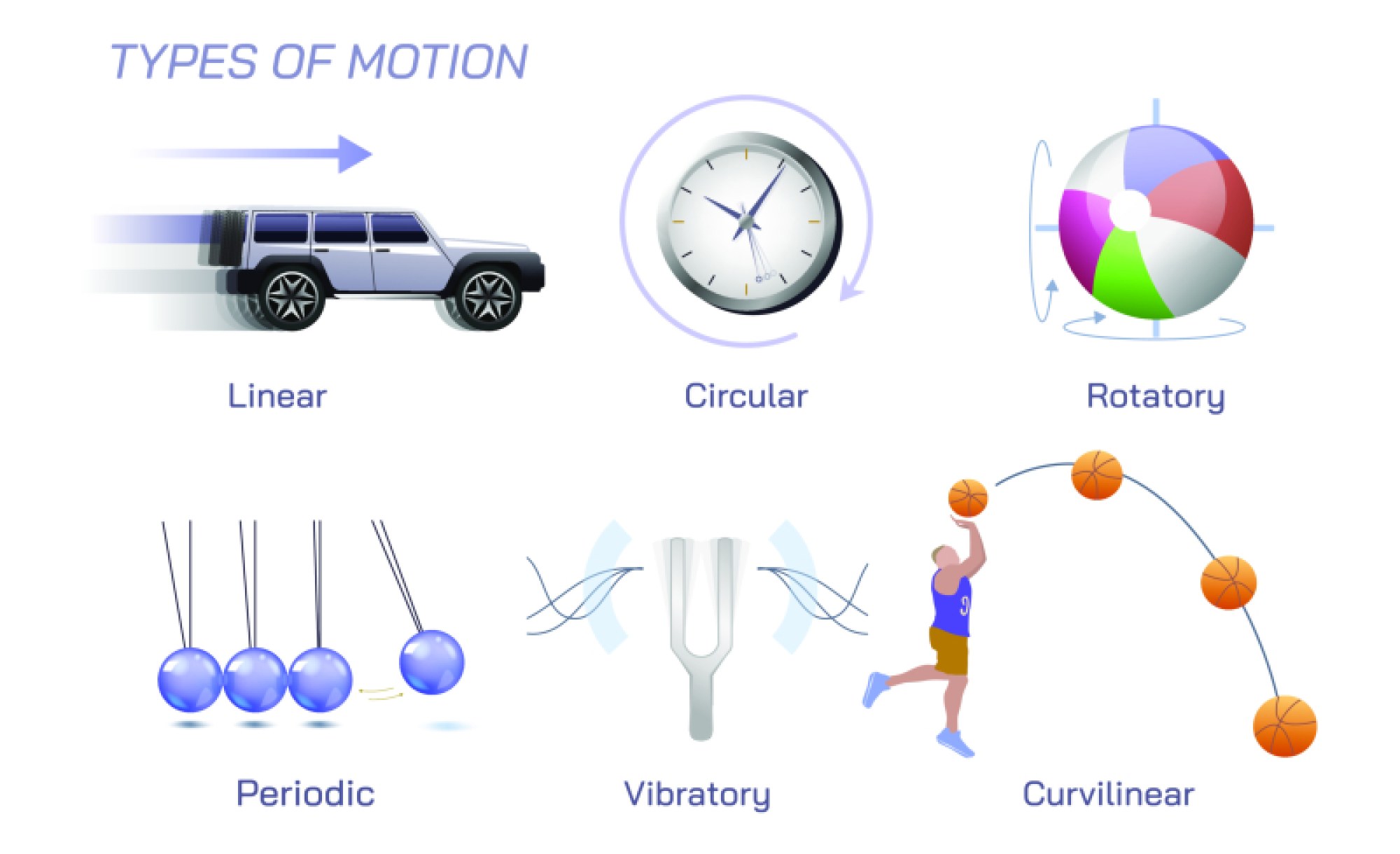
The most defining characteristic of curvilinear motion is that the path of the object is curved, not straight. This curved trajectory may take many forms — circular, parabolic, elliptical, spiral, or irregular — depending on the nature of the forces acting on the object. For example, a car driving around a curved road, a projectile following a parabolic arc, water flowing through a winding pipe, or a roller coaster looping through a track all display curvilinear motion in different contexts. Regardless of the specific shape of the curve, the physics principle remains the same: the object’s velocity vector changes direction continuously as it moves along its path.
Curvilinear motion becomes even clearer when focusing on tangential velocity, the velocity that is always directed tangent to the path at any point. In vector illustrations, this is represented by an arrow drawn horizontally or diagonally from the point on the curve showing the instant direction of motion. If the forces causing the curving path were suddenly removed — for instance, if a rope holding a spinning object were cut — the object would not continue along the curved path. Instead, it would immediately fly off in a straight line along the direction of its tangential velocity at that instant. This demonstrates a critical principle: objects in curvilinear motion do not move around curves naturally; they are constantly being redirected, and the straight-line portion of the tangential velocity reveals the object’s true inertial tendency.
Although an object’s tangential velocity shows the direction in which it would go if unforced, curvilinear motion requires a continuous effect that pulls, pushes, or guides the object toward the inside of the curve. In the special case of circular motion, this inward influence is called centripetal force. In other curved paths, the inward influence may come from gravity, mechanical constraints, air pressure, magnetic fields, or structural guidance. This inward force bends the velocity vector just enough to keep the object on the curved path rather than moving tangentially away. Therefore, although tangential velocity and inward influence are often illustrated separately, they work together: one drives the motion forward, and the other redirects it.
Every moment of curvilinear motion involves a change in direction of the velocity vector, even if the speed (magnitude of velocity) remains constant. Since acceleration is defined in physics as any change in velocity — whether in magnitude, direction, or both — curvilinear motion always involves acceleration due to change in direction. This type of acceleration, called centripetal acceleration in circular systems and generalized in other curved systems, points toward the center of curvature of the path rather than along the direction of motion. In illustrations, vectors showing direction change are often drawn pointing inward relative to the curve, helping viewers visualize how the object is continually guided along its path.
Curvilinear motion extends beyond idealized physics examples and appears everywhere in nature and technology. When a thrown ball follows an arcing trajectory, gravitational force continuously pulls it downward, bending its otherwise straight-line tangential path into a curve. When a satellite orbits Earth, gravity constantly pulls it toward the planet, curving what would otherwise be straight-line motion into elliptical or circular motion. When a skier carves turns on snow, their legs and skis generate internal forces that redirect their motion while inertia continuously tries to send them straight ahead. Even blood flowing through arteries or wind following the contour of terrain exhibits curvilinear motion driven by pressure gradients and fluid interaction.
The curved path in a vector illustration helps viewers understand that the geometry of motion matters as much as the forces involved. A gentle curve requires only mild inward influence to guide the motion, while a sharp curve demands stronger inward redirection. This explains why a car turns more safely on wide gradual curves than on narrow sharp turns — the inward frictional force between the tires and the road must be greater on sharp curves to counteract the tangential tendency to continue straight. In roller coasters, racetracks, and centrifuges, designing curves involves calculating the correct relationship between speed, curvature, and inward force to guarantee safety and performance.
Curvilinear motion also brings together scalar and vector reasoning. While scalars such as distance and speed describe the magnitude of travel, vectors such as velocity and acceleration describe orientation — the constantly changing direction along the curve. Vector diagrams, therefore, are particularly valuable because they reveal how motion is directional and dynamic rather than simply positional.
A full vector illustration of curvilinear motion typically includes:
• A curved path representing the trajectory of the moving object.
• A moving object positioned on the path to indicate its current location.
• Tangential velocity arrows drawn from the object, showing the instantaneous direction of motion.
• Inward direction or acceleration arrows pointing toward the inside of the curve, showing the force or influence causing the directional change.
• A sequence of repeated velocity vectors along the path to highlight how direction changes continuously.
Even without mathematical equations or computational graphs, such visualizations capture the essence of curvilinear motion: an object moves forward with momentum while an inward influence continuously turns it, combining inertia and force into coordinated motion. This simple yet deep principle applies across classical mechanics, sports, engineering, astronomy, and fluid dynamics.
Curvilinear motion ultimately illustrates one of the most fundamental ideas in physics — that motion is not defined solely by speed but by direction. The curved path reveals interaction, influence, and constraint. The tangential velocity shows the object’s natural inertial direction. The inward change of direction explains the continuous regulation by forces. Together, they form a complete picture of how objects move through curved trajectories in a world filled with motion that is rarely straight.