Center of Gravity — Stability and Balance Concept
The center of gravity is one of the most fundamental ideas in understanding how objects, living beings, and engineered systems maintain stability and balance. It represents the single point through which the entire weight of an object can be considered to act, even though gravity is pulling on every tiny particle within that object simultaneously. This simplification allows us to understand incredibly complex systems through a clear and intuitive framework: if the center of gravity is properly aligned with the support beneath it, stability is maintained; if it shifts outside the region of support, instability arises. Across physics, biomechanics, architecture, sports performance, robotics, and nature itself, the center of gravity functions as a universal truth governing equilibrium. By mastering this concept, we understand not only why things stand or fall but how bodies move gracefully, how structures remain safe, and how stability emerges from the interplay between mass distribution and gravitational force.
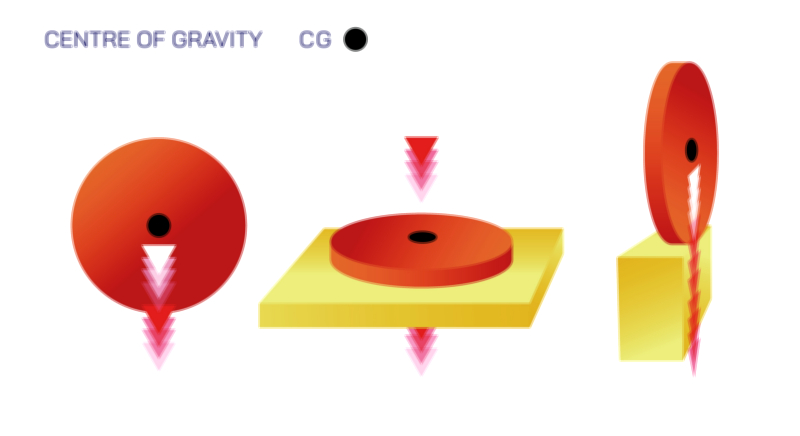
At its core, the center of gravity is essentially the “balancing point” of an object. For symmetric shapes with evenly distributed mass—like a sphere, a square block, or a uniform cylinder—the center of gravity lies at the geometric center. However, for irregular shapes or systems with uneven distribution of weight, the center of gravity shifts toward the heavier sections. This is why a hammer feels heavier at the metal head than at the handle, why a backpack full of books changes your posture when worn, and why a table becomes unstable when too much weight is placed at one corner. The human body provides an especially dynamic example: as we raise our arms, bend forward, sit, jump, or twist, the center of gravity continually shifts. Stability becomes a constant negotiation between body position and gravitational pull, requiring tiny muscular adjustments that happen unconsciously in the background. This dynamic balancing allows us to walk, run, climb, dance, and manipulate our environment without constantly falling over.
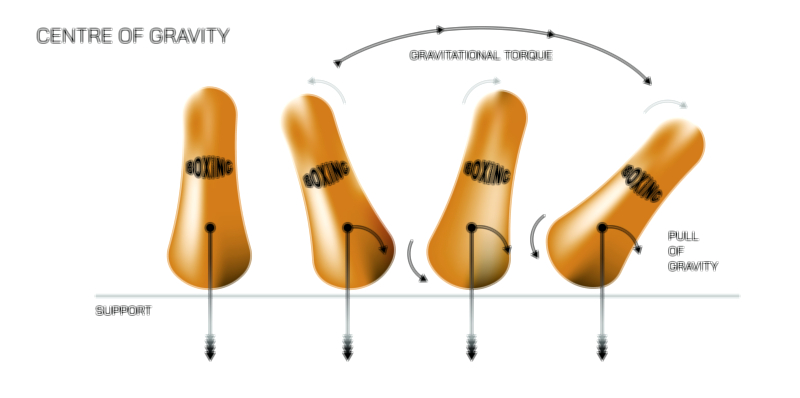
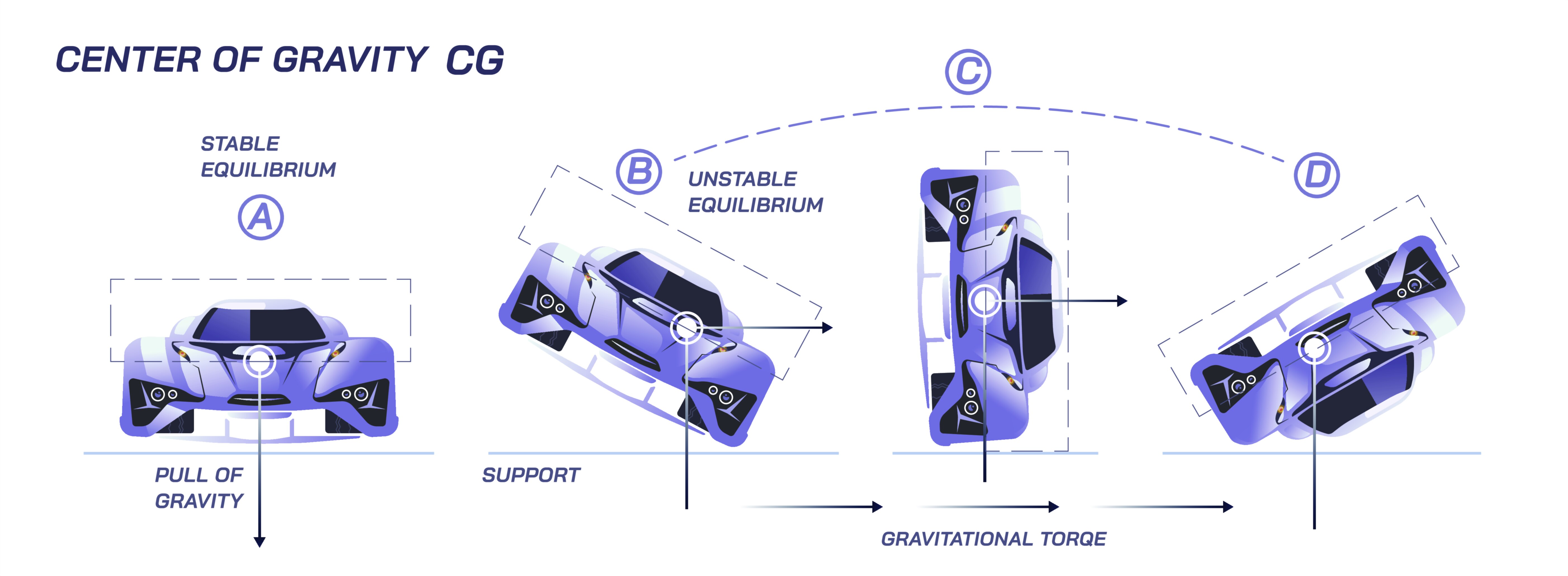
Stability itself depends entirely on how the center of gravity relates to the base of support. The base of support is the area beneath an object that touches the ground or any supporting surface. When the line of gravity—an imaginary vertical line passing downward from the center of gravity—falls within this base, the object remains balanced. When it falls outside, gravity creates a turning effect that causes the object to tip or fall. This is why athletes widen their stance before performing powerful motions, why furniture with broad bottoms resists tipping, and why tall, narrow objects tend to be unstable unless carefully designed. Lowering the center of gravity improves stability because it makes it harder for external forces to move the line of gravity beyond the base of support. Martial artists crouch to improve balance during combat, children instinctively widen their stance when learning to walk, and construction vehicles use heavy counterweights to keep their center of gravity safely positioned even when lifting massive loads.
Human movement reveals the remarkable complexity of maintaining stability. While walking, the center of gravity moves in a controlled path that shifts slightly from side to side and forward with every step. Running exaggerates this movement, requiring the body to repeatedly “catch itself” before falling. Standing still involves constant micro-corrections from leg and core muscles, which prevent the center of gravity from drifting outside the base of support. Specialized activities, such as ballet, acrobatics, gymnastics, or tightrope walking, involve intense awareness and mastery of this shifting point. A gymnast holding a handstand aligns their center of gravity above their hands with extraordinary precision; a dancer transitions smoothly between poses by moving their mass in a controlled flow; a circus performer stands on one foot atop a narrow platform by maintaining unwavering alignment between the center of gravity and the base beneath.
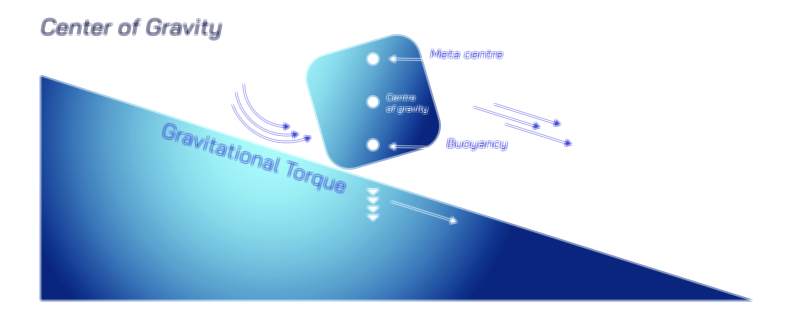
In engineering and design, the center of gravity is critical for constructing stable and safe structures. Buildings must resist wind forces, earthquakes, and shifting loads, requiring a center of gravity aligned to avoid tipping or collapse. Bridges distribute weight in carefully calculated patterns to maintain equilibrium under traffic and environmental forces. Cranes rely on counterweights that strategically lower and shift their center of gravity so they don't topple when lifting heavy loads. Vehicles are engineered with center of gravity considerations to enhance safety: cars designed with lower centers of gravity corner more safely and resist rollovers, while tall buses and trucks must account for the risk of tipping when turning or carrying cargo. Even aircraft must stay within strict center-of-gravity limits to ensure safe takeoff, stable flight, and controlled landing. In the maritime world, ships must maintain a center of gravity below the center of buoyancy to remain upright; improper cargo loading can raise the center of gravity enough to cause dangerous instability or capsizing.
The center of gravity also governs rotational stability. When an object rotates, it always spins around its center of gravity. A baton flipping through the air, a high diver somersaulting, or a skater spinning rapidly on the ice—all move with respect to this internal reference point. A figure skater accelerates their spin by pulling in their arms, concentrating mass closer to the center of gravity; when they extend their arms, the spin slows. Divers change their rotation speed by tucking or extending their limbs midair. Even falling objects like tools, toys, or tumbling debris follow predictable rotational paths defined by their center of gravity. These phenomena reveal that rotation and balance are deeply linked through this single point, highlighting how the distribution of mass dictates motion.
In robotics, maintaining the center of gravity within safe limits is essential for achieving human-like movement or stable walking on uneven terrain. Humanoid robots use sensors and algorithms to continuously monitor their center-of-gravity alignment, allowing them to walk, bend, climb stairs, or recover from pushes without falling. Quadrupedal robots shift their weight intelligently between legs as they move across obstacles. Industrial robots depend on fixed or dynamically controlled centers of gravity to avoid tipping during rapid, forceful actions. In these systems, balance emerges from computational strategies modeled after the very physics that govern living beings.
Nature itself provides countless examples of how organisms manipulate their center of gravity to survive. Cats use their tails to adjust balance during leaps or falls, altering the center of gravity midair. Birds change wing and tail positions to stabilize flight. Mountain goats stand securely on narrow cliff edges by keeping their center of gravity directly above small support points. Tall trees resist winds by distributing mass through trunks rooted deeply into the ground. Every animal that walks, flies, climbs, or swims must master the physics of equilibrium through evolutionary adaptations of structure and movement.
In art, performance, and design, the center of gravity becomes a creative instrument. Sculptors create pieces that appear precarious yet remain stable by ensuring the center of gravity stays over the supporting base. Dancers explore balance through movements that challenge the body’s natural equilibrium, shifting weight elegantly across space. Circus performers maintain stability in positions that seem to defy logic, demonstrating absolute control over their center of gravity.
Ultimately, the center of gravity is a universal principle that explains how stability and balance arise in the physical world. It reveals why objects stand upright, how bodies move gracefully, why structures remain strong, and what causes things to fall. Whether shaping the behavior of a simple toy, guiding an athlete’s movement, stabilizing a towering building, or determining the safety of vehicles and machines, the center of gravity informs every aspect of physical equilibrium. Through this concept, we gain a clearer understanding of how mass, movement, and gravity interact to create the stable, balanced world we rely on in every moment of life.