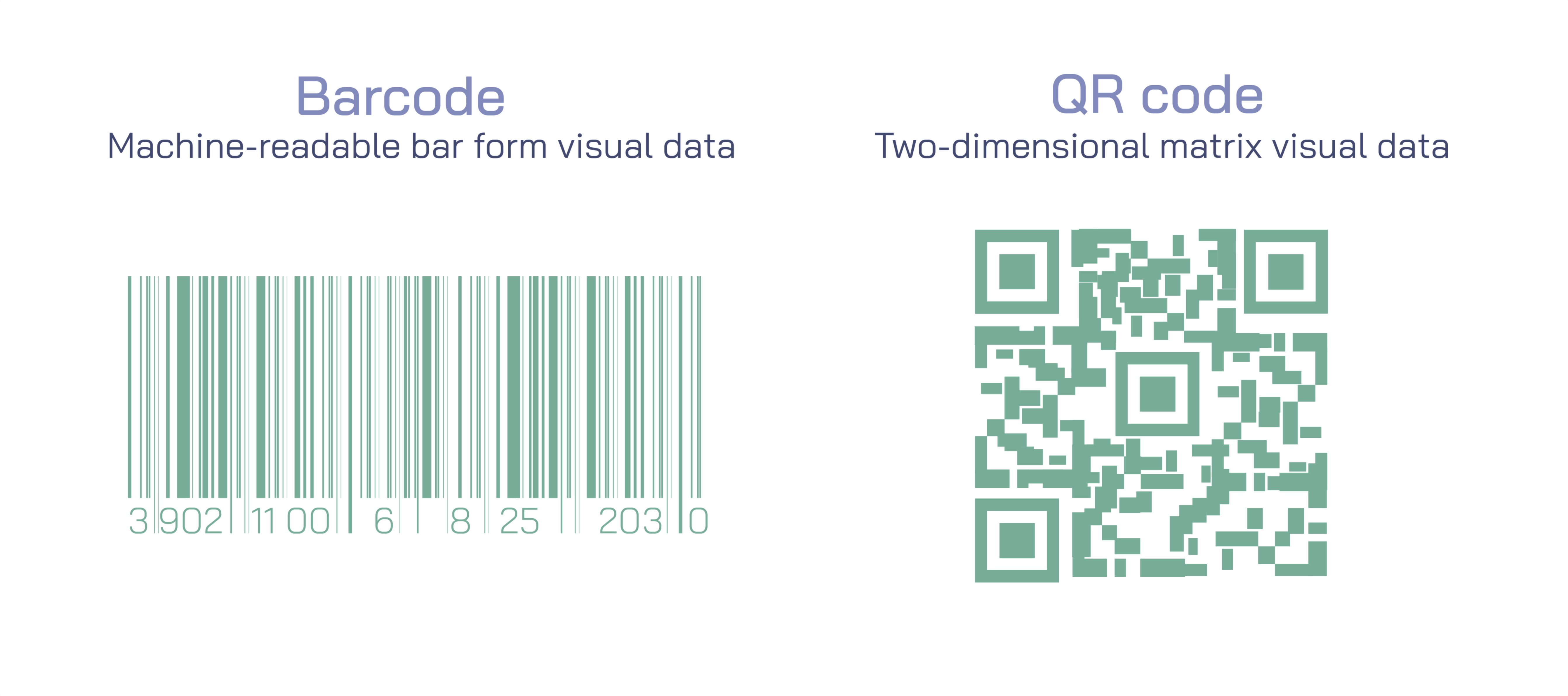
Bar Code and QR Code Showing Digital Scanning, Data Encoding, and Smart Identification Technology
Bar codes and QR codes are two of the most widely used machine-readable identification systems in the digital world, and although both store information visually through graphic patterns, they differ greatly in structure, capacity, and technological application. A clear illustration comparing their visual format, scanning behavior, and internal encoding makes it easy to understand why bar codes continue to dominate retail and inventory systems, while QR codes have become essential for smartphones, smart payments, authentication systems, and contactless services. At the core of both technologies is the same principle: information is encoded into a pattern of shapes that can be decoded by a device much faster and more accurately than by humans, enabling automation and efficiency in everything from supermarket checkout to logistics tracking and mobile payments.
The Bar Code, often referred to as a linear bar code, appears as a sequence of black vertical bars separated by white spaces of varying thickness. This system encodes information horizontally along a single dimension. Each pattern of bars and spaces corresponds to specific digits or letters according to a standardized encoding scheme. For example, UPC (Universal Product Code) used in retail stores encodes product identity such as manufacturer and item number so that every unit sold can be tracked precisely. Scanners read bar codes by emitting light across the surface; the black bars absorb more light while the white gaps reflect it. The resulting pattern of reflected light is converted into electrical signals and finally translated into digital data. This mechanism makes scanning extremely fast—far faster than manual entry—and resistant to typographical error. In visual comparisons, bar codes represent simplicity and efficiency: they store moderate amounts of information, are inexpensive to print, and are highly compatible with point-of-sale and warehouse systems.
However, bar codes have important limitations. Because data is stored in only one direction—left to right—the capacity is restricted. Most linear bar codes store only a limited number of characters, often numeric only. Bar codes are also sensitive to damage; a torn or wrinkled label may become unreadable because missing portions of the stripe disrupt the entire pattern. As the need for secure, compact, high-capacity data storage increased, a more advanced form of machine-readable encoding was developed: the QR code.
The QR Code—short for Quick Response Code—stores information in two dimensions rather than one. Instead of vertical bars, it displays a pattern of black squares and dots arranged on a white grid. Because the data is encoded both horizontally and vertically, a QR code can store far more information than a linear bar code—up to thousands of alphanumeric characters, full URLs, payment details, product history information, Wi-Fi access credentials, verification data, geolocation tags, and much more. The presence of three distinctive square markers in the corners of a QR code acts as a positioning guide for scanners, allowing the code to be read rapidly even if rotated, tilted, or partially damaged. This resilience is enhanced by built-in error-correction algorithms that reconstruct missing portions of the pattern if the code becomes scratched, dirty, or obscured. In diagrams comparing QR codes to bar codes, this two-dimensional structure and orientation flexibility stand out as major advantages.
The scanning technology of QR codes differs significantly from the traditional optical scanner used for bar codes. Smartphones and camera-based devices read QR codes by capturing the grid image and analyzing the contrast between dark and light modules using pattern-recognition algorithms. Because nearly all modern mobile devices integrate this recognition capability, QR codes have become one of the simplest ways to connect physical objects to digital information. The instant redirection to a website, payment gateway, product page, menu, contact form, or file download makes QR technology extremely valuable for smart commerce, digital marketing, event management, authentication, and Internet of Things (IoT) interactions.
Both technologies share a central purpose: to provide fast, automated identification without the need for human interpretation. However, their use cases differ based on capacity and versatility. Bar codes remain ideal for inventory labels, retail checkout, library systems, logistics, warehouse shelving, and any situation where a small amount of static information—such as a product number—is sufficient. QR codes excel in contexts where dynamic, high-capacity, or interactive data is needed, such as digital wallets, ticketing verification, vaccination proof, app downloads, multimedia links, user authentication, package journey tracking, secure login systems, and smart advertising where a simple scan unlocks additional content. QR codes can also be customized aesthetically with logos or colors without compromising scannability—an advantage bar codes cannot match.
Because both bar codes and QR codes have become deeply integrated into daily life, the contrast between them is often visual in illustrations:
A bar code shows straight vertical lines that store limited information in one direction.
A QR code shows a grid of squares and dots that stores high-density digital data in two directions.
Yet beneath the graphics lies a deeper message about how organizations use technology to bridge the physical and digital worlds. Bar codes automate identification and tracking, enabling efficiency in commercial and industrial systems. QR codes add a new dimension—fast digital connectivity—allowing objects, services, and locations to communicate instantly with computers and smartphones.
Together, bar code and QR code technology represent both the history and the evolution of digital identification. The bar code introduced automated tracking that transformed supply chains, retail systems, and manufacturing workflows. The QR code expanded that vision into the mobile and smart-device era, enabling not only recognition but also interaction. When illustrated side by side—showing scanning devices reading the patterns, data flowing into databases or mobile apps, and the storage of encoded information—the comparison highlights how both formats accomplish the same central task through different levels of complexity: turning visual symbols into usable information that moves the modern world.