Industrial conveyors are mechanical systems designed to transport materials efficiently from one location to another within industrial and commercial environments. They form the backbone of modern material handling and automation, enabling continuous, controlled movement of raw materials, components, and finished products. Without conveyor systems, large-scale manufacturing, mining, warehousing, and processing operations would be slower, more labor-intensive, and far less economical.
At their core, industrial conveyors are built to reduce manual handling and increase operational efficiency. By automating material transport, conveyors minimize human effort, reduce handling errors, and ensure consistent workflow. This makes them indispensable in industries where speed, precision, and safety are critical. Conveyors operate on the principle of continuous movement, allowing materials to flow steadily through different stages of production or processing.
The uses of industrial conveyors span a wide range of industries. In manufacturing plants, they connect different workstations, ensuring smooth movement of parts along assembly lines. In warehouses and logistics centers, conveyors handle sorting, loading, unloading, and distribution of goods. In mining and construction sectors, conveyors transport bulk materials such as coal, ores, sand, and aggregates over long distances. Food processing and pharmaceutical industries rely on conveyors for hygienic and controlled handling of products, while power stations use them to move fuel and waste materials efficiently.
There are several major types of industrial conveyors, each designed for specific applications. Belt conveyors are the most widely used type and consist of a continuous belt stretched over pulleys. They are ideal for transporting both bulk materials and packaged goods over horizontal or inclined paths. Their simplicity, reliability, and adaptability make them suitable for a wide variety of industrial uses.
Roller conveyors use cylindrical rollers mounted in frames to move items. These systems are commonly used in warehouses and distribution centers where boxes, pallets, or cartons need to be moved. Roller conveyors can be powered or gravity-based, depending on the required level of automation. They are especially effective for handling rigid loads with flat bottoms.
Chain conveyors are designed for heavy-duty applications. They use chains to move materials and are commonly found in automotive assembly lines and heavy manufacturing environments. Their robust construction allows them to handle high loads and harsh operating conditions.
Screw conveyors consist of a rotating helical screw enclosed within a tube or trough. They are widely used for moving granular, powdery, or semi-solid materials such as cement, grains, and chemicals. Screw conveyors provide controlled and enclosed transport, reducing spillage and contamination.
Bucket elevators are vertical or inclined conveyors equipped with buckets attached to a belt or chain. They are used to lift bulk materials such as grains, fertilizers, and minerals to higher elevations. Their design allows efficient vertical transport with minimal material loss.
Pneumatic conveyors use air pressure or vacuum to move materials through pipelines. These systems are particularly useful for transporting lightweight powders and granules in enclosed environments. Pneumatic conveying is common in food, chemical, and pharmaceutical industries due to its cleanliness and flexibility.
Another important aspect of industrial conveyors is belt types. Conveyor belts are the primary load-carrying components and are selected based on material characteristics, operating conditions, and industry requirements. Rubber belts are widely used for heavy-duty applications due to their strength and abrasion resistance. They are commonly found in mining, construction, and bulk material handling.
PVC belts are lightweight and cost-effective, making them suitable for packaging, logistics, and light manufacturing. They offer good flexibility and are easy to maintain. PU belts are often used in food processing and pharmaceutical industries because they are hygienic, resistant to oils, and easy to clean.
Steel mesh belts are used in applications involving high temperatures or where air circulation is required, such as baking, drying, or cooling processes. Fabric reinforced belts provide added strength and flexibility, allowing them to handle higher loads without excessive stretching. Specialized belts such as heat-resistant, oil-tolerant, and abrasion-protected varieties are designed to operate under specific environmental conditions.
Industrial conveyors are engineered to handle varying load capacities, speeds, and operating angles. Speed control systems allow precise regulation of material flow, while inclined and vertical conveyors enable efficient use of space. Modular designs make it easier to expand or reconfigure conveyor systems as production needs change.
Safety and reliability are critical considerations in conveyor design. Proper guarding, emergency stop mechanisms, and alignment systems help prevent accidents and equipment damage. Regular maintenance ensures smooth operation and extends service life, reducing downtime and operational costs.
From an economic perspective, industrial conveyors offer significant cost savings. By reducing manual labor, minimizing material loss, and improving workflow efficiency, conveyors enhance overall productivity. They also support industrial automation, enabling integration with sensors, control systems, and robotic equipment.
In modern industry, conveyors play a key role in workflow optimization. They ensure consistent material flow, reduce bottlenecks, and allow better coordination between production stages. As industries continue to move toward automation and smart manufacturing, conveyor systems remain essential components of efficient industrial infrastructure.
Industrial conveyors become even more important when we look beyond their basic function of moving materials and examine how deeply they influence the way modern industries are designed, operated, and scaled. A conveyor system is not just a piece of machinery; it is a backbone that shapes workflow, factory layout, labor structure, and even decision-making at a strategic level. Many industrial facilities are literally built around their conveyor systems, with production lines, storage zones, and processing units arranged to match the flow of materials.
One of the most significant advantages of industrial conveyors is their ability to create a predictable and repeatable workflow. Unlike manual handling, which varies depending on human speed, fatigue, and coordination, conveyors move materials at a constant, controlled pace. This consistency allows manufacturers to plan production more accurately, estimate output with greater precision, and synchronize different processes. When each stage of production receives materials at the right time and in the right quantity, overall efficiency improves dramatically.
Conveyors also play a major role in reducing physical strain and workplace injuries. Manual lifting, carrying, and repetitive handling are among the leading causes of industrial injuries. By taking over these physically demanding tasks, conveyors protect workers from fatigue, musculoskeletal disorders, and accidents. This not only improves worker safety and morale but also reduces downtime caused by injuries and compensation claims. In this way, conveyors contribute to both human well-being and operational stability.
Another important dimension of industrial conveyors is their adaptability to different environments. Conveyors can be designed to operate in extreme conditions such as high heat, freezing temperatures, dusty mines, humid food-processing plants, or chemically aggressive environments. Material selection, belt coatings, sealing systems, and structural design are all tailored to match these conditions. This flexibility allows conveyors to function reliably where many other transport methods would fail or require constant human intervention.
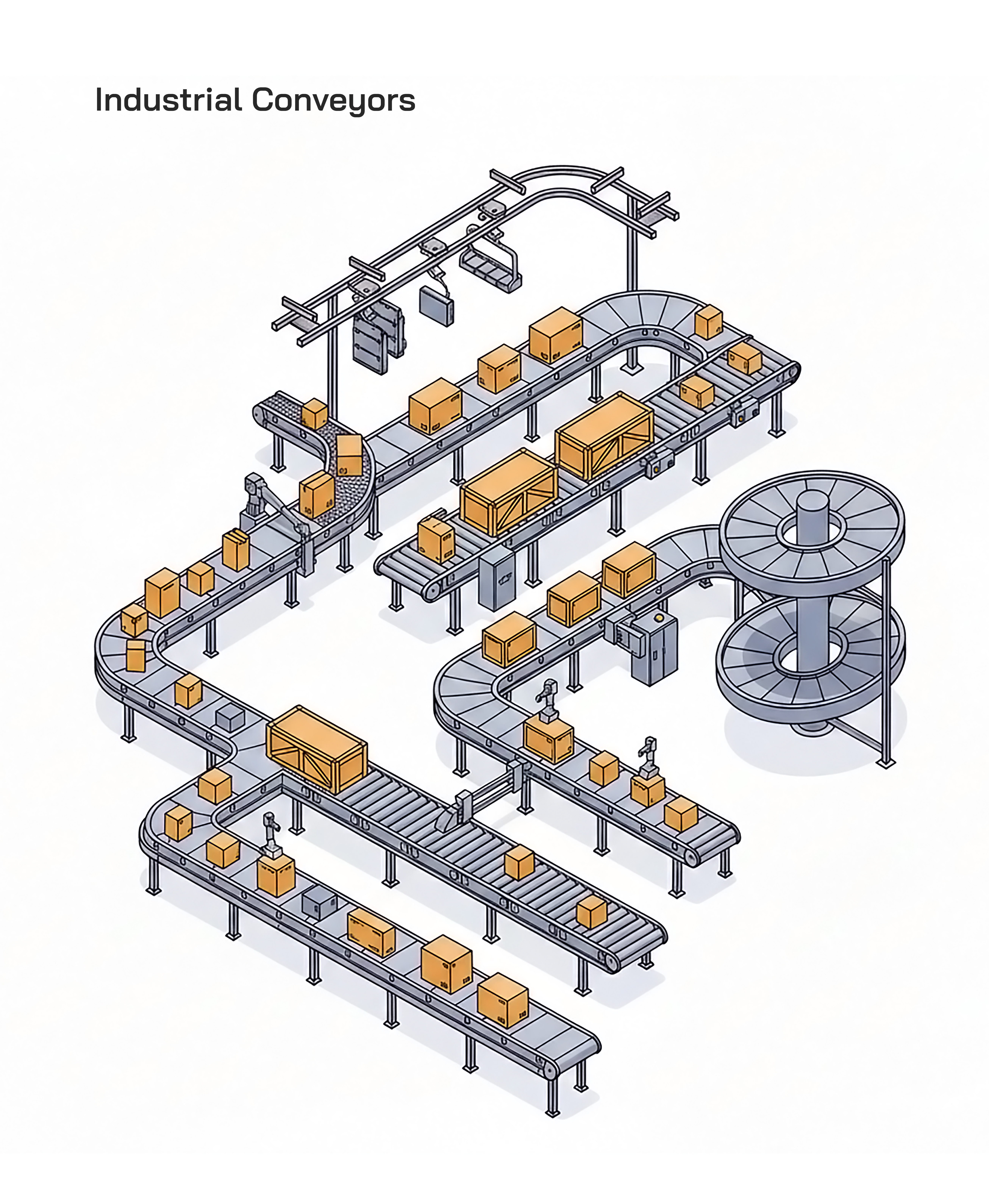
In terms of system design, conveyors are often customized to match the specific flow requirements of a facility. Straight-line conveyors are only the simplest form. In practice, conveyor systems may include curves, inclines, declines, vertical lifts, accumulation zones, and transfer points. These features allow materials to move efficiently through complex layouts without unnecessary handling. Smart design minimizes energy consumption and reduces wear by ensuring materials move smoothly rather than abruptly.
Automation has further expanded the role of conveyors in modern industry. Today’s conveyor systems are frequently integrated with sensors, programmable logic controllers, and computerized monitoring systems. These technologies allow conveyors to adjust speed automatically, stop when jams are detected, and coordinate with robotic arms or packaging machines. In advanced facilities, conveyors communicate with inventory management systems, enabling real-time tracking of materials as they move through production and storage.
Energy efficiency is another area where industrial conveyors have evolved significantly. Modern systems are designed to reduce power consumption through optimized motor sizing, variable frequency drives, and low-friction components. Some conveyors operate only when materials are present, automatically shutting down idle sections. These improvements reduce operating costs and align conveyor systems with sustainability goals, which are increasingly important in industrial planning.
Maintenance strategies have also become more sophisticated. Instead of waiting for breakdowns, many industries now use predictive maintenance approaches. Sensors monitor belt tension, motor temperature, vibration, and alignment, providing early warnings of potential issues. This allows maintenance teams to address problems before they cause failures, reducing downtime and extending equipment life. Well-maintained conveyor systems can operate reliably for many years, making them long-term investments rather than short-term tools.
Industrial conveyors also influence how businesses scale their operations. When demand increases, conveyor systems can often be extended or modified more easily than manual workflows. Modular conveyor designs allow companies to add new sections, change routes, or integrate additional machines without redesigning the entire system. This scalability makes conveyors particularly valuable in industries with fluctuating production volumes or expanding operations.
From a logistical perspective, conveyors enable high-throughput material handling that would be impossible with manual labor alone. In large distribution centers, thousands of items can be sorted, directed, and shipped every hour using conveyor networks. These systems rely on precise timing and coordination, ensuring that goods reach the correct destination with minimal delay. The speed and accuracy of conveyor-based logistics are critical to modern supply chains and e-commerce operations.
Environmental considerations also shape conveyor design and usage. Enclosed conveyors reduce dust emissions and prevent material spillage, protecting both workers and the surrounding environment. In food and pharmaceutical industries, hygienic conveyor designs prevent contamination and support strict regulatory standards. In mining and bulk handling, conveyors reduce the need for truck transport, lowering fuel consumption and emissions.
Beyond their physical role, conveyors influence how industries think about process optimization. By visualizing material flow, engineers can identify bottlenecks, inefficiencies, and waste. Conveyor systems make these issues visible and measurable, encouraging continuous improvement. Small changes in conveyor speed, layout, or sequencing can lead to significant gains in productivity and cost reduction.
In a broader sense, industrial conveyors symbolize the shift from labor-intensive production to automated, system-driven manufacturing. They represent the integration of mechanical engineering, control systems, and operational strategy into a unified whole. As industries continue to adopt smart manufacturing and Industry 4.0 principles, conveyors remain essential, serving as the physical link between digital planning and real-world production.
Ultimately, industrial conveyors are not merely tools for moving materials; they are enablers of modern industry. They support safety, efficiency, scalability, and innovation across countless sectors. By understanding their deeper role and capabilities, industries can design systems that are not only productive but resilient, sustainable, and ready to meet future demands.
Industrial conveyors reveal their full importance when we consider how they shape not just movement, but the entire philosophy of industrial efficiency. At a fundamental level, conveyors represent the idea of flow. Instead of treating material handling as a series of isolated actions, conveyors transform it into a continuous, organized stream. This shift from stop-and-go handling to smooth flow is one of the greatest contributors to modern industrial productivity, because it reduces wasted time, unnecessary motion, and idle resources.
One of the most valuable but often unnoticed benefits of conveyor systems is how they standardize processes. When materials move manually, every worker may handle items slightly differently, introducing variation. Conveyors eliminate much of this inconsistency by ensuring that materials arrive at workstations in the same orientation, at the same height, and at the same pace every time. This standardization improves product quality, simplifies training, and reduces the likelihood of errors, especially in assembly and packaging operations.
Conveyors also influence how factories manage space. Vertical conveyors, spiral conveyors, and overhead systems allow materials to move above or below working areas, freeing valuable floor space. This vertical integration is especially important in urban or high-cost industrial zones where expanding horizontally is impractical. By moving materials efficiently through multiple levels, conveyors help industries maximize output without increasing building size.
Another important dimension is how conveyors support just-in-time production systems. In such systems, materials are delivered exactly when needed, rather than being stored in large quantities. Conveyors make this possible by providing precise timing and controlled delivery between processes. This reduces inventory costs, minimizes storage requirements, and improves responsiveness to changes in demand. In highly optimized operations, conveyors act almost like a circulatory system, delivering materials exactly where and when they are required.
Human interaction with conveyor systems has also evolved significantly. Modern conveyors are designed with ergonomics in mind, ensuring that workers interact with materials at comfortable heights and angles. Adjustable conveyor heights, tilting sections, and ergonomic transfer points reduce strain and fatigue. Instead of workers adapting their bodies to machines, machines are increasingly designed to adapt to human needs, improving both comfort and productivity.
Noise reduction is another area where conveyor design has advanced. Early conveyor systems were often loud, creating stressful working environments. Today, improved materials, precision components, and better lubrication have significantly reduced noise levels. Quieter conveyors contribute to better communication, reduced stress, and improved overall workplace conditions, which in turn enhance long-term productivity and employee satisfaction.
In highly regulated industries, conveyors play a crucial role in compliance. Food, pharmaceutical, and medical device industries must meet strict hygiene and traceability standards. Conveyors in these environments are designed with smooth surfaces, minimal crevices, and easy-to-clean components. Some systems are built to be washed down regularly, while others use antimicrobial materials. These features ensure that conveyors support not only efficiency, but also safety and regulatory compliance.
Conveyors also contribute to traceability and quality control. When integrated with scanning systems, sensors, and tracking software, conveyors can record the movement of individual items throughout the production process. This allows manufacturers to trace defects back to specific batches, machines, or time periods. In industries where recalls or quality audits are critical, this level of visibility is invaluable.
Another key advantage of conveyors is their role in reducing material damage. Manual handling increases the risk of drops, impacts, and improper stacking. Conveyors move materials gently and predictably, reducing shock and vibration. Specialized conveyor designs, such as cushioned belts or accumulation conveyors, allow products to queue without contact, protecting fragile items like electronics, glass, or packaged food.
From a systems perspective, conveyors act as connectors between different technologies. Robotic arms, automated storage systems, sorting machines, and inspection units all rely on conveyors to deliver materials accurately. Without conveyors, automation would be fragmented and inefficient. In this sense, conveyors are the physical foundation that allows digital automation and robotics to function effectively.
Training and workforce development are also influenced by conveyor systems. As material handling becomes more automated, workers shift from physically moving goods to supervising systems, monitoring performance, and handling exceptions. This changes skill requirements, emphasizing technical understanding, problem-solving, and system awareness. Conveyors therefore play a role in shaping the modern industrial workforce, pushing it toward higher-skill, safer roles.
Environmental sustainability is becoming increasingly important in conveyor system design. Lightweight materials, energy-efficient motors, and intelligent control systems reduce power consumption. Enclosed conveyors minimize dust and spillage, protecting surrounding ecosystems. In some industries, conveyors replace fleets of trucks or forklifts, reducing fuel use and emissions. These benefits make conveyors an important part of sustainable industrial strategies.
Looking to the future, conveyor systems are becoming smarter and more adaptive. With advances in sensors, artificial intelligence, and data analytics, conveyors can optimize themselves in real time. They can adjust speed based on workload, reroute materials automatically, and predict failures before they occur. This intelligence transforms conveyors from passive machines into active participants in production decision-making.
In a broader sense, industrial conveyors represent the invisible order behind modern life. The products people use every day—from food and clothing to electronics and building materials—have almost certainly traveled on conveyor systems at some point. These systems quietly enable mass production, global trade, and rapid distribution without drawing attention to themselves.
Ultimately, industrial conveyors are not just mechanical devices; they are strategic assets. They influence efficiency, safety, quality, scalability, and sustainability all at once. By understanding conveyors as integrated systems rather than simple transport tools, industries can unlock higher levels of performance and resilience. In the modern industrial world, conveyors are not optional conveniences—they are essential frameworks that allow complex operations to function smoothly, reliably, and economically.
In conclusion, industrial conveyors are vital systems that support material handling across countless industries. Their uses range from simple transport to complex automated workflows. With a wide variety of conveyor types and belt options available, these systems can be tailored to specific operational needs. By improving efficiency, safety, and productivity, industrial conveyors continue to be a cornerstone of modern industrial operations.