A fixed platform oil rig system is one of the most established and widely used offshore structures for the extraction of oil and natural gas from beneath the seabed. These platforms represent a cornerstone of offshore petroleum engineering and have played a critical role in meeting global energy demands for decades. Designed to remain permanently anchored to the ocean floor, fixed platforms provide a stable and durable base for drilling, production, and processing operations in offshore environments, particularly in shallow to moderately deep waters.
The fundamental concept of a fixed platform oil rig system lies in its rigid connection to the seabed. Unlike floating rigs, fixed platforms are physically attached to the ocean floor using large steel or concrete support structures. These supports are engineered to withstand extreme environmental forces, including waves, currents, wind, and storms. The stability provided by this fixed foundation allows for continuous drilling and production activities with high operational reliability and safety.
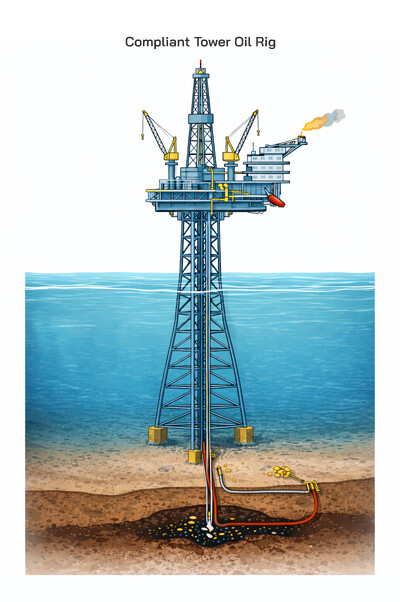
Structurally, a fixed platform typically consists of two main sections: the substructure and the topside. The substructure, often referred to as a jacket or base, is the portion that extends from the seabed to above the water surface. Steel jacket platforms are the most common type, constructed from tubular steel members arranged in a lattice framework. This design offers excellent strength while minimizing resistance to water movement. In some cases, particularly for very shallow waters or specific geological conditions, gravity-based concrete structures are used. These rely on their massive weight to remain securely positioned on the seabed.
The topside of a fixed platform houses all the operational facilities required for drilling and production. This includes drilling rigs, wellheads, processing equipment, power generation units, living quarters, control rooms, and safety systems. The topside is typically fabricated in modules onshore and then transported to the installation site, where it is lifted and secured onto the substructure. This modular approach improves construction efficiency and reduces offshore installation time.
The working process of a fixed platform oil rig system begins with drilling wells into the seabed to access underground oil and gas reservoirs. Once drilling is completed, the platform transitions into the production phase. Hydrocarbons flow from the reservoir through wellbores to the surface, where they are processed to separate oil, gas, water, and other impurities. The processed hydrocarbons are then transported to shore via subsea pipelines or transferred to storage and transportation vessels.
Fixed platforms are particularly well-suited for operations on the continental shelf, where water depths are generally limited. Their design makes them most economical and practical in shallow water environments, typically up to a few hundred meters in depth. In these conditions, fixed platforms offer long-term stability and lower operational costs compared to floating systems, especially when producing from large or long-life reservoirs.
One of the key advantages of fixed platform oil rig systems is their durability. Once installed, they can remain operational for several decades with proper maintenance. Their rigid structure allows for precise drilling operations and supports heavy equipment, making them ideal for large-scale production. The stability of fixed platforms also enhances safety, as there is minimal movement compared to floating rigs.
Another significant benefit is their ability to support extensive processing facilities directly on the platform. This reduces the need for additional offshore infrastructure and simplifies production logistics. Fixed platforms can handle multiple wells and high production volumes, making them efficient hubs for offshore oil and gas extraction.
However, fixed platform systems also have limitations. Their installation requires substantial upfront investment, including fabrication, transportation, and heavy-lift operations. They are not suitable for deepwater environments, where the cost and engineering challenges become prohibitive. Additionally, once installed, fixed platforms cannot be relocated, which limits flexibility if reservoir conditions change or production declines earlier than expected.
Environmental considerations are an important aspect of fixed platform design and operation. Engineers incorporate corrosion protection systems, such as coatings and cathodic protection, to prevent structural degradation caused by seawater. Platforms are also designed to minimize environmental impact, with strict safety measures in place to prevent oil spills and manage waste. Over their lifecycle, fixed platforms are subject to rigorous inspection and maintenance programs to ensure structural integrity and environmental compliance.
The installation process of a fixed platform oil rig system is a complex engineering undertaking. It begins with detailed seabed surveys and geotechnical analysis to assess soil conditions and load-bearing capacity. The jacket or base structure is then transported offshore and positioned using specialized vessels. Piles are driven deep into the seabed through the legs of the jacket to secure it firmly in place. Once the substructure is installed, the topside modules are lifted and integrated, followed by commissioning and testing of all systems.
From an economic perspective, fixed platforms remain a vital component of the offshore energy sector. They are particularly valuable for mature offshore fields where long-term production is expected. Their ability to operate continuously with high efficiency makes them a reliable source of oil and gas for national and global energy supply chains.
In the broader context of offshore engineering, fixed platform oil rig systems represent a balance between structural strength, operational efficiency, and economic viability. While newer technologies such as floating platforms and subsea production systems have expanded the range of offshore development, fixed platforms continue to dominate shallow-water offshore production due to their proven performance and reliability.
Fixed platform oil rig systems also involve a complex network of subsea and surface components that work together beyond the primary structural elements. Beneath the seabed, well casings, cement layers, and reservoir control systems ensure that hydrocarbons are extracted safely and efficiently. These subsurface elements are designed to isolate different geological layers, prevent fluid migration, and maintain pressure control throughout the life of the field. The integration between subsurface engineering and surface facilities is a defining strength of fixed platform operations, allowing engineers to manage reservoirs with high precision over long periods.
A critical operational aspect of fixed platforms is reservoir management. Because these platforms are intended for long-term production, engineers continuously monitor reservoir pressure, flow rates, and fluid composition. This data helps optimize recovery while preventing damage to the reservoir. Techniques such as water injection or gas injection are often implemented through the same fixed platform infrastructure to maintain pressure and improve hydrocarbon recovery. These secondary recovery methods significantly extend the productive life of offshore fields.
Fixed platforms also play an important role in offshore field development planning. They are often used as central hubs that connect multiple satellite wells or smaller subsea structures. In such configurations, the fixed platform serves as the main processing and control center, while additional wells feed hydrocarbons back to it via subsea pipelines. This hub-and-spoke approach improves economic efficiency by reducing the need for multiple large platforms in the same field.
Another important dimension of fixed platform systems is their role in offshore logistics. These platforms are designed to support regular helicopter and supply vessel operations. Helidecks enable safe personnel transfer, while cranes facilitate the loading and unloading of equipment, supplies, and materials. Efficient logistics are essential for maintaining uninterrupted production, conducting maintenance, and responding quickly to operational issues.
Human factors engineering is a major consideration in fixed platform design. Living quarters are engineered to provide safe, comfortable accommodation for offshore workers who may remain on the platform for extended rotations. These areas include sleeping facilities, dining spaces, recreation rooms, and medical stations. The layout of work areas, walkways, and control rooms is carefully planned to reduce fatigue, enhance safety, and improve operational efficiency in a challenging offshore environment.
Fire and explosion protection systems are particularly critical on fixed platforms. Hydrocarbon processing inherently involves flammable materials, so platforms are equipped with advanced detection and suppression systems. These include gas detectors, fire alarms, deluge systems, firewalls, and emergency shutdown mechanisms. The rigid structure of fixed platforms allows for well-defined safety zones that separate hazardous areas from living and control spaces.
From a maintenance perspective, fixed platforms are designed for accessibility and longevity. Structural members are inspected regularly using visual inspections, sensors, and underwater inspection techniques. Maintenance strategies focus on preventing corrosion, fatigue damage, and structural degradation. Because fixed platforms remain in one location for decades, long-term asset integrity management is a central operational priority.
Decommissioning is another important aspect of fixed platform lifecycle management. When a field reaches the end of its productive life, the platform must be safely dismantled or repurposed. Decommissioning involves plugging and abandoning wells, removing topside facilities, and addressing the substructure according to environmental and regulatory requirements. In some cases, parts of fixed platforms are converted into artificial reefs, supporting marine ecosystems and providing environmental benefits after production ends.
Fixed platform oil rig systems also have strategic importance for national energy security. Their long-term, stable production profiles make them reliable contributors to domestic energy supplies. Countries with extensive continental shelves have relied heavily on fixed platforms to develop offshore resources in a controlled and predictable manner. This reliability has supported economic development and reduced dependence on imported energy in many regions.
Technological innovation continues to influence fixed platform design and operation. Digital monitoring systems, automation, and remote control technologies are increasingly integrated into platform operations. These advancements improve efficiency, reduce human exposure to hazardous conditions, and enable predictive maintenance. Even though fixed platforms are a mature technology, ongoing innovation ensures they remain competitive and relevant in modern offshore development.
Environmental monitoring around fixed platforms has also advanced significantly. Continuous monitoring of water quality, seabed conditions, and marine life helps operators detect and mitigate environmental impacts. Fixed platforms, due to their permanence, often become habitats for marine organisms, creating localized ecosystems around their structures. Understanding and managing these ecological interactions is now an important component of offshore operations.
In the broader evolution of offshore energy systems, fixed platforms represent a foundational technology that paved the way for more advanced offshore developments. Lessons learned from decades of fixed platform operation have informed the design of floating platforms, subsea systems, and hybrid offshore installations. Their legacy is deeply embedded in offshore engineering knowledge and best practices.
Overall, fixed platform oil rig systems are not just static structures but dynamic, integrated production systems. They combine geology, structural engineering, mechanical systems, human operations, and environmental management into a single long-term offshore solution. Their continued use reflects a balance between proven reliability and adaptive modernization, ensuring they remain a key element of offshore energy production where conditions allow.
Fixed platform oil rig systems are also closely tied to offshore regulatory frameworks and international safety standards, which shape how these structures are designed, operated, and maintained. Because fixed platforms remain permanently in one location, governments require extensive environmental impact assessments and risk analyses before approval. These assessments consider seabed stability, marine ecosystems, shipping routes, and long-term environmental risks. Compliance with such regulations ensures that fixed platforms operate within strict safety and environmental boundaries throughout their lifespan.
Material selection is another critical yet often overlooked aspect of fixed platform systems. The harsh marine environment exposes structures to constant saltwater corrosion, temperature variations, and cyclic loading from waves and currents. Engineers therefore rely on specialized high-strength steels, corrosion-resistant alloys, and advanced protective coatings. Sacrificial anodes and impressed current cathodic protection systems are installed to slow electrochemical corrosion, significantly extending structural life and reducing maintenance frequency.
Wave and fatigue analysis plays a major role in the engineering of fixed platforms. Even though these structures are rigidly anchored, they are subject to continuous cyclic stresses caused by waves, tides, and wind. Over time, these repeated loads can lead to metal fatigue. Engineers model these forces in detail during the design phase to ensure that joints, welds, and structural members can withstand decades of operation without failure. Fatigue-resistant design is one of the reasons fixed platforms are considered highly reliable offshore structures.
Fixed platforms also support complex drilling strategies that go beyond simple vertical wells. Directional and horizontal drilling techniques allow operators to reach reservoirs located far from the platform’s base. This capability reduces the number of platforms required in a field and minimizes seabed disturbance. By drilling multiple wells from a single fixed platform, operators maximize resource recovery while limiting environmental footprint.
Another important operational element is produced water management. Along with oil and gas, reservoirs often produce significant amounts of water. Fixed platforms are equipped with treatment systems that separate and treat this water before it is either reinjected into the reservoir or discharged in compliance with environmental regulations. Effective water management is essential to maintaining production efficiency and protecting marine environments.
Fixed platform oil rigs also influence offshore workforce culture and operations. Workers typically follow rotational schedules, spending weeks offshore before returning onshore. This operational model requires careful planning of staffing, training, and emergency preparedness. The stable nature of fixed platforms allows for more predictable working conditions compared to floating rigs, which can be affected by constant motion.
In terms of power supply, fixed platforms may generate electricity on-site using gas turbines fueled by produced natural gas. This self-sufficiency reduces dependence on external power sources and improves operational reliability. In some regions, platforms are also connected to onshore power grids, reducing emissions and improving energy efficiency. The choice of power strategy depends on location, distance from shore, and environmental considerations.
Communication and data systems are another integral part of modern fixed platforms. High-speed data links transmit real-time operational information to onshore control centers. This allows engineers and managers to monitor performance, detect anomalies, and make informed decisions without being physically present offshore. Digital integration has transformed fixed platforms into data-driven assets, enhancing safety and efficiency.
Fixed platforms can also play a transitional role in the evolving energy landscape. Some existing platforms are being evaluated for reuse or adaptation in renewable energy projects, such as offshore wind or carbon capture and storage operations. Their robust foundations and established offshore presence make them potential candidates for supporting new energy infrastructure, extending their usefulness beyond traditional oil and gas production.
Weather resilience is another distinguishing factor of fixed platform systems. These structures are designed to endure extreme weather events, including hurricanes and cyclones, depending on their geographic location. Elevated decks, reinforced structural members, and wave-resistant designs help protect critical equipment and personnel. This resilience contributes to uninterrupted production and reduces downtime caused by adverse weather.
Economically, fixed platforms often anchor entire offshore supply chains. Their long-term presence supports service vessels, maintenance contractors, logistics hubs, and onshore processing facilities. This creates sustained economic activity and employment in coastal regions. The predictability of fixed platform operations makes them attractive investments when reservoir size and lifespan justify the initial capital cost.
From a systems engineering perspective, fixed platforms exemplify integration at scale. Mechanical systems, structural elements, process equipment, safety infrastructure, and human operations are all tightly coordinated. Any modification or upgrade must be carefully assessed to avoid unintended impacts on other systems. This integrated complexity is managed through detailed engineering documentation and rigorous change management processes.
In educational and engineering contexts, fixed platform oil rig systems are often used as case studies for offshore design principles. They demonstrate how engineering disciplines converge to solve challenges related to stability, durability, safety, and environmental stewardship. Lessons learned from fixed platforms continue to influence offshore engineering standards worldwide.
Ultimately, fixed platform oil rig systems represent a mature yet continually evolving technology. Their long operational history provides valuable insight into offshore risk management, lifecycle planning, and sustainable resource extraction. Even as offshore energy systems diversify, fixed platforms remain a benchmark for reliability and engineering excellence in shallow-water offshore production.
In conclusion, the fixed platform oil rig system is a foundational technology in offshore oil and gas production. Its rigid seabed anchoring, robust structural design, and capacity to support extensive drilling and processing operations make it indispensable in suitable water depths. Despite evolving energy landscapes and technological advancements, fixed platforms remain a critical asset in meeting global energy demands, showcasing the enduring importance of sound engineering and structural stability in offshore petroleum operations.