Nicotinamide — Structure, Function, and Health Benefits
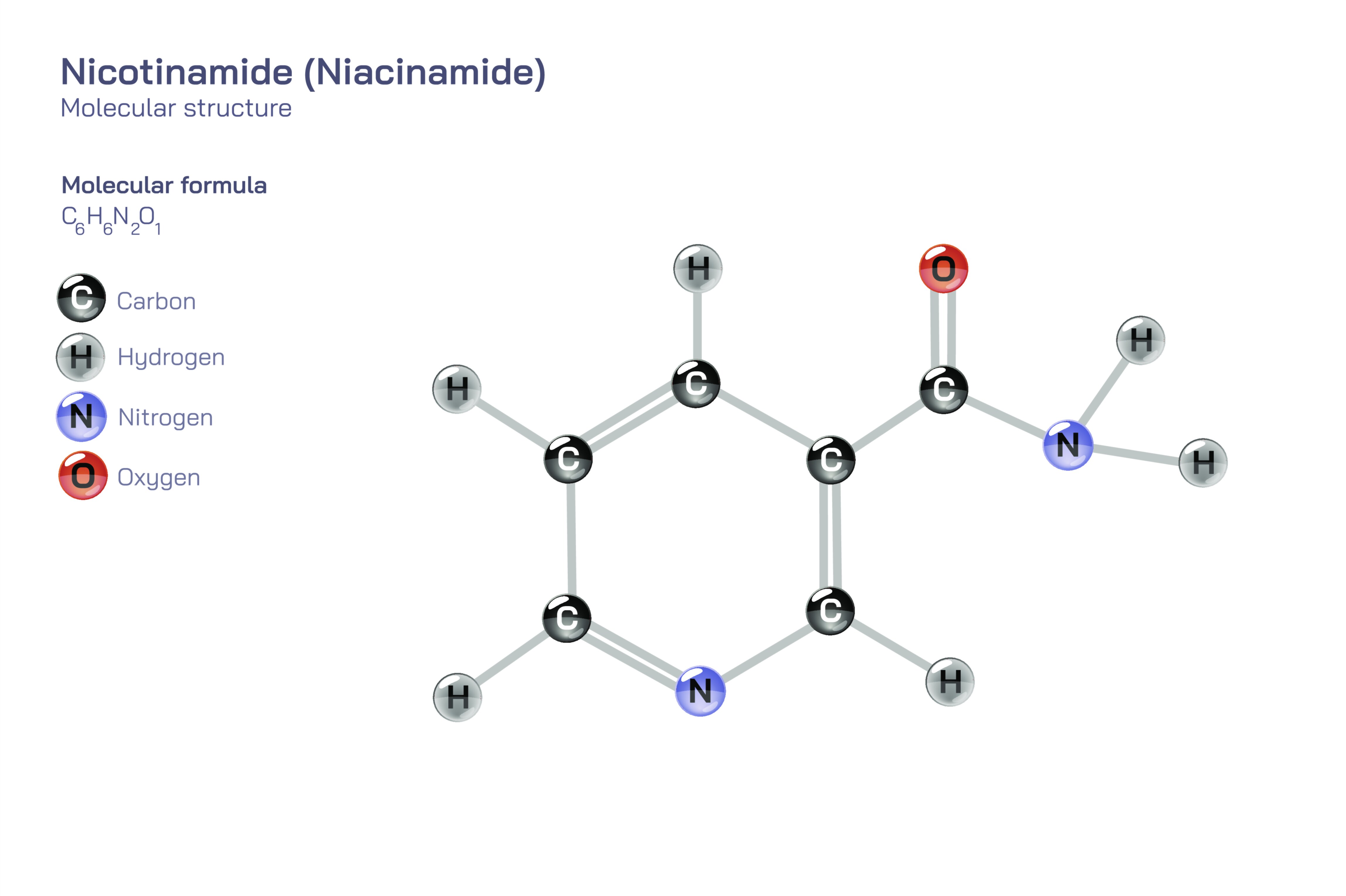
Nicotinamide, also known as niacinamide, is a biologically essential molecule whose chemical structure and functional behavior enable it to support cellular energy metabolism, DNA repair, immune function, neurological balance, skin health, and overall physiological resilience. It is one of the two major forms of vitamin B3 (the other being nicotinic acid), and its biological significance arises not merely from the atoms that constitute it but from the way those atoms are arranged into a structure that allows the molecule to serve as a precursor for some of the most fundamental biochemical cofactors in living systems. Structurally, nicotinamide consists of a six-membered aromatic pyridine ring bearing an amide substituent, an arrangement that gives it a unique combination of stability, water solubility, and reactivity. When represented in a vector illustration of molecular structure, the pyridine ring appears as a hexagonal ring with alternating double bonds, and the amide group is shown branching from the ring in the form of a carbonyl bonded to an amine. This positioning is not incidental: it allows nicotinamide to enter cellular pathways that convert it into the coenzymes nicotinamide adenine dinucleotide (NAD⁺) and its phosphorylated form NADP⁺. These coenzymes lie at the heart of energy metabolism, serving as electron carriers in redox reactions that make ATP production possible. The chemical blueprint of nicotinamide therefore functions not merely as a vitamin but as an irreplaceable building block in the biochemical machinery that sustains life.
The functional role of nicotinamide in the human body extends immediately to energy production, because NAD⁺ participates in every major metabolic pathway that harvests energy from carbohydrates, fats, and proteins. Cells produce ATP through processes that rely on the transfer of electrons from nutrient molecules to NAD⁺, and the resulting NADH delivers these electrons into the mitochondrial electron transport chain. Without an adequate supply of nicotinamide, the body cannot synthesize sufficient NAD⁺, and the orderly flow of energy collapses. This is why vitamin B3 deficiency leads to pellagra, a disease characterized by weakness, cognitive impairment, mucosal and dermatological damage, and gastrointestinal dysfunction. The phenomenon illustrates the direct connection between molecular structure and physiological outcome: without the nicotinamide component of NAD⁺, mitochondria lack the electron-shuttling capability needed to maintain life. In addition to ATP production, NADP⁺ supports anabolic reactions including fatty acid synthesis, cholesterol metabolism, and antioxidant regeneration through glutathione recycling, reinforcing the understanding that nicotinamide is a cornerstone of cellular redox balance. It becomes clear that nicotinamide is not a luxury nutrient but a functional participant in every moment of biochemical activity within living organisms.
Nicotinamide also plays a central role in DNA repair and genomic stability, a feature that emerges from its involvement in NAD⁺-dependent enzymes such as PARPs (poly-ADP-ribose polymerases) and sirtuins. These enzymes require NAD⁺ as a substrate to regulate chromatin structure, coordinate cellular responses to DNA damage, and determine whether a cell repairs itself, halts its growth, or undergoes programmed cell death. When DNA strands break — whether through oxidative stress, environmental toxins, ultraviolet exposure, or ordinary metabolic activity — PARPs are activated and use NAD⁺ to signal and guide repair processes. Similarly, sirtuins depend on NAD⁺ to regulate gene expression, inflammatory signaling, mitochondrial efficiency, and cellular aging. Because NAD⁺ availability is dependent on dietary and metabolic levels of nicotinamide, the vitamin becomes tightly linked to longevity pathways, cell survival mechanisms, and the maintenance of healthy tissue. The scientific interest in nicotinamide for healthy aging, neuroprotection, and metabolic wellness stems from this structural foundation: the molecule furnishes the NAD⁺ that makes these restorative pathways possible.
In dermatological science, nicotinamide has attracted substantial attention due to its ability to support skin barrier function, reduce inflammation, improve moisture retention, and assist in DNA repair following ultraviolet radiation exposure. Unlike the flushing response that sometimes accompanies high-dose nicotinic acid, nicotinamide does not trigger vasodilatory reactions and is therefore well tolerated in both oral and topical forms. Because skin cells are directly exposed to oxidative stress and UV-induced DNA damage, they rely heavily on NAD⁺ to activate repair pathways. Topical nicotinamide increases NAD⁺ levels locally and therefore enhances skin resilience to environmental stressors. It supports the synthesis of ceramides, which strengthen the lipid barrier that prevents moisture loss, and it reduces inflammatory signaling in acne-prone and sensitive skin types. Clinical dermatology has also shown that oral nicotinamide supplementation can reduce the recurrence of non-melanoma skin cancers in high-risk populations by supporting the repair of UV-damaged DNA — again reinforcing that the benefits originate not from superficial coverage but from biochemical support for cellular self-maintenance.
Nicotinamide also influences neurological function because the nervous system is one of the most energy-demanding tissues in the human body. Neurons depend on a constant supply of NAD⁺ to maintain membrane potential, neurotransmission, and synaptic plasticity. When NAD⁺ levels are low — whether due to aging, chronic inflammation, or metabolic dysfunction — oxidative stress accumulates, calcium homeostasis becomes unstable, and cells become more vulnerable to degeneration. By supplying the precursor required to restore NAD⁺, nicotinamide supports energy metabolism within neurons, reduces excitotoxicity, and helps maintain the balance of neurotransmitter systems. Research interest in nicotinamide for Parkinson’s disease, Alzheimer’s disease, multiple sclerosis, and neuroinflammatory disorders reflects the recognition that boosting NAD⁺ metabolism is a biochemical rather than symptomatic intervention. This connection does not make nicotinamide a cure for neurological disease, but it illustrates that neural health is directly tied to the metabolic pathways enabled by its molecular structure.
Nicotinamide also affects the immune system because immune cells proliferate rapidly and generate reactive oxygen species as part of host defense — processes that require robust NAD⁺ availability. During immune activation, white blood cells increase their demand for NAD⁺ to support rapid ATP turnover, antioxidant defense, and inflammatory cytokine production. When NAD⁺ levels fall, immune response becomes erratic, inflammation becomes dysregulated, and tissue damage may occur. Nicotinamide supplementation has demonstrated benefits in stabilizing immune function in inflammatory skin conditions, metabolic disorders, and immune exhaustion states by improving NAD⁺-dependent control of inflammatory signaling. In this way, the immune-modulating properties of nicotinamide are not the result of direct suppression or stimulation but arise from restoring the metabolic environment in which immune cells can function harmoniously.
The safety and tolerability profile of nicotinamide is one of the reasons it is widely used. Unlike nicotinic acid, it does not produce flushing reactions or sharp changes in lipid metabolism and can therefore be used comfortably in long-term supplementation. At physiological levels, it does not accumulate in tissues or cause toxicity because excess is metabolized and excreted. Nevertheless, as with any biologically active compound, extreme megadoses may interfere with methylation pathways or hepatic metabolism, reminding us that nutritional molecules achieve beneficial outcomes when balanced with biological demand rather than exaggerated beyond natural metabolic capacity. When used appropriately, nicotinamide offers a biological advantage by supporting the steady supply of NAD⁺ rather than forcing rapid, destabilizing shifts in metabolism.
Across energy metabolism, DNA repair, immune function, skin health, neurological resilience, and cellular longevity, the diverse effects of nicotinamide trace back to a single principle: its structure enables the body to synthesize the NAD⁺ and NADP⁺ required to sustain life. When a vector illustration shows nicotinamide as a pyridine ring with an amide substituent, it displays the molecular identity that makes all of these biological functions possible. Although that diagram appears simple, the molecule it depicts influences thousands of enzymatic reactions happening every second in every cell. The amide-bearing aromatic ring becomes the backbone of coenzymes that govern energy, survival, defense, and repair. Through this relationship between structure and function, nicotinamide serves as a clear example of how microscopic molecular architecture translates into macroscopic health benefits that affect the entire human organism — illustrating once again that the most powerful tools of biology are often contained within the smallest structures of chemistry.