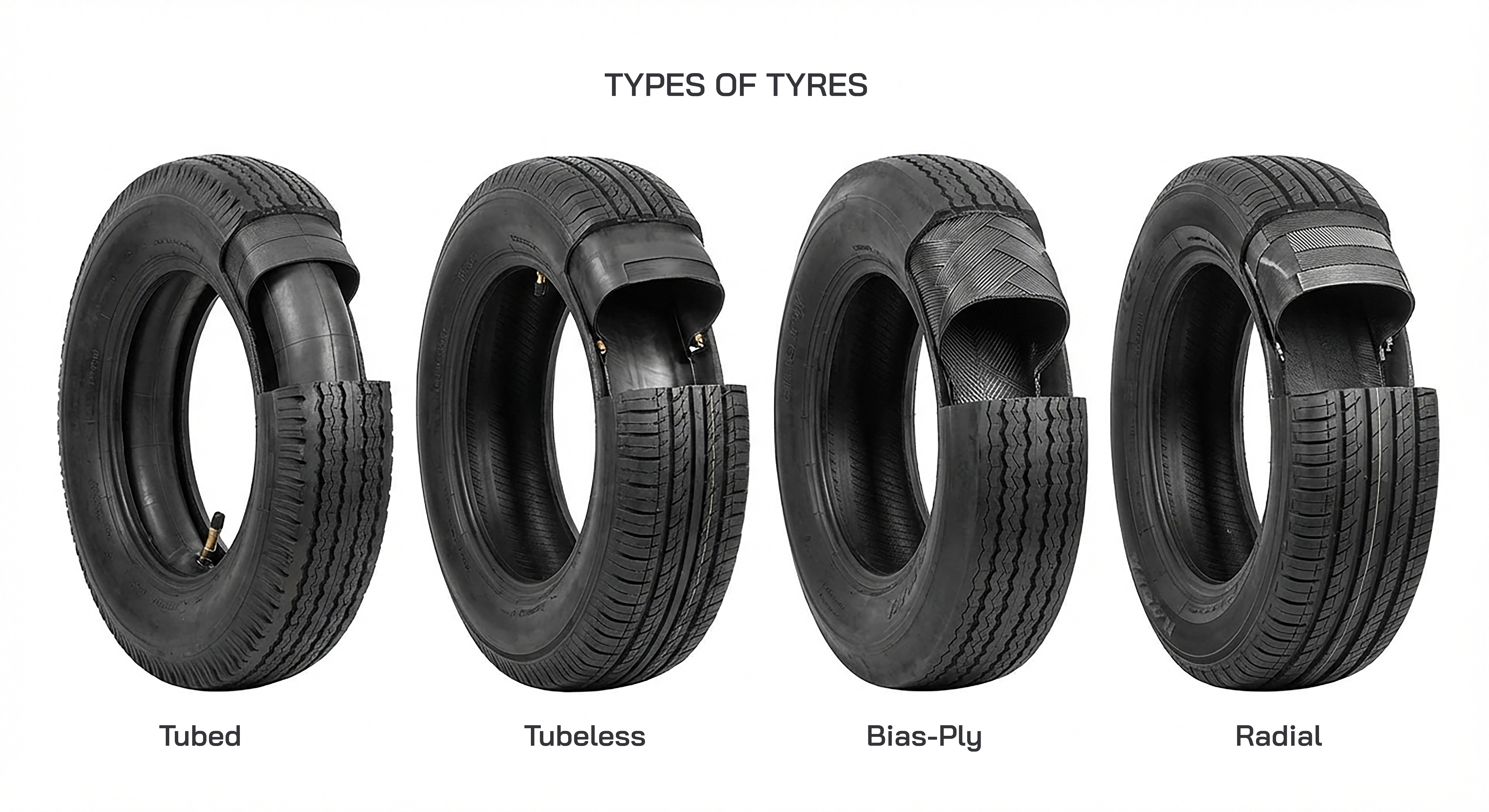
Tyres are not uniform components; they are engineered in different structural forms to meet specific vehicle requirements, road conditions, and performance expectations. Among the most commonly recognized tyre types are tubed, tubeless, bias ply, and radial tyres. Each type represents a distinct approach to air retention, internal construction, flexibility, and durability. Understanding these tyre types is essential for making informed decisions related to safety, comfort, efficiency, and long-term vehicle performance.
Tubed tyres represent one of the earliest and most traditional tyre designs. In this type, air is held inside a separate inner chamber that sits between the outer rubber casing and the wheel rim. The outer casing provides structural strength and road contact, while the inner tube maintains air pressure. This design has historically been common in older vehicles, bicycles, motorcycles, and wheels with spokes that cannot form an airtight seal. One characteristic of tubed tyres is that when punctured, air can escape rapidly, often resulting in sudden deflation. While the construction is simple and repairs are straightforward, the presence of an inner tube increases friction and heat generation during operation, which can affect durability at higher speeds.
Tubeless tyres represent a more advanced approach to air retention. Instead of using a separate inner chamber, these tyres incorporate an airtight inner lining that seals directly against the wheel rim. This design significantly reduces the chances of sudden air loss, as punctures typically cause slow leakage rather than immediate deflation. Tubeless tyres also generate less heat because there is no friction between a tube and the outer casing. This improves stability, especially during extended highway driving. Their ability to maintain pressure more consistently enhances safety, comfort, and fuel efficiency, making them the preferred choice for most modern passenger vehicles.
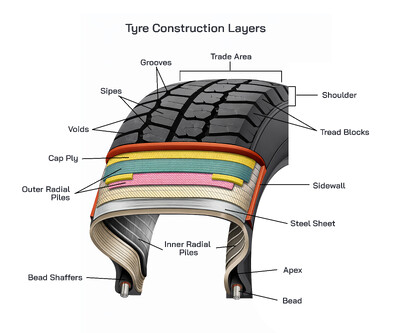
Bias ply tyres differ from tubed or tubeless classifications because they are defined by internal cord orientation rather than air containment method. In bias ply construction, reinforcing cords are arranged diagonally across the tyre, with each layer crossing over the next. This creates a thick, layered structure that provides high strength and resistance to heavy loads. The sidewalls and tread area act together as a single unit, resulting in a relatively stiff structure. Bias ply tyres perform well under heavy-duty conditions and uneven surfaces, making them suitable for agricultural machinery, industrial equipment, and certain off-road applications. However, this stiffness also leads to higher rolling resistance and reduced comfort at higher speeds.
Radial tyres represent a major technological advancement in tyre engineering. In this design, internal cords are arranged perpendicular to the direction of travel, extending from one bead to the other. This configuration allows the sidewalls and tread area to function independently. Steel or fabric belts are placed beneath the tread to enhance stability while maintaining sidewall flexibility. The result is improved road contact, smoother rolling behavior, and better heat dissipation. Radial tyres offer superior ride comfort, longer service life, and improved handling, especially during cornering and braking. These advantages have made radial construction the global standard for most road-going vehicles.
Each tyre type responds differently to driving conditions. Tubed tyres are often favored in environments where repair simplicity is important and speeds remain low. Tubeless tyres excel in modern mobility scenarios where safety, efficiency, and comfort are priorities. Bias ply tyres are chosen for rugged service where strength and load-bearing capacity outweigh speed considerations. Radial tyres dominate passenger transport due to their balanced performance, reduced fuel consumption, and enhanced driving stability.
The choice between these tyre types also affects maintenance practices. Tubed tyres require careful monitoring of both the outer casing and the inner chamber. Tubeless tyres rely on proper rim sealing and benefit from regular pressure checks. Bias ply tyres may wear more evenly under heavy loads but can generate more heat on paved surfaces. Radial tyres require precise alignment and balancing to deliver their full performance potential.
From a safety perspective, understanding tyre construction is critical. Sudden deflation risks, heat buildup, braking behavior, and corner stability are all influenced by tyre type. Using an inappropriate tyre for a specific application can compromise control and increase wear. Matching tyre design to vehicle purpose and driving environment ensures optimal performance and reliability.
In terms of technological evolution, the transition from tubed and bias ply designs toward tubeless and radial constructions reflects advancements in materials science and automotive engineering. Modern tyres are designed not only to support vehicle weight but also to contribute actively to handling, efficiency, and safety systems.
Tyres are far more than simple rubber rings that allow a vehicle to roll. They are complex, load-bearing, heat-managing, grip-generating structures that operate under constant stress while being the only point of contact between a vehicle and the road. When we look beyond the basic categories of tubed, tubeless, bias ply, and radial tyres, a deeper layer of engineering intent becomes visible. Each design reflects compromises between strength, flexibility, heat control, cost, safety, and service conditions, all shaped by decades of real-world use and technological refinement.
One important aspect often overlooked is how tyre construction affects heat behavior over time. Heat is the silent enemy of tyre life. As a tyre flexes during rotation, internal friction generates heat. In tubed tyres, this heat is amplified because the inner tube rubs slightly against the outer casing, especially under load or low pressure. Over long distances or higher speeds, this heat accumulation can weaken materials and increase failure risk. Tubeless tyres manage heat more efficiently because the air is held directly within the tyre structure, reducing internal movement and allowing heat to dissipate more evenly through the casing and rim. This difference becomes especially noticeable during extended highway driving or in hot climates.
Air pressure stability is another critical factor that separates these tyre types in practical use. Tubed tyres tend to lose air more suddenly when punctured because the inner tube can tear or pinch, releasing air rapidly. This sudden pressure loss can reduce control instantly. Tubeless tyres, by contrast, often self-regulate minor punctures as the rubber seals around small objects like nails, allowing air to escape slowly. This gradual loss gives drivers more time to react, stop safely, and address the issue. This single characteristic has played a major role in tubeless tyres becoming the standard for modern passenger vehicles.
The interaction between tyre construction and road surface also deserves attention. Bias ply tyres, with their crisscross cord layers, distribute stress across the entire structure, making the tyre feel solid and robust. On rough terrain, loose soil, or uneven surfaces, this stiffness becomes an advantage because the tyre resists cuts, sidewall damage, and deformation. However, on smooth paved roads, the same stiffness limits the tyre’s ability to adapt to minor surface irregularities, reducing comfort and increasing rolling resistance. This is why bias ply tyres feel harsher at speed and consume more energy compared to radial tyres.
Radial tyres behave very differently because their sidewalls and tread perform separate roles. The flexible sidewalls absorb shocks and road imperfections, while the reinforced tread area maintains a stable contact patch. This separation allows the tyre to maintain consistent grip even as the vehicle corners, brakes, or accelerates. Over time, this also leads to more uniform tread wear, extending tyre life. The improved contact with the road translates into better steering response and predictable handling, qualities that are essential for modern vehicles equipped with advanced braking and stability systems.
Another layer of understanding comes from maintenance and long-term ownership. Tubed tyres may seem easier to repair in remote or rural areas because a punctured tube can be patched or replaced without specialized equipment. This makes them practical in regions where service infrastructure is limited. Tubeless tyres, while requiring proper rim compatibility and careful mounting, reduce the frequency of complete breakdowns due to punctures. Their maintenance focuses more on regular pressure monitoring and timely inspection of valve stems and rim seals.
Bias ply tyres demand attention to load limits and operating speeds. They perform best when used exactly as intended, under heavy loads and moderate speeds. When pushed beyond these conditions, heat buildup accelerates wear and reduces reliability. Radial tyres, although more forgiving, require accurate wheel alignment and balancing. Because they are more responsive, even small misalignments can lead to uneven wear. This sensitivity is not a flaw but a reflection of their precision-oriented design.
Tyre construction also influences fuel efficiency in subtle but measurable ways. Rolling resistance, which is the energy lost as a tyre deforms and recovers during rotation, is higher in bias ply tyres due to their stiffer structure. Radial tyres minimize this energy loss through flexible sidewalls and optimized tread design, allowing vehicles to travel farther using the same amount of fuel. Over thousands of kilometers, this efficiency difference becomes economically and environmentally significant.
Noise generation is another dimension shaped by tyre design. Older tubed and bias ply tyres often produce more road noise because their rigid structure transmits vibrations directly into the vehicle. Modern radial tubeless tyres are engineered with noise-reducing tread patterns and internal damping characteristics that absorb vibrations before they reach the cabin. This contributes to the quieter, smoother ride expected in contemporary vehicles.
From a safety engineering perspective, tyre evolution mirrors the broader evolution of vehicles themselves. As engines became more powerful and vehicles capable of higher speeds, tyre designs had to manage greater forces without compromising control. Radial tubeless tyres emerged not just as a comfort upgrade but as a safety necessity, capable of handling heat, speed, and load simultaneously while maintaining predictable behavior under stress.
Environmental considerations are now influencing tyre development as well. Longer-lasting radial tyres reduce waste, while improved fuel efficiency lowers emissions indirectly. Tubeless designs also minimize material use by eliminating inner tubes, reducing overall resource consumption. These factors are increasingly important as automotive design moves toward sustainability.
In real-world decision-making, no tyre type is universally “better” in all situations. Each exists because it serves a purpose shaped by geography, vehicle design, usage patterns, and economic considerations. Understanding these deeper characteristics allows drivers, mechanics, and vehicle owners to make choices that align with safety, performance expectations, and practical realities rather than relying solely on tradition or cost.
Ultimately, tyres represent a balance between science and experience. Their internal structures reflect decades of learning about how rubber, fabric, steel, air, heat, and motion interact under constant stress. By appreciating the additional layers of design behind tubed, tubeless, bias ply, and radial tyres, one gains a clearer understanding of why modern mobility feels safer, smoother, and more reliable than ever before.
In conclusion, tubed, tubeless, bias ply, and radial tyres each represent distinct engineering philosophies. Tubed tyres emphasize simplicity, tubeless tyres prioritize safety and efficiency, bias ply tyres focus on strength, and radial tyres deliver balanced performance. Understanding these differences empowers drivers, technicians, and vehicle owners to select the most suitable tyre type, ensuring safer, smoother, and more efficient transportation across a wide range of driving conditions.