Knowing your tyre type is a fundamental aspect of vehicle ownership, safety, and performance. Every tyre carries a wealth of information printed on its sidewall, encoded in a standardized format that communicates its size, construction, load capacity, speed capability, and intended vehicle application. Understanding these markings allows drivers to select the correct tyres, maintain proper performance, and ensure compliance with safety standards. Although the sequence of letters and numbers may appear complex at first glance, each element has a specific meaning that can be interpreted with clarity once the structure is understood.
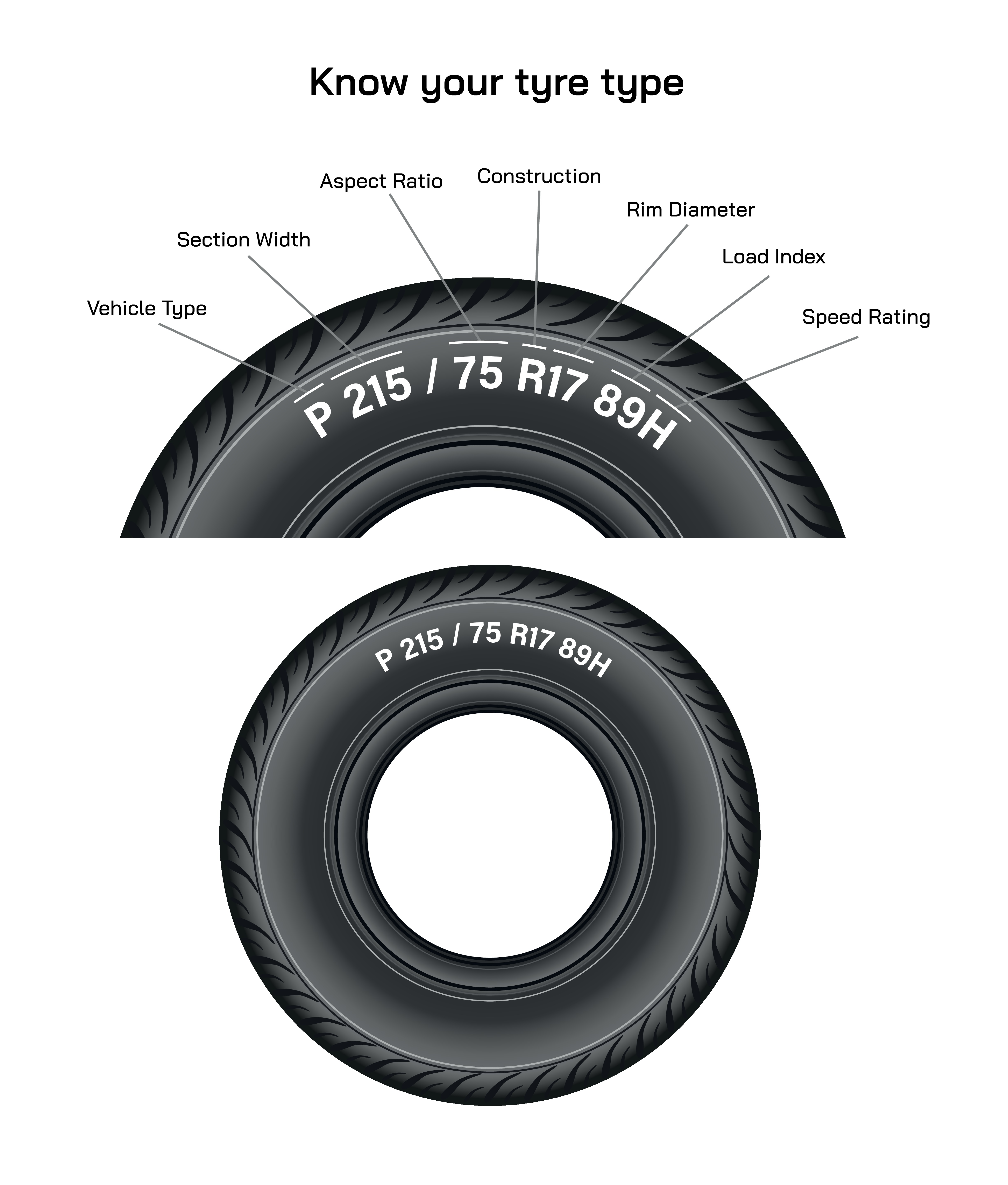
The tyre sidewall typically begins with a letter or combination of letters that indicate the vehicle category for which the tyre is designed. This classification helps distinguish tyres intended for passenger cars, commercial vehicles, or two-wheelers. The vehicle category influences the tyre’s load-carrying capability, structural strength, and performance expectations. Selecting a tyre that matches the vehicle type is essential, as incorrect classification can affect handling stability and braking control.
Following the vehicle category is the section width, which represents the width of the tyre from one sidewall to the other when mounted and inflated under standard conditions. This measurement is usually expressed in metric units and plays a significant role in determining road contact area. A wider tyre generally provides better grip and stability, while a narrower tyre may improve fuel efficiency and reduce rolling resistance. Choosing the correct width ensures proper clearance within the wheel well and avoids interference with suspension components.
Next in the sequence is the aspect ratio, expressed as a percentage. This value indicates the height of the tyre’s sidewall relative to its width. A lower aspect ratio means a shorter sidewall, which typically enhances handling response and cornering stability. A higher aspect ratio results in a taller sidewall, offering improved ride comfort and impact absorption. Understanding the aspect ratio helps drivers balance comfort and performance according to driving conditions and vehicle design.
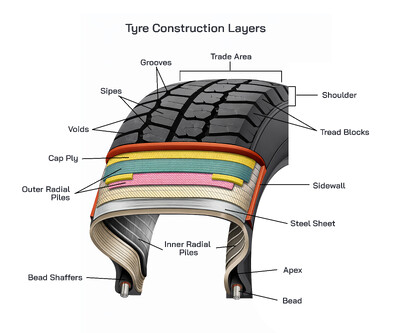
The construction type is a crucial part of tyre identification. Most modern tyres feature radial construction, indicated by a specific letter on the sidewall. Radial tyres have internal cords arranged perpendicular to the direction of travel, providing better flexibility, heat dissipation, and tread life. In contrast, older bias-ply tyres use diagonal cord arrangements, which offer different load-handling characteristics but are less common in modern passenger vehicles. Knowing the construction type ensures compatibility with vehicle suspension and handling characteristics.
The rim diameter follows the construction indicator and specifies the size of the wheel on which the tyre must be mounted. This measurement is critical for proper fitment, as even a small mismatch can prevent installation or compromise safety. The rim diameter must match exactly with the wheel size specified by the vehicle manufacturer. Proper alignment between tyre and rim ensures secure seating, balanced rotation, and effective load distribution.
Beyond size and construction, the tyre sidewall also displays the load index. This numerical code represents the maximum load the tyre can safely carry when properly inflated. Each load index corresponds to a specific weight value defined by international standards. Using tyres with an inadequate load index can lead to excessive stress, overheating, and potential failure. Understanding this rating is particularly important for vehicles carrying heavy loads or operating under demanding conditions.
Adjacent to the load index is the speed rating, represented by a letter. This rating indicates the maximum speed at which the tyre can operate safely under recommended conditions. Speed ratings are standardized and reflect the tyre’s ability to manage heat and maintain structural integrity at higher speeds. Selecting a tyre with an appropriate speed rating ensures safe performance during highway driving and prevents premature wear or damage.
Additional information on the sidewall may include details about tubeless format, manufacturing standards, and compliance codes. Tubeless tyres are designed to retain air without an inner tube, improving puncture resistance and reducing sudden air loss. Compliance markings indicate adherence to safety and quality regulations, providing assurance of reliability and performance consistency.
Understanding tyre type also involves recognizing how these markings relate to real-world driving conditions. Tyres designed for highway usage differ from those intended for off-road environments. Performance-oriented tyres prioritize grip and handling, while durability-focused tyres emphasize long service life and resistance to wear. Climate suitability is another important consideration, as tyres must perform reliably across temperature variations and weather conditions.
Correct tyre identification supports effective maintenance practices. Proper air inflation, aligned with sidewall specifications, ensures even wear and optimal performance. Awareness of tyre ratings helps drivers monitor wear patterns and determine appropriate replacement intervals. Using the correct tyre type also contributes to improved fuel efficiency and reduced environmental impact through lower rolling resistance.
From a safety perspective, knowing your tyre type enhances road safety by ensuring that tyres match vehicle requirements and driving demands. Properly rated tyres improve braking control, steering precision, and overall vehicle stability. They also reduce the risk of blowouts and mechanical failure, particularly during high-speed travel or heavy loading.
Knowing your tyre type goes far beyond reading numbers on a sidewall; it is about understanding how those markings translate into real driving behavior, safety margins, and long-term vehicle health. Tyres are the only components of a vehicle that maintain continuous contact with the road, and every decision made during their design is reflected in the information printed on them. When drivers truly understand tyre type, they gain insight into how their vehicle interacts with the road under everyday conditions as well as during critical moments.
One important but often overlooked aspect of tyre type knowledge is how manufacturers design tyres for specific driving priorities. Some tyres are engineered with a focus on stability and predictability rather than outright grip. These tyres may not feel sporty, but they provide consistent behavior across a wide range of speeds and road surfaces. Others are designed to deliver immediate response and strong cornering forces, which can feel exciting but may wear faster or perform poorly in cold conditions. The tyre type printed on the sidewall reflects these design philosophies, even if it is not stated explicitly.
Tyre type also determines how a vehicle reacts under stress. During emergency braking or sudden steering inputs, tyres experience extreme forces in very short timeframes. A tyre that matches the vehicle’s intended use responds progressively, allowing the driver to maintain control. A mismatched tyre may react abruptly, reducing stability and increasing stopping distance. This is why tyre type is not just a recommendation but an integral part of the vehicle’s safety system.
Another deeper consideration is how tyre type influences suspension performance. Vehicle suspension systems are tuned assuming a certain tyre stiffness, sidewall flexibility, and contact behavior. When tyres with significantly different characteristics are installed, suspension geometry may no longer work as intended. This can result in increased vibration, uneven tire wear, or unpredictable handling. Even if the tyre physically fits the wheel, an unsuitable tyre type can disrupt the delicate balance engineered into the vehicle.
Tyre type also plays a major role in how a vehicle handles long-distance driving. Heat buildup over time is one of the biggest enemies of tyre integrity. Tyres designed for sustained highway speeds manage heat more efficiently through internal structure and compound selection. Using a tyre type not intended for prolonged high-speed operation can cause gradual internal damage that is invisible from the outside. Understanding tyre type helps drivers avoid these hidden risks, especially during long journeys.
Fuel efficiency is another area strongly influenced by tyre type. Rolling resistance varies significantly between tyre designs. Some tyres are engineered to minimize energy loss as they roll, improving fuel economy and reducing emissions. Others sacrifice efficiency for grip or durability. While the difference may seem small on a daily basis, over thousands of kilometers it becomes substantial. Choosing the correct tyre type aligns vehicle performance with economic and environmental goals without compromising safety.
Noise and comfort are also deeply tied to tyre type. The internal structure and tread layout determine how road vibrations and air movement are transmitted into the vehicle cabin. Tyres designed for comfort reduce harshness and road noise, making long drives less fatiguing. Performance-focused tyres may transmit more feedback and noise, which some drivers prefer for road feel but others find uncomfortable. Knowing tyre type allows drivers to match tyre behavior with personal driving preferences.
Tyre type awareness is especially important as vehicles age. As suspension components wear, tyres often compensate by absorbing additional vibration and irregular movement. Choosing a tyre type with appropriate sidewall characteristics can help maintain ride quality and control even as mechanical components experience normal wear. Conversely, an unsuitable tyre type can amplify existing issues, making the vehicle feel unstable or harsh.
Seasonal conditions further highlight the importance of tyre type. Temperature changes affect rubber flexibility, which directly impacts grip. Tyres designed for warmer climates may harden in cold weather, reducing traction. Tyres intended for variable or cold conditions remain flexible, maintaining safer performance. Understanding tyre type helps drivers anticipate how their vehicle will behave across seasons rather than reacting after performance drops.
Tyre type also influences driver confidence. A vehicle that responds consistently builds trust between the driver and the machine. This trust encourages smoother driving, better anticipation of road conditions, and fewer panic reactions. When tyres behave unpredictably due to incorrect type selection, drivers may overcorrect or hesitate, increasing the risk of accidents. Confidence is not just psychological; it is rooted in predictable mechanical behavior.
From a maintenance perspective, knowing tyre type helps drivers recognize normal versus abnormal wear. Different tyre constructions wear in different patterns. Understanding what is expected allows drivers to identify alignment issues, improper inflation, or suspension problems early. This proactive awareness can prevent costly repairs and extend the overall lifespan of both tyres and vehicle components.
Tyre type knowledge also supports informed replacement decisions. When replacing tyres, drivers often focus only on size compatibility. However, maintaining consistent tyre type across replacements ensures that vehicle behavior remains familiar. Sudden changes in handling, braking response, or ride quality are often traced back to unnoticed changes in tyre type rather than mechanical faults.
At a broader level, understanding tyre type encourages responsible vehicle ownership. It shifts tyre selection from guesswork to informed decision-making. This reduces waste caused by premature tyre replacement and improves overall road safety. In a world where vehicles are becoming faster, heavier, and more technologically advanced, tyres remain a fundamental safety component that depends heavily on correct identification and use.
Ultimately, knowing your tyre type is about understanding how your vehicle communicates with the road. Tyres translate steering inputs into direction, braking force into stopping power, and engine output into motion. Every marking on the sidewall reflects choices made to balance safety, comfort, efficiency, and durability. When drivers take the time to understand these markings, they gain control not only over tyre selection but over the entire driving experience.
In practical terms, tyre type knowledge empowers drivers. It allows them to choose tyres that suit their driving habits, environment, and vehicle design rather than relying solely on recommendations or assumptions. This understanding transforms tyres from overlooked consumables into critical performance components. In doing so, it enhances safety, confidence, and satisfaction on every journey, making tyre knowledge an essential part of responsible and informed driving.
Understanding tyre type is not merely an exercise in decoding symbols; it is about learning how a vehicle is meant to behave in real driving situations. Every tyre is designed with assumptions about how it will be used, where it will be driven, and what kind of stresses it will face over its lifetime. The sidewall markings are a compressed form of this design logic, translating complex engineering decisions into a format that drivers and technicians can reference. When these markings are properly understood, they become a powerful tool for making smarter, safer, and more confident driving choices.
One of the most important but rarely discussed aspects of tyre type is how it influences driver perception. The way a vehicle feels on the road—how quickly it responds to steering, how stable it feels at speed, and how confidently it stops—is largely determined by the tyres. Two vehicles of the same model can feel completely different if their tyre types differ. This difference is not accidental; it is the result of variations in stiffness, construction intent, and performance limits encoded into the tyre’s specifications. Knowing tyre type helps drivers understand why a vehicle feels the way it does and whether that behavior matches their expectations and driving needs.
Tyre type also plays a significant role in how a vehicle behaves at its limits. Under normal driving, many tyres feel similar. Differences become obvious during sudden braking, evasive steering, or driving on poor surfaces. A tyre designed for moderate speeds and loads may perform acceptably in daily traffic but lose composure when pushed harder. A tyre intended for higher performance will maintain control longer under stress but may sacrifice comfort or longevity. Sidewall information quietly indicates where those limits lie, allowing drivers to choose tyres that provide a suitable margin of safety for their driving style.
Another layer of importance lies in vehicle balance. Modern vehicles are carefully engineered systems in which tyres are part of the suspension and steering design. Manufacturers tune suspension geometry, damping, and steering response around specific tyre characteristics. Installing a tyre type that deviates significantly from what the vehicle expects can alter this balance. The result may be excessive body movement, increased road noise, or uneven tyre wear. Even though the tyre may meet size requirements, its type can still affect how harmoniously the vehicle systems work together.
Tyre type also determines how forgiving a vehicle is to imperfect conditions. Roads are rarely ideal, and drivers do not always maintain perfect inflation or alignment. Some tyre types are designed with greater tolerance for these imperfections. They may continue to perform safely even when conditions are less than ideal. Others are more sensitive, delivering excellent performance when everything is correct but deteriorating quickly when conditions deviate. Understanding tyre type helps drivers select tyres that match not only their vehicle, but also their maintenance habits and local road quality.
Weather adaptation is another crucial dimension. Tyre type reflects assumptions about operating temperature and surface conditions. Rubber compounds behave differently depending on temperature, and tyre construction determines how quickly heat builds up or dissipates. A tyre type suited for warm climates may feel stiff and unresponsive in colder conditions, reducing grip and increasing stopping distances. Conversely, a tyre designed for variable conditions maintains more consistent behavior as temperatures change. Sidewall markings provide clues to these design intentions, even if they do not explicitly mention climate.
Tyre type awareness also influences how drivers interpret wear and aging. As tyres age, rubber compounds harden and internal flexibility changes. A tyre type designed with higher initial stiffness may become noticeably harsher as it ages, while a more comfort-oriented tyre may remain acceptable for longer. Understanding tyre type allows drivers to anticipate these changes and replace tyres before performance drops below acceptable levels. This proactive approach improves safety and avoids the false assumption that tread depth alone determines tyre usability.
Another often-overlooked factor is how tyre type affects emergency scenarios. In sudden avoidance maneuvers, tyres must generate rapid lateral forces without losing grip. The internal structure and intended performance range of the tyre determine how smoothly this force builds. A well-matched tyre provides progressive feedback, allowing the driver to adjust steering input. A mismatched tyre may break traction abruptly, reducing the driver’s ability to recover. Sidewall information helps identify tyres designed to maintain control under such conditions.
Tyre type also has implications for vehicle loading beyond simple weight capacity. How a tyre responds to partial loads, uneven loads, or shifting loads depends on its structural design. For example, a tyre designed for consistent highway cruising may behave differently when frequently carrying heavy cargo or multiple passengers. Knowing tyre type allows drivers to match tyres not only to maximum load requirements but also to typical usage patterns, improving stability and comfort.
From an economic perspective, understanding tyre type helps avoid false savings. Choosing a cheaper tyre that technically fits but does not match the vehicle’s needs can result in faster wear, reduced efficiency, or compromised safety. Over time, these drawbacks often outweigh initial cost savings. Conversely, selecting a tyre type aligned with vehicle design and driving habits maximizes value by delivering consistent performance and predictable lifespan.
Tyre type knowledge also becomes increasingly important as vehicles evolve. Modern vehicles generate higher torque, use advanced driver-assistance systems, and rely on precise sensor feedback. Tyres play a critical role in how these systems function. Incorrect tyre type can interfere with traction control, stability systems, and braking assistance, reducing their effectiveness. Understanding tyre markings helps ensure that these technologies operate as intended.
At a personal level, knowing tyre type builds confidence. Drivers who understand their tyres are more likely to notice changes in behavior, recognize warning signs, and respond appropriately. This awareness reduces reliance on guesswork and external advice, empowering drivers to make informed decisions. Confidence behind the wheel is not just about skill; it is also about trust in the equipment.
Ultimately, tyre type knowledge bridges the gap between engineering intent and everyday use. The markings on a tyre are not random codes; they are a summary of how that tyre is meant to perform, what conditions it expects, and what limits it can safely handle. When drivers learn to read and understand this information, they gain insight into their vehicle’s behavior at a fundamental level.
In practical terms, knowing your tyre type transforms tyres from passive components into active contributors to safety and performance. It encourages thoughtful selection, better maintenance, and more predictable driving experiences. In a world where driving conditions are increasingly complex and vehicles are more capable than ever, this understanding is not optional—it is an essential part of responsible and informed vehicle ownership.
In conclusion, knowing your tyre type means understanding the language printed on the tyre sidewall. Each letter and number provides essential information about size, construction, load capacity, and speed capability. By learning to interpret these markings, drivers gain greater control over vehicle performance, safety, and longevity. This knowledge transforms tyres from a simple component into a well-understood engineering system that supports confident and responsible driving.