The Eastern Chipmunk is a small yet remarkably complex mammal that plays an important role in forest ecosystems across eastern North America. Scientifically known as Tamias striatus, this species is widely recognized for its distinctive striped appearance, energetic movements, and highly organized lifestyle. Despite its small size, the Eastern Chipmunk demonstrates advanced survival strategies, intelligent behavior, and ecological significance that make it a fascinating subject of study in wildlife biology and natural history.
The Eastern Chipmunk is primarily found in deciduous and mixed forests, woodland edges, brushy areas, and sometimes suburban gardens where natural cover is available. Its ability to adapt to human-altered landscapes while maintaining wild behavior has allowed it to thrive in a wide range of environments. Forest floors covered with leaf litter, fallen logs, rocks, and shrubs provide ideal conditions for shelter and food storage. These habitats offer protection from predators and access to seeds, nuts, fruits, and insects that form the core of its diet.
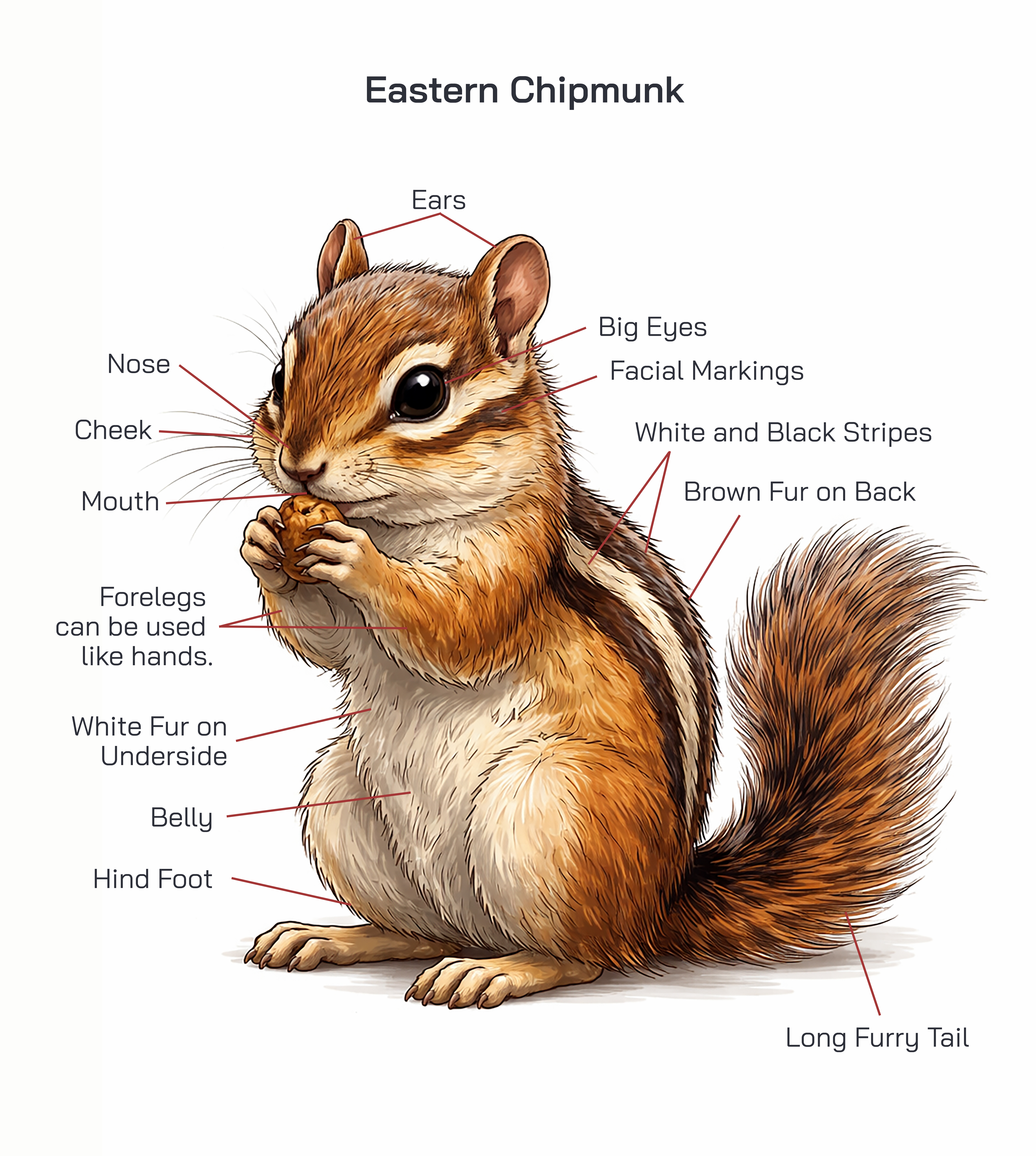
Physically, the Eastern Chipmunk is easily identifiable by its reddish-brown coat and five dark stripes running along its back, separated by lighter bands. These stripes serve as natural camouflage, breaking up the animal’s outline and helping it blend into forest surroundings. The body is compact and agile, supported by strong hind legs adapted for quick bursts of movement. The tail, though not as bushy as that of tree squirrels, plays an important role in balance, communication, and signaling danger. One of the most distinctive anatomical features of the Eastern Chipmunk is its expandable cheek pouches, which allow it to transport large quantities of food efficiently.
Behaviorally, the Eastern Chipmunk is diurnal, meaning it is active during daylight hours. Its daily routine is carefully structured around foraging, vigilance, and territory maintenance. Unlike social rodents, chipmunks are generally solitary animals, interacting with others mainly during the breeding season. Each individual maintains a defined home range centered around a burrow system that serves as a shelter, food storage area, and safe retreat from predators.
The burrow systems constructed by Eastern Chipmunks are highly sophisticated. Entrances are often well hidden beneath rocks, roots, or vegetation, making them difficult for predators to locate. Inside, the tunnels lead to separate chambers designated for nesting, food storage, and waste. This organization helps maintain hygiene and reduces disease risk. The nesting chamber is lined with dried leaves and grasses, providing insulation during colder months.
Diet plays a central role in the life of the Eastern Chipmunk. It is an omnivore, consuming a wide variety of plant and animal matter. Seeds, acorns, nuts, berries, fruits, and grains form the bulk of its diet, while insects, worms, snails, and occasionally bird eggs provide essential protein. The chipmunk’s habit of collecting and storing food is a defining behavior. Using its cheek pouches, it gathers food and transports it back to its burrow, where it is stored for later consumption.
This food-hoarding behavior is especially important for winter survival. Unlike some mammals that migrate or rely entirely on fat reserves, the Eastern Chipmunk depends heavily on stored food. During winter, it enters a state of reduced activity rather than true hibernation. It periodically wakes to feed on stored supplies, conserving energy while avoiding prolonged exposure to harsh conditions. This strategy allows it to remain in its burrow for extended periods, emerging only when necessary.
Communication among Eastern Chipmunks is primarily vocal and behavioral. They are known for their sharp, high-pitched alarm calls, which warn of approaching predators such as hawks, snakes, foxes, and domestic cats. These calls not only alert nearby chipmunks but can also confuse predators by signaling that they have been detected. Tail movements, body posture, and sudden freezing behavior further enhance their ability to respond to threats quickly and effectively.
Reproduction in Eastern Chipmunks typically occurs once or twice a year, depending on environmental conditions. Breeding usually takes place in early spring and sometimes again in late summer. After a gestation period of about a month, the female gives birth to a litter of small, hairless, and blind young. These offspring remain in the burrow for several weeks, relying entirely on the mother for warmth and nourishment. As they grow, they gradually develop fur, vision, and coordination before venturing outside the burrow to explore their surroundings.
As young chipmunks mature, they learn essential survival skills such as foraging, predator avoidance, and territory establishment. Many juveniles disperse to find their own territories, reducing competition and promoting genetic diversity. While mortality rates are high due to predation and environmental challenges, those that survive their early months can live several years in the wild.
The ecological importance of the Eastern Chipmunk is often underestimated. By collecting and storing seeds, chipmunks contribute significantly to seed dispersal. Forgotten or abandoned food caches can germinate, supporting forest regeneration and plant diversity. Additionally, as both predator and prey, chipmunks play a crucial role in maintaining balance within food webs. They help control insect populations while serving as a food source for larger animals.
From an ecological perspective, the presence of Eastern Chipmunks is often an indicator of a healthy forest environment. Their dependence on diverse plant life and natural ground cover makes them sensitive to habitat destruction and environmental degradation. Conservation of forests, reduction of excessive pesticide use, and preservation of natural ground layers are essential for sustaining chipmunk populations.
The Eastern Chipmunk continues to reveal layers of biological and ecological complexity beyond its commonly observed behaviors. One of the most remarkable aspects of this species is its finely tuned sensory system, which allows it to survive in environments filled with constant threats. The Eastern Chipmunk possesses excellent vision adapted for detecting motion, an acute sense of hearing capable of picking up subtle disturbances, and a highly developed sense of smell used to locate food caches, recognize territory boundaries, and identify predators. These sensory abilities work together to create a rapid-response survival system that is critical for an animal of such small size.
Seasonal adaptation is another defining characteristic of the Eastern Chipmunk. As daylight length and temperature change throughout the year, the chipmunk’s behavior, metabolism, and physiology adjust accordingly. In autumn, feeding activity increases dramatically as the animal gathers and stores food in preparation for winter. During this period, chipmunks may travel longer distances and take greater risks to accumulate sufficient reserves. Their body weight may increase slightly, but unlike animals that rely on fat storage alone, the chipmunk’s primary winter survival strategy remains its carefully organized underground pantry.
During winter months, the Eastern Chipmunk enters a state known as torpor rather than true hibernation. Its body temperature drops, heart rate slows, and energy consumption is reduced, but it does not remain continuously dormant. Instead, it wakes periodically to feed on stored food. This intermittent dormancy allows the chipmunk to survive harsh winters without the need to forage in dangerous conditions. The ability to transition between active and reduced metabolic states demonstrates a high level of physiological control and energy efficiency.
The cognitive abilities of the Eastern Chipmunk are also noteworthy. Studies and field observations suggest that chipmunks possess strong spatial memory, enabling them to remember the locations of multiple food caches spread across their territory. This memory is essential for survival, especially when snow cover or leaf litter conceals visual landmarks. Chipmunks rely on mental mapping rather than scent alone, which prevents competitors from easily locating their stored food. This cognitive skill places them among the more intelligent small mammals in terms of problem-solving and environmental awareness.
Predator avoidance strategies in the Eastern Chipmunk extend beyond simple flight. When threatened, a chipmunk may use deceptive tactics such as changing direction abruptly, freezing in place to avoid detection, or retreating into complex burrow networks with multiple exits. Some alarm calls are believed to convey specific information about predator type or threat level, allowing nearby animals to respond appropriately. This level of communication efficiency enhances survival not only for the individual but also for others within hearing range.
The relationship between Eastern Chipmunks and their environment is deeply interconnected. They influence soil structure through burrowing, which improves aeration and nutrient mixing in forest soils. This activity benefits plant roots and microorganisms, indirectly supporting ecosystem health. Their feeding habits affect plant population dynamics, as selective consumption can influence which species thrive in a given area. In this way, chipmunks help shape the composition and regeneration patterns of forests over time.
Interactions with humans have become increasingly common as urban and suburban development expands into natural habitats. Eastern Chipmunks often adapt well to parks, gardens, and residential areas, provided there is sufficient ground cover and food availability. While they are generally not aggressive, their digging behavior can sometimes conflict with human landscaping preferences. However, these interactions also provide opportunities for people to observe wildlife up close, fostering awareness and appreciation for native species.
From a conservation standpoint, the Eastern Chipmunk is currently considered stable in population, but this does not mean it is immune to environmental pressures. Habitat fragmentation, loss of forest floor vegetation, and exposure to pesticides can negatively impact local populations. Climate change may also alter food availability and seasonal patterns, potentially disrupting the delicate balance chipmunks rely on for survival. Long-term monitoring and habitat preservation remain important for ensuring that this species continues to thrive.
In scientific research, the Eastern Chipmunk has contributed valuable insights into topics such as animal behavior, memory, hibernation physiology, and ecological interactions. Its relatively small size, clear behavioral patterns, and adaptability make it a useful model for studying how mammals respond to environmental change. These studies not only deepen understanding of chipmunks themselves but also offer broader lessons about resilience and adaptation in wildlife.
Ultimately, the Eastern Chipmunk represents far more than a familiar forest resident. It is a finely adapted organism whose survival depends on intelligence, organization, and close integration with its environment. Its presence supports ecological balance, enriches biodiversity, and serves as a reminder that even the smallest animals can play outsized roles in the natural world.
In summary, the Eastern Chipmunk is far more than a small striped rodent commonly seen darting across forest paths. It is a highly adaptive, intelligent, and ecologically valuable mammal with complex behaviors and survival strategies. Through its burrowing, food storage, communication, and role in seed dispersal, the Eastern Chipmunk contributes meaningfully to ecosystem health and biodiversity. Understanding and appreciating this species highlights the importance of even the smallest animals in maintaining the delicate balance of natural environments.