The Mauritius kestrel is one of the rarest and most remarkable birds of prey in the world, known for its restricted range, unique evolutionary history, and dramatic conservation story. Endemic to the island of Mauritius in the Indian Ocean, this small falcon has developed specialized characteristics that reflect adaptation to an isolated island environment. Its survival against extreme odds has made it an international symbol of wildlife conservation and ecological resilience.
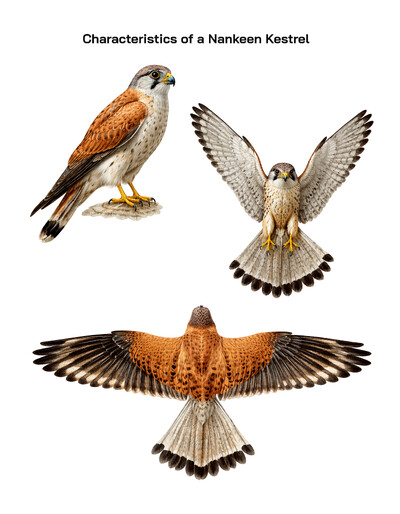
Physically, the Mauritius kestrel is compact and lightly built, smaller and more delicate than many mainland kestrels. Its body structure is designed for maneuverability rather than speed, allowing it to navigate dense forest environments with precision. The wings are relatively short and rounded, enabling rapid turns and controlled glides between trees. A long tail provides balance and steering control, especially during low-altitude flight through narrow forest gaps.
The plumage of the Mauritius kestrel is warm and distinctive, dominated by chestnut, reddish-brown, and buff tones. The feathers often show fine spotting or speckling, particularly on the underparts, which helps the bird blend into dappled forest light. This natural camouflage is essential for hunting and avoiding detection within wooded habitats. The head carries a focused expression, enhanced by dark eyes that reflect strong visual acuity.
The beak of the Mauritius kestrel is sharply curved and well suited for tearing small prey. Its talons, though not large, are strong and precise, allowing it to grasp agile animals such as geckos and small birds. Exceptional eyesight enables the kestrel to detect subtle movements among foliage, a critical trait in visually complex environments.
Habitat behavior is closely tied to native forest ecosystems. The Mauritius kestrel primarily occupies remaining patches of indigenous woodland, mountain slopes, and river gorges. These habitats provide suitable nesting cavities, hunting perches, and a stable prey base. Unlike open-country kestrels, this species is strongly associated with forest interiors and edges, reflecting long-term adaptation to island vegetation.
Hunting behavior is agile and opportunistic. The Mauritius kestrel often hunts from perches, launching short, fast flights to capture prey in mid-air or from branches. It relies on quick acceleration and sharp turns rather than prolonged chases. Its diet includes insects, small birds, and reptiles such as geckos, allowing flexibility in response to seasonal prey availability.
Reproductive characteristics reflect both specialization and vulnerability. The Mauritius kestrel typically nests in tree hollows or cliff cavities, laying a small clutch. Pair bonding is strong, and both adults participate in feeding and protecting the young. Slow reproduction and limited nesting sites historically contributed to population decline, making the species highly sensitive to environmental disturbance.
Ecologically, the Mauritius kestrel plays an important role as a small predator within island food webs. By regulating populations of insects and small vertebrates, it helps maintain ecological balance in forest systems. Its presence is closely linked to healthy native habitats, making it a valuable indicator of ecosystem condition.
Historically, the Mauritius kestrel faced near extinction due to habitat loss, pesticide use, and introduced predators. At one point, only a handful of individuals remained. Intensive conservation efforts, including captive breeding and habitat management, led to a remarkable recovery. This success has made the species one of the most celebrated examples of avian conservation worldwide.
To understand the Mauritius kestrel beyond its physical traits and conservation headline, it helps to see it as a product of long isolation and quiet adjustment. Scientifically known as Falco punctatus, this bird evolved in an environment with very different pressures than those faced by continental falcons. On Mauritius, competition was limited, prey types were unusual, and dense forest replaced open plains. Over generations, this shaped not only how the kestrel flies and hunts, but how it thinks, reacts, and survives. It became a bird finely tuned to a narrow world, where success depended on precision rather than power.
One of the most remarkable yet rarely discussed aspects of the Mauritius kestrel is its behavioral intelligence. Living in dense forests requires constant decision-making. The bird must judge distances between branches, predict prey movement in cluttered space, and choose flight paths that avoid injury. This kind of environment favors mental flexibility and learning. Young kestrels likely spend extended periods refining their skills, practicing short flights and failed strikes before mastering the controlled movements that define adult hunting. Survival depends not on instinct alone, but on experience built through repeated trial and error.
Its relationship with prey is also more delicate than in many raptors. Because island ecosystems tend to have fewer species, overexploitation of prey can be dangerous. The Mauritius kestrel appears to hunt in a way that balances need with sustainability, shifting focus between insects, reptiles, and small birds depending on availability. This flexibility helps prevent the collapse of its own food base. In this sense, the kestrel is not just a predator but an active participant in maintaining long-term ecological balance within a limited system.
Another important but often overlooked factor is how silence and stealth shape its daily life. In dense forests, sound carries differently, and sudden noise can betray a hunter’s presence. The Mauritius kestrel’s movements are typically subtle and controlled, minimizing disturbance. Even its perching behavior suggests caution, choosing locations that offer both visibility and concealment. This quiet style of living contrasts sharply with the dramatic stoops of open-country falcons and reflects a predator adapted to patience rather than spectacle.
The kestrel’s near-extinction also altered its behavior in ways that science is still uncovering. When populations dropped to critically low levels, surviving individuals had fewer mates, reduced territory competition, and altered social dynamics. Conservationists observed changes in breeding behavior, territory use, and tolerance between individuals. These shifts demonstrate that animals are not static; they adjust socially and behaviorally under extreme pressure. The Mauritius kestrel became, in real time, an example of resilience through behavioral change.
Human involvement in its recovery created a rare situation where a wild raptor’s life became closely intertwined with direct management. Captive breeding programs required detailed understanding of individual personalities, stress tolerance, and parenting ability. Some birds proved better breeders than others, not because of physical traits, but due to temperament. This highlighted an often ignored truth: personality matters in wildlife survival. The success of the Mauritius kestrel was influenced not only by genetics and habitat, but by the behavioral diversity of individual birds.
The species also reshaped how conservation itself is viewed. Before its recovery, many believed that saving a species reduced to a few individuals was unrealistic. The kestrel challenged this assumption. Its return showed that even extreme declines can be reversed when science, long-term commitment, and habitat protection work together. As a result, the Mauritius kestrel became a reference point for conservation programs worldwide, influencing strategies used for other critically endangered birds.
Emotionally, the bird carries a powerful symbolic weight. Unlike species lost before modern conservation ethics developed, the Mauritius kestrel survived at the edge of disappearance in full human awareness. Its story unfolded alongside growing environmental responsibility, making its recovery feel personal to many researchers and conservationists. It represents not just survival, but redemption—a rare case where humans actively corrected damage they had caused.
In today’s changing climate, the Mauritius kestrel faces new, quieter challenges. Shifts in rainfall, temperature, and forest composition may alter prey availability and nesting conditions. Because the species is so specialized, even small environmental changes can have outsized effects. This makes ongoing monitoring essential. The kestrel’s survival is no longer just about preventing extinction, but about ensuring long-term stability in a rapidly changing world.
To go beyond biology and conservation statistics, the Mauritius kestrel, scientifically known as Falco punctatus, can be understood as a species that now lives with a kind of inherited pressure. Even though its numbers have recovered from the brink of extinction, the bird still exists in a landscape shaped by loss, fragmentation, and constant human presence. Its modern life is not a return to some untouched past, but an ongoing negotiation with a changed world. Every generation is born into forests that are smaller, more isolated, and more vulnerable than those its ancestors once knew.
One of the most subtle yet important aspects of the Mauritius kestrel’s life today is how it copes with limited choice. On large continents, raptors can shift territories, expand ranges, or relocate when conditions decline. For an island endemic, options are few. This reality likely influences how individual birds make decisions. Territory selection, mate choice, and nesting attempts may be more conservative, favoring known success over risky exploration. This cautious behavioral tendency is not fear-based, but survival-driven, shaped by generations that endured extreme scarcity.
The kestrel’s interaction with its environment also involves a delicate balance between tradition and adaptation. Many behaviors are inherited responses fine-tuned to native forest structures that no longer exist in their original form. As forests regenerate unevenly or are replaced by mixed vegetation, the kestrel must reinterpret familiar instincts in unfamiliar settings. A perch that once offered perfect cover may now be exposed, and a hunting route that worked for decades may suddenly fail. This constant recalibration requires flexibility, suggesting that the species’ long-term survival depends as much on learning as on instinct.
Another underappreciated aspect is how isolation affects genetic identity beyond simple population size. Even with recovery, the Mauritius kestrel remains genetically narrow compared to widespread species. This means that individual health, fertility, and adaptability can vary significantly from bird to bird. Conservationists have observed that not all kestrels respond equally well to stress, habitat change, or breeding demands. Some individuals thrive, while others struggle, reinforcing the idea that recovery does not erase vulnerability, it merely transforms it.
The kestrel’s daily life is also shaped by sound and stillness in ways that are rarely considered. Forests on Mauritius are quieter than many mainland habitats, lacking large predators and dense bird communities. In such an environment, even small sounds can stand out. The kestrel’s movements, landings, and takeoffs are likely fine-tuned to minimize noise, especially when hunting. Silence becomes a hunting tool, and stillness becomes an active state rather than rest. This quiet mastery is part of what makes the species so difficult to observe in the wild.
From a human perspective, the Mauritius kestrel now occupies a unique emotional space. It is no longer just a wild animal; it is a known survivor. Researchers, conservation workers, and even local communities often view it with a sense of guardianship. This relationship is unusual in the natural world. The bird is wild and independent, yet its continued existence is inseparable from human awareness. This creates a rare dynamic where protection is ongoing rather than reactive, driven by memory of how close extinction truly was.
The kestrel also plays a role in shaping conservation philosophy itself. Its story has shifted how scientists think about thresholds. It proved that populations reduced to critically low numbers are not automatically doomed, but it also demonstrated that recovery requires constant attention. The species has become a reminder that conservation success is not an endpoint, but a process. Without continued habitat care, monitoring, and restraint, recovery can quietly reverse.
Climate variability adds another layer of complexity to its future. Changes in rainfall patterns may alter forest structure, insect populations, and reptile behavior, indirectly affecting kestrel hunting success. Unlike generalist predators, the Mauritius kestrel cannot easily switch ecosystems. This makes it a sensitive indicator of environmental change, not through dramatic collapse, but through subtle shifts in breeding success and territory stability that require careful observation to detect.
At an individual level, each Mauritius kestrel lives a life shaped by precision. There is little excess in its behavior. Movements are efficient, hunts are calculated, and energy is conserved whenever possible. This economy of effort reflects a species that evolved under constraints and continues to live with them. Nothing is wasted, because waste is a risk an island predator cannot afford.
In a broader sense, the Mauritius kestrel represents a rare moment where evolution, destruction, and restoration intersect in a single living species. It carries the imprint of ancient isolation, the scars of human impact, and the imprint of deliberate recovery. Its continued flight through Mauritius’ forests is not just a biological event, but a living record of choices—both natural and human—that shaped its fate.
Ultimately, the Mauritius kestrel teaches that survival is not a single victory, but an ongoing state. Its story did not end with recovery; it simply entered a new chapter. Each generation must navigate a landscape that is safer than before, yet still uncertain. By existing at all, the Mauritius kestrel reminds us that hope in conservation is real, but fragile, and that protecting life on islands requires not only action, but long memory, patience, and humility. The Mauritius kestrel is more than a rare bird confined to a remote island. It is a lesson written in feathers and flight about adaptation, vulnerability, and hope. Its existence reminds us that evolution can create extraordinary specialists, but also that specialization comes with risk. At the same time, its recovery proves that informed human action can restore balance rather than destroy it. In watching the Mauritius kestrel glide through forest gaps today, we are not just seeing a bird—we are witnessing the continuation of a story that once nearly ended, and now stands as one of conservation’s most meaningful successes.
In summary, the Mauritius kestrel is characterized by its compact form, forest-adapted flight, specialized hunting behavior, and profound conservation significance. Its survival reflects both evolutionary uniqueness and the positive impact of focused environmental protection. Today, the Mauritius kestrel stands as a living symbol of hope for endangered species and fragile island ecosystems.