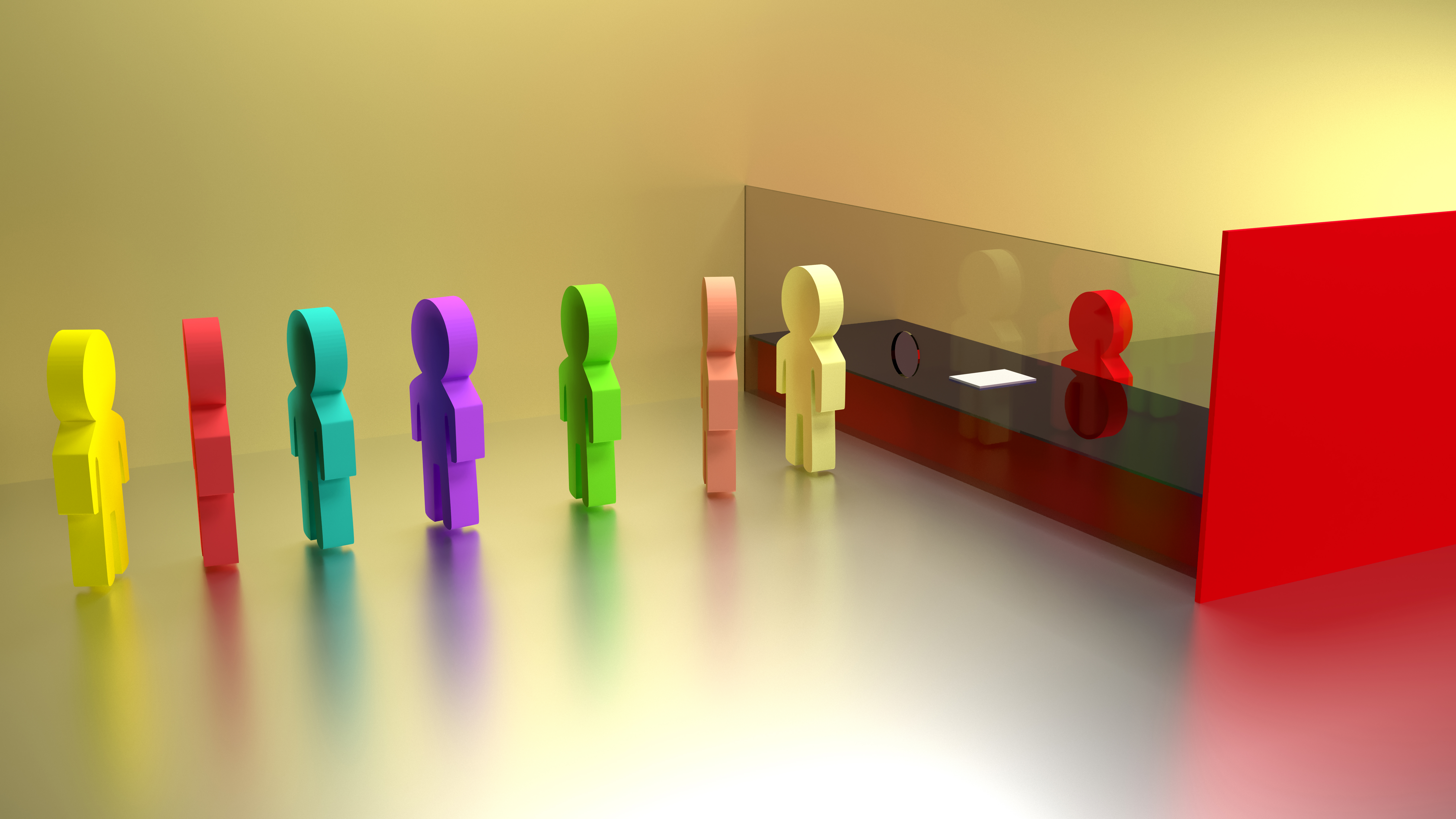
3D Rendered Crowd in Queue Illustration — Detailed Visual Overview
A 3D rendered crowd in queue illustration presents a clear and structured view of people standing in an organized line, often representing the movement and arrangement of individuals within public spaces. This type of visual is widely used in learning materials, planning guides, digital interfaces, service layouts, and public design communication because it captures human positioning in a simple yet visually engaging form. The refined models, smooth surfaces, and balanced lighting allow viewers to understand how a group arranges itself while waiting for service, access, or interaction within a controlled environment.
A typical queue illustration shows individuals standing one behind another in a linear or slightly curved formation. Each figure is usually created using stylized 3D shapes that maintain a friendly appearance while keeping the focus on arrangement rather than identity. The spacing between the figures is carefully designed to demonstrate social organization, flow, and orderly progression. Shadows and light gradients often emphasize depth, helping viewers interpret the spatial relationship between each figure and the line as a whole. This structure communicates organization, patience, and systematic flow.
One of the primary strengths of this visual style is its ability to simplify complex crowd behavior. Even though real queues vary in posture, spacing, and movement, the 3D illustration distills the concept into a clean, understandable structure. Designers use these scenes to explain how crowd flow works in public areas such as ticket counters, entry gates, service desks, transport stations, or event venues. In these contexts, a clean queue visual helps people understand where they should stand, how movement proceeds, and how order is maintained in the space.
In educational environments, a 3D queue illustration supports lessons about social behavior, group coordination, or public system design. It shows how people organize themselves naturally when waiting for controlled service. In architectural and planning material, such visuals also help communicate how a space should be designed to support smooth movement. When discussing waiting zones, counters, guided paths, or directional flow, the illustration becomes a valuable tool for demonstrating how a physical space should guide people efficiently.
The 3D format offers depth and clarity that 2D icons often cannot achieve. The shadows beneath each figure help viewers understand standing position, distance, and movement direction. The lighting, carefully balanced to avoid harsh contrast, enhances the shapes in a way that allows the line to feel realistic yet approachable. This balance of realism and simplicity ensures the illustration works well in both technical diagrams and general audience presentations.
For designers, the illustration is a flexible asset that can be adapted to multiple themes. Some versions may include barrier posts, tiled floors, or soft environmental elements that help contextualize the queue. Other versions may keep the background simple, focusing only on the line of figures. This flexibility enables use in signage, slideshows, mobile app interfaces, safety instructions, or workflow guides. Even when placed in compact layouts, the figures retain clarity because of the clean modeling and balanced proportions.
In digital communication, a 3D rendered queue illustration is particularly effective for explaining waiting procedures or guiding user interactions. In user experience contexts, designers often use such visuals to represent stepwise progress, turn-based organization, or access sequences. The clear arrangement of the figures acts as a metaphor for structured waiting, guidance, and accessibility.
Public awareness materials also rely on such visuals to explain expected behavior in service locations. Whether discussing smooth movements, respecting personal space, or following a designated path, the illustration provides a nonverbal cue that people understand instantly. The neutral shapes, simple colors, and clean arrangement allow the message to be interpreted without distraction.
Overall, a 3D rendered crowd in queue illustration provides a structured and visually clear representation of human arrangement in organized spaces. Its clean modeling, balanced lighting, and intuitive layout make it ideal for explaining flow, order, and systematic movement. Whether used in planning, educational guides, public design, user experience layouts, or awareness material, the illustration offers a reliable and polished way to communicate how groups align and progress through organized systems.