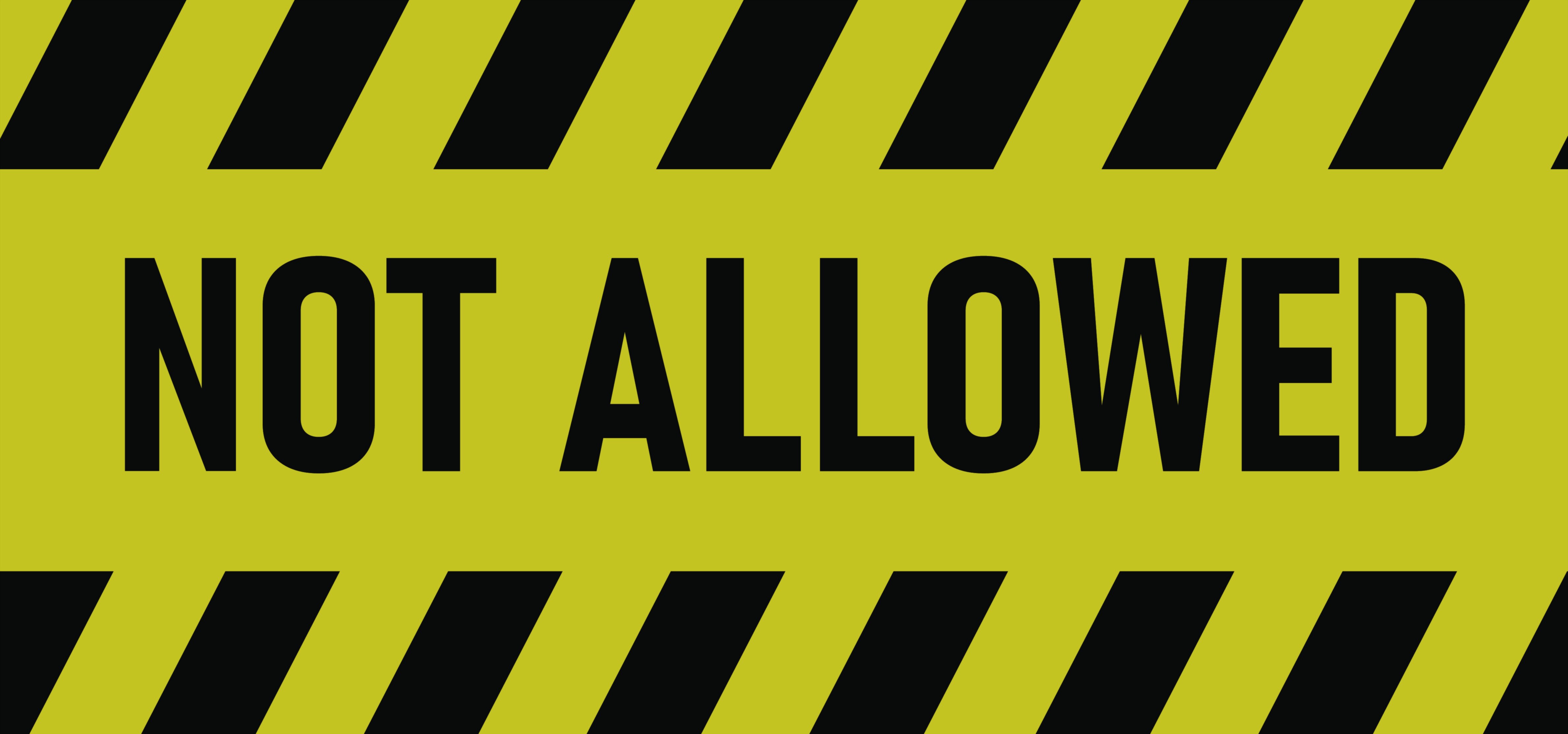
Not Allowed Sign Board Vector Illustration — Prohibition and Safety Warning Symbol
A Not Allowed sign, especially when presented as a sharp and high-contrast vector illustration with bold prohibition graphics and unmistakable symbolism, exists as one of the clearest visual instructions used to communicate immediate restriction, safety protection, and behavioral boundaries in shared environments. Although the phrase looks simple, it carries a powerful meaning because it informs every viewer that a specific action or behavior is strictly prohibited and must not occur under any circumstance. The sign does not depend on personal interpretation, informal judgment, or contextual clues; its role is to override assumption and replace uncertainty with authoritative clarity at the exact point where a person might decide to perform an action that is unsafe, inappropriate, or disruptive. The vector format makes this communication even more effective because the design remains perfectly crisp regardless of scale or application, allowing the sign to retain its strong visual authority whether printed small for indoor workplace labeling or produced as a large outdoor board for public areas, campuses, industrial zones, parking facilities, or transportation sites. From the moment the viewer sees the familiar red prohibition circle and diagonal slash, the brain recognizes instantly that the behavior being referenced is not permitted.
The need for a Not Allowed sign arises because human beings navigate environments largely through observation rather than constant regulation, and without clear signage, individuals often assume permission based on accessibility rather than situational rules. If something is reachable, located in the open, or placed in a shared space, many people naturally interpret that it may be interacted with, even if that interaction is not intended or safe. A person might attempt to smoke near flammable material, feed animals in a restricted ecosystem, use a passageway reserved for emergency personnel, climb on a structure not designed for play, dispose of waste in an incorrect area, use electronic devices near sensitive medical equipment, park in a space reserved for disabled access, or sit in a place meant for operational equipment. In these moments, the absence of a sign leads to misunderstandings that may create danger, conflict, legal violation, disruption, or emotional discomfort. The Not Allowed sign prevents those misunderstandings before they occur, informing people that the behavior they are considering is not permitted, not because someone dislikes them or wants to enforce power, but because the rule exists to protect safety, order, and the functionality of the space.
Safety is one of the most important reasons behind the use of Not Allowed signs. Many prohibited behaviors appear harmless on the surface, yet pose dangers that average individuals might not recognize until harm has already happened. Smoking near oxygen cylinders, using mobile phones around explosive vapors, touching electrical panels, entering soft ground construction areas, climbing on machinery, placing hands near moving parts, operating tools without training, or walking into wildlife areas all involve immediate risks that are often invisible to the untrained observer. What looks physically stable may be structurally weak; what looks inactive may actually be energized; what looks like a harmless animal may be trained to protect property. The Not Allowed sign acts as a shield that warns individuals before they unknowingly place themselves in danger. The warning does not stand there to police someone’s freedom; it stands there because a single decision can have consequences that are irreversible.
Another major purpose of the sign is the protection of operational stability and workflow continuity. In many environments, controlled processes and coordinated activities require strict conditions to function correctly. If someone engages in a prohibited action, even unintentionally, it can trigger system-wide interruptions. A passenger opening a restricted door in a metro station can halt train schedules. A person standing in a loading zone can interfere with logistics movement. Someone touching delicate scientific instruments can invalidate research or damage calibrated machinery. Interference in hospital spaces can disrupt patient care, while unauthorized handling of materials in warehouses can lead to misplacement or inventory loss. The Not Allowed sign maintains order by communicating that certain actions must not occur for the environment to function safely and efficiently, ensuring that workers and systems stay focused on their tasks without sudden distractions or danger.
Security also forms a vital rationale behind the message. Prohibited actions are often related not only to personal safety but to the integrity of property, assets, and information. Touching confidential documents, entering server rooms, photographing sensitive facilities, opening secured lockers, interacting with prototype equipment, or manipulating control switches can expose private data or compromise security infrastructure. The sign therefore becomes a frontline defense against tampering, vandalism, unauthorized observation, and theft. It prevents wrongdoing not by confrontation, but by making expectations clear. Even if no security personnel are physically present, the sign prevents accidental or intentional breaches simply by informing people that certain actions cross a boundary that must be respected.
Legal responsibility provides another powerful layer of meaning behind the use of Not Allowed signage. Many jurisdictions require organizations to inform people whenever certain actions are prohibited due to risk, regulation, or liability. If a person is injured performing a prohibited action in an area where no warning is posted, legal responsibility may fall upon the organization for failing to communicate the restriction. When a Not Allowed sign is displayed, however, the environment has fulfilled its obligation to notify individuals, and responsibility shifts to those who ignore the posted warning. Whether in a commercial property, public building, industrial plant, residential complex, school, hospital, transportation site, or outdoor facility, the sign becomes visible evidence that the boundary was clearly communicated before the action took place. It protects both public users and property managers by ensuring that the rule was presented fairly, transparently, and without ambiguity.
The psychological benefit of the sign is equally important because it reduces confusion and unnecessary conflict. When boundaries are not labeled visibly, property owners or employees may be forced to verbally stop individuals who unknowingly perform prohibited behaviors. This can lead to embarrassment, upset reactions, accusations of unfairness, or interpersonal tension — all caused not by bad intentions, but by lack of information. The Not Allowed sign prevents these uncomfortable interactions by letting the environment communicate expectations rather than people. This protects dignity on both sides: individuals avoid making mistakes that lead to reprimand, and staff avoid the emotional burden of enforcing rules through confrontation. Everyone remains aligned not because someone corrected them afterward, but because they were informed before acting.
The vector format of the sign strengthens its effect by ensuring perfect clarity and universal recognition. The diagonal red slash instantly tells the human brain that an action must be halted, even before text is read. The circular boundary activates instinctive caution, and the contrasting colors ensure fast interpretation from a distance, under dim lighting, or in partially obstructed conditions. Because vector artwork does not lose quality, the icon remains recognizable whether printed small on a laboratory label or large across a construction site fence. It is equally effective for multilingual and multicultural audiences because the symbol communicates meaning without relying solely on written language.
Viewed in a broader sense, the Not Allowed sign reflects an essential principle of shared environments — boundaries protect people, property, workflow, and respect. It is not a symbol of exclusion or control, but of proactive protection. It transforms possibility into awareness, curiosity into caution, and uncertainty into clarity. It discourages actions that could lead to injury, disruption, conflict, or legal harm before those events unfold. It ensures that safety and responsibility do not depend on constant human supervision, but exist independently through information.
Ultimately, the Not Allowed Sign Board Vector Illustration — Prohibition and Safety Warning Symbol is a tool designed not to restrict people unnecessarily, but to defend them from risk, defend workplaces from interruption, defend property from tampering, and defend social harmony from misunderstanding. It saves harm before it forms, prevents conflict before tension rises, and reinforces respect before anyone feels compelled to intervene. By appearing exactly at the moment when a decision is about to be made, it gives every individual the knowledge they need to choose safety, responsibility, and awareness — and that simple moment of informed decision becomes a powerful form of protection for both the person and the environment around them.