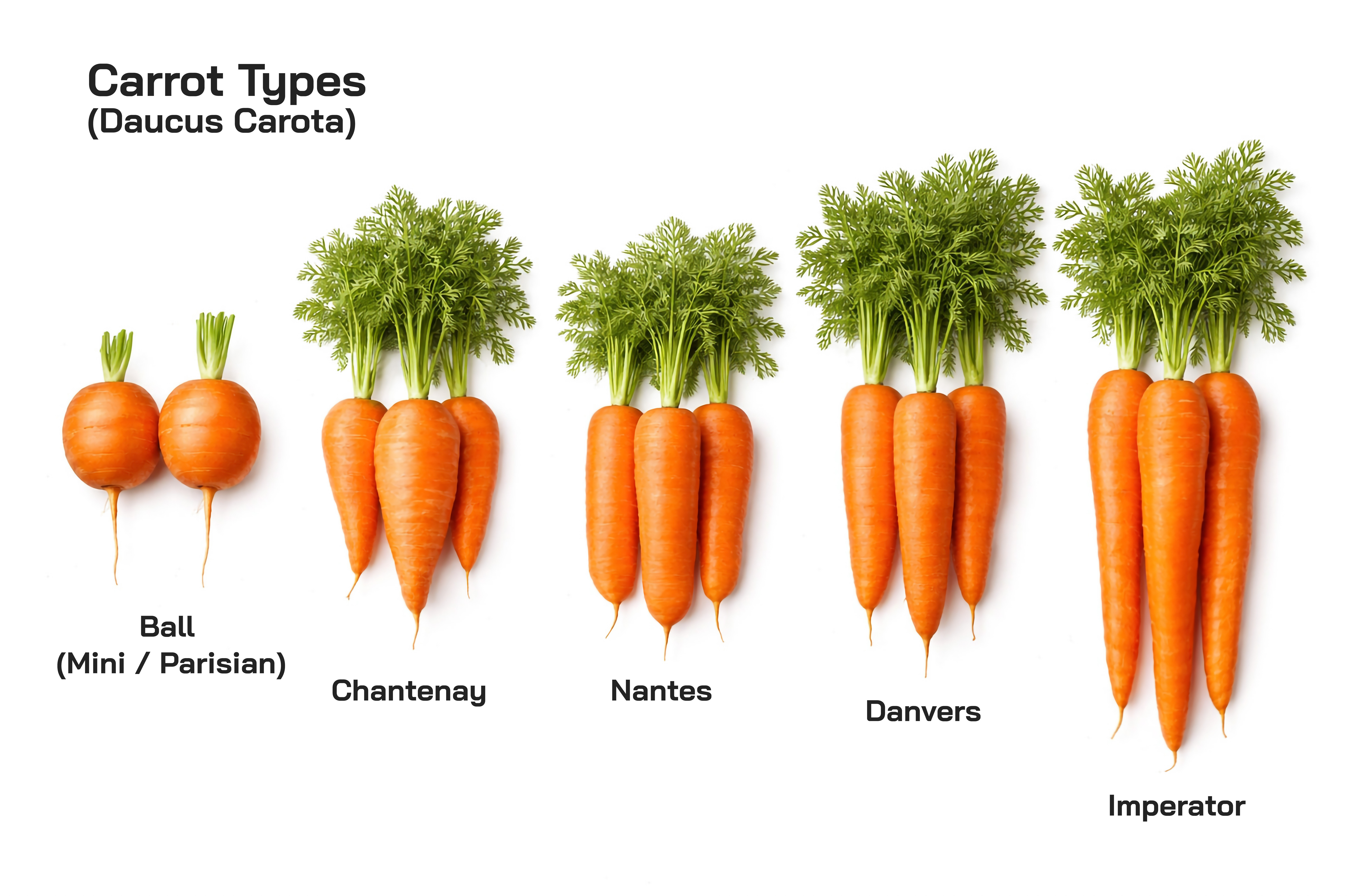
Carrots present a remarkable example of how human selection can shape a single species into multiple forms tailored to diverse agricultural and culinary needs. Over centuries, farmers, gardeners, and seed developers observed how slight variations in root length, thickness, sweetness, and adaptability could make a difference in harvest success and consumer preference. Gradually, recognizable market classes emerged, each with its own personality. These types are not merely aesthetic categories; they influence planting decisions, soil preparation, harvesting techniques, transport efficiency, and even how the vegetable appears on a dinner plate. Understanding them provides insight into why carrots have remained such a dependable crop in both small gardens and industrial agriculture.
Nantes carrot
Nantes carrots are famous for their elegant cylindrical form and smooth skin. They tend to be evenly shaped from top to bottom, often with minimal taper, which makes them visually attractive and easy to process. The interior is usually fine grained and juicy, lacking the woody core sometimes found in other types. Because of this tenderness, they are widely appreciated for fresh eating. Biting into one typically reveals a satisfying snap followed by balanced sweetness.
Retailers favor Nantes varieties because their uniform appearance simplifies grading and packaging. Shoppers often encounter them in supermarkets where presentation and consistent size influence buying behavior. In the kitchen, they lend themselves to salads, light steaming, glazing, and juicing. Their natural sugars become more noticeable with gentle cooking, allowing chefs to highlight flavor without complicated seasoning. Nutritionally, they deliver the well-known carotenoid content associated with carrots in general, supporting eye health and antioxidant intake while remaining approachable for daily consumption.
Imperator carrot
Imperator carrots are long, slender, and often dramatic in length, sometimes stretching far beyond the proportions of other classes. Their shape requires deep, loose soil to develop fully, which means they are frequently grown in regions capable of supporting intensive field preparation. When conditions are right, yields can be impressive, and the roots pack efficiently into shipping cartons.
The variety is commonly recognized as the backbone of large-scale commercial supply. Its high sugar content makes it appealing in raw snack formats, sliced sticks, and processed items. Because it is so widely cultivated, many consumers unconsciously associate its appearance with the generic idea of a carrot. The crisp texture withstands handling during distribution, while the sweetness supports use in juices and ready-to-eat packs. From a health standpoint, Imperator carrots contribute significantly to population intake of fiber and provitamin A simply because of their dominance in the marketplace.
Danvers carrot
Danvers carrots are medium in length with a noticeable taper toward a pointed tip. Historically, they gained importance because of their ability to perform well under a range of soil conditions, including heavier or clay-rich fields that might challenge longer varieties. Their structure provides resilience, and farmers value the reliability of harvest.
Flavor tends to be more pronounced, sometimes described as robust or earthy, which makes Danvers particularly useful in cooked preparations. Soups, stocks, and roasted vegetable dishes benefit from the depth they bring. Processing industries also appreciate their adaptability, slicing them into coins or shredding them for packaged foods. As with other carrots, the nutritional package includes antioxidants and essential nutrients, yet culinary versatility gives Danvers a distinctive role in bridging farm practicality with kitchen creativity.
Chantenay carrot
Chantenay carrots are short and stout, easily recognized by their broad shoulders and comparatively blunt taper. This architecture makes them especially suitable for shallow or rocky soils where long roots might fork or become misshapen. Gardeners often choose them when ground depth is limited, confident that they will still obtain attractive produce.
In culinary terms, Chantenay types are valued for firm texture and rich carrot flavor. They hold up well in longer cooking processes such as braising, yet can also be grated or diced effectively. Their compact size simplifies mechanical harvesting and reduces breakage. For consumers, they offer the same nutritional virtues expected from carrots, packaged in a form that reflects agricultural adaptation to challenging terrain.
Parisian carrot
Often referred to as Ball or Mini carrots, Parisian types are nearly spherical. Their unusual shape attracts immediate attention and makes them favorites for specialty markets and home gardens. Because they require minimal depth, they thrive in containers, raised beds, and urban agriculture settings where space is restricted.
Their small size invites whole cooking, quick roasting, or decorative presentation. Despite miniature proportions, they carry the same sweet profile and nutrient density as larger relatives. For families encouraging vegetable intake, these bite-sized forms can be especially appealing, transforming healthy eating into something playful and accessible.
Across these five categories, diversity in form reflects adaptation to soil, climate, and consumer demand. Some varieties prioritize length and yield, others reliability in difficult ground, and still others convenience for gardeners. Together they sustain year-round supply and support countless recipes, from rustic stews to modern snack packs.
What unites them is a shared contribution to health. Carrots consistently provide carotenoids, fiber, and hydration while remaining low in fat. Their colors brighten meals and signal freshness, reinforcing positive associations with vegetable consumption. Whether cylindrical, slender, pointed, stout, or round, each root represents a collaboration between breeding knowledge and culinary tradition.
The diversity expressed within cultivated carrots invites reflection not only on agricultural selection but also on the human imagination that guided it. Across centuries, growers evaluated countless subtle variations in root form, surface finish, maturation time, and post-harvest behavior. Each decision to save seed from one plant rather than another quietly redirected the future of the crop. What appears today as a stable set of recognizable market classes is therefore the accumulated result of innumerable judgments about usefulness, beauty, and reliability. The carrot illustrates how gradual choices, repeated over long durations, can reshape a species while still preserving continuity with its wild ancestry.
Variation also reveals how intimately farming practices are tied to geography. Regions with lighter soils often favored elongated forms that could extend freely, while areas facing climatic unpredictability sometimes preferred types that matured quickly or resisted environmental stress. Over time, these regional preferences became culinary identities. A particular carrot shape might signal a familiar recipe, a festive meal, or a seasonal memory. Even as global trade has blurred boundaries, echoes of those associations remain, giving the vegetable emotional resonance that extends beyond nutrition.
The marketplace amplifies these connections. Shoppers frequently make decisions based on visual cues that communicate freshness, flavor expectations, or suitability for certain dishes. Long smooth roots may suggest crispness, whereas thicker shoulders imply heartiness. Merchandisers understand this language of form and arrange displays accordingly, sometimes mixing varieties to highlight abundance or separating them to emphasize specialization. Through such choreography, diversity becomes a tool for storytelling, inviting consumers to imagine different culinary possibilities.
Food historians often note that carrots adapted readily to evolving tastes. As sweetness became more desirable in many cuisines, breeding favored lines that delivered gentle sugars without overwhelming earthiness. These preferences influenced not only eating habits but also processing industries that sought predictable flavor profiles. The vegetable’s ability to respond to such demands ensured its survival within competitive markets where novelty frequently displaces tradition.
Home gardening movements have added another layer of interpretation. Enthusiasts who cultivate multiple carrot types in small plots gain direct experience of differences in emergence, canopy growth, and harvest ease. Pulling roots from the soil becomes a moment of discovery, revealing shapes that textbooks describe but only touch can fully explain. Gardeners often share these experiences with neighbors, exchanging seeds and advice, thereby maintaining living networks of experimentation outside commercial channels.
Cultural symbolism continues to evolve as well. Because carrots grow hidden beneath the surface, they are sometimes used metaphorically to represent unseen potential or rewards that require patience. Educators draw on this imagery when encouraging persistence, reminding students that effort invested quietly can produce satisfying results later. Such metaphors reinforce the vegetable’s place in everyday language.
In artistic practice, carrot diversity inspires study of proportion and color. Painters and photographers are attracted to contrasts between feathery foliage and solid root, between matte skin and vibrant interior. When arranged together, different forms create visual rhythms that echo patterns found in nature more broadly. Creative interpretation thus sustains appreciation even among those who may never cultivate the plant themselves.
Scientific inquiry continues to probe the genetic foundations underlying visible variation. Advances in molecular techniques allow researchers to trace relationships among cultivars, revealing pathways of inheritance that link modern types with historical selections. This knowledge can guide future breeding by identifying traits associated with resilience or improved sensory quality. The carrot becomes both subject of study and beneficiary of technological progress.
Dietary education frequently leverages diversity to encourage broader vegetable consumption. Presenting multiple shapes and colors stimulates curiosity, particularly among children who may be hesitant about unfamiliar foods. When young eaters encounter novelty within a familiar species, barriers soften. Sampling becomes playful rather than intimidating, supporting lifelong habits that include varied produce.
International cuisine demonstrates how adaptable carrots are to flavor partnerships. They absorb spices, complement herbs, and harmonize with grains and proteins. Because each market class brings slightly different texture or moisture, cooks can select types that best suit desired outcomes. Diversity therefore enhances creativity, providing a palette from which culinary traditions continue to evolve.
Environmental discussions also benefit from attention to variation. Maintaining a wide range of cultivars can buffer production against emerging challenges, reducing vulnerability that accompanies uniformity. Seed diversity acts as insurance, preserving options for adaptation. Farmers who experiment with multiple types may discover combinations that perform well under local conditions, strengthening resilience.
Even retail packaging reflects these themes. Some brands now highlight specific varieties, educating consumers about differences once known mainly to specialists. Labels may describe flavor nuances or recommended preparations, transforming routine purchase into opportunity for learning. Through such communication, diversity becomes visible rather than hidden behind generic terminology.
At the household level, selecting among carrot types can influence meal planning. A cook anticipating a quick snack may reach for tender, smaller roots, while someone preparing a long-simmered dish might prefer firmer textures. These choices, repeated daily, weave agricultural diversity into personal routine. Over time, preferences form, shaping demand that travels back through supply chains to fields and seed catalogs.
Migration and globalization further enrich the picture. People relocating to new regions often seek vegetables reminiscent of those from home. When markets supply familiar carrot forms, they support continuity of culinary heritage. Conversely, encountering new shapes may inspire experimentation, blending traditions in creative ways. The vegetable becomes mediator between memory and adaptation.
Public exhibitions, agricultural museums, and tasting events increasingly celebrate such multiplicity. Visitors compare roots side by side, learning how breeding history intersects with gastronomy. These experiences cultivate appreciation for farmers’ contributions and for the subtlety embedded within everyday food.
Ultimately, carrot diversity reminds us that agriculture is not static. It is an ongoing conversation among environment, culture, and innovation. Each variety represents a chapter in that dialogue, preserved because someone recognized value in its particular qualities. By continuing to explore and protect this range, societies ensure that future generations inherit options as rich as those enjoyed today.
Through this lens, the carrot stands as more than nourishment. It is evidence of human curiosity, patience, and capacity for collaboration with nature. The shapes resting in market bins testify to centuries of engagement, to choices made in fields and gardens that still influence meals around the world. Recognizing this heritage deepens respect for a vegetable that might otherwise be taken for granted, inviting gratitude for the quiet complexity hidden within its familiar form.
When we continue to look at carrots through the lens of diversity, new dimensions keep emerging, revealing how deeply this crop is woven into the evolving fabric of agriculture and society. Every variation that has survived to the present moment has done so because it answered a need somewhere, sometime. Perhaps it grew dependably in marginal soil, perhaps it matured at a convenient interval, or perhaps it simply pleased the eye of a gardener who chose to save its seed. Survival of a type is therefore an archive of preference. It documents what people valued and what landscapes permitted.
This ongoing archive is not closed. Farmers and breeders remain active participants, making selections that will shape what markets display decades from now. Climate unpredictability, consumer curiosity, and sustainability priorities all influence which characteristics rise in importance. A root that tolerates erratic rainfall or maintains sweetness under temperature swings may become highly desirable. Thus, diversity becomes a forward-looking strategy as much as a celebration of history. It allows agriculture to remain flexible in the face of change.
At the same time, the presence of multiple carrot forms enriches storytelling about food origins. When educators present children with contrasting shapes, they open conversations about adaptation, trade, and innovation. Students begin to understand that vegetables are not static objects appearing magically on shelves; they are outcomes of long relationships between people and land. Curiosity about why one carrot is stout while another is slender can lead to discussions about soil depth, cultural taste, or breeding goals. Through simple observation, complex systems become approachable.
Chefs and culinary writers also draw inspiration from this range. Diversity encourages menus that highlight nuance, pairing particular carrot styles with complementary techniques. Some may be shaved thin to emphasize delicacy, others cut into hearty segments that invite slow transformation. The act of choosing becomes creative expression. By naming varieties, cooks acknowledge growers and landscapes, reinforcing awareness that flavor begins far from the stove.
The aesthetic dimension of carrots deserves further contemplation. Arranged together, different silhouettes create a study in geometry that appeals to designers and photographers alike. Markets become galleries where repetition and variation coexist. This visual pleasure influences purchasing behavior, proving that beauty can be as persuasive as nutritional argument. When consumers respond to form, they indirectly sustain the diversity that produced it.
Seed exchanges illustrate grassroots commitment to maintaining options. Gardeners trade packets across regions, preserving lines that might otherwise fade from commercial attention. These informal networks function as guardians of genetic heritage. Participants often speak of stewardship, recognizing that holding seed carries responsibility toward future cultivators. The carrot becomes a link in an intergenerational chain.
Economic resilience is intertwined with such practices. By cultivating a spectrum of types, producers may access multiple niches, from fresh markets to processing or specialty sales. Diversity spreads risk. If one segment faces difficulty, others may remain stable. This strategic flexibility helps farms navigate volatile conditions without abandoning tradition.
Meanwhile, advances in communication allow knowledge about performance and flavor to circulate more widely than ever. Reviews, cooking demonstrations, and agricultural forums share experiences that guide choices at every level of the supply system. Information once limited to local circles now travels globally, accelerating innovation while preserving community voice.
Cultural memory frequently surfaces in these exchanges. People describe how certain carrots resemble those from childhood gardens or regional dishes. Such memories carry emotional weight, influencing demand in ways statistics alone cannot capture. Food becomes a bridge between time periods, enabling continuity amid mobility and modernization.
Attention to diversity also invites ethical reflection. Preserving multiple cultivars acknowledges that resilience often depends on variety rather than uniformity. Monocultures may deliver efficiency, yet they can be vulnerable. Carrots remind us that maintaining a wide repertoire of forms supports stability not only biologically but socially. It fosters creativity, choice, and adaptability.
The sensory experiences tied to different shapes reinforce these ideas. Bite, aroma, and visual appeal vary subtly, rewarding attentive eaters. Engaging with those distinctions cultivates mindfulness, turning meals into opportunities for appreciation. Diversity enriches daily life by inviting comparison and discovery.
In research institutions, living collections safeguard this potential. Plots containing numerous carrot lines allow scientists to evaluate responses to emerging pressures and to search for traits that might prove valuable in breeding. These gardens function as reservoirs of possibility, ensuring that future challenges can be met with informed creativity.
Public engagement with agriculture benefits from such visibility. When people witness variety firsthand, they gain insight into the complexity behind familiar foods. Respect for farming deepens, and conversations about sustainability become grounded in tangible examples rather than abstractions.
Ultimately, the many faces of the carrot express humanity’s ongoing negotiation with nature. They demonstrate how curiosity, necessity, and imagination combine to generate abundance. Each root on display today is both inheritance and invitation, carrying forward lessons from the past while leaving room for reinterpretation.
As we continue this narrative, it becomes clear that diversity is not merely a feature of carrots; it is their enduring message. By valuing multiplicity, societies cultivate resilience, pleasure, and connection. The vegetable that seems so ordinary thus becomes extraordinary, embodying the power of gradual change guided by attentive hands and hopeful vision.
As agriculture advances, new cultivars will continue to emerge, yet these foundational types remain reference points for growers and buyers worldwide. They demonstrate how variation within a single species can satisfy multiple purposes without losing nutritional integrity. Through this diversity, carrots maintain their reputation as reliable, adaptable, and universally appreciated components of the human diet.