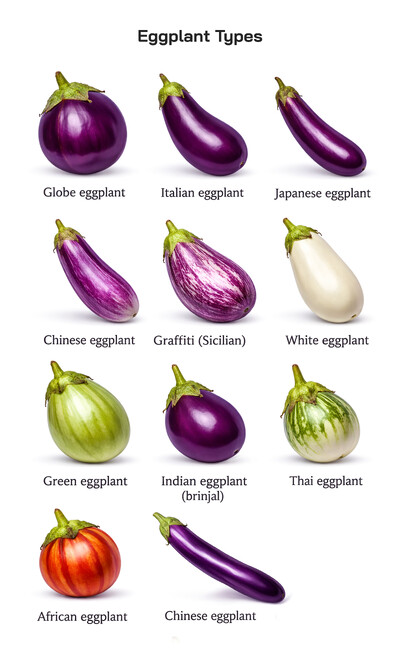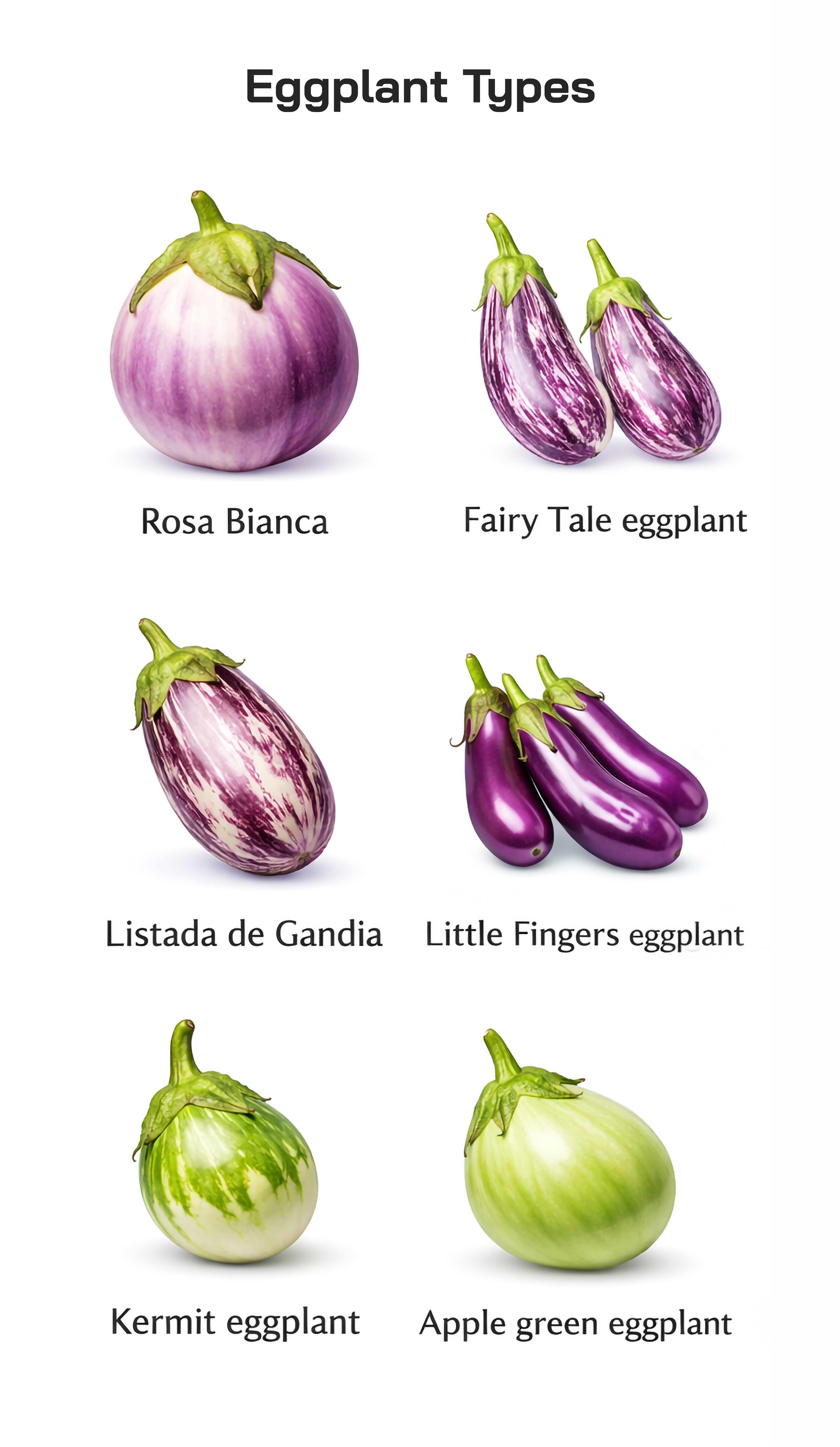
Eggplants are among the most visually diverse vegetables, and the types shown here represent a wide range of forms, colors, and culinary behaviors. These varieties are not only distinct in appearance but also in how they cook, taste, and adapt to different cuisines. Each type reflects selective cultivation shaped by regional preferences, climate conditions, and cooking traditions.
Rosa Bianca is a classic round eggplant known for its soft lavender and white skin. Its shape resembles a small melon, and its flesh is notably tender with very low bitterness. Because of its creamy interior, Rosa Bianca performs exceptionally well when roasted or baked. The round structure allows even heat penetration, producing a smooth texture that absorbs oils and seasonings gently without becoming heavy.
Fairy Tale eggplant is small and slender with decorative purple and white striping. This variety is prized for its thin skin and delicate flesh, which cooks quickly and evenly. Its compact size makes it ideal for slicing and pan-cooking, and it is often used whole or halved. The mild flavor allows it to blend well with herbs, sauces, and light seasonings.
Listada de Gandia is easily recognized by its bold striping and oval shape. The flesh is firm yet tender, allowing it to retain structure during cooking. This makes it suitable for grilling, frying, and sautéing. The skin remains attractive after cooking, adding visual appeal to finished dishes. Its balanced texture supports both quick and slow cooking methods.
Little Fingers eggplant consists of small, elongated fruits that grow in clusters. These eggplants have thin skins and minimal seeds, reducing bitterness and preparation time. Their narrow shape allows rapid cooking and even browning, making them ideal for stir-frying or grilling. Because of their size, they are often used whole or simply halved, preserving moisture and texture.
Kermit eggplant is a small, round green variety with light striping. It has a firm flesh that holds well in soups and curries. Unlike softer eggplants, Kermit varieties maintain bite even after simmering. This makes them especially valuable in dishes that require extended cooking without collapse. Their slightly crisp texture provides contrast in richly seasoned preparations.
Apple Green eggplant is round to slightly oval with smooth green skin. Its flesh is mild and less spongy than many purple varieties, allowing it to cook evenly without absorbing excessive oil. This makes it suitable for frying, roasting, and stuffing. The pale green color adds visual variety to mixed vegetable dishes and plated meals.
Across these eggplant types, texture varies significantly. Some soften quickly and become creamy, while others retain firmness and shape. This variation allows cooks to choose the right eggplant for specific techniques. Eggplants with tender interiors are ideal for roasting and baking, while firmer types excel in frying and simmered dishes.
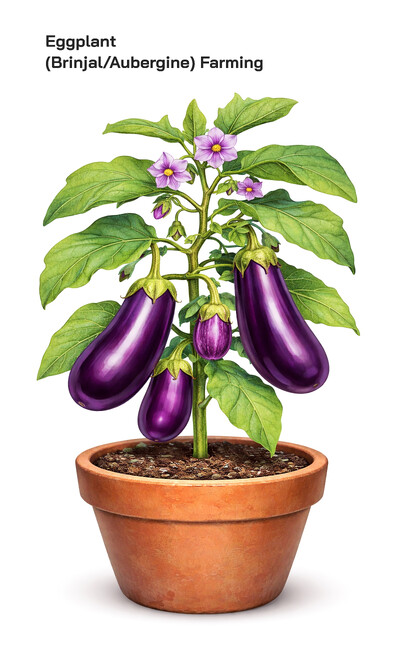
Growing characteristics also differ among these varieties. Most prefer warm climates, good sunlight, and well-drained soil. Some types are compact and suitable for container planting, while others spread more widely. Seasonal harvesting ensures optimal texture and flavor, contributing to their popularity in fresh markets.
Culinarily, these eggplants are valued for their ability to absorb flavors. Their flesh acts as a carrier for spices, oils, and sauces, making them central ingredients in many traditional and modern recipes. Whether used in Mediterranean, Asian, or fusion dishes, they adapt easily to diverse cooking styles.
Eggplant varieties also influence how people emotionally approach cooking, because each type sets expectations before the knife even touches the skin. When someone picks up a small, striped eggplant, there is an instinctive sense that it will cook quickly and gently. A large, round one suggests something slower, more deliberate, almost comforting. These expectations shape how people cook without conscious planning. Eggplants quietly guide behavior, inviting certain techniques and discouraging others simply through their form and weight.
Another layer of diversity lies in how eggplants react to heat progression. Some varieties reward gradual heating, transforming slowly and evenly, while others respond best to sudden high heat. This difference affects not only texture but also aroma. Slow-cooking types release sweetness over time, filling kitchens with warm, mellow scents. Fast-reacting varieties release sharper, fresher aromas that signal quick meals. Over years, people associate these smells with comfort, urgency, or celebration, tying specific eggplants to emotional states.
Eggplant diversity also affects how dishes feel nutritionally, even when ingredients are similar. Firmer varieties create meals that feel structured and filling, while softer ones create meals that feel soothing and rich. This perception influences when and why people choose certain eggplants. Hearty varieties often appear in main dishes, while delicate ones appear in side dishes or lighter meals. The vegetable quietly adapts to human energy needs and eating patterns.
The way eggplants interact with cookware is another subtle factor. Some varieties respond better to cast iron or open pans, developing caramelization without sticking, while others need gentler surfaces to avoid tearing. These interactions shape cooking habits and even influence which tools people rely on. Over time, a household’s preferred eggplant variety may align naturally with its cooking equipment, reinforcing routine and familiarity.
Eggplant skins also affect how dishes visually age. Some skins wrinkle and deepen in color beautifully, adding character, while others fade or soften until nearly invisible. This changes how leftovers look and feel the next day. Varieties that remain visually appealing after cooking often become favorites for meals meant to be shared or served again. Appearance continues to matter long after the first bite.
Eggplants also behave differently when layered with other vegetables. Some merge seamlessly, becoming part of a unified texture, while others maintain identity, creating contrast. This influences how dishes are structured. In layered bakes or stews, cooks learn which eggplants disappear into the background and which stand out. These choices are rarely written down but are remembered through experience and habit.
Another overlooked aspect is how eggplants respond to pressure from lids, weights, or stacking. Some collapse easily, releasing moisture and flavor, while others resist and hold shape. This affects how they perform in covered cooking or pressed dishes. In regions where fuel was limited and pots stayed covered longer, varieties that handled pressure well were favored, shaping local cuisine quietly but decisively.
Eggplant diversity also influences how people season instinctively. Some varieties seem to “ask” for bold spices, while others feel complete with minimal seasoning. This intuition develops over time, as cooks learn to trust the vegetable’s natural direction. A gentle eggplant may only need oil and salt, while a firmer one invites garlic, chili, or complex spice blends. The vegetable itself becomes a guide rather than a blank canvas.
The relationship between eggplant and water content is central to its versatility. High-moisture varieties contribute juiciness to dishes, while drier ones provide substance. This affects not only texture but also how dishes are served. Juicy eggplants pair well with bread or grains that absorb liquid, while drier ones stand alone more confidently. These pairings evolved naturally as people matched ingredients that balanced each other.
Eggplant also plays a role in how people learn to manage bitterness. Some varieties introduce bitterness gently, teaching restraint in seasoning and cooking time. Others are naturally sweet and forgiving. Through these differences, cooks develop sensitivity to balance, learning when to counter bitterness and when to let it remain. Eggplant becomes a teacher of nuance rather than force.
Culturally, eggplant diversity mirrors migration patterns. As people moved, they carried seeds and preferences, adapting varieties to new environments. Over time, those varieties changed, creating regional identities layered over shared origins. This is why eggplants from different regions can look similar yet behave differently. They are shaped by the memory of where they came from and the reality of where they now grow.
Eggplant diversity also affects how food is shared socially. Small varieties encourage individual portions and personalization, while larger ones encourage communal dishes. This influences how meals are served and experienced. Food becomes either a shared centerpiece or a collection of personal servings, shaping interaction and atmosphere at the table.
Another quiet influence is how eggplants respond to time off heat. Some continue cooking internally after removal, while others stop immediately. This affects timing and confidence in the kitchen. Experienced cooks learn which varieties need rest and which should be served instantly. These lessons are learned through repetition, not instruction.
Eggplants also influence how people talk about food success. A dish that “turned out well” often owes that success to choosing the right variety, even if it is never acknowledged. This reinforces loyalty to certain eggplants, building trust that extends beyond recipe logic. Trust becomes as important as technique.
The vegetable’s adaptability also makes it central to dietary shifts. As people explore plant-based eating, eggplant varieties offer different paths—some replacing meat through density and richness, others offering lightness and balance. This flexibility allows people to change habits without abandoning familiar flavors or structures.
Eggplant diversity even influences how people garden emotionally. Growing a specific variety creates anticipation shaped by past cooking experiences. Harvesting an eggplant that matches expectation brings satisfaction beyond yield. This emotional reward helps preserve lesser-known varieties through personal attachment rather than commercial demand.
Ultimately, eggplant diversity exists because no single form could serve every human need. Life demands variety—fast days and slow days, celebration and survival, abundance and restraint. Eggplants answered these demands quietly, evolving into forms that match real situations rather than ideals.
Each variety is a solution to a specific way of living. Together, they form a vegetable family that adapts without losing identity. This is why eggplant remains deeply embedded in everyday cooking across cultures. It does not insist on being the star, yet it carries meals, memories, and habits with quiet reliability.
Eggplant is not diverse by accident. Its diversity is practical, emotional, and human. It reflects how people live, cook, and share food. And as long as human lives remain varied, eggplants will continue to exist in many forms—each one shaped by the simple question of how best to feed a life.
Eggplant diversity also influences how people understand freshness and quality in markets. Different varieties send different visual signals when they are at their peak. Some look best when glossy and firm, others when slightly matte or softer to the touch. Shoppers who grow up around certain types develop an intuitive sense of readiness that does not always translate to other varieties. This is why an eggplant that looks “perfect” to one person may seem unripe or overripe to another. These perceptions are learned through repeated handling rather than formal knowledge.
The way eggplants are named across regions also reflects how closely people relate to them. Many varieties carry names tied to places, shapes, colors, or even emotions. These names often describe how the eggplant behaves rather than how it looks. Over time, the name becomes shorthand for expectation. When someone mentions a specific eggplant variety, experienced cooks already imagine texture, cooking time, and flavor response without needing further explanation. Language becomes a tool for preserving culinary memory.
Eggplant diversity also affects how people manage hunger and fullness. Some varieties feel deeply satisfying even in small amounts because they absorb fats and seasonings densely. Others allow larger portions without heaviness. This difference influences portion sizes and meal planning. In regions where meals needed to sustain long working hours, denser varieties became staples. In places where meals were lighter or more frequent, softer varieties fit naturally. These choices were shaped by daily life rather than nutritional theory.
Another unique aspect is how eggplant varieties respond to fermentation and preservation. Some hold structure well in pickling or brining, while others collapse or become overly soft. This trait influenced which eggplants were preserved for off-season use. In climates with strong seasonal shifts, varieties that preserved reliably became central to survival strategies. These preserved forms often gained cultural significance, becoming associated with winter foods or special occasions.
Eggplants also influence how people experience bitterness as a flavor. Some varieties introduce bitterness gently, acting as a counterbalance rather than a flaw. This teaches appreciation for complexity rather than sweetness alone. In cultures that value layered flavors, slightly bitter eggplants are prized rather than avoided. This preference shapes palate development and influences how people approach other vegetables and foods later in life.
The vegetable’s relationship with oil temperature is another subtle teacher. Certain varieties demand patience, absorbing oil slowly and evenly, while others react instantly. These differences help cooks learn timing and restraint. Over years, people become better cooks not because they follow recipes, but because eggplant teaches them how ingredients respond to heat. Different varieties emphasize different lessons, turning everyday cooking into quiet education.
Eggplant diversity also shapes how dishes are plated and presented. Some varieties keep clean edges and defined shapes, making them suitable for formal presentation. Others soften and spread, creating rustic, comforting visuals. These visual outcomes influence where and how eggplant appears—formal meals, home cooking, street food, or shared platters. Appearance reinforces cultural ideas about what kind of food belongs in which setting.
Another overlooked factor is how eggplants behave when combined with dairy or creamy elements. Some varieties melt into sauces smoothly, while others retain separation and contrast. This determines whether eggplant feels integrated or highlighted within a dish. Over time, these interactions shaped classic pairings, even if the reason was never articulated.
Eggplant diversity also affects how people approach waste reduction. Some varieties can be reused creatively when overcooked or damaged, becoming dips, spreads, or fillings. Others are less forgiving. Households that relied heavily on eggplant learned which types allowed flexibility and which required precision. This knowledge reduced waste and built trust in the ingredient, strengthening its role in everyday cooking.
From a sensory perspective, eggplants differ in sound, smell, and resistance during cooking. Some crackle loudly in hot oil, others cook quietly. Some release strong aromas, others remain subtle. These cues guide cooks instinctively. Over time, people associate these sensory signals with success or failure, adjusting technique without conscious analysis.
Eggplant diversity also influences how people share recipes. In regions with many varieties, recipes are often loosely written, assuming local knowledge of which eggplant to use. In regions with fewer types, instructions become more specific. This difference affects how food traditions are transmitted and how accessible they feel to outsiders. Understanding eggplant variety becomes a key to understanding the cuisine itself.
The vegetable’s adaptability also makes it central to changing dietary identities. As people move between cultures or adopt new eating habits, eggplant acts as a familiar anchor. Different varieties allow continuity even when cooking styles change. This makes eggplant emotionally reassuring during transitions, whether geographic, economic, or personal.
Eggplant diversity also reflects how humans value balance. No single variety dominates globally because no single approach to eating dominates life. Some days require speed, others patience. Some meals are celebratory, others practical. Eggplants evolved alongside these realities, offering forms that fit each situation.
The vegetable’s long history of adaptation has made it quietly resilient. It thrives not because it is flashy, but because it listens—to soil, climate, heat, seasoning, and human need. Each variety represents a successful negotiation between nature and daily life.
Ultimately, eggplant diversity is a reminder that food evolves through use, not theory. Varieties survived because they worked—for cooking fires, for families, for seasons, for limited resources. Their shapes and textures are records of human problem-solving written in flesh and skin.
Eggplants continue to endure because they are not rigid. They bend, absorb, soften, and transform. Their many forms exist because people needed them to behave differently in different moments. This quiet usefulness is why eggplant remains so deeply woven into global cooking.
In the end, eggplant is not just a vegetable with many varieties. It is a companion to human routine, adapting as life changes. Its diversity is not decorative; it is functional, emotional, and deeply human. And as long as people live differently from one another, eggplants will continue to grow in many forms—each one answering a specific way of living, eating, and sharing food.
In summary, the eggplant types shown here demonstrate the remarkable diversity of this vegetable. From round and creamy to slender and firm, each variety offers unique advantages in texture, flavor, and preparation. This diversity ensures that eggplant remains a globally important and highly adaptable ingredient in kitchens around the world.