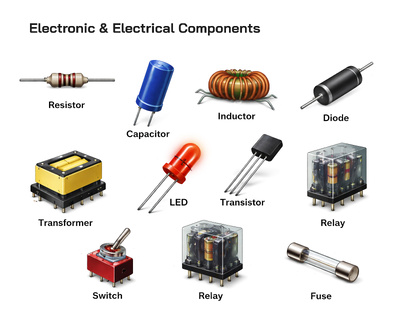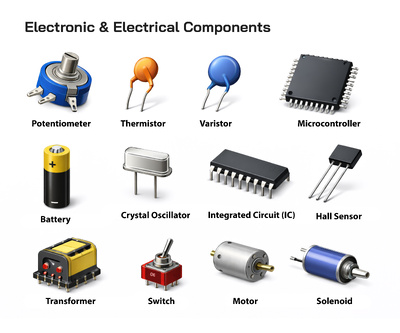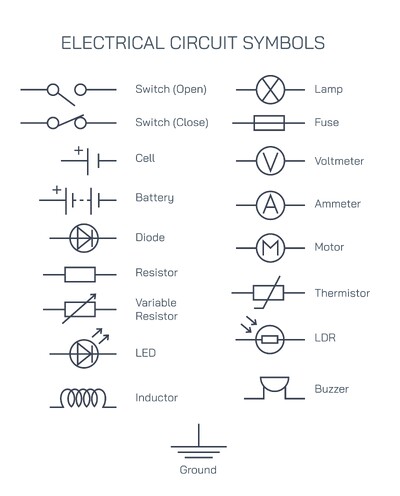
Electrical and electronic components are the functional elements that allow electrical energy and signals to be controlled, converted, protected, and transmitted. Components such as circuit breakers, rectifiers, TRIACs, MOSFETs, photodiodes, Zener diodes, light dependent resistors, speakers, buzzers, and antennas each perform specialized roles within electrical and electronic systems. Together, they enable safe power distribution, efficient signal processing, sensing, control, and communication across domestic, industrial, and communication technologies.
A circuit breaker is a critical electrical protection device designed to automatically interrupt the flow of current when a fault condition such as overload or short circuit occurs. Its main characteristic is the ability to detect abnormal current levels and disconnect the circuit to prevent damage to equipment and reduce fire risk. Circuit breakers are widely used in residential wiring, commercial buildings, and industrial power systems, where they provide reusable and reliable protection compared to traditional fuses. Their importance lies in maintaining electrical safety and ensuring system reliability.
A rectifier is an electronic component or circuit used to convert alternating current into direct current. This conversion is essential because many electronic devices operate on direct current even when supplied from an alternating current source. Rectifiers are commonly built using diodes arranged in specific configurations to achieve efficient current conversion. They are used in power supplies, battery chargers, and electronic adapters, forming the foundation of nearly all DC-powered electronic systems.
A TRIAC is a semiconductor device used for controlling alternating current power. It can conduct current in both directions when triggered, making it especially useful for AC power control applications. TRIACs are widely used in light dimmers, motor speed controllers, and temperature control systems. Their ability to smoothly regulate power flow allows for efficient and adjustable control of electrical loads in both household and industrial equipment.
A MOSFET, or metal-oxide-semiconductor field-effect transistor, is a highly efficient switching and amplification device. Its key characteristic is that it is voltage-controlled, requiring very little input power to operate. MOSFETs are extensively used in power electronics, switching regulators, inverters, and digital circuits. Their fast switching speed, high efficiency, and ability to handle high currents make them indispensable in modern electronic and electrical designs.
A photodiode is a light-sensitive semiconductor device that converts light into an electrical signal. Its operation is based on changes in current or voltage when exposed to light. Photodiodes are widely used in light detection systems, optical communication, medical equipment, and automatic lighting controls. Their fast response time and sensitivity make them ideal for applications where precise light measurement is required.
A Zener diode is a special type of diode designed to operate in reverse breakdown mode at a specific voltage. This characteristic allows it to maintain a stable voltage across a circuit. Zener diodes are commonly used for voltage regulation, reference voltage generation, and circuit protection. Their ability to clamp voltage at a fixed level helps protect sensitive electronic components from voltage fluctuations.
A light dependent resistor, commonly known as an LDR, is a resistor whose resistance changes based on the intensity of light falling on it. In bright light, its resistance decreases, while in darkness, resistance increases. LDRs are widely used in automatic lighting systems, streetlights, light-sensitive alarms, and display brightness control circuits. Their simple construction and reliable response make them popular for light-sensing applications.
A speaker is an electroacoustic device that converts electrical audio signals into sound waves. It operates by moving a diaphragm in response to varying electrical signals, producing audible sound. Speakers are essential components in audio systems, televisions, communication devices, and public address systems. Their role is crucial in delivering information, entertainment, and alerts through sound.
A buzzer is a sound-producing device used primarily for alerts, warnings, and notifications. Unlike speakers, buzzers are designed to produce simple tones or beeps rather than complex audio. They are widely used in alarms, timers, household appliances, and industrial control panels. Buzzers provide immediate audible feedback, making them important for safety and user interaction.
An antenna is a component used to transmit and receive electromagnetic waves for communication. Its main function is to convert electrical signals into radio waves and vice versa. Antennas are essential in radio, television, mobile communication, satellite systems, and wireless networking. The design and placement of an antenna directly affect signal strength, range, and communication quality.
When these electronic and electrical components are examined beyond their basic operating principles, their broader influence on system design, reliability, and technological evolution becomes clear. Each component contributes not only a specific function but also affects how an entire system behaves under real operating conditions such as load variation, environmental stress, signal interference, and long-term usage. Understanding these deeper roles is essential for designing systems that are safe, efficient, durable, and adaptable.
Circuit breakers play a strategic role in modern electrical infrastructure by enabling selective protection and coordinated fault management. In advanced installations, breakers are chosen and rated so that only the affected section of a system disconnects during a fault, while the rest remains operational. This selective tripping capability is critical in industrial plants, data centers, and hospitals, where uninterrupted power is essential. Modern circuit breakers also integrate monitoring and communication features, allowing real-time diagnostics, fault logging, and remote operation. These developments transform circuit breakers from simple protective devices into intelligent system guardians that enhance operational continuity and maintenance efficiency.
Rectifiers influence not only current conversion but also overall power quality. The way rectification is implemented affects ripple content, efficiency, and electromagnetic interference in a system. In sensitive electronics, poor rectification can introduce noise that degrades signal integrity or causes malfunction. Advanced rectifier designs incorporate filtering and regulation stages to deliver clean and stable power. In large-scale power electronics, rectifiers also play a key role in energy efficiency, minimizing losses during conversion and supporting sustainable power usage across industrial and renewable energy systems.
TRIACs extend their importance through their ability to provide smooth and continuous control over AC power. Their behavior under varying load conditions directly affects system performance and lifespan. In control applications, precise triggering of TRIACs allows gradual power changes rather than abrupt switching, reducing mechanical stress and thermal shock on connected devices. This characteristic is especially valuable in heating systems, fan controllers, and lighting solutions where comfort, efficiency, and component longevity are priorities. Proper integration of TRIACs also requires careful consideration of noise suppression and thermal management to ensure stable long-term operation.
MOSFETs form the backbone of modern power electronics and digital control systems due to their scalability and efficiency. Their role extends beyond simple switching, as they enable advanced power management strategies such as pulse-width modulation, energy recovery, and high-frequency conversion. In modern systems, MOSFETs are selected not only for voltage and current ratings but also for switching characteristics that affect heat generation and efficiency. Their widespread use has driven the miniaturization of power supplies, the growth of electric mobility, and the expansion of high-speed digital electronics.
Photodiodes contribute significantly to precision sensing and communication systems by providing reliable conversion of light into electrical signals. Their behavior under different lighting conditions, wavelengths, and response speeds determines system accuracy and performance. In advanced applications, photodiodes are combined with amplification and processing circuits to extract meaningful information from weak or rapidly changing light signals. This capability supports technologies such as optical data transmission, scientific instrumentation, and automated inspection systems, where accuracy and speed are critical.
Zener diodes support system stability by providing consistent reference points and protective boundaries within circuits. Their predictable voltage behavior allows designers to create simple yet effective regulation and protection schemes. In complex systems, Zener diodes often act as secondary safeguards, ensuring that transient conditions do not escalate into catastrophic failures. Their presence improves fault tolerance and protects sensitive components, especially in environments where voltage fluctuations are common.
Light dependent resistors influence system behavior through their gradual and analog response to changing light conditions. Unlike digital sensors, LDRs provide smooth transitions that are well suited for adaptive control applications. This makes them valuable in systems that must respond naturally to environmental changes rather than switching abruptly. Their simplicity also makes them reliable and cost-effective for long-term outdoor or unattended applications, where maintenance access may be limited.
Speakers contribute to system usability and communication effectiveness by translating electrical signals into audible information. Beyond entertainment, speakers play a vital role in alerts, guidance systems, and accessibility solutions. Their design affects clarity, efficiency, and sound dispersion, which are critical factors in public safety systems and communication devices. In integrated systems, speakers are often optimized alongside signal processing components to ensure intelligible and distortion-free output.
Buzzers serve as immediate feedback mechanisms that enhance safety and user awareness. Their simple and unmistakable sound patterns are designed to attract attention quickly, even in noisy environments. This makes them essential in warning systems, fault indicators, and confirmation signals. The reliability and low power consumption of buzzers ensure consistent performance in both consumer electronics and industrial control systems.
Antennas define the interface between electronic systems and the surrounding electromagnetic environment. Their effectiveness directly influences communication range, data integrity, and resistance to interference. Antenna design involves careful consideration of frequency, orientation, and environment to achieve optimal performance. As wireless technology expands, antennas have become increasingly sophisticated, supporting multi-band operation and compact integration without compromising signal quality.
Taken together, these components shape how electrical and electronic systems interact with energy, information, and users. Their roles extend beyond isolated functions, influencing system safety, efficiency, communication, and adaptability. As technology advances toward smarter, more connected, and energy-aware solutions, the importance of circuit breakers, rectifiers, TRIACs, MOSFETs, photodiodes, Zener diodes, LDRs, speakers, buzzers, and antennas continues to grow. A deeper understanding of their advanced characteristics and system-level contributions provides valuable insight into how modern electrical and electronic systems achieve reliability, intelligence, and long-term performance.
As electrical and electronic systems become increasingly interconnected, the interaction between these components and their surrounding infrastructure has gained greater significance. Modern designs emphasize not only correct functionality but also resilience against disturbances such as electrical noise, mechanical stress, and environmental exposure. Each component contributes to this resilience in a distinct way, helping systems remain stable and predictable even under demanding conditions.
Circuit breakers, for instance, are now integral to energy management strategies rather than being limited to fault protection. In advanced power systems, breakers are coordinated with sensors and control logic to manage load distribution, prevent overloads, and support automated recovery after faults. This coordination improves energy efficiency and reduces downtime, particularly in smart grids and industrial power networks. By acting as both protective and control elements, circuit breakers help balance safety with operational continuity.
Rectifiers influence how efficiently energy is converted and utilized throughout a system. Their interaction with downstream components determines voltage smoothness, thermal performance, and overall reliability. In high-performance electronics, rectifier behavior affects how well sensitive circuits are isolated from fluctuations in the power source. Careful rectifier selection and integration contribute to longer component life and consistent system operation, especially in environments with unstable power supplies.
TRIACs play an important role in managing user comfort and equipment stress by enabling gradual power adjustments. Their controlled switching reduces sudden electrical and mechanical shocks, which can extend the lifespan of connected loads. In applications such as climate control or lighting systems, this smooth regulation enhances efficiency and improves the user experience. Properly managed TRIAC operation also minimizes electrical noise, supporting compliance with electromagnetic compatibility standards.
MOSFETs are central to the efficiency gains seen in modern electronics. Their ability to operate at high speeds with minimal losses allows designers to reduce component size while increasing power density. This has enabled compact and lightweight systems without sacrificing performance. MOSFETs also support precise control strategies that optimize energy usage, which is increasingly important in battery-powered and energy-conscious applications.
Photodiodes enable accurate and responsive interaction with light-based signals. Their integration into feedback systems allows real-time adjustment of performance based on environmental input. This responsiveness supports applications ranging from automatic lighting control to optical communication systems. The reliability of photodiodes under varying conditions ensures consistent signal detection, which is essential for systems that depend on precise timing and measurement.
Zener diodes contribute to system robustness by defining safe operating boundaries for voltage-sensitive components. Their predictable behavior under stress conditions helps designers create circuits that tolerate unexpected fluctuations without cascading failures. By stabilizing critical reference points, Zener diodes support consistent operation even when external conditions are less than ideal.
Light dependent resistors offer a simple yet effective means of adapting system behavior to ambient light. Their gradual response supports smooth transitions that feel natural to users and reduce mechanical or electrical stress. This characteristic makes them well suited for long-term applications where simplicity, reliability, and low maintenance are priorities.
Speakers enhance communication between systems and users by conveying information audibly. Their effectiveness depends on how well they are matched with signal processing and amplification stages. Clear and efficient sound output improves safety messaging, accessibility, and user satisfaction. In complex systems, speakers often serve as the final interface through which electronic decisions are communicated to people.
Buzzers provide immediate and unmistakable alerts that support rapid human response. Their simplicity ensures reliability, and their distinctive sound patterns reduce the likelihood of missed warnings. In safety-critical systems, buzzers act as essential notification tools that complement visual indicators and automated controls.
Antennas complete the chain of communication by linking electronic systems to the external world. Their performance influences not only range but also data integrity and reliability. As wireless systems become more prevalent, antenna integration must balance size constraints with performance requirements. Well-designed antennas enable stable connectivity, supporting everything from basic broadcasting to advanced data networks.
Collectively, these components form a cooperative ecosystem rather than isolated elements. Their combined behavior determines how systems respond to faults, adapt to changing conditions, communicate information, and deliver reliable performance over time. As technology continues to evolve toward smarter, more autonomous, and more connected solutions, the roles of these components will further expand. A comprehensive understanding of their interactions and system-level contributions is essential for designing electrical and electronic systems that are not only functional, but also resilient, efficient, and future-ready.
In conclusion, components such as circuit breakers, rectifiers, TRIACs, MOSFETs, photodiodes, Zener diodes, LDRs, speakers, buzzers, and antennas form the backbone of electrical safety, power control, sensing, and communication systems. Each component fulfills a distinct role, from protecting circuits and regulating voltage to enabling sound output and wireless connectivity. Together, they allow modern electrical and electronic systems to operate safely, efficiently, and intelligently in everyday and industrial applications.