Earthworms are essential soil organisms that play a major role in maintaining soil fertility, structure, and biological balance. Among the many species found worldwide, common earthworms are broadly grouped based on their habitat preferences, behavior, and physical traits. These groups include epigeic, anecic, and endogeic earthworms, along with certain tropical species that are widely used in composting systems. Each type performs a distinct ecological function that supports healthy soil environments.
Epigeic earthworms are small to medium in size and are easily recognized by their reddish-brown coloration with visible stripes or bands along the body. Their slender shape and high activity levels make them well suited for life on or near the soil surface. These earthworms are commonly found in compost piles, decaying leaf litter, and organic waste layers rather than deep soil. They do not create permanent burrows but instead move rapidly through decomposing material, breaking it down into nutrient-rich compost. Their feeding behavior accelerates organic matter decomposition, making them highly valuable in composting and waste recycling systems.
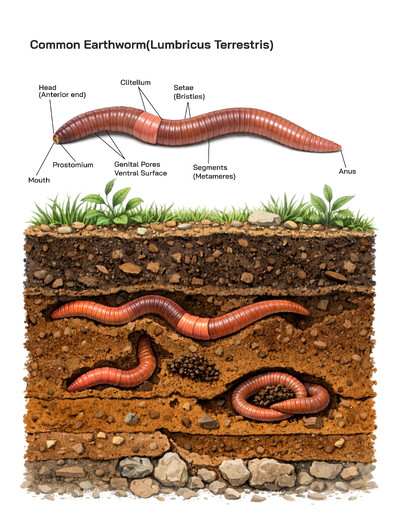
Anecic earthworms are among the largest and most robust earthworm species. They have long, thick bodies with a darker upper surface, usually brown or reddish, and a noticeably paler underside. Their appearance is less uniform, reflecting adaptation to a life spent moving between surface and deep soil layers. Anecic earthworms construct permanent vertical burrows that can extend deep into the ground. They emerge mainly at night to pull surface plant material into their tunnels, where it is consumed and mixed with soil. This behavior connects surface organic matter with deeper soil layers, improving aeration, water movement, and nutrient distribution.
Endogeic earthworms differ significantly in appearance and lifestyle from surface and deep-burrowing species. They are usually smaller, smoother, and lighter in color, ranging from pale brown to gray or greenish shades. Their reduced pigmentation is due to their mostly underground existence, where exposure to light is minimal. Endogeic earthworms live within the mineral soil, creating horizontal burrows as they feed on soil rich in organic particles. Their continuous movement and feeding activity mix soil layers and contribute to stable soil aggregation, which enhances moisture retention and resistance to erosion.
Perionyx excavatus is a distinct earthworm species commonly associated with tropical and subtropical regions. It has a slim, smooth body with a deep purple to dark reddish coloration and a glossy appearance. Compared to other earthworms, it appears more delicate but is extremely active and fast-moving. This species thrives in warm, moist environments and is widely used in vermiculture due to its rapid growth and high organic waste processing ability. Its energetic feeding behavior results in fine-textured compost that is rich in nutrients and beneficial microorganisms.
Each of these earthworm species contributes uniquely to soil ecosystems. Epigeic species focus on surface organic matter breakdown, anecic species link surface and deep soil processes, endogeic species improve soil structure from within, and Perionyx excavatus excels in intensive composting environments. Together, they support nutrient cycling, soil aeration, microbial activity, and long-term soil fertility.
Earthworm groups also differ significantly in their physiological tolerance to environmental stress, which determines where and how they can be effectively used in soil management systems. Epigeic earthworms, for example, are highly sensitive to moisture loss and temperature fluctuations because they live close to the surface. As a result, they perform best in controlled environments such as compost bins or shaded organic layers where moisture and food supply are stable. Their sensitivity makes them less suitable for direct soil improvement in open fields but ideal for rapid organic waste conversion.
Anecic earthworms, in contrast, demonstrate strong resilience to seasonal changes. Their deep vertical burrows allow them to escape extreme heat, cold, and drought by retreating into lower soil layers. This adaptive behavior enables them to remain active contributors to soil health over long periods, even in temperate climates with harsh seasonal variation. Their long lifespan and stable burrow systems mean their impact accumulates slowly but persistently, making them especially valuable for long-term soil restoration and sustainable agriculture.
Endogeic earthworms exhibit a different form of resilience that is closely tied to soil texture and composition. Because they spend nearly their entire life within mineral soil, they are less affected by surface disturbances such as tillage or temporary organic matter removal. Their survival depends more on soil structure, clay content, and organic particle availability within the soil matrix. This makes them key contributors to internal soil conditioning, particularly in agricultural soils where repeated cultivation disrupts surface-dwelling organisms.
Perionyx excavatus shows exceptional tolerance to high organic loads and warm conditions, which explains its dominance in tropical vermiculture systems. Unlike many earthworms that slow down under dense organic accumulation, this species thrives in rich waste environments. Its rapid metabolism allows it to process large quantities of organic material quickly, but this same trait also makes it less tolerant of cold temperatures and dry conditions. As a result, its use is generally limited to managed composting systems rather than open-field soil improvement.
Another important distinction among these earthworm groups lies in their contribution to soil microbial diversity. Epigeic earthworms strongly stimulate surface microbial populations by fragmenting fresh organic matter and increasing microbial access to carbon-rich substrates. Anecic earthworms influence microbial communities across soil depths by transporting surface material downward, creating microbial hotspots along their burrow walls. Endogeic earthworms, meanwhile, support microbial populations within mineral soil by continuously redistributing fine organic particles, creating stable environments for long-term microbial activity.
The physical impact of these earthworms on soil porosity also varies considerably. Anecic earthworms create large, stable channels that significantly enhance deep water infiltration and root penetration. Endogeic earthworms generate a dense network of smaller horizontal pores that improve soil crumb structure and uniform moisture distribution. Epigeic earthworms have minimal direct impact on soil porosity but indirectly improve soil conditions by producing compost that enhances soil aggregation when applied.
In agricultural systems, the presence or absence of specific earthworm groups can influence crop performance in different ways. Fields dominated by anecic and endogeic earthworms often show improved root depth, better drought resistance, and enhanced nutrient uptake. Compost enriched with epigeic or Perionyx excavatus activity tends to boost early plant growth by providing readily available nutrients and beneficial microbes. Matching earthworm type to agricultural goals is therefore an important consideration in sustainable land management.
Earthworm groups also differ in their interaction with soil contaminants. Endogeic earthworms, due to their constant ingestion of mineral soil, are more exposed to heavy metals and pollutants bound to soil particles. This makes them useful bioindicators for soil contamination but also vulnerable to polluted environments. Epigeic species are more exposed to surface-applied chemicals, while anecic earthworms may accumulate contaminants from both surface and deep layers, reflecting overall soil health.
In ecological restoration, the strategic introduction or encouragement of specific earthworm groups can accelerate recovery processes. Epigeic species help rebuild organic layers in degraded soils, anecic species restore vertical connectivity and water movement, and endogeic species stabilize soil structure internally. However, careful assessment is necessary, as introducing non-native earthworms into sensitive ecosystems can disrupt existing soil processes and native biodiversity.
From an evolutionary perspective, these earthworm groups represent different adaptive solutions to life underground. Epigeic earthworms prioritize speed and rapid reproduction, anecic earthworms invest in longevity and structural modification of soil, endogeic earthworms specialize in efficient soil processing, and Perionyx excavatus exemplifies rapid adaptation to high-resource tropical environments. This diversity of strategies explains why earthworms as a whole are so successful across a wide range of ecosystems.
In managed composting and waste recycling, understanding these distinctions is critical for efficiency. Systems dominated by Perionyx excavatus or epigeic species produce fast results but require careful moisture and temperature control. Systems that integrate compost application with soil hosting anecic and endogeic earthworms achieve slower but more durable improvements in soil health. Combining these approaches creates a complementary cycle between organic waste processing and soil enhancement.
By understanding how epigeic, anecic, endogeic earthworms and Perionyx excavatus differ in physiology, behavior, resilience, and ecological impact, it becomes clear that healthy soils depend on biological diversity below ground. These earthworms collectively form a living infrastructure that supports plant growth, water regulation, nutrient cycling, and long-term land productivity. Their quiet but continuous activity ensures that soil remains a dynamic, living system capable of sustaining ecosystems and human food systems alike.
Earthworm functional groups also differ in how they influence soil chemistry over extended time periods. Beyond immediate nutrient release, their activity alters the chemical environment of the soil by changing how minerals and organic compounds interact. As soil passes through earthworm digestive systems, chemical bonds are modified, leading to slower but more stable nutrient release patterns. This gradual transformation reduces nutrient losses through leaching and volatilization, helping soils retain fertility even under repeated cropping or rainfall events.
Another important but often overlooked aspect is how earthworms affect soil aggregation longevity. While many soil organisms contribute to aggregation, earthworm-produced aggregates tend to be more stable because they are bound by mucus and organic compounds processed during digestion. These aggregates resist breakdown under rain impact and irrigation, which helps maintain soil structure over long periods. The persistence of these aggregates improves soil resilience against erosion, particularly in sloped or intensively managed landscapes.
Earthworm diversity also influences how soils respond to mechanical disturbance. In soils dominated by endogeic species, internal structure can recover relatively quickly after tillage because these worms remain active within the mineral layers. In contrast, systems dependent mainly on epigeic species may experience slower structural recovery if surface organic layers are disturbed or removed. Anecic species provide long-term stability through their permanent burrows, but their populations can take longer to recover once disrupted. These differences explain why soil recovery rates vary widely depending on earthworm community composition.
The role of earthworms in regulating soil gas exchange extends beyond simple aeration. Their burrows create micro-environments where oxygen and carbon dioxide concentrations differ from surrounding soil. These gradients influence microbial respiration and root metabolism, subtly shaping biological processes at the microscale. Improved gas exchange supports beneficial aerobic microbes while preventing conditions that favor harmful anaerobic processes, such as the buildup of toxic compounds in compacted soils.
Earthworms also influence the spatial distribution of nutrients within agricultural fields. Rather than nutrients remaining concentrated where residues are applied, earthworm movement redistributes them more evenly. This spatial leveling reduces nutrient hotspots and deficiencies, leading to more uniform crop growth. Such redistribution is particularly important in low-input farming systems, where efficient use of existing nutrients is essential for productivity.
The interaction between earthworms and soil organic matter quality is another critical factor. Earthworms preferentially process certain types of organic residues, gradually shifting soil organic matter composition toward more stable forms. This selective processing affects how long organic carbon remains stored in the soil. Over time, soils with active earthworm communities often develop a balance between easily decomposable material and long-term carbon reserves, supporting both fertility and climate regulation.
Earthworm activity also influences soil color and visual characteristics, which can reflect underlying changes in soil health. Soils with active mixing often appear darker and more uniform due to the incorporation of organic matter into deeper layers. This visual change is not merely cosmetic but indicates improved nutrient availability, moisture retention, and biological activity. Farmers and soil scientists have long used such visual cues as informal indicators of soil condition.
From a hydrological perspective, earthworm burrows play a role in moderating groundwater recharge. By facilitating controlled infiltration, they help balance surface runoff and deep percolation. This balance reduces flood risk during heavy rainfall while maintaining groundwater levels during dry periods. In landscapes prone to erosion or waterlogging, earthworm activity contributes to more stable hydrological behavior.
Earthworm populations also interact with plant diversity in complex ways. Diverse plant communities provide varied root exudates and litter types, supporting a wider range of earthworm species and functional groups. In turn, diverse earthworm communities enhance soil conditions that allow multiple plant species to coexist. This feedback loop strengthens ecosystem stability and productivity, particularly in natural grasslands and agroforestry systems.
In long-term land use scenarios, earthworms influence how soils age and develop. Continuous mixing of organic and mineral components slows the formation of compacted layers and hardpans, extending the productive lifespan of soils. This process is especially important in regions with intensive land use, where soil degradation can occur rapidly without biological buffering mechanisms.
Earthworms also contribute to the resilience of soils under climate stress. As rainfall patterns become more erratic and temperatures fluctuate, soils with active earthworm communities are better able to absorb shocks. Improved structure, moisture regulation, and nutrient stability help plants withstand droughts, heavy rains, and temperature extremes. This buffering capacity positions earthworms as key allies in climate-adaptive land management.
In managed ecosystems, fostering balanced earthworm communities requires thoughtful practices rather than direct intervention alone. Reduced soil disturbance, consistent organic inputs, and avoidance of harmful chemicals create conditions where multiple earthworm groups can coexist. Over time, this coexistence leads to layered functionality within the soil, where surface processing, internal mixing, and deep connectivity all occur simultaneously.
Earthworms also play an educational role in shaping human understanding of soil as a living system. Observing their activity helps bridge the gap between abstract soil science and tangible biological processes. Their visible castings and burrows provide direct evidence that soil health depends on life below ground, reinforcing the importance of biological management alongside physical and chemical approaches.
The continued study of earthworm functional diversity reveals that soil health is not driven by a single process or organism, but by interactions across multiple biological levels. Epigeic, anecic, endogeic earthworms, and species like Perionyx excavatus each contribute unique strengths that collectively sustain soil systems. Their combined effects influence chemistry, physics, biology, and hydrology in ways that no single group could achieve alone.
By appreciating these deeper, long-term influences, earthworms can be understood not merely as decomposers or burrowers, but as architects of soil ecosystems. Their cumulative activity shapes the foundation upon which plant productivity, ecosystem stability, and human food security depend. This perspective underscores why protecting and encouraging earthworm diversity is essential for sustainable land use and the future health of soils worldwide. The ecological importance of earthworms lies not in a single species or group, but in the combined actions of multiple functional types. Each group operates at a different soil level, processes different forms of organic matter, and contributes uniquely to soil structure and fertility. Recognizing and respecting these functional differences allows farmers, gardeners, and land managers to work with natural soil biology rather than against it.
In conclusion, common earthworm species differ in size, color, habitat, and behavior, yet all play vital roles in sustaining healthy soils. Understanding these differences helps in selecting appropriate species for composting, agriculture, and soil restoration, while also highlighting the remarkable diversity and ecological importance of earthworms in natural and managed environments.