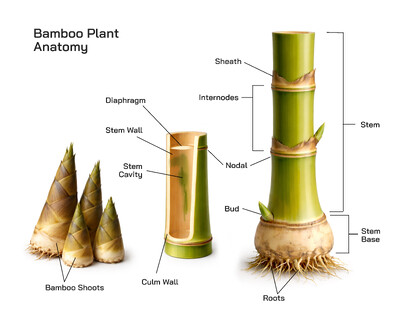
Bamboo plant, scientifically known as Bambusa vulgaris, is one of the most widely cultivated bamboo species across tropical and subtropical regions. Unlike trees, bamboo belongs to the grass family and exhibits remarkably rapid growth, making it one of the fastest renewable plant resources on Earth. Its strong culms, dense clumping habit, and adaptability to varied environments have established it as a vital plant for agriculture, industry, and ecological balance.
Farming of Bambusa vulgaris primarily relies on vegetative propagation rather than seeds. This method ensures uniform growth and predictable quality. Healthy rhizomes or culm cuttings are selected from mature plants and planted in prepared land. Proper land preparation involves loosening soil to encourage rhizome expansion and ensuring good drainage to prevent water stagnation. Bamboo roots spread horizontally, forming dense clumps that anchor soil and support sustained growth.
Soil conditions play an important role in bamboo farming. Bambusa vulgaris thrives best in fertile, well-drained loamy soils enriched with organic matter. While it tolerates a range of soil types, waterlogged or extremely dry soils restrict culm development. Adequate spacing between planting pits allows clumps to expand freely without competition, ensuring straight and healthy culm formation.
Water availability strongly influences bamboo growth. This species prefers consistent moisture, particularly during early establishment. Rainfall-dependent systems support bamboo farming in many regions, while supplementary irrigation improves productivity during dry periods. Bamboo responds well to moisture retention practices that keep soil evenly hydrated without flooding.
Climate suitability is one of the strongest advantages of Bambusa vulgaris. It grows best in warm and humid climates with moderate to high rainfall. Tropical and subtropical weather conditions provide ideal temperature ranges for rapid culm emergence and elongation. Bamboo tolerates seasonal variation but performs poorly in regions with severe frost or prolonged cold conditions.
Geographically, Bambusa vulgaris is widely cultivated across Asia, Africa, and Latin America. In Asia, it supports traditional construction, handicrafts, and food systems. African regions utilize bamboo for housing materials, fencing, and fuel alternatives. In Latin areas, bamboo is increasingly integrated into agroforestry and sustainable land-use practices due to its environmental benefits.
The importance of Bambusa vulgaris extends beyond agriculture. Ecologically, bamboo plays a crucial role in erosion control due to its extensive rhizome network that stabilizes soil on slopes and riverbanks. Its fast growth allows rapid carbon absorption, contributing to climate change mitigation. Bamboo also releases significant oxygen, enhancing environmental quality.
Economically, bamboo supports millions of livelihoods worldwide. Its culms are used in construction, furniture making, scaffolding, and housing support due to their strength and flexibility. Bamboo fibers are processed into paper pulp, textiles, and packaging materials. Handicraft industries rely heavily on bamboo for making baskets, mats, and decorative items.
Edible bamboo shoots derived from Bambusa vulgaris are an important food source in many cultures. These shoots are harvested when young and tender, providing nutrition and income for farming communities. Their culinary use further increases bamboo’s agricultural value.
Several types and forms of Bambusa vulgaris exist, distinguished by culm color, thickness, and growth behavior. Some varieties display bright green culms, while others show yellow coloration with green stripes. These variations influence both ornamental and commercial use, allowing bamboo to serve functional and aesthetic purposes.
In landscaping, Bambusa vulgaris is planted for windbreaks, privacy screens, and environmental restoration projects. Its dense foliage and tall culms make it effective for land rehabilitation and biodiversity support. Bamboo plantations also integrate well into agroforestry systems, improving soil health and farm sustainability.
Bambusa vulgaris also exhibits a unique growth rhythm that distinguishes it from most woody plants. Once a new culm emerges from the soil, it reaches its full height within a remarkably short period, often in a single growing season. Unlike trees, bamboo culms do not increase in diameter as they age; instead, strength develops through gradual lignification of tissues. This growth behavior influences farming practices, as management focuses on timing of harvest rather than long-term trunk thickening. Farmers carefully observe culm age to ensure harvesting occurs when strength, flexibility, and durability are at optimal levels.
An important aspect of bamboo farming involves clump management. Bambusa vulgaris forms dense clumps that can become overcrowded if left unmanaged. Periodic removal of older, weak, or poorly positioned culms improves air circulation and light penetration within the clump. This practice encourages healthier new shoot emergence and maintains uniform culm quality. Proper clump thinning also reduces pest habitat and improves access for harvesting, making long-term plantation management more efficient.
Bamboo’s underground rhizome system plays a central role in its resilience and productivity. The rhizomes store energy and nutrients, allowing the plant to recover quickly after harvesting. This regenerative capacity enables repeated harvesting without replanting, making bamboo a perennial resource. In sustainable systems, careful harvesting that avoids damage to rhizomes ensures continuous productivity for decades from a single planting.
Soil enrichment strategies in bamboo farming often rely on natural recycling of biomass. Fallen leaves and harvested culm residues decompose and return nutrients to the soil. This self-sustaining nutrient cycle reduces dependence on external fertilizers. Over time, bamboo plantations often improve soil organic matter, enhance microbial activity, and increase moisture retention, benefiting surrounding crops when integrated into mixed farming systems.
Bambusa vulgaris is also valued for its adaptability to agroforestry models. It can be grown alongside fruit trees, spices, or shade-tolerant crops, creating layered farming systems that maximize land use efficiency. In such systems, bamboo provides structural support, wind protection, and microclimate regulation while contributing economic returns. This integration strengthens farm resilience by diversifying income sources and reducing reliance on a single crop.
From a climate perspective, bamboo demonstrates high tolerance to intense rainfall events. Its flexible culms bend rather than break under strong winds, reducing storm damage. In flood-prone areas, bamboo’s root network slows water movement and reduces soil displacement. These characteristics make Bambusa vulgaris especially valuable in regions experiencing increased climate variability and extreme weather events.
Bamboo also plays an increasingly important role in climate mitigation strategies. Its rapid biomass accumulation allows significant carbon capture in a short period. While individual culms have shorter lifespans than trees, the continuous cycle of growth and regeneration maintains a steady carbon sink when plantations are managed sustainably. This has led to growing interest in bamboo as a component of climate-resilient land-use planning.
The industrial uses of Bambusa vulgaris continue to expand as technology advances. Beyond traditional construction and handicrafts, bamboo is now processed into engineered products such as laminated boards, panels, and structural composites. These materials offer high strength-to-weight ratios and are increasingly used as alternatives to timber and steel in sustainable building projects. Bamboo’s renewability and rapid regrowth provide an advantage in industries seeking low-impact raw materials.
In the energy sector, bamboo is gaining attention as a renewable biomass source. Bamboo residues and culms unsuitable for construction can be converted into charcoal, bioenergy, or pellets. This utilization reduces waste and offers rural communities additional income streams while providing alternatives to fossil fuels and unsustainably harvested firewood.
Culturally, Bambusa vulgaris holds symbolic significance in many societies. It is often associated with resilience, flexibility, and longevity due to its growth characteristics. Bamboo structures and tools are embedded in daily life, ceremonies, and traditional craftsmanship. These cultural connections strengthen community attachment to bamboo cultivation and promote its continued use across generations.
Global popularity of Bambusa vulgaris has increased as sustainability becomes a priority in development planning. Governments, environmental organizations, and industries recognize bamboo’s potential to address challenges related to deforestation, rural employment, and climate change. This recognition has led to expanded bamboo planting initiatives and research into improved management and processing techniques.
Different forms of Bambusa vulgaris offer varied functional and ornamental value. Variations in culm color, size, and growth habit allow selection for specific purposes such as landscaping, screening, or industrial use. Some forms are preferred for decorative planting due to striking coloration, while others are selected for thicker culms suitable for construction. This diversity enhances bamboo’s versatility across sectors.
Bamboo’s role in urban environments is also growing. Bambusa vulgaris is increasingly planted in cities for green belts, noise reduction, and air quality improvement. Its fast growth and dense foliage make it effective for urban greening projects that require quick results. Urban bamboo planting contributes to temperature moderation and improves visual landscapes in densely populated areas.
Education and skill transfer are integral to successful bamboo utilization. Traditional knowledge of harvesting, curing, and treatment methods ensures durability and resistance to pests. Combining this knowledge with modern processing techniques enhances product quality and market value. As global interest grows, training programs and research institutions play a vital role in developing skilled bamboo-based industries.
In essence, Bambusa vulgaris represents a unique convergence of agriculture, ecology, industry, and culture. Its farming practices emphasize regeneration and long-term productivity rather than single-use extraction. Its wide range of uses supports livelihoods, environmental restoration, and sustainable development. As global demand shifts toward renewable and resilient resources, Bambusa vulgaris continues to gain prominence as a plant that meets economic needs while aligning closely with natural systems.
Bambusa vulgaris also demonstrates a remarkable capacity for adaptation at the genetic and physiological level, which explains its success across widely separated regions. When introduced into new environments, the species adjusts culm thickness, internode length, and leaf density in response to local temperature, rainfall, and soil fertility. This plasticity allows bamboo stands to remain productive even when conditions differ significantly from their region of origin. Such adaptability reduces the risk associated with large-scale planting and has encouraged its spread beyond traditional bamboo-growing zones.
Harvest management is a defining feature of sustainable bamboo farming. Culms are typically harvested selectively rather than clear-cut, ensuring that the clump remains healthy and productive. Mature culms are removed while younger ones are left to support photosynthesis and energy storage within the rhizome system. This selective approach maintains structural balance within the clump and supports continuous shoot production year after year. The practice contrasts sharply with annual cropping systems and highlights bamboo’s long-term productivity model.
Post-harvest treatment methods further enhance the value of Bambusa vulgaris. Freshly cut bamboo is susceptible to biological degradation if left untreated, so traditional and modern curing methods are widely applied. These include controlled drying, water soaking, and natural preservatives derived from plant sources. Properly treated bamboo gains improved durability and resistance, allowing it to be used in long-lasting structures and products. This treatment stage significantly expands bamboo’s usability across industries.
Bamboo’s contribution to soil and water conservation extends beyond erosion control. Dense bamboo stands influence local hydrology by slowing surface runoff and improving groundwater recharge. Leaf litter forms a protective layer that reduces evaporation and enhances moisture infiltration. Over time, this creates a more stable soil-water environment that benefits surrounding vegetation. In watershed management projects, Bambusa vulgaris is increasingly recognized as a strategic species for restoring degraded landscapes.
In rural economies, bamboo acts as a bridge between subsistence and market-oriented agriculture. Farmers can use bamboo for household needs while also selling culms, shoots, or processed products. This dual-use nature reduces dependency on external markets and increases household resilience. Even small bamboo plots can generate steady returns due to bamboo’s high regrowth rate and diverse applications.
Bambusa vulgaris also plays a role in promoting circular economies. Nearly every part of the plant can be utilized, from culms and shoots to leaves and residues. Waste from bamboo processing can be repurposed into compost, bioenergy, or secondary products, minimizing material loss. This closed-loop utilization aligns strongly with modern sustainability principles and reduces environmental pressure.
The role of bamboo in food systems extends beyond edible shoots. Bamboo leaves are sometimes used as fodder or wrapping material in traditional food preparation, reflecting multifunctional use within local cultures. These practices illustrate how bamboo integrates seamlessly into daily life, supporting both nourishment and utility without generating waste.
International interest in bamboo-based architecture has elevated Bambusa vulgaris to global prominence. Architects and engineers increasingly explore bamboo as a structural material capable of meeting modern design and safety requirements. Its flexibility, tensile strength, and aesthetic appeal make it suitable for innovative construction that blends tradition with modern engineering. This has expanded bamboo’s image from a rural material to a globally recognized sustainable resource.
Bamboo also contributes to social development initiatives. In many regions, bamboo-based enterprises support women’s groups, artisan cooperatives, and community-led businesses. Skills such as weaving, construction, and processing provide employment opportunities that do not require large capital investment. These social benefits enhance bamboo’s role as a tool for inclusive development.
The expansion of bamboo research has further strengthened its global relevance. Studies focusing on growth optimization, pest resistance, and processing efficiency continue to improve yields and product quality. This research-driven approach helps standardize bamboo production and supports its integration into formal markets. Bambusa vulgaris benefits from this growing knowledge base, which enhances both farmer confidence and investor interest.
In environmental education and awareness programs, bamboo is often highlighted as an example of harmony between productivity and sustainability. Its rapid growth and regenerative nature provide tangible evidence that economic use of plants does not have to result in environmental degradation. This educational value reinforces bamboo’s symbolic role in promoting sustainable lifestyles.
Urban planners increasingly recognize the psychological and environmental benefits of bamboo landscapes. Dense bamboo groves reduce noise pollution, improve air quality, and create calming green spaces. Bambusa vulgaris, with its tall culms and lush foliage, is particularly effective in transforming urban margins and degraded spaces into functional green zones. These applications extend bamboo’s importance beyond agriculture into urban well-being.
On a global scale, Bambusa vulgaris continues to gain recognition as a strategic plant for future development. Its alignment with climate resilience, renewable resource use, and rural empowerment makes it uniquely suited to address interconnected global challenges. Unlike short-term solutions, bamboo offers a long-lasting framework for sustainable growth that benefits both people and ecosystems.
In conclusion, Bambusa vulgaris is far more than a fast-growing grass; it is a cornerstone species that links farming, ecology, industry, and culture. Its farming practices emphasize regeneration, its uses span traditional and modern sectors, and its environmental benefits support long-term land health. As global priorities increasingly focus on sustainability and resilience, Bambusa vulgaris stands out as a plant that not only adapts to change but actively supports a balanced and regenerative future.
In summary, Bambusa vulgaris is a highly valuable bamboo species that combines rapid growth, environmental resilience, and economic versatility. Its farming practices are simple yet effective, supported by suitable soil, warm climate, and adequate moisture. Its wide regional presence, diverse uses, and ecological importance make it a cornerstone plant for sustainable development, rural livelihoods, and environmental conservation worldwide.