Tuna fish are among the most powerful, fast, and efficient swimmers in the marine world. They belong to a group of open-ocean fish that have evolved extraordinary physical and physiological traits that allow them to dominate vast oceanic environments. The characteristics of tuna fish reflect millions of years of adaptation to life in the open sea, where speed, endurance, and efficiency are essential for survival. Unlike many coastal fish, tuna are true pelagic species, meaning they spend most of their lives far from shore, continuously swimming across great distances in search of food and suitable environmental conditions.
One of the most distinctive characteristics of tuna fish is their streamlined body shape. The body is elongated, spindle-shaped, and smooth, minimizing resistance as the fish moves through water. This fusiform shape allows tuna to cut through the ocean with minimal drag, enabling them to maintain high speeds for long periods. The skin of tuna is covered with very small scales, which further reduce friction and contribute to their hydrodynamic efficiency. Beneath the skin lies a complex system of muscles and connective tissues designed to convert muscular energy directly into forward motion.
The muscular system of tuna fish is highly specialized. A large portion of their body mass consists of powerful red muscles that are rich in blood vessels and mitochondria. These muscles support continuous swimming and high endurance. Unlike many other fish that rely primarily on short bursts of movement, tuna are built for sustained motion. Their muscles are arranged in a way that transfers force efficiently to the tail, making each tail beat powerful and energy-efficient. This muscular design allows tuna to travel hundreds or even thousands of kilometers during seasonal migrations.
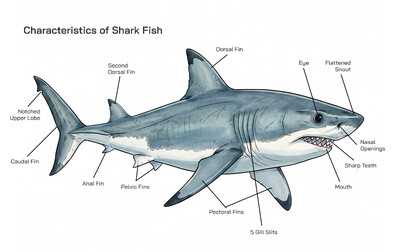
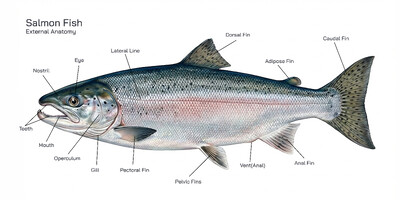
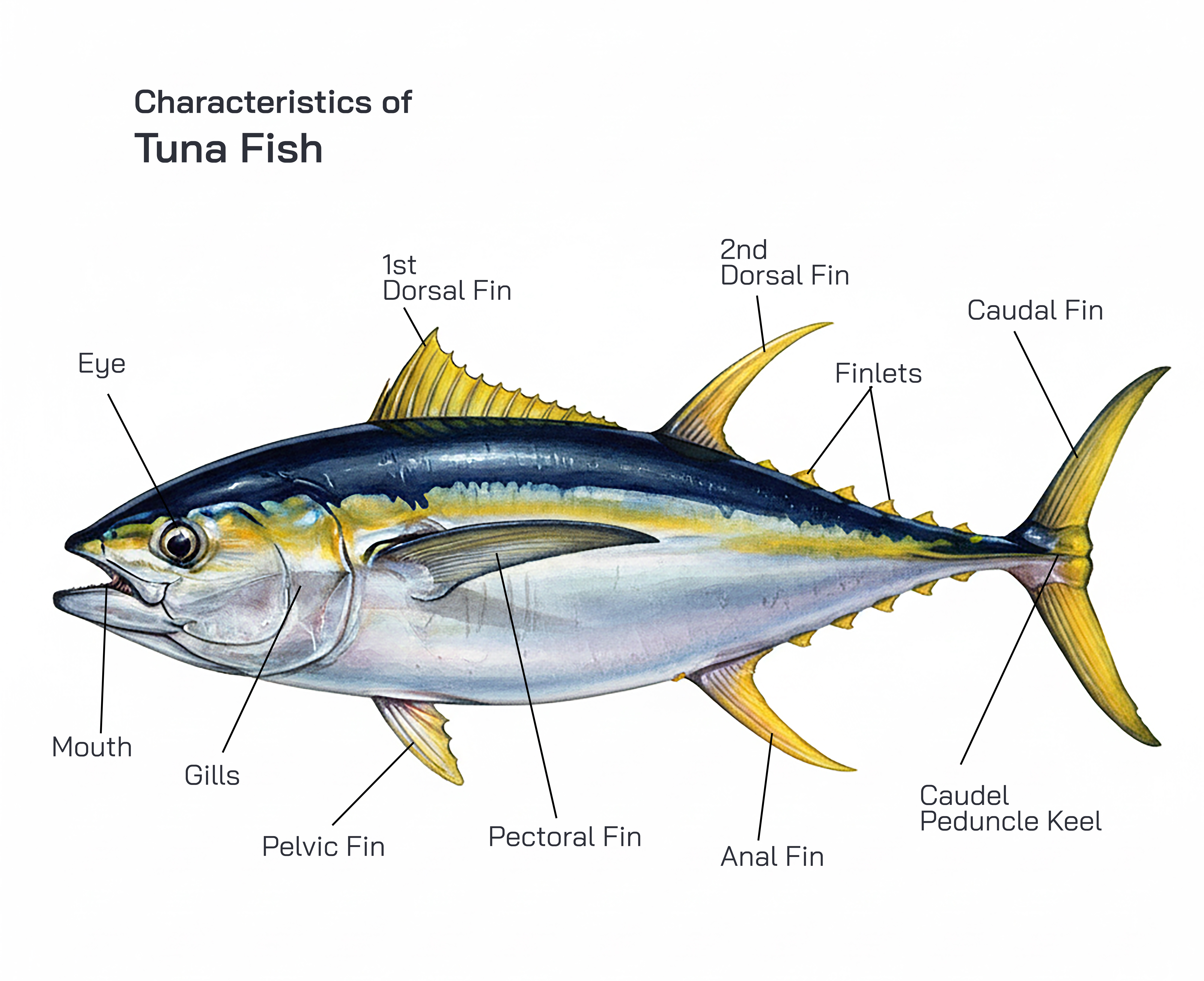
The tail, or caudal fin, of a tuna fish is another defining feature. It is large, stiff, and crescent-shaped, providing strong propulsion. The narrow base of the tail, known as the caudal peduncle, reduces water resistance and increases thrust efficiency. On either side of the caudal peduncle are small keels that stabilize the tail during rapid movement. This tail structure is one of the main reasons tuna are capable of reaching exceptional swimming speeds compared to most other fish species.
Tuna fish also possess a well-developed fin system that enhances stability and maneuverability. The dorsal and anal fins can be folded into grooves along the body, reducing drag when the fish swims at high speed. Pectoral fins help with steering and balance, especially during slower movement or changes in direction. The ability to retract fins is a unique characteristic that highlights the tuna’s specialization for speed and endurance in open water environments.
Another remarkable characteristic of tuna fish is their advanced respiratory system. Tuna have large gill surfaces that allow efficient extraction of oxygen from water. As they swim, water continuously flows over their gills, enabling constant oxygen uptake. This system supports their high metabolic rate and continuous movement. Tuna must keep swimming to ensure adequate water flow over their gills, which is why they are rarely seen resting or stationary.
One of the most fascinating characteristics of tuna fish is their ability to regulate body temperature. Unlike most fish, which are cold-blooded and have body temperatures similar to their surrounding water, tuna can maintain parts of their body at temperatures higher than the environment. This partial warm-blooded nature is made possible by a specialized blood circulation system that conserves heat generated by muscle activity. Warmer muscles function more efficiently, allowing tuna to swim faster, react quicker, and hunt more effectively in colder waters.
The circulatory system of tuna fish is highly efficient and supports their active lifestyle. Their hearts pump blood rapidly, delivering oxygen and nutrients to muscles at a high rate. The blood vessels are arranged to minimize heat loss and maximize oxygen delivery. This efficient circulation is directly linked to the tuna’s ability to sustain long-distance migrations and high-speed swimming without exhaustion.
In terms of habitat, tuna fish are found in oceans around the world, primarily in tropical, subtropical, and temperate waters. They prefer open seas rather than coastal zones and often inhabit the upper layers of the ocean where food is abundant. Tuna are known for their extensive migratory behavior, traveling across entire ocean basins in response to changes in temperature, food availability, and breeding requirements. This migratory nature is a key characteristic that influences their growth, reproduction, and population dynamics.
The feeding behavior of tuna fish reflects their role as top predators in marine ecosystems. They are carnivorous and feed on a wide range of prey, including smaller fish, squid, and crustaceans. Tuna hunt primarily by sight and speed, using rapid acceleration to chase down fast-moving prey. Their sharp, conical teeth are designed to grip slippery prey rather than chew. Tuna often hunt in schools, coordinating their movements to herd prey into dense groups, making feeding more efficient.
Tuna fish have highly developed sensory systems that support their predatory lifestyle. Their eyes are well adapted for detecting movement in low-light conditions, allowing them to hunt at various depths and times of day. The lateral line system along their body helps them sense vibrations and pressure changes in the water, enabling them to detect nearby prey and avoid obstacles or predators. These sensory adaptations enhance their ability to survive in the vast and often challenging open-ocean environment.
Reproduction is another important aspect of tuna fish characteristics. Tuna are generally broadcast spawners, releasing large numbers of eggs into the open water. Fertilization occurs externally, and the resulting larvae drift with ocean currents during early development. This reproductive strategy increases the chances of survival by producing vast numbers of offspring, compensating for the high mortality rates common in open-ocean environments. Tuna grow rapidly, reaching maturity relatively quickly compared to many other large fish species.
Behaviorally, tuna fish are known for their schooling habits, especially during early life stages and feeding activities. Swimming in schools provides protection from predators, increases feeding success, and improves hydrodynamic efficiency. As they mature, some tuna species may adopt more solitary behaviors, especially during long-distance migrations. Their behavior is closely linked to environmental cues such as water temperature, oxygen levels, and prey availability.
The lifespan of tuna fish varies depending on species, environmental conditions, and fishing pressure. Some species live for only a few years, while others can survive for several decades. Throughout their lives, tuna face numerous challenges, including natural predators and human activities such as commercial fishing. Despite these pressures, their biological characteristics have allowed them to remain among the most successful and widespread fish in the world’s oceans.
Tuna fish represent one of the most refined outcomes of marine evolution, embodying a near-perfect balance between strength, speed, endurance, and efficiency. Their entire biology is shaped by the demands of an open-ocean lifestyle where food sources are scattered, predators are swift, and survival depends on constant movement. Unlike reef or bottom-dwelling fish that rely on hiding or short bursts of motion, tuna are built to live in perpetual motion, converting energy into forward thrust with exceptional efficiency. This continuous swimming lifestyle has influenced not only their external shape but also their internal organs, metabolism, and even their behavior.
At the cellular level, tuna fish display adaptations that support their extreme activity. Their muscle cells contain a high density of mitochondria, the structures responsible for producing energy. This allows tuna to generate large amounts of energy through aerobic respiration without rapidly tiring. The red muscle tissue, which powers sustained swimming, is located deep within the body rather than near the skin, reducing drag and improving streamlining. This internal placement also helps retain heat, contributing to their ability to maintain elevated muscle temperatures compared to surrounding water.
The connective tissue system of tuna fish plays a critical role in energy transfer. Elastic tendons connect muscles to the tail, storing and releasing energy with each tail beat. This spring-like mechanism reduces the metabolic cost of swimming, allowing tuna to travel long distances while conserving energy. Such efficiency is vital during migrations that may span entire ocean basins, sometimes covering thousands of kilometers without rest.
Tuna fish also exhibit remarkable adaptations in their nervous system. Their brains are relatively large compared to many other fish species, supporting complex sensory processing and rapid response times. Quick decision-making is essential for capturing fast prey and avoiding predators in open water, where there are few physical barriers or hiding places. Their reaction speed, combined with powerful muscles, allows them to change direction or accelerate in fractions of a second.
The digestive system of tuna fish is optimized for a high-protein diet. Their stomachs are elastic and capable of expanding to accommodate large meals, which is important because prey availability in the open ocean can be unpredictable. When food is abundant, tuna consume large quantities to build energy reserves. Their intestines efficiently absorb nutrients, supporting rapid growth and sustained metabolic activity. This efficient digestion allows tuna to convert prey into muscle mass and energy with minimal waste.
Another defining characteristic of tuna fish is their tolerance for a wide range of environmental conditions. While they are most commonly associated with warm waters, many species regularly dive into colder, deeper layers of the ocean in search of prey. Their ability to regulate muscle and organ temperature allows them to function effectively even when surrounding water temperatures drop significantly. This vertical mobility gives tuna access to food resources unavailable to many other predators and reduces competition.
Tuna fish also demonstrate advanced blood chemistry adaptations. Their blood contains high concentrations of hemoglobin, enabling it to carry large amounts of oxygen. Additionally, the hemoglobin has a strong affinity for oxygen, ensuring efficient uptake even when oxygen levels in water are relatively low. This is particularly important during deep dives or in regions where oxygen concentrations fluctuate.
Social behavior in tuna fish is complex and flexible. Schooling behavior is not random but often structured by size, age, and species. Fish of similar size tend to school together, reducing the risk of smaller individuals being targeted by predators within the group. Schooling also creates hydrodynamic advantages, as fish swimming behind others experience reduced water resistance. This collective efficiency allows the entire group to travel farther using less energy.
Communication within tuna schools occurs through subtle body movements, changes in swimming speed, and pressure signals detected through the lateral line system. These non-visual cues allow tuna to coordinate movements even in low-light conditions or murky water. Such coordination is especially important during hunting, when precise timing and direction changes are needed to trap fast-moving prey.
The growth rate of tuna fish is another remarkable characteristic. Many species grow rapidly during early life stages, reducing the amount of time they are vulnerable to predators. Fast growth is supported by their efficient metabolism and constant feeding. As they mature, growth slows, but muscle density and strength continue to increase, enhancing swimming performance and reproductive success.
Reproductive maturity in tuna fish is closely tied to size and energy reserves rather than age alone. Individuals must reach a certain physical condition before they can successfully reproduce. During spawning seasons, tuna often migrate to specific regions where environmental conditions favor egg survival. These spawning grounds are usually warm, nutrient-rich waters where larvae can develop quickly. The timing of reproduction is synchronized with ocean currents to maximize larval dispersal and survival.
Early life stages of tuna are particularly vulnerable, and only a tiny fraction of larvae survive to adulthood. However, those that do survive grow rapidly and soon develop the swimming abilities that define adult tuna. This life history strategy, characterized by high reproductive output and rapid growth, has allowed tuna populations to persist despite natural and human-induced pressures.
From an ecological perspective, tuna fish play a crucial role in maintaining balance within marine ecosystems. As apex or near-apex predators, they regulate populations of smaller fish and squid, preventing any single species from becoming overly dominant. Their migrations also redistribute nutrients across vast ocean areas, indirectly supporting productivity in different marine regions.
Tuna fish have also adapted to exploit different ecological niches depending on species. Some species remain closer to the surface, while others spend much of their time in deeper waters. Variations in body size, fin length, and muscle composition reflect these differences in lifestyle. Despite these variations, all tuna share the core characteristics of speed, endurance, and efficiency.
In the context of human interaction, tuna fish have become one of the most economically important marine species. Their flesh is rich in protein and oils, making it highly valued worldwide. This intense demand has placed significant pressure on wild populations, highlighting the importance of understanding tuna biology for effective conservation and management. Their slow reproductive turnover relative to fishing pressure makes them particularly vulnerable to overexploitation.
Despite modern challenges, the fundamental characteristics of tuna fish remain a testament to evolutionary optimization. Every aspect of their structure, from microscopic muscle fibers to large-scale migratory behavior, reflects adaptation to a life spent in constant motion across the open ocean. Tuna fish are not merely fast swimmers; they are living systems finely tuned for endurance, efficiency, and survival in one of the most demanding environments on Earth.
Tuna fish continue to stand out in the marine world as extraordinary examples of biological refinement, and their characteristics become even more impressive when examined through the lens of long-term survival and evolutionary success. Their bodies are not simply fast-moving machines but integrated systems where structure, physiology, and behavior function together with remarkable precision. Every adaptation seen in tuna fish supports a lifestyle that demands constant activity, rapid decision-making, and efficient use of energy in an environment where rest is rarely possible.
One of the lesser-discussed yet crucial characteristics of tuna fish is their skeletal structure. Their bones are lightweight but strong, reducing overall body mass while maintaining structural integrity during high-speed swimming. This skeletal efficiency allows muscles to work without unnecessary load, improving acceleration and endurance. The vertebral column is especially flexible in a controlled way, allowing powerful side-to-side tail movement without compromising stability. This balance between flexibility and stiffness is essential for sustained propulsion over long distances.
The skin of tuna fish also contributes significantly to their performance. It is not just smooth but biologically active. Beneath the surface lies a network of blood vessels that helps regulate temperature and oxygen delivery. The skin’s texture reduces turbulence as water flows over the body, enhancing laminar flow and reducing drag. This microscopic advantage becomes enormously important when multiplied over millions of tail beats during long migrations.
Tuna fish are also highly efficient in how they manage energy reserves. They store energy primarily in the form of lipids within muscle tissues and internal organs. These fat reserves are not excessive, as excess weight would hinder swimming efficiency, but are precisely balanced to provide fuel during long journeys when food availability may be low. This energy management strategy allows tuna to cross nutrient-poor regions of the ocean without significant loss of strength or speed.
Another defining characteristic is their adaptability to changing ocean conditions. Tuna fish are highly responsive to variations in temperature, salinity, and oxygen levels. They constantly adjust their swimming depth to find optimal conditions, sometimes moving vertically hundreds of meters within a single day. This vertical migration behavior allows them to exploit different prey layers and avoid unfavorable environmental conditions, giving them a competitive advantage over less adaptable species.
Tuna fish also exhibit advanced learning and memory capabilities. Research suggests that tuna can remember migratory routes, feeding grounds, and spawning areas over many years. This spatial memory enables them to return to productive regions with remarkable accuracy. Such cognitive abilities reduce the energy cost of searching for food and suitable breeding sites, further enhancing survival and reproductive success.
Their immune system is another important but often overlooked aspect of tuna characteristics. Living in open ocean environments exposes tuna to a wide range of parasites and pathogens. To cope with this, tuna possess robust immune defenses that allow them to heal quickly from injuries and resist infections. Their fast metabolism also supports rapid tissue repair, which is essential given the physical demands of constant swimming and frequent encounters with prey and competitors.
The interaction between tuna fish and ocean currents is another fascinating element of their biology. Tuna do not simply swim against currents; they strategically use them to conserve energy. By aligning their movements with prevailing currents during migration, tuna can travel greater distances with less effort. This ability to exploit ocean dynamics reflects a deep evolutionary integration between tuna behavior and the physical environment of the sea.
Tuna fish also play a significant role in shaping the behavior of other marine species. As powerful predators, their presence influences the movement patterns and population structures of smaller fish and squid. Prey species often alter their depth or schooling behavior in response to tuna activity, demonstrating the tuna’s influence beyond direct predation. This makes tuna an important ecological regulator in pelagic ecosystems.
Another notable characteristic is the way tuna fish age. Unlike many animals that show a clear decline in physical performance with age, mature tuna often maintain high swimming efficiency and strength for much of their lifespan. Their muscles remain functional, and their cardiovascular systems continue to support intense activity. This extended period of peak performance increases their lifetime reproductive output and ecological impact.
The sensory world of tuna fish is finely tuned to open-ocean conditions. Their vision is adapted to detect contrast and motion rather than fine detail, which is ideal for spotting prey against the open water backdrop. Their inner ear and lateral line systems work together to provide precise information about speed, orientation, and nearby movement. This sensory integration allows tuna to maintain stable swimming paths even at very high speeds.
Tuna fish also demonstrate resilience to injury. Minor damage to fins or skin does not significantly impair their swimming ability, and regeneration occurs relatively quickly. This resilience is crucial in an environment where encounters with predators, prey, and even human fishing gear are frequent. The ability to continue functioning despite injury is a key survival trait.
From an evolutionary perspective, tuna fish represent a lineage that has remained highly successful with relatively little change in overall body plan for millions of years. This stability indicates that their design is close to optimal for their ecological niche. While minor variations exist among species, the fundamental characteristics of tuna—streamlined shape, powerful muscles, efficient respiration, and advanced circulation—remain consistent.
In broader terms, tuna fish can be seen as living indicators of ocean health. Because they rely on large, connected marine ecosystems, changes in tuna populations often reflect changes in ocean productivity, temperature patterns, and human impact. Their wide-ranging movements integrate conditions across vast regions, making their biology deeply connected to global ocean processes.
Ultimately, the characteristics of tuna fish go far beyond simple speed or strength. They represent a complex integration of anatomy, physiology, behavior, and environmental awareness. Tuna are not merely surviving in the open ocean; they are mastering it. Their ability to move endlessly, hunt efficiently, adapt quickly, and reproduce successfully in one of the most demanding environments on the planet places them among the most remarkable animals in the natural world.
In summary, the characteristics of tuna fish represent a remarkable combination of speed, strength, endurance, and efficiency. Their streamlined body, powerful muscles, advanced respiratory and circulatory systems, temperature regulation, and keen senses make them perfectly adapted for life in the open ocean. Tuna are not only ecologically important as top predators but also biologically fascinating examples of evolutionary specialization. Their ability to thrive in vast and dynamic marine environments highlights the extraordinary adaptability of life in the oceans.