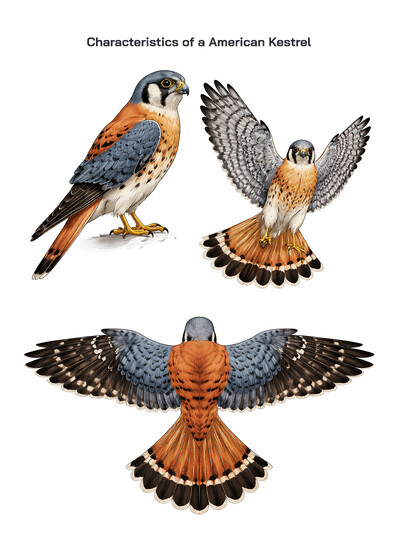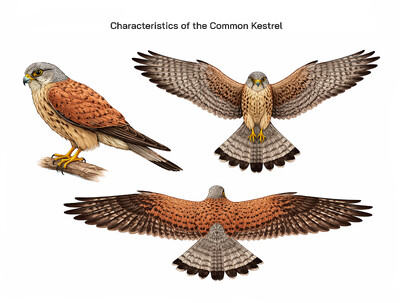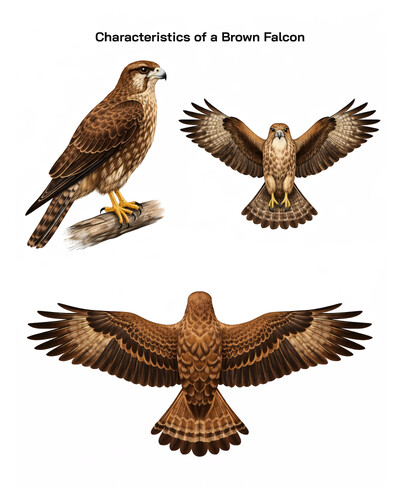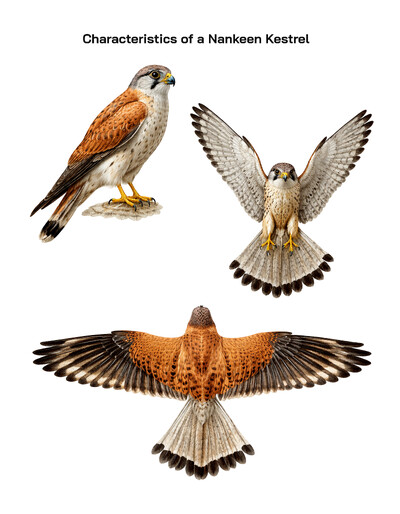
The Amur falcon is one of the most remarkable small falcons in the world, best known for its extraordinary long-distance migration and exceptional endurance. Scientifically named Falco amurensis, this species demonstrates how a relatively small bird of prey can achieve one of the longest and most demanding migratory journeys among raptors. Its physical design, feeding behavior, and seasonal movements make it a unique and ecologically important falcon.
In physical structure, the Amur falcon is slim, lightweight, and aerodynamically efficient. Its body is compact yet elongated, allowing sustained flight over vast distances with minimal energy loss. The wings are long, narrow, and sharply pointed, ideal for gliding and fast directional control. The tail is narrow and moderately long, contributing to stability and maneuverability during prolonged flight and aerial hunting.
Plumage characteristics of the Amur falcon are subtle but distinctive. Adult males typically display a smooth gray upper body with darker flight feathers and a contrasting white undertail. Females are more patterned, with barred underparts and brownish tones that provide effective camouflage. This sexual dimorphism allows easy identification in the field and reflects differing ecological roles during breeding and migration periods.
The head of the Amur falcon is compact with a sharply curved beak adapted for capturing small prey. Its talons, while not as massive as those of larger falcons, are sharp and efficient for grasping insects and small vertebrates in midair. Vision is a critical characteristic, enabling the falcon to detect fast-moving prey against bright skies and complex backgrounds.
Behaviorally, the Amur falcon is highly specialized for aerial feeding. It primarily hunts insects, particularly flying species such as locusts, dragonflies, beetles, and termites. During peak insect swarms, the falcon feeds almost continuously while on the wing, catching prey in rapid succession. This insect-based diet distinguishes it from many other falcons that rely more heavily on birds or mammals.
One of the most defining characteristics of the Amur falcon is its migratory behavior. Each year, it undertakes an extraordinary journey between breeding grounds in parts of eastern Asia and wintering areas in southern Africa. This migration involves crossing vast landmasses and large bodies of water, including extended non-stop flights over the Arabian Sea. Such endurance highlights exceptional physiological efficiency and navigational skill.
During migration, Amur falcons are known for forming large communal roosts. Thousands of individuals may gather in trees or wooded areas during stopovers, creating impressive natural spectacles. These communal behaviors provide safety from predators and allow energy conservation during long journeys.
Habitat preference varies seasonally. During breeding periods, Amur falcons occupy open woodland edges, river valleys, and agricultural landscapes where insects are abundant. They often use existing tree cavities or old nests built by other birds rather than constructing their own. This nesting strategy allows them to focus energy on reproduction and migration.
Parental care is shared between both adults. Eggs are incubated carefully, and once hatched, chicks are fed primarily on insects. Juveniles develop rapidly, gaining flight skills before joining migratory movements. Early mastery of flight and hunting is essential, as survival depends on the ability to complete long journeys shortly after fledging.
Ecologically, the Amur falcon plays a vital role in controlling insect populations. By consuming large numbers of agricultural pests, it provides natural pest control across multiple continents. This service benefits ecosystems and farming regions alike, highlighting the falcon’s importance beyond its visual and behavioral appeal.
The Amur falcon is also an important indicator species. Because it depends on healthy insect populations, safe migratory corridors, and suitable roosting sites, changes in its numbers can signal broader environmental issues such as habitat loss, climate shifts, or pesticide impact.
Historically, the Amur falcon was underappreciated due to its small size, but modern research and conservation awareness have brought attention to its extraordinary life cycle. Protection of key roosting sites and increased understanding of migration routes have become central to its conservation.
Beyond its visible physical traits and well-known migratory feats, the Amur falcon represents a remarkable example of physiological efficiency and evolutionary fine-tuning. One of its lesser-discussed adaptations lies in how its body manages energy at a cellular level. During long migratory flights, the Amur falcon relies heavily on fat metabolism rather than rapid muscle exhaustion. Its muscles are rich in mitochondria, allowing sustained energy release over extended periods without significant loss of performance. This adaptation enables the falcon to maintain steady wingbeats and controlled gliding for days, even when food intake is temporarily unavailable during long sea crossings.
Navigation in the Amur falcon is another extraordinary capability that extends beyond simple instinct. Research suggests that these falcons use a combination of solar orientation, Earth’s magnetic field, wind pattern recognition, and landscape memory to guide their journeys. Juveniles, despite having no prior migratory experience, are able to follow ancestral routes with astonishing accuracy. This suggests a strong genetic component to navigation, reinforced over time by environmental cues. Such navigational precision is essential when crossing vast oceanic regions where visual landmarks are absent.
Seasonal timing plays a crucial role in the Amur falcon’s survival. Migration schedules are closely synchronized with insect population cycles across continents. The falcon’s arrival at stopover sites often coincides with mass insect emergences, ensuring abundant food availability. This synchronization demonstrates how tightly linked the species is to global ecological rhythms. Any disruption to these cycles, whether due to climate variability or pesticide use, can have cascading effects on survival and breeding success.
Social structure in the Amur falcon is more complex than it may initially appear. While primarily solitary hunters during flight, they display strong tolerance and coordination when roosting communally. These large roosts are not random gatherings but structured assemblies where birds select safe, thermally efficient sites that reduce overnight energy loss. Younger birds often position themselves near experienced adults, potentially benefiting from collective vigilance and learned responses to predators or disturbances.
Genetically, the Amur falcon shows relatively low regional differentiation despite its vast geographic range. This genetic consistency is likely a result of extensive mixing during migration and communal roosting, which promotes gene flow across populations. Such genetic resilience helps maintain overall species stability but also means that large-scale threats along migration routes can impact the entire global population rather than isolated regional groups.
Human interaction with the Amur falcon has historically been minimal, but in recent decades, it has increased significantly. Agricultural expansion has created both opportunities and risks. On one hand, farmland attracts insects that provide abundant food. On the other hand, intensive pesticide use can reduce prey availability and introduce toxins into the falcon’s food chain. Even low-level chemical exposure can weaken flight endurance, impair reproduction, and reduce juvenile survival rates over time.
Climate change presents a subtle yet serious challenge for the Amur falcon. Shifts in wind patterns can alter traditional migration corridors, forcing birds to expend more energy or take riskier routes. Changes in rainfall and temperature also affect insect abundance, potentially breaking the delicate timing between migration and food availability. While the species has demonstrated remarkable adaptability, rapid environmental change may outpace its ability to adjust without significant population stress.
From a conservation perspective, international cooperation is essential for protecting the Amur falcon. Because it crosses dozens of countries annually, no single region can ensure its survival alone. Protection of key roosting habitats, reduction of illegal hunting, and regulation of pesticide use along migration routes are among the most effective conservation measures. Public awareness campaigns have already proven successful in reducing direct human threats in several regions.
The Amur falcon also holds scientific value beyond ornithology. Its endurance, metabolic efficiency, and navigation strategies are studied for insights into aerodynamics, energy optimization, and biological navigation systems. These studies have potential applications in fields ranging from aviation to environmental monitoring, highlighting how understanding one small falcon can contribute to broader scientific knowledge.
An often overlooked aspect of the Amur falcon’s biology is its remarkable flexibility in responding to unpredictable environmental conditions. Unlike many raptors that depend on narrow ecological niches, the Amur falcon demonstrates a high degree of behavioral plasticity. When typical insect prey becomes scarce due to weather fluctuations or habitat disturbance, it is capable of temporarily shifting its hunting strategy to exploit alternative food sources such as small reptiles or amphibians. This adaptability plays a critical role in allowing the species to survive across highly variable landscapes spanning multiple climatic zones.
Physiologically, the Amur falcon exhibits advanced feather maintenance strategies that support long-term flight efficiency. During migration, feather condition is critical, as even minor damage can significantly increase drag and energy expenditure. The species invests substantial time in preening and feather alignment during rest periods, ensuring optimal aerodynamic performance. Molting cycles are precisely timed to avoid overlap with major migratory phases, reducing vulnerability during long-distance travel. This careful scheduling reflects a finely tuned evolutionary balance between maintenance and movement.
Another important dimension of the Amur falcon’s ecology is its role in cross-continental nutrient transfer. By feeding intensively in one region and roosting or defecating in another, the falcon contributes to the movement of organic matter and nutrients across ecosystems. While this contribution may seem minor on an individual level, the cumulative effect of thousands of birds migrating annually can influence soil fertility and insect population dynamics at key stopover sites. Such processes illustrate how migratory species act as biological connectors between distant ecosystems.
The Amur falcon’s vocal communication is subtle but functionally significant. Unlike more vocal raptors, it relies on short, sharp calls primarily during breeding and territorial interactions. These vocalizations help maintain pair bonds, coordinate nesting behavior, and signal alarm without attracting excessive attention from predators. During migration and communal roosting, silence becomes a survival strategy, reducing the risk of detection in unfamiliar or exposed environments.
Juvenile development in the Amur falcon involves a critical learning phase that extends beyond basic flight skills. Young falcons must rapidly acquire proficiency in judging wind currents, thermals, and prey movement patterns. Mistakes during this learning period can be fatal, particularly during early migration. Survival rates among juveniles are therefore highly dependent on favorable environmental conditions and the availability of safe stopover habitats. This sensitivity makes juvenile survival an important indicator of population health.
The species’ interaction with wind systems is another key factor in its migratory success. Amur falcons strategically exploit prevailing wind patterns to reduce energy expenditure, often adjusting altitude to find optimal air currents. By alternating between active flapping and extended gliding, they achieve an efficient balance between speed and energy conservation. This dynamic flight strategy allows them to cover immense distances with minimal physiological strain, even when crossing challenging regions such as open seas or arid zones.
Culturally, the Amur falcon has gained increasing recognition as a symbol of global biodiversity and shared environmental responsibility. In regions where large roosting events occur, local communities have begun to associate the arrival of these falcons with seasonal change and ecological abundance. Conservation-driven ecotourism has emerged in some areas, providing economic incentives to protect roosting habitats and discourage harmful practices. This shift highlights the potential for human-wildlife coexistence when awareness and education are prioritized.
Technological advancements have significantly expanded scientific understanding of the Amur falcon. Satellite tracking and lightweight telemetry devices have revealed migration routes with unprecedented precision, uncovering previously unknown stopover sites and flight behaviors. These insights have helped conservationists identify critical habitats that require protection and have underscored the importance of international collaboration in wildlife management.
From an evolutionary perspective, the Amur falcon represents a successful balance between specialization and flexibility. Its reliance on insects might suggest vulnerability, yet its mobility and adaptability offset this risk. This balance has allowed the species to persist through historical climate shifts and habitat changes that have challenged less adaptable raptors. Studying this balance offers valuable lessons for understanding how species may respond to future environmental pressures.
Ultimately, the Amur falcon, scientifically known as Falco amurensis, embodies the resilience and interconnectedness of the natural world. Its life is shaped not by a single landscape or season, but by a continuous interaction with global ecological systems. Protecting this species requires a holistic approach that recognizes migration, climate, agriculture, and human behavior as inseparable elements of its survival story. Through sustained research, conservation action, and international cooperation, the Amur falcon can continue to thrive as one of nature’s most extraordinary long-distance travelers. The Amur falcon stands as a powerful symbol of interconnected ecosystems. Its life cycle links forests, farmlands, oceans, and savannas into a single biological narrative. Protecting this species means safeguarding not just a bird, but the global ecological networks that support migration, seasonal balance, and biodiversity on a planetary scale.
In conclusion, the Amur falcon is characterized by its slender build, insect-based diet, communal behavior, and one of the most impressive migratory journeys in the avian world. Its endurance, efficiency, and ecological value make it a symbol of long-distance migration and natural balance. Despite its size, the Amur falcon represents one of the most extraordinary achievements in bird evolution and continues to inspire scientific study and conservation efforts worldwide.