The Northern Crested Caracara is one of the most distinctive and behaviorally unique birds of prey in the Americas. Scientifically known as Caracara cheriway, this raptor belongs to the falcon family but differs markedly from typical high-speed falcons in both appearance and lifestyle. Often described as a ground-oriented falcon, the Northern Crested Caracara combines intelligence, adaptability, and opportunistic feeding strategies, making it an important ecological presence in open landscapes.
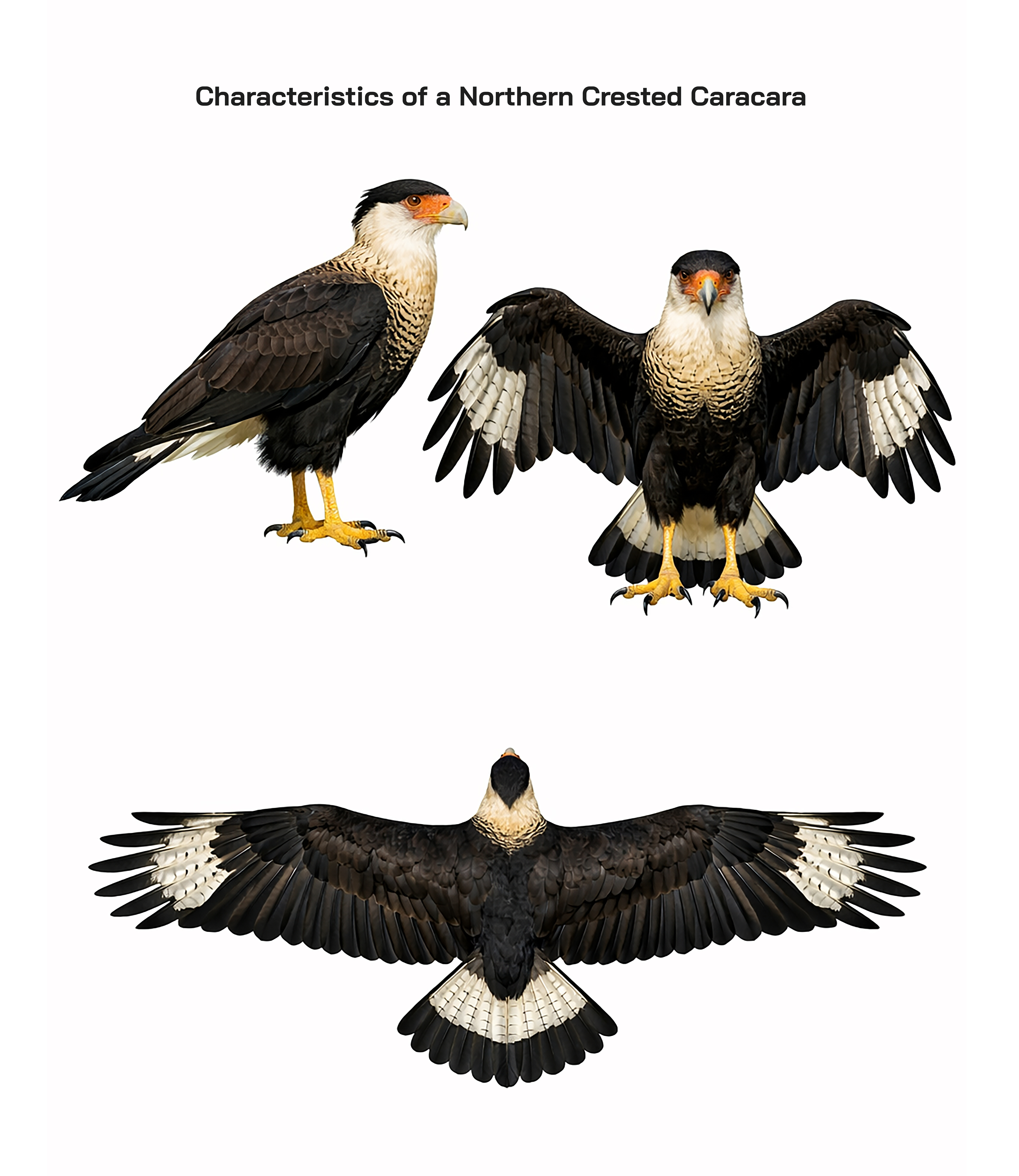
In physical appearance, the Northern Crested Caracara is a large, long-legged raptor with an upright stance that resembles a terrestrial predator more than an aerial hunter. Its body is robust, supported by strong legs adapted for walking and running on the ground. Unlike the streamlined shape of diving falcons, the caracara has broad wings that are relatively flat in flight, allowing it to soar slowly and steadily rather than engage in rapid stoops. This wing structure reflects its preference for energy-efficient flight and ground-based activity.
One of the most striking visual features of the Northern Crested Caracara is its head. The bird has a bold black cap topped with a short crest that can be raised or lowered depending on alertness or mood. The face is partially bare, displaying bright orange to reddish skin around the eyes and base of the beak. This bare facial skin changes color intensity with age and emotional state, adding to the bird’s expressive appearance. The beak is strong and sharply hooked, suitable for tearing flesh, cracking hard food items, and manipulating objects.
Plumage coloration contributes to its unmistakable look. The neck and chest are pale, often creamy or white, contrasting sharply with darker wings and back. The tail is barred and conspicuous in flight. This high-contrast pattern makes the caracara easily recognizable both on the ground and in the air.
Behaviorally, the Northern Crested Caracara is renowned for its intelligence. It is considered one of the most cognitively advanced raptors, capable of problem-solving and learning from experience. Observations have shown caracaras manipulating objects, cooperating with other birds, and adapting quickly to new food opportunities. This intelligence supports their success in changing environments, including areas influenced by human activity.
Unlike many birds of prey that rely almost exclusively on hunting live animals, the Northern Crested Caracara is highly opportunistic. Scavenging plays a major role in its feeding strategy. It frequently feeds on carrion, roadkill, and discarded animal remains, acting as a natural cleaner within ecosystems. This scavenging behavior reduces waste and helps recycle nutrients back into the environment.
In addition to scavenging, the caracara is an active hunter and forager. It feeds on insects, reptiles, small mammals, bird eggs, and occasionally live birds. Much of this foraging occurs on the ground, where the bird walks confidently while searching for food. Its long legs and strong feet allow it to move efficiently across open terrain, an unusual trait among falcon relatives.
Habitat preference reflects this ground-oriented lifestyle. Northern Crested Caracaras inhabit open and semi-open environments such as grasslands, savannas, ranchlands, agricultural areas, and coastal plains. These habitats provide wide visibility, abundant food sources, and suitable nesting sites. The species is commonly associated with southern regions of North America, Central America, and parts of northern South America.
Social behavior in the Northern Crested Caracara is more complex than in many raptors. While individuals can be territorial, they are often seen in pairs or small family groups. Pair bonding is strong, and mates may remain together for extended periods. This social structure supports cooperative breeding behaviors and territory defense.
Nesting typically occurs in trees, where pairs build large stick nests. These nests are often reused and expanded over time. Both adults participate in nest construction, incubation, and chick rearing. Parental care is attentive, with adults actively defending the nest and providing food for the young. Juveniles remain dependent for an extended period, during which they learn essential foraging and survival skills.
Ecologically, the Northern Crested Caracara plays multiple important roles. As a scavenger, it contributes to ecosystem cleanliness and nutrient cycling. As a predator, it helps regulate populations of small animals and insects. Its presence often indicates healthy open habitats with balanced food availability.
From a conservation perspective, the Northern Crested Caracara has attracted interest due to habitat changes and human expansion. While the species is adaptable, loss of open landscapes and disturbance at nesting sites can affect local populations. Conservation efforts focus on habitat protection, monitoring, and maintaining coexistence in agricultural and ranching regions.
Culturally and scientifically, the Northern Crested Caracara is admired for its intelligence and distinctive behavior. It challenges traditional perceptions of falcons as purely aerial hunters and demonstrates the diversity of survival strategies within birds of prey. Its adaptability makes it a valuable subject for studies on raptor cognition and ecological flexibility.
What makes the Northern Crested Caracara especially fascinating is how differently it experiences the world compared to most birds of prey. Rather than treating the landscape as something to pass over quickly from the air, the caracara engages with it closely and deliberately. It spends significant time on the ground, walking with confidence, stopping to examine objects, and assessing situations before acting. This measured, almost thoughtful approach gives the impression of a bird that is constantly evaluating its surroundings rather than reacting instinctively.
The caracara’s intelligence is most evident in how it approaches food. Instead of relying on speed or surprise alone, it often uses patience and observation. Individuals have been seen waiting at a distance to see how other scavengers behave before moving in, or timing their approach to avoid conflict. This strategic awareness reduces risk and conserves energy, a practical advantage in open environments where resources can be unpredictable. Over time, individual birds appear to refine their strategies based on experience, suggesting a strong capacity for learning.
Another striking aspect of the Northern Crested Caracara is its confidence around unfamiliar elements. While cautious, it is rarely timid. New objects, changes in terrain, or human-related structures are often investigated rather than avoided outright. This curiosity allows the species to persist in landscapes that have been altered by human activity. Unlike raptors that retreat from disturbance, the caracara often finds ways to coexist, adapting its behavior rather than abandoning territory.
Social awareness is also more developed in this species than in many raptors. Caracaras seem keenly aware of the presence and behavior of others, including members of their own species and different scavengers. They frequently adjust their posture, movement, and timing based on who is nearby. This awareness reduces unnecessary confrontation and allows them to exploit opportunities efficiently. In group settings, younger birds appear to learn by watching adults, gradually refining their own behavior.
The relationship between the caracara and its environment is deeply tied to open space. Wide landscapes allow the bird to use its vision effectively, scanning for opportunities while remaining grounded. Fences, posts, and low structures are often used as observation points, not unlike lookout towers. From these vantage points, the caracara can monitor activity below without committing to flight, conserving energy while staying alert.
Emotionally, the Northern Crested Caracara displays a surprising range of expressive behavior. Changes in posture, crest position, and facial coloration appear to communicate alertness, agitation, or calm. While not emotional in the human sense, these visual cues suggest a sophisticated internal state that responds to context. Observers often note that caracaras appear “aware” in a way that feels almost mammalian, particularly during interactions with other animals.
The extended care provided to young birds plays a crucial role in shaping these behaviors. Juvenile caracaras spend considerable time observing adults, following them on foraging excursions and watching how food is obtained and handled. This prolonged learning period allows skills to be passed on through observation rather than instinct alone. Such learning-based development is relatively uncommon among birds of prey and underscores the caracara’s cognitive complexity.
The caracara’s adaptability also reflects a deep understanding of risk. While bold, it rarely engages in unnecessary danger. It assesses threats carefully, often choosing retreat over confrontation unless the reward is significant. This balanced approach helps explain its long-term success across varied habitats. It does not rely on dominance alone but on judgment, timing, and flexibility.
Human-altered landscapes have inadvertently created both challenges and opportunities for the Northern Crested Caracara. Roads, agricultural areas, and grazing lands can provide food sources, but they also introduce hazards. The species’ intelligence allows it to exploit these environments while minimizing risk, but this balance is delicate. Where human activity becomes too intense or fragmented, even adaptable species like the caracara can struggle.
Ecologically, the caracara serves as a stabilizing presence. By removing carrion and controlling certain prey populations, it helps prevent the buildup of waste and limits outbreaks of small animals or insects. These contributions often go unnoticed, yet they support broader ecosystem health. In this sense, the caracara functions as both cleaner and regulator, quietly maintaining balance in open systems.
The way people perceive the Northern Crested Caracara often evolves with observation. At first glance, it may seem less dramatic than faster falcons or larger eagles. Over time, however, its intelligence, confidence, and adaptability become increasingly apparent. Many researchers and bird enthusiasts develop a deep respect for the species precisely because it defies expectations of what a falcon should be.
Culturally, the caracara occupies an interesting space between wildness and familiarity. It remains unmistakably wild, yet it navigates human-influenced landscapes with ease. This coexistence challenges assumptions about wildlife adaptability and highlights the importance of preserving open habitats that allow such species to thrive without forcing them into conflict with people.
Ultimately, the Northern Crested Caracara represents a different model of survival among birds of prey. Instead of relying on speed, power, or isolation, it succeeds through awareness, flexibility, and learning. Its story is not one of dominance from the sky, but of thoughtful engagement with the land. This grounded intelligence, paired with ecological usefulness, makes the Northern Crested Caracara one of the most compelling and quietly remarkable raptors of the Americas.
The Northern Crested Caracara lives life at a different pace than many birds of prey, and this slower rhythm reveals much about its character. Where other raptors rely on sudden bursts of speed or dramatic aerial maneuvers, the caracara depends on awareness, timing, and decision-making. It often pauses, watches, and waits. This patience is not hesitation; it is strategy. By taking time to assess situations, the caracara reduces wasted energy and unnecessary risk, which is especially important in environments where food availability can change from day to day.
One of the most humanlike qualities of the caracara is how intentional its movements appear. When walking on the ground, it does not rush. Each step seems purposeful, as if the bird is constantly evaluating what lies ahead. This ground-based confidence gives the impression of a raptor that understands its physical presence and uses it deliberately. Unlike birds that seem perpetually alert to escape, the caracara appears comfortable occupying space, standing tall, and surveying its surroundings with calm authority.
The way the caracara uses its intelligence is subtle but consistent. Rather than solving one complex problem at a time, it excels at adapting behavior incrementally. Over repeated experiences, it learns which areas are reliable, which situations carry risk, and when it is better to wait than to act. This gradual refinement of behavior suggests memory and experience play a major role in its survival. Individual caracaras likely differ in confidence and approach depending on what they have learned over time.
Observation is central to the caracara’s lifestyle. It spends long periods watching other animals, vehicles, or changes in the environment. This watching is not passive. The bird seems to track patterns, noting where opportunities appear and how other species behave. In this way, the caracara uses the activity of others as information, allowing it to act efficiently without constant trial and error. This observational learning is one reason it thrives in complex landscapes.
Another defining feature of the Northern Crested Caracara is its emotional restraint. It does not react impulsively to every disturbance. Sudden movement or unfamiliar sights often prompt alertness rather than panic. The bird lifts its head, adjusts posture, and reassesses. This controlled response reduces stress and allows clearer decision-making. In a world where many animals rely on immediate flight responses, this restraint sets the caracara apart.
The caracara’s relationship with energy use is also noteworthy. By favoring walking, short flights, and soaring rather than constant flapping, it conserves strength. This efficiency allows it to remain active throughout the day without exhaustion. Its broad wings and relaxed flight style support this approach, turning movement into something economical rather than costly. Over time, this energy-saving strategy likely contributes to its long-term survival and reproductive success.
Interactions with other animals reveal the caracara’s social intelligence. It often positions itself carefully when feeding near others, maintaining distance while staying close enough to benefit. Instead of direct confrontation, it uses timing and positioning to access food. This approach minimizes conflict and injury. Younger birds learn these social dynamics gradually, often making mistakes before refining their behavior through experience.
The extended learning period of young caracaras highlights how much of their behavior is acquired rather than instinctive. Juveniles spend significant time observing adults before mastering essential skills. This slow development allows them to adapt their behavior to local conditions rather than relying on rigid instincts. Such flexibility is rare among raptors and reflects a sophisticated survival strategy.
The caracara’s adaptability also extends to how it handles uncertainty. When food is scarce, it broadens its search methods. When competition increases, it adjusts timing. When landscapes change, it explores rather than retreats. This willingness to experiment is a powerful advantage. Instead of being limited to a narrow niche, the caracara maintains multiple options, increasing resilience in changing environments.
From an ecological standpoint, the caracara’s presence influences how open landscapes function. By removing carrion and consuming a wide range of prey, it helps prevent imbalances. Its scavenging reduces the buildup of decaying matter, while its hunting contributes to population control. These roles are performed quietly and consistently, without drawing attention, yet they are essential to ecosystem health.
Human-altered environments present both opportunity and risk for the Northern Crested Caracara. Roads, ranches, and agricultural lands can provide food, but they also introduce dangers such as collisions and habitat fragmentation. The caracara’s intelligence allows it to navigate these environments better than many species, but its success depends on space, tolerance, and coexistence rather than constant disturbance.
Over time, observers often notice that caracaras seem to develop individual personalities. Some appear bolder, others more cautious. Some are quicker to approach new situations, while others prefer observation. These differences suggest that experience shapes behavior significantly, reinforcing the idea that the species relies on learning as much as instinct.
What makes the Northern Crested Caracara truly remarkable is not just its adaptability, but the way it embodies a different philosophy of survival. It succeeds not by dominating the skies, but by understanding the land. It reads its environment, learns from it, and adjusts thoughtfully. This grounded intelligence allows it to persist where more specialized species struggle.
In the end, the Northern Crested Caracara represents resilience through awareness rather than force. Its life is shaped by patience, observation, and flexibility. Watching a caracara go about its day offers a reminder that survival does not always belong to the fastest or strongest, but often to those who pay attention, learn continuously, and adapt with care. This quiet wisdom is what makes the Northern Crested Caracara not only ecologically important, but deeply fascinating to those who take the time to understand it.
In conclusion, the Northern Crested Caracara is characterized by its long legs, upright posture, bare facial skin, and exceptional intelligence. As a ground-foraging, scavenging, and opportunistic falcon, it occupies a unique ecological niche. Its ability to adapt, learn, and exploit a wide range of food sources ensures its continued importance in open ecosystems, making it one of the most fascinating and unconventional birds of prey in the world.