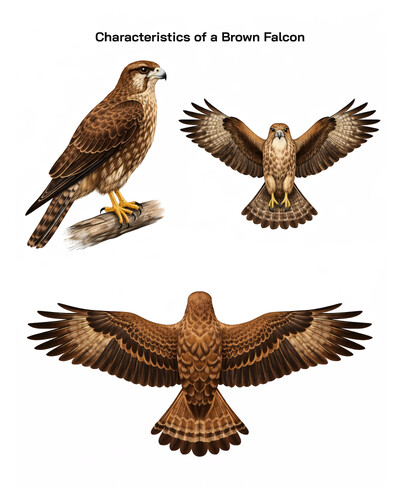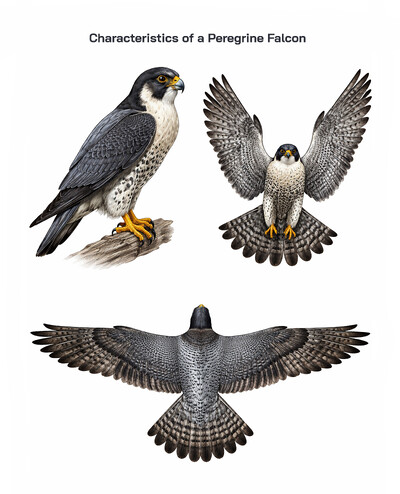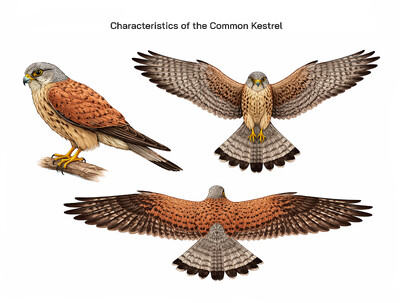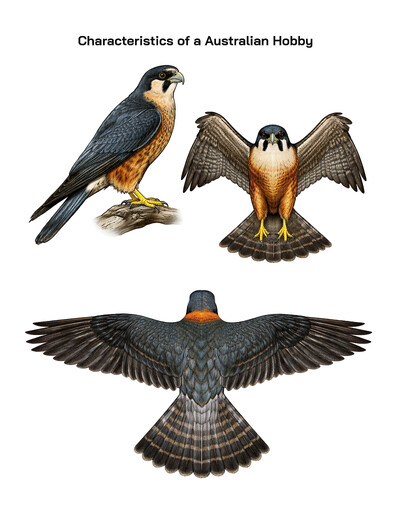
The black falcon is a striking bird of prey native to Australia and is regarded as one of the continent’s most agile and powerful aerial hunters. Scientifically known as Falco subniger, the black falcon is distinguished by its dark coloration, swift flight, and remarkable adaptability to open and often harsh environments. Although less widely known than some other falcon species, it holds an important place within Australian ecosystems due to its predatory efficiency and behavioral uniqueness.
In physical appearance, the black falcon is a medium-sized falcon with a streamlined and athletic build. Its body is slender yet muscular, designed for speed and maneuverability. The plumage is predominantly dark brown to black, giving the species its common name. This dark coloration provides effective camouflage against the shadowed landscapes of grasslands and open plains, especially when viewed from below. Subtle variations in feather tone may appear depending on age and lighting conditions, but overall the bird maintains a uniformly dark profile.
The wings of the black falcon are long, narrow, and sharply pointed, a classic falcon trait that enables rapid acceleration and sustained high-speed flight. These wings allow the bird to change direction quickly while pursuing prey across wide, open spaces. The tail is relatively long and acts as a stabilizer during tight aerial turns, contributing to the falcon’s exceptional agility in flight.
The head of the black falcon is compact and equipped with a strongly hooked beak used for tearing flesh. Its talons are sharp and powerful, capable of gripping and subduing prey mid-air or on the ground. Vision is one of the species’ most critical characteristics. Like other falcons, the black falcon has highly developed eyesight, enabling it to spot small animals from great distances while soaring or flying low over the landscape.
Behaviorally, the black falcon is an accomplished aerial predator. It relies on speed, precision, and surprise to capture prey. Rather than hovering, it typically flies low and fast, flushing prey into movement before launching a rapid pursuit. Its hunting style often involves swift chases rather than vertical dives, reflecting adaptation to open habitats where long-distance visibility is high.
Dietary habits of the black falcon are flexible and opportunistic. It primarily feeds on small birds, which it captures in flight, but it will also hunt mammals, reptiles, and large insects when available. This varied diet allows the species to survive in environments where food availability can change seasonally or unpredictably.
One of the most distinctive behavioral traits of the black falcon is its association with fire. The species is known to take advantage of bushfires, flying near smoke fronts to capture animals fleeing flames. This fire-following behavior demonstrates advanced adaptability and situational awareness, allowing the falcon to exploit sudden increases in prey availability. Such behavior highlights the bird’s intelligence and its role in natural fire-driven ecosystems.
The black falcon inhabits a wide range of open environments across Australia. It is commonly found in grasslands, savannas, arid zones, semi-desert regions, and inland plains. These landscapes provide the open space necessary for high-speed hunting and clear visibility. Unlike forest-dwelling raptors, the black falcon prefers unobstructed terrain where its flight skills can be fully utilized.
In terms of social behavior, black falcons are generally solitary or found in pairs, particularly during the breeding season. They are territorial birds, defending hunting grounds and nesting sites from intruders. Breeding sites vary depending on habitat and may include cliff ledges, tree hollows, or other elevated locations that offer safety from ground predators. Nest construction is minimal, and the species often reuses existing structures rather than building elaborate nests.
Reproduction involves strong pair bonding and shared parental responsibilities. Both adults participate in feeding and protecting the young until they are capable of flight and independent hunting. Juvenile black falcons gradually develop their flight skills and hunting efficiency, learning through practice and observation before reaching maturity.
Ecologically, the black falcon serves as a top predator within its environment. By controlling populations of birds, small mammals, and reptiles, it helps maintain balance within open-land ecosystems. Its presence often reflects healthy prey populations and functioning ecological processes. As a raptor adapted to fire-prone landscapes, it also illustrates the complex relationship between wildlife and natural disturbances.
From a conservation perspective, the black falcon is of growing interest due to habitat changes and land-use pressures. Alterations to grasslands, changes in fire management, and human development can affect prey availability and nesting opportunities. Continued research and monitoring are important for understanding population trends and ensuring the species remains a stable component of Australian biodiversity.
Looking beyond its physical form and hunting habits, the black falcon reveals itself as a bird shaped as much by behavior and intelligence as by anatomy. Life in Australia’s vast and often unpredictable landscapes demands more than speed alone. The black falcon survives by constantly reading its environment, responding to subtle changes in weather, prey movement, and seasonal patterns. This awareness allows it to remain effective in regions where conditions can shift rapidly from abundance to scarcity.
One of the most impressive qualities of the black falcon is its ability to operate efficiently over enormous distances. Open Australian landscapes offer little shelter, which means the falcon must rely on strategic movement rather than fixed hunting points. Individuals often patrol wide areas, adjusting their flight height and speed depending on wind conditions and prey behavior. This dynamic use of space reflects a highly developed sense of environmental assessment, where the bird continuously evaluates when to conserve energy and when to commit to pursuit.
The black falcon’s relationship with fire-dominated landscapes goes beyond opportunistic feeding. Over generations, these birds have become integrated into fire-driven ecological cycles. In many regions, fire resets vegetation, redistributes prey, and alters movement patterns of animals. The black falcon’s presence during these events suggests a deep evolutionary familiarity with disturbance-based ecosystems. Rather than avoiding chaos, the species exploits it, turning sudden disruption into hunting advantage.
This behavior also highlights the falcon’s capacity for learning. Young black falcons appear to acquire fire-following behavior through observation and experience rather than instinct alone. Over time, they learn how smoke movement, wind direction, and fire intensity influence prey escape routes. This learning-based adaptation suggests a level of cognitive flexibility that sets the species apart from more rigidly patterned predators.
Flight style in the black falcon also reflects a careful balance between aggression and efficiency. While capable of explosive speed, it rarely expends maximum effort without clear opportunity. Much of its flight consists of controlled, low-altitude scanning interspersed with rapid bursts of acceleration. This approach minimizes unnecessary exertion and reduces the risk of injury, which is critical in remote environments where recovery options are limited.
Territorial awareness in black falcons extends beyond simple defense. Rather than constant confrontation, territory is often maintained through presence and repeated use. Familiar flight paths, favored perches, and regular patrols establish dominance without frequent conflict. This low-conflict strategy conserves energy and reduces injury risk, reinforcing long-term survival.
The black falcon’s breeding success is closely tied to environmental stability. Years with balanced rainfall and healthy prey populations tend to produce higher fledgling survival. In harsher years, breeding may be delayed or limited, reflecting a flexible reproductive strategy. Rather than producing offspring at all costs, the species appears to prioritize long-term survival over short-term population growth.
Parental care in black falcons reveals another layer of behavioral complexity. Adults not only provide food but also manage exposure to environmental stress. Young birds are gradually introduced to flight challenges, wind conditions, and prey pursuit, allowing skill development without overwhelming risk. This structured learning period increases juvenile survival once independence is reached.
Interactions with other raptors also shape the black falcon’s behavior. In shared landscapes, competition exists with other birds of prey, but direct conflict is often avoided through differences in hunting height, prey choice, or activity timing. This subtle partitioning reduces competition and allows multiple predator species to coexist within the same environment.
Human-altered landscapes present both challenges and opportunities for black falcons. Agricultural areas can increase prey availability, but infrastructure development may reduce nesting options or increase collision risks. The falcon’s adaptability allows it to exploit some modified environments, yet it remains sensitive to excessive disturbance and loss of open hunting space.
Culturally, the black falcon has begun to attract greater attention due to growing awareness of fire ecology and indigenous knowledge systems. Traditional ecological knowledge in Australia has long recognized the connection between fire, wildlife movement, and predator behavior. Modern scientific interest increasingly aligns with these perspectives, offering a more holistic understanding of how species like the black falcon fit into broader ecological narratives.
The black falcon’s dark coloration may also serve subtle functional roles beyond camouflage. Dark feathers absorb heat more efficiently, which may aid thermoregulation during cool mornings or in windy conditions. This thermal advantage, combined with flight efficiency, supports early activity periods when prey may be less alert.
Longevity in black falcons reflects a life strategy built around experience. Older individuals often display refined hunting efficiency, relying more on anticipation and positioning than raw speed. This accumulation of experience suggests that survival improves with age, reinforcing the value of cautious, intelligent behavior over reckless aggression.
From an ecological viewpoint, the black falcon acts as a stabilizing force rather than a disruptive one. By selectively removing weak, exposed, or abundant prey, it contributes to healthier prey populations and balanced ecosystems. Its role is not simply to hunt, but to shape movement patterns and population dynamics across open landscapes.
When studying the Black Falcon, one begins to see a bird shaped not just by evolution, but by the rhythm and unpredictability of the Australian continent itself. Australia’s landscapes are defined by extremes—fire and flood, drought and sudden abundance—and the black falcon has evolved as a specialist in navigating these contrasts. Its success is rooted in flexibility, a trait that goes far beyond physical ability and enters the realm of behavioral intelligence.
One of the most compelling aspects of the black falcon’s life is how it responds to change rather than stability. Many predators depend on consistent prey patterns, but the black falcon thrives in environments where predictability is rare. This adaptability allows it to shift hunting strategies, flight behavior, and even daily routines in response to environmental cues. Subtle changes in wind direction, animal movement, or vegetation cover are interpreted almost instantly, guiding the falcon’s decisions moment by moment.
The bird’s interaction with fire-disturbed landscapes offers insight into a deeper ecological intelligence. Fire does not simply create opportunity by flushing prey; it reshapes the entire spatial layout of the land. The black falcon appears capable of anticipating where prey will emerge, often positioning itself ahead of escape routes rather than reacting blindly. This suggests a form of spatial forecasting, where the bird uses past experience to predict future movement, an ability that elevates it beyond instinct-driven behavior.
Silence and observation play a significant role in the black falcon’s hunting philosophy. Unlike predators that rely on sudden chaos, the black falcon often waits, watching from a distance before committing to action. This restraint conserves energy and reduces risk, especially in open environments where failed pursuits can be costly. The bird’s stillness, sometimes lasting long minutes, reflects a calculated patience that is essential for survival in landscapes where opportunities may be brief and widely spaced.
Flight for the black falcon is not merely a means of movement, but a finely tuned tool of interaction with the air itself. Wind currents, thermal lift, and pressure changes are read instinctively, allowing the bird to glide, hover briefly, or accelerate with minimal effort. This mastery of airspace reduces dependence on brute force and extends the falcon’s operational range across vast territories without exhaustion.
Learning plays a central role in the black falcon’s life, particularly during early development. Young birds do not immediately exhibit the refined hunting behavior of adults. Instead, they experiment, fail, and gradually adjust their techniques. Over time, patterns emerge—certain flight angles yield better results, specific prey behaviors signal vulnerability, and particular landscapes offer higher success rates. This gradual accumulation of knowledge shapes each falcon into a more efficient hunter as it matures.
Individual personality differences have also been observed among black falcons. Some individuals show bold, aggressive hunting styles, while others favor cautious, methodical approaches. These variations suggest that success does not depend on a single behavioral formula, but on adaptability within a framework of shared physical traits. Such diversity may enhance population resilience, allowing the species to persist across varied and changing environments.
The black falcon’s interaction with other species extends beyond predation. Its presence influences how prey animals move, feed, and group together. Birds may alter flight patterns, and small mammals may change foraging times in response to falcon activity. These indirect effects ripple through the ecosystem, shaping behavior even when no hunting occurs. In this way, the black falcon acts as both a hunter and a behavioral regulator within open landscapes.
Human-altered environments introduce complex challenges. While some agricultural regions increase prey density, they also fragment open space and introduce hazards such as fences, power lines, and vehicles. The black falcon’s adaptability allows partial adjustment, but there are limits. The loss of uninterrupted hunting corridors and safe nesting sites can gradually erode suitability, even if prey remains available.
Fire management practices also influence the black falcon’s future. Changes in fire frequency, intensity, and timing can disrupt long-established ecological rhythms. While the species is adapted to fire, unnatural patterns may alter prey responses or vegetation structure in ways that reduce hunting efficiency. Understanding these interactions is essential for managing landscapes in ways that support both biodiversity and traditional fire-adapted species.
The black falcon’s relatively low population density is another important characteristic. It does not exist in large numbers, and its territories are expansive. This naturally limits population growth but ensures that pressure on prey remains balanced. Such restraint reflects an evolutionary equilibrium rather than weakness, emphasizing sustainability over dominance.
Culturally, the black falcon is increasingly recognized as a symbol of Australia’s wild interior. Unlike species that adapt easily to urban environments, it remains closely tied to open skies and expansive land. This connection reinforces its role as an indicator of ecosystem health, particularly in grassland and savanna regions where biodiversity is often overlooked.
Scientific interest in the black falcon continues to grow as researchers explore links between predator behavior, fire ecology, and landscape management. The species offers valuable insight into how intelligent predators respond to disturbance rather than avoiding it. These lessons extend beyond ornithology, informing broader discussions about resilience, adaptation, and coexistence with natural forces.
At a deeper level, the black falcon represents a philosophy of survival that aligns with the Australian environment itself. Rather than resisting change, it flows with it. Rather than dominating through force, it succeeds through awareness. Its life is a balance of action and restraint, speed and stillness, instinct and learning.
Ultimately, the black falcon is not merely a bird of prey but a living expression of ecological harmony in a land shaped by extremes. Its continued presence reminds us that survival in challenging environments depends not on strength alone, but on intelligence, patience, and the ability to read the world as it truly is. The black falcon embodies adaptation through intelligence as much as through strength. It is a predator defined not by excess, but by precision. Its success lies in reading the land, understanding change, and responding with calculated action. In a continent shaped by extremes of fire, drought, and space, the black falcon stands as a symbol of survival through awareness, patience, and mastery of the air.
In conclusion, the black falcon is characterized by its dark plumage, streamlined build, exceptional speed, and adaptability to open and fire-influenced landscapes. As a skilled aerial hunter and ecological regulator, it plays a vital role in Australia’s natural systems. Its unique behaviors, particularly fire-following hunting strategies, make it one of the most fascinating and specialized falcons in the world.