The Red Sindhi cow, scientifically classified as Bos indicus, is one of the most recognized zebu breeds valued for its adaptability and dependable performance in hot climates. Originating from the Sindh region, the breed evolved in environments marked by high temperatures, limited water availability, and fluctuating feed conditions. Over generations, careful selection by livestock keepers reinforced traits such as heat tolerance, disease resistance, and the ability to maintain productivity under stress. These qualities have enabled the Red Sindhi to gain importance far beyond its place of origin.
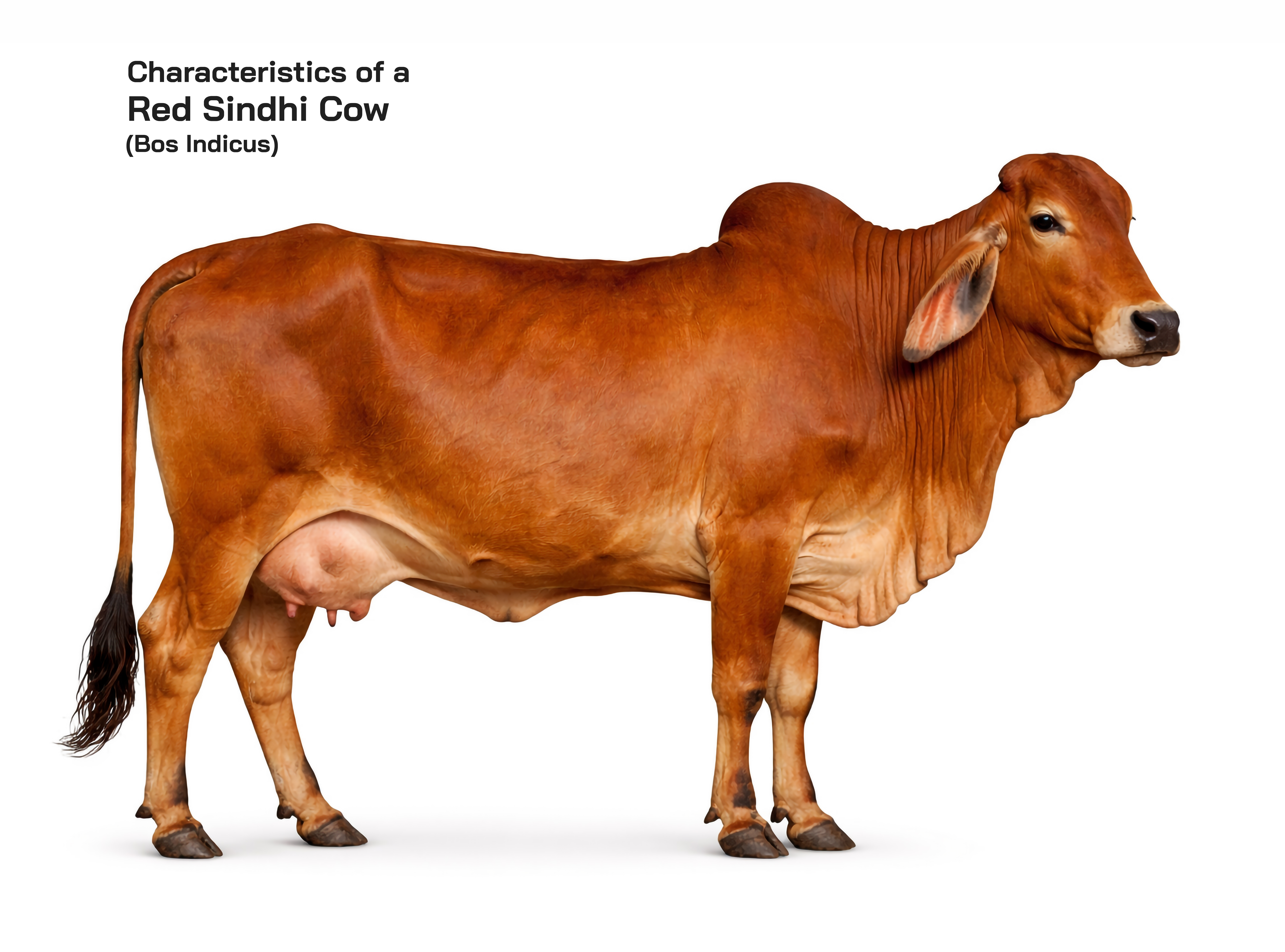
The breed is best known for its deep reddish-brown coat, which can range from lighter copper shades to darker mahogany tones. Some animals may show small white markings, but the dominant impression is a rich red coloration that gives the breed its name. Like other Bos indicus cattle, the Red Sindhi possesses a prominent hump, loose skin, and a well-developed dewlap. These features play a role in thermoregulation, allowing the animal to dissipate body heat more effectively. The coat is typically short and sleek, further aiding comfort in warm weather.
In terms of body structure, Red Sindhi cattle are medium-sized with a compact and functional build. Their frame supports efficient grazing and endurance, making them suitable for systems where animals must travel to find feed and water. Strong legs and durable hooves help them navigate varied terrain without difficulty. This physical resilience is one reason they remain popular in regions where environmental conditions can be unpredictable.
The udder conformation of the Red Sindhi is generally well developed, supporting consistent milk production relative to other zebu breeds. Farmers appreciate the reliability of yield even when nutritional inputs are modest. The milk is valued for household consumption as well as for local markets, providing an important source of nutrition and income. The ability to sustain output without intensive management is a defining advantage.
Temperamentally, Red Sindhi cows are known to be calm and manageable. They respond well to regular routines and adapt easily to different handling systems. Their cooperative nature simplifies daily husbandry tasks such as milking, movement between grazing areas, and health care. This stable behavior contributes to smoother farm operations and improved animal welfare.
Adaptability is perhaps the most celebrated characteristic of the breed. Red Sindhi cattle can tolerate extreme heat and humidity, conditions that often reduce performance in less suited animals. They also show resistance to many tropical diseases and parasites, lowering the need for extensive medical intervention. These natural defenses make them particularly valuable in low-input systems where veterinary resources may be limited.
Reproductive reliability further enhances their appeal. Cows typically display strong maternal instincts, ensuring attentive care of calves. Regular calving intervals help maintain herd numbers and support predictable production cycles. For many farmers, this dependability forms the basis of economic stability.
The global importance of the Red Sindhi has expanded through exportation and crossbreeding initiatives. Countries in Asia, Africa, and other tropical regions have integrated Red Sindhi genetics to strengthen local cattle populations. The breed’s influence has been especially important where heat tolerance and resilience are primary concerns. Through such programs, Red Sindhi cattle have contributed to improved sustainability and productivity worldwide.
Breed organizations continue to encourage preservation while promoting improvement in health, fertility, and output. These efforts maintain the identity of the Red Sindhi while ensuring that it meets contemporary agricultural demands. The breed’s heritage as a hardy, adaptable animal remains central to its reputation.
The Red Sindhi has become increasingly significant in discussions about how dairy animals can remain productive in environments where climatic and economic pressures are constant. Specialists often examine the breed as a model of biological efficiency, focusing on how well it translates modest resources into stable milk flow. This quality allows farmers to maintain continuity even when rainfall patterns, forage availability, or market access fluctuate from year to year.
One of the breed’s additional strengths lies in its reputation for management flexibility. Producers frequently observe that Red Sindhi cattle integrate smoothly into both small household herds and larger cooperative structures. Their steady responses to routine handling make it easier to establish predictable schedules for milking, grazing, and health observation. Consistency of behavior becomes an operational advantage, reducing uncertainty and supporting better planning.
Researchers are also interested in the breed’s role in thermal adaptation studies. By analyzing how these animals regulate body temperature, scientists gain insight into physiological pathways that support productivity in warm regions. Such knowledge contributes to wider strategies aimed at preparing livestock systems for rising global temperatures. The Red Sindhi therefore influences scientific understanding well beyond its immediate population.
In practical husbandry, the breed encourages development of resource-conscious feeding programs. Instead of depending on heavy supplementation, farmers often design rations that make optimal use of locally available fodder. This approach strengthens regional agriculture and reduces vulnerability to imported feed costs. Over time, it helps build dairy systems that are both economically and environmentally sustainable.
The Red Sindhi has also shaped approaches to preventive health culture. Because animals are naturally resilient, attention can focus on maintaining hygiene, water quality, and observation routines rather than constant treatment. This preventive orientation saves labor and promotes long-term stability. It also aligns well with community-based systems where veterinary access may be limited.
Milk supply planning provides another area where the breed exerts influence. Stable lactation patterns enable cooperatives and processors to forecast collection volumes more accurately. Predictability improves transport logistics and helps maintain consistent product availability for consumers. Through this indirect pathway, Red Sindhi cattle contribute to broader economic organization.
Educational programs frequently highlight the breed when discussing adaptation as a production strategy. Students learn that compatibility between animal and environment can often yield better results than attempting to modify surroundings extensively. This lesson encourages thoughtful integration of genetics with landscape.
International development initiatives increasingly rely on Red Sindhi genetics in regions seeking to strengthen dairy capacity under heat stress. Collaborative exchanges of breeding material foster knowledge partnerships that extend across continents. These networks support innovation while respecting local realities, demonstrating how global cooperation can enhance resilience.
The breed also supports rural households by contributing to income diversification. Reliable milk output can underpin small-scale processing, local sales, or cooperative membership. Such opportunities improve financial security and help stabilize communities that depend heavily on agriculture.
Technological progress is beginning to merge with traditional strengths. Digital monitoring tools applied to Red Sindhi herds often confirm patterns of steadiness in intake and activity. These findings make the breed compatible with data-driven management, where recognizing departures from normal behavior is essential.
Culturally, the Red Sindhi remains a symbol of adaptation achieved through patience and experience. Its history reinforces respect for pastoral knowledge and reminds farmers that enduring solutions often arise from understanding local conditions deeply. This identity motivates conservation as well as improvement.
Looking toward the future, the breed is likely to gain even greater prominence as governments and producers seek livestock capable of sustaining milk production without excessive input. Its proven ability to function reliably within constraints offers practical guidance for shaping policies and investment.
The Red Sindhi further illustrates how a livestock population can shape the philosophy of dairying in regions where certainty is rare. Farmers who depend on animals capable of maintaining routine under pressure often build their entire management structure around that reliability. Seasonal planning for fodder, water storage, and labor becomes more confident when the biological engine of the farm behaves in expected ways. In this sense, the breed acts as a stabilizing reference that supports long-term continuity.
Another growing dimension of importance is the Red Sindhi’s influence on community-centered dairy development. Because many herds are kept by smallholders, success depends on shared services such as breeding programs, veterinary outreach, and milk collection. Animals that integrate well into cooperative frameworks strengthen these networks. Their dependable lactation encourages collective marketing, helping villages achieve bargaining power and consistent income.
The breed has also inspired innovation in heat-smart housing concepts. Even though it tolerates high temperatures, providing airflow, shaded resting areas, and carefully oriented shelters can further protect comfort and output. Farmers experimenting with such designs often discover improvements that benefit other livestock too. Thus, the Red Sindhi becomes a catalyst for upgrading infrastructure across entire farms.
In research communities, the breed contributes to understanding adaptive immunity patterns. Observing how individuals respond to endemic challenges informs targeted prevention strategies and refines recommendations for vaccination timing. Insights gained from these herds frequently ripple outward, strengthening health planning for broader cattle populations.
Milk distribution systems benefit from the Red Sindhi’s reputation for steadiness. Regular supply makes it easier to coordinate chilling, transport, and processing, particularly in remote areas. When variation is reduced, waste declines and profitability improves. Through this mechanism, the breed supports regional economic resilience beyond the farm gate.
Educationally, Red Sindhi cattle often appear in training modules that emphasize alignment between environment and genetics. Students see firsthand that productivity can be preserved by matching animals to climate rather than forcing unsuitable adaptation. This approach encourages sustainable thinking that values prevention over correction.
The breed also has importance in discussions about youth engagement in agriculture. Young farmers are more likely to remain in dairying when they observe animals that reward attentive care with consistent results. Reliability builds confidence, and confidence sustains commitment. In this way, the Red Sindhi indirectly contributes to generational continuity.
International partnerships increasingly recognize the breed as a resource for climate resilience planning. Countries facing hotter futures look to proven examples rather than theoretical models. By sharing expertise and breeding knowledge, regions strengthen mutual capacity and reduce dependence on costly external solutions.
Technological integration continues to advance. Activity monitors and milk recording platforms reveal that Red Sindhi herds often present clear, repeatable baselines. Such clarity enhances the effectiveness of digital oversight and allows earlier response when deviations occur. The combination of traditional endurance with modern tools forms a powerful management alliance.
Culturally, the Red Sindhi symbolizes perseverance and adaptation. Its enduring presence in pastoral life reinforces pride and collective identity, reminding communities that survival has long depended on cooperation between humans, animals, and landscape. Celebrations, fairs, and training gatherings frequently highlight the breed as a representation of this relationship.
Looking forward, the Red Sindhi is poised to become even more central as agricultural strategies increasingly prioritize efficiency within limitation. As water resources tighten and energy costs rise, animals capable of steady milk production without extraordinary support will gain prominence. The breed’s established record provides reassurance that sustainable progress is achievable.
In the broadest sense, the Red Sindhi’s ongoing influence demonstrates that resilience is not merely a trait but a system built from genetics, knowledge, and shared practice. By underpinning reliable dairying, encouraging infrastructure improvement, and strengthening community networks, it continues to guide livestock agriculture toward futures where stability and responsibility stand alongside productivity.
Ultimately, the Red Sindhi demonstrates that strength in dairying can emerge from harmony between genetics, environment, and community organization. By supporting dependable milk supply, flexible husbandry, and international collaboration, the breed continues to influence the direction of livestock agriculture toward systems grounded in resilience and shared responsibility.
In summary, the Red Sindhi cow represents a powerful example of how Bos indicus cattle have evolved to meet environmental challenges. Its reddish coat, distinctive hump, calm temperament, and resistance to harsh conditions highlight centuries of adaptation. Through local significance and global expansion, the Red Sindhi continues to support livestock systems that depend on resilience, reliability, and sustainable performance.