The Hariana cow, scientifically classified as Bos indicus, is a well-known zebu breed that originated in northern India, particularly in the regions of Haryana and surrounding states. Developed in agricultural landscapes where climate can vary from hot summers to cooler winters, the breed evolved through continuous selection for endurance, efficiency, and reliability. Farmers traditionally depended on Hariana cattle for multiple roles within rural economies, and this long-standing partnership shaped animals capable of performing steadily under practical field conditions. Today, the breed remains an important part of regional agriculture and has contributed to livestock development beyond its homeland.
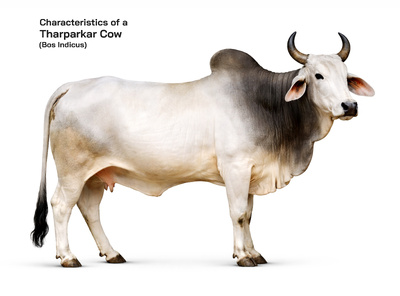
Physically, Hariana cattle are medium to large in size and present a clean, functional appearance. Their coat is generally white or light grey, sometimes with darker shading around the neck and shoulders. A prominent hump, loose skin, and a well-developed dewlap are typical features, aiding in heat regulation. The head is moderately long with alert eyes and short horns, giving the animal a composed yet attentive look. Strong legs and firm hooves provide stability, allowing movement across fields and pastures with ease.
Structural balance is one of the breed’s strengths. Hariana cattle are built for endurance rather than extremes, which helps them remain productive over many years. Their conformation supports mobility and resilience, essential traits in systems where animals must adapt to changing availability of forage and water. This durability contributes to reduced maintenance challenges and supports sustainable management.
Temperament in Hariana cattle is generally calm and cooperative. With regular human contact and consistent routines, they become easy to handle, simplifying everyday husbandry. Their steady nature supports safe operations during feeding, health checks, and breeding activities. Farmers value this predictability, as it reduces stress and promotes harmony within the herd.
Cattle husbandry practices for Hariana animals often rely on efficient use of local resources. They perform well under grazing systems and can maintain body condition with moderate supplementation. Access to clean water, balanced minerals, and routine preventive health measures ensures steady performance. Because the breed has natural resistance to many regional challenges, it can remain productive even when management inputs are limited. This resilience makes Hariana cattle particularly valuable for small and medium-scale farmers.
Reproductive reliability is another positive trait. Cows usually demonstrate stable fertility and attentive maternal behavior, which helps calves grow securely during early life stages. Consistent reproduction supports herd continuity and allows farmers to plan future development with confidence. These attributes reinforce the breed’s economic and practical importance.
The global importance of the Hariana breed is reflected in its use in crossbreeding initiatives aimed at enhancing adaptability and structural strength in other cattle populations. By contributing genes associated with endurance and resilience, Hariana cattle have influenced livestock improvement programs in various countries. This international role underscores the universal relevance of traits developed under traditional farming conditions.
Breed conservation efforts focus on maintaining genetic integrity while supporting gradual improvement. Organizations and farmers work together to ensure that the Hariana retains its essential qualities while adapting to modern agricultural expectations. Such programs safeguard the breed’s heritage and secure its place in the future of livestock production.
Culturally, the Hariana cow symbolizes stability and partnership in rural communities. It reflects generations of knowledge about managing animals in harmony with the environment. This deep-rooted connection continues to inspire pride and commitment among those who maintain the breed.
The Hariana breed’s long association with mixed farming systems has encouraged the development of traits that extend beyond visible physical qualities. One additional aspect often discussed by livestock planners is the breed’s efficiency in converting locally available roughage into useful output while maintaining stable health. In many traditional villages, animals are supported by crop residues, seasonal grasses, and by-products from grain processing. Hariana cattle are known for utilizing such materials effectively without rapid loss of body condition. This capacity allows households to maintain animals even in years when green fodder is scarce, reinforcing the breed’s reputation as a dependable partner in uncertain agricultural cycles.
Another noteworthy dimension involves metabolic steadiness. Compared with highly specialized exotic breeds that may show sharp peaks and declines in productivity, Hariana cows often exhibit a more even physiological rhythm. This steadiness is valuable in management planning because it reduces sudden nutritional stress and supports gradual, predictable changes throughout lactation. Farmers who operate with limited access to advanced feed technologies frequently appreciate animals that do not demand abrupt dietary adjustments. The breed’s ability to maintain functional equilibrium under routine village management is therefore a hidden but powerful strength.
The relationship between Hariana cattle and human settlement patterns has also shaped their development. In many northern Indian communities, animals are housed close to family dwellings, leading to frequent daily interaction. Over time, this proximity has favored animals that tolerate noise, movement, and the presence of multiple handlers. Such familiarity encourages cooperative behavior during milking and routine care, improving hygiene and efficiency. The social adaptability that arises from this history remains relevant as farms modernize, because animals accustomed to close human contact often transition more easily into organized dairy environments.
From a milk perspective, Hariana cows contribute in ways that extend beyond volume alone. Their lactation patterns often align well with household needs, providing regular supply for family nutrition, small-scale sale, and traditional processing into regional dairy foods. In rural economies, this regularity supports women’s participation in income generation, since milk marketing is frequently managed at the household level. Thus, the breed indirectly strengthens social structures and community resilience, highlighting how animal characteristics can influence livelihoods far beyond the farm gate.
Water management provides another angle for understanding Hariana adaptability. Northern India experiences periods of both abundance and shortage, and cattle that can cope with variation are essential. Hariana animals typically maintain function when watering schedules shift, provided basic welfare is respected. This flexibility simplifies herd logistics in areas where irrigation cycles, canal supply, or rainfall patterns determine availability. The capacity to remain composed despite such fluctuations supports continuity of production and reduces risk.
Genetic conservationists often emphasize the breed’s value as a reservoir of traits that may become increasingly important under climate change. As global temperatures rise and weather patterns grow less predictable, livestock systems require animals capable of tolerating stress without extensive technological intervention. Hariana cattle represent generations of adaptation to exactly such conditions. Their inclusion in breeding strategies can therefore strengthen future herds, providing insurance against environmental uncertainty while maintaining cultural continuity.
Training and working relationships also deserve attention. In many regions, young animals are gradually introduced to routines from an early age, learning to respond to voice commands and daily schedules. This educational process creates adults that are attentive and manageable. Because temperament influences everything from milking efficiency to veterinary treatment, early habituation plays a significant role in herd success. Hariana cattle, with their receptive nature, often respond well to this gradual familiarization, enhancing their practicality for farmers.
Another important element is longevity in productive service. While lifespan depends on nutrition and care, Hariana cows frequently remain active contributors for many years, allowing families to benefit from accumulated knowledge of each individual animal’s behavior and needs. Familiarity between caretaker and cow reduces mistakes and improves welfare. Over time, this continuity can be as economically significant as any measurable output, since stable herds minimize replacement pressures.
Internationally, the breed has attracted interest among development programs focused on sustainable dairying in warm regions. Planners seeking animals that can operate effectively in smallholder conditions often look toward Hariana genetics as a model of balance. By participating in cooperative breeding initiatives, the breed supports knowledge exchange between countries facing similar climatic realities. This movement of ideas and animals strengthens agricultural diplomacy and promotes shared solutions to food security challenges.
Educational institutions also value the Hariana for research and demonstration. Because the breed illustrates adaptation to real-world farming constraints, it provides students with practical insight into how management, environment, and genetics interact. Observing such cattle helps future veterinarians and farmers appreciate the importance of resilience alongside productivity. Through teaching herds and field stations, the breed contributes to building professional capacity for the next generation.
Cultural festivals and livestock fairs further reinforce the Hariana’s identity. Animals presented in these gatherings symbolize continuity between past and present, linking ancestral knowledge with contemporary aspirations. Recognition at community events encourages careful breeding and pride in maintaining traditional lines. This social appreciation often motivates farmers to invest in health and welfare, indirectly improving overall herd standards.
In evolving dairy markets, traceability and authenticity are gaining attention. Indigenous breeds like the Hariana can offer narratives rooted in geography, climate, and community practice. Such stories resonate with consumers interested in sustainable sourcing and ethical husbandry. By embodying a history of adaptation and partnership, the breed supports emerging market opportunities that reward heritage and responsible management.
The continuing relevance of Hariana cattle becomes even clearer when examining how they fit into emerging models of low-carbon and resource-conscious agriculture. Systems that depend heavily on imported feed, climate-controlled housing, or intensive medical intervention can be difficult to sustain in regions where capital is limited. Hariana animals, shaped by generations of adaptation to local realities, frequently require fewer external inputs to remain functional. Their compatibility with open housing, seasonal fodder planning, and locally available materials supports farming methods that aim to reduce environmental burden while maintaining dependable output. In this way, the breed quietly aligns with global conversations about sustainability without losing its traditional identity.
Another dimension worth noting is the relationship between Hariana cattle and crop agriculture. In mixed farms, animals and fields operate as interconnected units. Residues from harvest become feed, and manure returns nutrients to the soil. Hariana cattle, accustomed to such cycles, integrate smoothly into this circular model. Their digestive efficiency allows them to process fibrous materials that might otherwise go unused, transforming agricultural by-products into valuable resources. This synergy reduces waste and strengthens farm resilience, demonstrating how breed characteristics can influence broader ecological balance.
Community breeding structures also highlight additional importance. In many areas, decisions about mating, replacement, and herd expansion are made collectively or with guidance from local cooperatives. Hariana cattle, with their established reputation and predictable inheritance of traits, provide a stable foundation for these cooperative strategies. Shared knowledge about lineage and performance circulates within villages, creating informal networks of expertise. These networks enhance decision-making and foster mutual support among farmers, reinforcing social cohesion alongside agricultural productivity.
Health management offers further insight into the breed’s suitability for practical systems. Animals that respond well to preventive care, vaccination schedules, and simple biosecurity measures allow veterinary services to operate more effectively. Hariana cattle often show resilience that complements such programs, meaning that interventions can focus on maintenance rather than crisis response. This stability benefits public health as well, since consistent herd wellness reduces the likelihood of disruptions in milk supply or sudden economic strain on families.
The role of women in dairying is particularly significant in many Hariana-keeping regions. Daily milking, feeding, and calf care frequently fall within their responsibilities, making manageable animals essential. The breed’s cooperative nature and familiarity with close human presence can reduce physical difficulty and improve safety. As a result, Hariana cattle contribute indirectly to empowerment and financial participation by supporting tasks that are accessible and sustainable at the household level. Reliable milk availability strengthens nutrition for children and offers opportunities for small-scale marketing, weaving the animal’s influence into social development.
Modernization of rural infrastructure has also opened new avenues for the breed. With improved transportation and chilling facilities, farmers can connect to wider markets while still relying on traditional animals. Hariana cattle thus serve as a bridge between local heritage and expanding economic opportunity. Their presence in contemporary supply chains demonstrates that progress does not necessarily require abandoning indigenous resources; instead, it can build upon them.
Climate variability presents ongoing challenges, including irregular rainfall and shifting seasonal patterns. Animals capable of coping with fluctuation become invaluable in maintaining continuity. Hariana cattle, long accustomed to environmental unpredictability, can buffer households against sudden change. Their capacity to remain functional when pasture conditions alter or when supplementary feed must be adjusted reinforces confidence among farmers who depend on steady returns.
The breed’s educational role continues to grow as interest in indigenous livestock knowledge expands. Researchers studying adaptation, disease resistance, and sustainable dairying frequently turn to Hariana populations for insight. Observations gathered from village herds contribute to scientific understanding and help shape policies that recognize the importance of local genetics. This exchange between traditional practice and formal research benefits both domains, ensuring that innovation remains grounded in experience.
Urban consumers are increasingly curious about the origins of their food, and breeds tied closely to cultural landscapes often attract attention. Hariana cattle, associated with long histories of responsible stewardship, can become ambassadors for transparent and ethical production. Their story encourages appreciation of the people and environments behind everyday nourishment, fostering stronger connections between rural producers and urban communities.
As technology advances, digital record keeping and cooperative databases are beginning to document pedigrees and performance more systematically. Hariana herds participating in such initiatives gain visibility and support, while maintaining their distinctive identity. Accurate data helps refine breeding choices without undermining the qualities that made the animals valuable in the first place. The blend of tradition and innovation illustrates how indigenous breeds can thrive in modern contexts.
Looking forward, the Hariana’s contribution may become even more significant as agriculture seeks balance between productivity and resilience. Breeds that embody moderation, durability, and compatibility with local resources offer pathways toward stability. By continuing to support families, integrate with crops, and adapt to environmental stress, Hariana cattle demonstrate that progress can be rooted in continuity.
Through these additional perspectives—ecological integration, social partnership, educational value, and future relevance—the Hariana emerges not merely as a regional animal but as a model of sustainable dairying. Its quiet strengths, developed over centuries of collaboration between people and landscape, continue to provide guidance for agricultural systems navigating the uncertainties of tomorrow.
Ultimately, the Hariana’s additional significance lies in its quiet reliability. It may not always dominate headlines or promotional campaigns, yet it continues to support millions of daily interactions between people, land, and animals. Through balanced metabolism, social compatibility, environmental tolerance, and cultural presence, the breed sustains agricultural systems that value continuity as much as innovation. In a rapidly changing world, these qualities become increasingly precious, ensuring that the Hariana remains not only a part of history but also a contributor to the future of resilient milk production.
In summary, the Hariana cow stands as a dependable representative of Bos indicus cattle. Its light coat, sturdy frame, calm temperament, and ability to thrive under varied conditions highlight a legacy of adaptation and practical value. Through effective husbandry and international influence, the Hariana continues to contribute to livestock systems that prioritize resilience, sustainability, and continuity.