The Ongole cow, scientifically classified as Bos indicus, is one of the most celebrated zebu breeds known for its size, power, and remarkable resilience. Originating from the coastal districts of Andhra Pradesh in India, the breed developed in a climate marked by heat, humidity, and seasonal variations in feed availability. Over generations, farmers and pastoral communities selected animals capable of enduring these pressures while maintaining dependable performance. This long history of adaptation shaped the Ongole into a breed that is admired both locally and internationally.
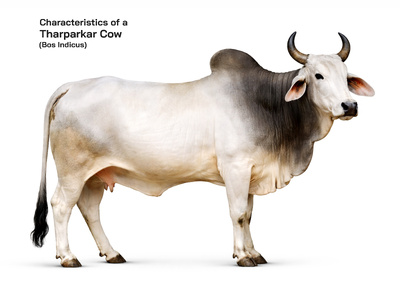
Physically, Ongole cattle are large animals with a commanding presence. They typically possess a massive body, broad chest, and strong bone structure. Their coat is usually white or light grey, sometimes deepening around the neck and hump. The hump itself is prominent, a characteristic feature of Bos indicus breeds, and is associated with strength and endurance. Loose skin and a well-developed dewlap assist in thermoregulation, helping the animal remain comfortable in high temperatures. The head is carried proudly, with alert eyes that reflect awareness and vitality.
Structural soundness is a key advantage of the Ongole. Strong legs and durable hooves allow these cattle to travel across varied terrain in search of forage and water. This ability has historically been vital in areas where grazing resources shift with the seasons. Their body design supports sustained activity, making them reliable participants in diverse agricultural settings.
Temperamentally, Ongole cattle are generally steady and intelligent. While their large size demands respectful handling, they respond well to consistent management and familiar routines. With proper care, they become cooperative members of the herd, allowing farmers to conduct daily operations smoothly. Their alert nature often translates into good survival instincts, contributing to herd stability.
Cattle husbandry for Ongole animals usually builds on their natural strengths. They are efficient grazers and can maintain condition on available pasture with moderate supplementation. Providing clean water, mineral balance, and preventive health programs enhances performance while preserving the breed’s inherent resilience. Because Ongoles show resistance to many tropical diseases and parasites, they require fewer medical interventions than less adapted breeds, which helps reduce costs in low-input systems.
Reproductive reliability is another notable characteristic. Ongole cows tend to display regular fertility patterns and attentive maternal behavior. Calves benefit from strong care during early development, supporting growth and herd continuity. This dependable reproduction allows farmers to plan long-term strategies and maintain stable livestock numbers.
The global importance of the Ongole breed has grown through its exportation and genetic influence. In several countries, Ongole cattle have been used to strengthen local populations, especially where heat tolerance and structural strength are priorities. Their traits have contributed to the development of other well-known breeds, demonstrating how regional livestock can have international impact.
Breed organizations and conservation initiatives aim to preserve the purity and quality of Ongole genetics while encouraging improvement in productivity and health. These efforts ensure that the breed remains competitive in modern agriculture without losing the attributes that made it successful historically. Maintaining this balance between tradition and innovation is central to the breed’s future.
Culturally, the Ongole is often associated with pride and heritage. Its impressive stature and enduring presence in rural life make it a symbol of strength and partnership between humans and animals. Farmers value not only its utility but also the continuity it represents across generations.
The Ongole also influences modern dairying through the way it supports confidence in long-term planning. Farmers who manage animals known for steadiness often develop strategies that extend many years into the future. Investments in pasture improvement, water security, and family labor allocation become easier to justify when the herd is expected to respond reliably. In this manner, the breed contributes to economic stability not only through milk itself but through the predictability that surrounds it.
Another expanding theme is the Ongole’s relationship with spatial management on farms. Because of their scale and composure, producers frequently design wider shade zones, reinforced flooring, and generous access points to water. These improvements reduce competition within the herd and help maintain orderly movement. Once established, such infrastructure tends to elevate welfare standards for every animal present, amplifying the breed’s indirect impact.
In many dairying communities, Ongole cattle help strengthen cooperative culture. When output remains comparatively even, neighbors can synchronize delivery times and share transport resources. Collective action becomes more efficient, allowing producers to participate in larger markets while retaining local identity. The breed’s reliability therefore fosters both independence and partnership at the same time.
Milk management strategies also benefit from the animal’s inherent consistency. Stable production patterns encourage families to diversify into small-scale processing such as cultured products or regional specialties. Because the base supply is dependable, experimentation becomes less risky. Through these ventures, Ongole cattle support entrepreneurship and rural creativity.
Researchers increasingly pay attention to how the breed informs climate-ready livestock policy. Instead of relying solely on mechanical cooling or imported genetics, planners can look to populations already adapted to demanding heat. The Ongole offers a tangible demonstration that resilience, once embedded in breeding objectives, can sustain productivity with fewer external supports.
In training programs, the breed frequently appears in modules that emphasize attentive observation. Learners are encouraged to notice subtle shifts in appetite, stance, or interaction, using the animal’s normal calmness as a reference. This practice cultivates skilled stockmanship and reinforces the principle that early awareness is central to herd health.
Another significant contribution lies in the development of fodder planning traditions. Farmers accustomed to working with Ongole cattle often map out seasonal availability months ahead, matching anticipated needs with crop cycles. Such foresight reduces waste and builds a buffer against drought or delayed rains. The herd becomes part of a wider agricultural calendar that links livestock and cultivation.
International dialogue continues to expand around the breed. Partnerships among research centers, breeding groups, and extension agencies create platforms for sharing techniques suited to hot climates. Through these exchanges, Ongole cattle help connect diverse regions facing similar environmental realities, strengthening global cooperation.
The cultural dimension remains powerful. The breed’s dignified outline frequently appears in festivals, educational materials, and rural narratives, reinforcing respect for pastoral heritage. Younger generations encounter not only an animal but a history of perseverance that inspires continued commitment to agriculture.
As pressure mounts to produce milk efficiently while limiting environmental footprint, animals capable of operating within natural constraints become increasingly valuable. The Ongole stands as evidence that careful alignment between genetics and habitat can yield durable results. Its record suggests that adaptation achieved over centuries can remain relevant even amid rapid modernization.
In the broadest sense, the Ongole’s ongoing significance lies in its ability to anchor change. While technologies evolve and markets expand, the presence of a dependable, climate-suited breed provides continuity. By supporting stable milk production, encouraging infrastructure refinement, and nurturing cooperative systems, the Ongole continues to guide dairying toward futures where resilience and practicality remain at the heart of agricultural progress.
The Ongole occupies a distinctive place in livestock development because it represents a meeting point between impressive physical scale and careful environmental adaptation. Beyond its visible stature, agricultural observers frequently note the breed’s capacity to remain composed and functional across long production cycles. This steadiness enables managers to build dairying plans that depend on continuity rather than dramatic fluctuation, an approach increasingly valued in regions where weather and market forces can change rapidly.
One area of additional interest is the Ongole’s relationship with energy management. Animals of substantial size must distribute effort wisely to avoid excessive strain. Many caretakers remark that Ongole cattle move with a measured rhythm, balancing activity with rest. This pacing supports endurance and helps maintain milk flow across seasons. Researchers studying sustainable livestock systems often point to such efficiency as evidence that adaptation can be as important as feed intensity.
In husbandry practice, the breed encourages thoughtful design of movement corridors and resting areas. Providing wide passages, stable footing, and shaded recovery spaces allows animals to express natural behavior without difficulty. These adjustments, though simple, can improve welfare and productivity simultaneously. Farms that refine infrastructure around Ongole requirements frequently see benefits extend to other animals as well.
Milk production from Ongole cows is often associated with dependable household supply. Even where output varies with management and climate, many herds maintain enough regularity to support family nutrition and participation in local markets. This reliability forms a buffer against uncertainty, helping rural communities maintain financial stability.
Another dimension concerns the breed’s role in collective resource use. In areas where grazing lands and water sources are shared, animals that integrate calmly into group systems reduce conflict and simplify coordination. Ongole cattle, when accustomed to routine interaction, often fit well within such frameworks, strengthening cooperation among farmers.
Educational programs frequently highlight the breed when discussing how traditional breeding objectives align with modern sustainability goals. The emphasis placed historically on endurance, mobility, and survival now appears highly relevant in a period of climate concern. Students learn that past experience can offer valuable guidance for future planning.
Health management strategies also benefit from the Ongole’s predictable patterns. When animals normally display calm and steady behavior, caretakers can quickly identify unusual signs. Early recognition improves response and helps maintain long productive lives. This preventive approach aligns with cost-effective dairying.
Internationally, Ongole genetics continue to influence cattle improvement initiatives in warm regions. Countries searching for animals capable of maintaining milk production under high temperatures often examine this breed’s history. Exchanges of breeding knowledge and training strengthen professional ties and contribute to global resilience.
The breed further inspires innovation in feed resource optimization. Because Ongole cattle can utilize a variety of forages, farmers frequently explore combinations of native grasses, crop residues, and cultivated fodder. This experimentation promotes self-reliance and reduces dependence on expensive imports.
Culturally, the Ongole stands as a figure of dignity and endurance. Community events and educational gatherings often use the breed to symbolize continuity between generations of livestock keepers. Such symbolism reinforces commitment to careful stewardship.
Looking ahead, the breed’s value is likely to increase as dairying seeks animals capable of maintaining output within environmental limits. Policymakers and producers recognize that large-scale technological intervention is not always feasible; genetic suitability becomes a primary tool. The Ongole offers a proven example of how adaptation can support sustainable milk supply.
Ultimately, the broader significance of the Ongole lies in its demonstration that resilience can anchor agricultural progress. By supporting reliable production, encouraging cooperative management, and fostering international collaboration, the breed continues to shape livestock systems toward models that prioritize endurance, practicality, and respect for ecological realities.
In summary, the Ongole cow embodies resilience, structural power, and adaptability within Bos indicus cattle. Its large frame, distinctive hump, calm intelligence, and ability to thrive under demanding conditions have secured its place in livestock systems around the world. Through effective husbandry and global recognition, the Ongole continues to contribute meaningfully to agriculture, demonstrating the lasting value of breeds shaped by both environment and human care.