The Kangayam cow, scientifically classified as Bos indicus, is a well-known zebu breed originating from the Kongu region of Tamil Nadu in southern India. Developed in an area characterized by dry climate, limited rainfall, and hardy vegetation, the breed evolved through generations of selective management focused on endurance, strength, and reliability. Farmers required cattle capable of supporting agricultural life in demanding environments, and the Kangayam became a trusted partner in sustaining rural livelihoods. Its reputation for toughness and practical utility continues to define its identity today.
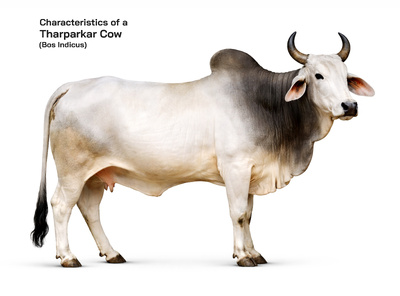
Physically, Kangayam cattle are medium to large animals with a compact yet muscular build. Their coat color is generally grey, ranging from light silver to darker tones, often with shading around the head, neck, and hump. Calves may appear reddish at birth before gradually changing color as they mature. A prominent hump, firm dewlap, and tight skin are typical features that contribute to thermoregulation and stamina. The head is well proportioned, and the horns are usually short to medium in length, curving outward in a graceful manner.
One of the most important characteristics of the Kangayam breed is structural strength. The animals possess solid legs, durable hooves, and a frame designed for sustained activity. These features enable them to move across dry lands efficiently in search of grazing and water. Their body design supports long service life and reduces susceptibility to injury, which is vital in extensive systems where animals must rely on natural resources.
Temperamentally, Kangayam cattle are alert yet manageable. With regular human interaction and consistent routines, they become cooperative and dependable. This combination of awareness and steadiness allows farmers to conduct daily husbandry with confidence. Their predictable behavior contributes to herd harmony and simplifies management tasks.
Cattle husbandry for Kangayam animals often emphasizes minimal input and maximum adaptation. They are excellent grazers and can maintain condition on coarse forage that might not support other breeds. Nonetheless, providing balanced nutrition, access to water, and routine preventive health care enhances their productivity and longevity. Their natural resistance to many local diseases and parasites further reduces management burdens, making them ideal for sustainable agricultural systems.
Reproductive performance is another strength of the breed. Kangayam cows typically show consistent fertility and strong maternal instincts, ensuring that calves receive proper care during early growth stages. Reliable reproduction allows farmers to maintain herd numbers and plan future development effectively. These qualities strengthen the economic foundation of livestock enterprises.
The global importance of the Kangayam is gradually increasing as interest grows in breeds that can thrive under climate stress. Their genetics are valued for resilience, structural soundness, and efficient resource use. In some regions, Kangayam cattle have been incorporated into improvement programs aimed at enhancing endurance and adaptability. This broader recognition highlights the relevance of traditional breeds in modern agriculture.
Conservation efforts are crucial to preserving the Kangayam’s identity. Breed societies and farmers work together to maintain genetic purity while encouraging responsible development. These initiatives ensure that the breed remains capable of meeting contemporary expectations without losing the characteristics shaped by history.
Culturally, the Kangayam cow holds a special place in local communities. It represents a legacy of cooperation between humans and animals in challenging landscapes. The breed’s image is closely tied to regional pride, agricultural festivals, and a sense of continuity across generations.
The Kangayam is increasingly examined by livestock planners as a model for how indigenous genetics can support stable dairying under ecological pressure. Beyond visible strength, researchers highlight metabolic thriftiness, meaning the animal can regulate energy use efficiently during fluctuations in forage availability. This internal balance allows lactation to continue without the dramatic body stress sometimes seen in less adapted populations. In village economies where fodder supply shifts with monsoon cycles, such steadiness provides families with predictable access to milk and income streams.
Another layer of interest concerns how Kangayam cattle interact with landscapes. Their grazing style tends to be selective yet non-destructive, which helps maintain plant regeneration in fragile dry zones. Agricultural extension workers often cite this behavior when promoting systems that integrate livestock with long-term soil and vegetation health. Because sustainability is now central to rural development policy, the breed’s compatibility with environmental management gives it renewed relevance.
Within household dairying, keepers frequently observe that Kangayam cows respond strongly to familiar caretakers and established rhythms of work. Once a relationship is built, animals may display remarkable consistency in milking temperament, standing quietly and conserving energy. This predictability reduces labor fatigue and enables older or younger family members to participate in daily routines, widening social involvement in agriculture.
Attention is also given to the breed’s role in preserving genetic diversity. As global agriculture has leaned toward uniform, high-input animals, many local types declined. Kangayam survival demonstrates that regional breeds still possess irreplaceable biological solutions, particularly for heat management and disease challenge. Maintaining such resources ensures future breeding flexibility at a time when climates are becoming less stable.
Milk from Kangayam cows often supports micro-economies built around direct sale, cooperative pooling, or value-added preparation within villages. Because supply is dependable rather than extreme, planning becomes easier for small processors. Women’s groups in particular benefit, transforming regular output into yogurt, clarified butter, and fermented products that circulate within local markets.
Educational institutions increasingly use the breed in training programs that teach low-input herd strategies. Students learn how housing orientation, shade planning, and watering points can enhance natural adaptation rather than replace it. Kangayam cattle thus become living classrooms for sustainable design.
International observers view these systems as templates for resilience. Delegations from semi-arid regions often study how traditional knowledge integrates with modest technological support. Through such exchanges, the breed contributes to global conversations about climate-ready dairying.
Discussions about the Kangayam from another angle often begin with its capacity to anchor community stability. In many dry districts, herd ownership functions as a form of living savings. Animals that remain fertile, mobile, and capable of providing milk across variable seasons become economic safeguards. Kangayam cattle, by maintaining routine productivity without elaborate infrastructure, fit naturally into this security framework.
Veterinary professionals note that preventive care strategies with this breed frequently emphasize monitoring rather than heavy intervention. Because individuals possess inherent robustness, early detection and timely response are usually sufficient to maintain herd health. This lighter medical footprint reduces expenditure and aligns with environmentally sensitive management philosophies.
Housing approaches also reveal interesting adaptations. Simple open sheds with effective airflow often meet comfort requirements, provided shade and dry resting areas are available. Farmers invest effort in orientation and cleanliness rather than expensive construction, demonstrating how design intelligence can substitute for capital intensity.
From a nutritional viewpoint, Kangayam cattle illustrate how moderate supplementation can complement hardy grazing ability. Crop residues, local fodder trees, and seasonal grasses become integral parts of feeding calendars. By aligning diets with regional agriculture, producers strengthen circular resource use and reduce dependency on purchased concentrates.
The breed further contributes to social heritage. Festivals, exhibitions, and youth training events present Kangayam animals as emblems of identity, encouraging younger generations to remain connected with livestock stewardship. Cultural pride, in turn, supports conservation momentum.
Milk utilization patterns demonstrate flexibility. Some households emphasize direct family nutrition, while others coordinate collective marketing. Because output levels are reliable, partnerships with nearby towns can be sustained without fear of dramatic shortages. This continuity reinforces trust between producers and consumers.
Globally, the breed is increasingly referenced in dialogues about how indigenous cattle might buffer agriculture against warming trends. Its experience in dry, heat-exposed regions provides practical evidence that adaptation already exists within traditional gene pools. By studying and maintaining these animals, countries gain options for future breeding strategies.
Through these combined roles—economic, environmental, and cultural—the Kangayam continues to influence livestock thinking far beyond its geographical origin. It stands not merely as a regional type but as a guide for building dairy systems that endure through uncertainty while sustaining rural life.
Another dimension of the Kangayam that attracts attention is the relationship between mobility and metabolic stability. Animals that walk considerable distances daily without excessive fatigue tend to preserve appetite and rumen efficiency. Observers frequently note that such balance helps maintain lactation rhythm even when grazing routes are long. In dryland agriculture, where movement is unavoidable, this feature becomes central to reliable milk supply.
Community breeding structures often revolve around trust networks, where knowledge of lineage and performance is exchanged verbally among families. This social circulation of information functions as an informal yet remarkably effective registry. By relying on memory, reputation, and shared observation, villages maintain quality while avoiding bureaucratic barriers. Kangayam herds therefore illustrate how collective stewardship can sustain improvement across generations.
Researchers are also intrigued by behavioral thermoregulation. During hotter hours, animals instinctively adjust posture, shade preference, and grazing timing. Instead of forcing uniform schedules, experienced caretakers design routines that respect these patterns. The result is a partnership in which management amplifies natural resilience rather than competing with it.
In the sphere of youth engagement, training initiatives often use Kangayam cattle to demonstrate that traditional breeds can coexist with innovation. Students experiment with fodder planning, digital record keeping, and cooperative marketing while still relying on animals that evolved for rugged settings. This blend of heritage and technology suggests pathways toward modernization that remain culturally grounded.
Milk distribution built on moderate yet stable flow encourages long-term relationships with buyers. Small processors prefer predictability, and Kangayam herds frequently deliver it. Over time, this dependability cultivates brand identity linked to authenticity and regional origin.
Environmental planners emphasize that animals capable of thriving on locally available vegetation reduce transport of external feed. Lower transport means lower cost and less ecological strain. Thus, the breed indirectly supports climate mitigation strategies while continuing to provide rural income.
International collaborations increasingly frame Kangayam genetics as part of a global safety net. Rather than replacing high-yield animals, they complement them, offering insurance against extreme conditions. This cooperative model broadens agricultural resilience worldwide.
Expanding from another viewpoint, the Kangayam often symbolizes continuity in regions where rapid economic change challenges agricultural traditions. Families who maintain herds preserve skills such as forage identification, seasonal planning, and humane handling. These competencies, passed through daily practice, strengthen community knowledge systems that might otherwise fade.
In herd management workshops, facilitators frequently highlight how routine observation can replace complex technology. Subtle shifts in appetite, posture, or movement are read as early indicators of need. Kangayam cattle, because of their expressive yet composed nature, make such interpretation easier for attentive keepers.
Women’s participation in dairying gains special attention. Regular milk availability empowers household enterprises that process and sell products within local markets. By supporting consistent daily income, the breed indirectly strengthens education and health opportunities for families.
Architectural design also adapts around these animals. Shade trees, wind direction, and resting surfaces become more important than heavy construction. This approach encourages environmentally harmonious farms that blend with rural landscapes rather than dominating them.
Nutritionists examining indigenous systems observe that varied diets derived from crop cycles can maintain body function effectively. Kangayam cattle utilize these mixtures with notable efficiency, reinforcing the concept that diversity in feed sources can substitute for intensity.
Beyond national borders, visitors often study such systems when searching for models of low-risk dairying. They find that success depends not only on genetics but also on patience, familiarity, and respect for animal rhythms. Kangayam management thus becomes an educational narrative about balance.
As climate projections grow more uncertain, policymakers value breeds already proven in adversity. The Kangayam provides living confirmation that adaptation is achievable without sacrificing continuity.
Through cultural celebration, practical reliability, and expanding international dialogue, the breed continues to influence how future livestock programs may be designed, emphasizing harmony between productivity, environment, and community well-being.
In summary, the Kangayam cow is a resilient and dependable member of the Bos indicus family. Its grey coat, strong frame, calm temperament, and ability to flourish in dry environments demonstrate the success of adaptation guided by human care. Through effective cattle husbandry and expanding international interest, the Kangayam continues to support livestock systems that value durability, sustainability, and heritage.