The Gir cow, scientifically classified as Bos indicus, is one of the most famous and influential zebu breeds in the world. Originating from the Gir forest region of western India, this breed developed in an environment characterized by high temperatures, seasonal droughts, and rugged grazing conditions. Over centuries, natural adaptation combined with selective breeding by pastoral communities shaped cattle that are remarkably hardy, productive, and capable of thriving under climatic stress. Today, the Gir is recognized not only within its native region but also internationally for its resilience and valuable genetic traits.
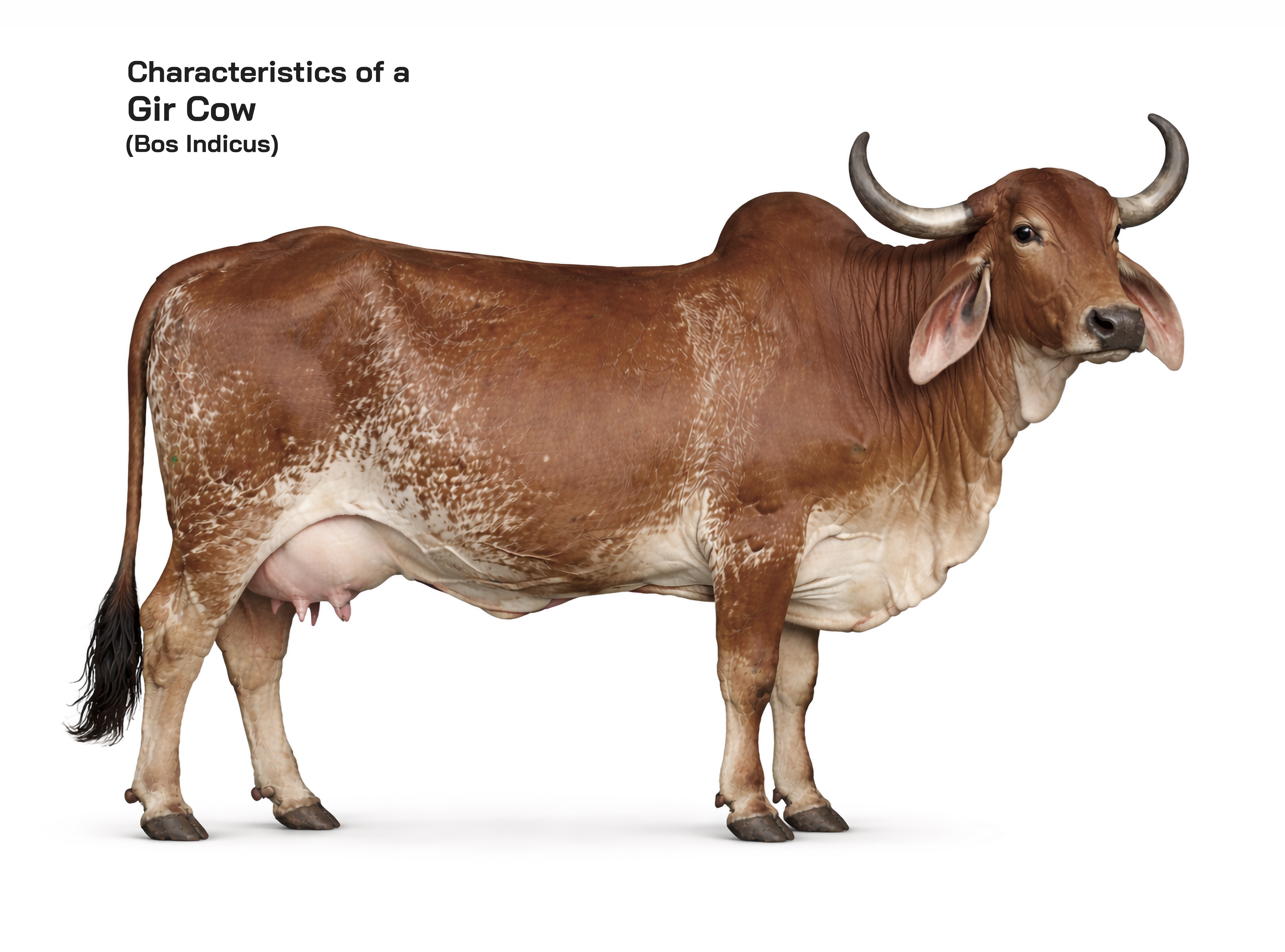
One of the most striking characteristics of the Gir cow is its distinctive appearance. These animals typically have a domed or convex forehead, giving the head a unique profile that is easy to recognize. Their ears are long, pendulous, and often curled at the tips, serving as both a breed identifier and a feature that may help with heat regulation. The coat color varies widely, ranging from red and white spotted patterns to shades of mottled brown. This diversity adds visual interest while maintaining the breed’s identity. A well-developed hump over the shoulders, loose skin, and prominent dewlap are typical zebu features that contribute to thermoregulation and endurance.
Body structure in the Gir emphasizes strength combined with functionality. They are medium to large animals with a deep chest and sturdy legs, enabling them to travel long distances in search of forage. This mobility has historically been essential in semi-arid landscapes where feed availability changes with the seasons. Their hooves and limbs are adapted to withstand rough ground, supporting sustained grazing without significant strain.
The udder development of the Gir cow is another valued trait. The breed is widely appreciated for its milk production capacity among Bos indicus cattle. Under proper management, Gir cows can produce consistent yields while maintaining good milk composition. Their ability to remain productive even under moderate feeding conditions makes them highly suitable for smallholder systems where inputs may be limited. This reliability has been central to their enduring popularity.
Temperament in Gir cattle is generally calm and cooperative. They are known for intelligence and responsiveness to handlers, qualities that simplify daily management. Their adaptability to routine milking and herd movement supports both traditional and organized farming practices. Farmers often highlight their balanced nature, which combines alertness with steadiness.
Heat tolerance is one of the most important reasons for the Gir’s prominence. Their loose skin, large ears, and light hair coat help dissipate heat efficiently. They can remain active and productive during periods of high temperature that might challenge less adapted breeds. Resistance to many tropical diseases and parasites further enhances their suitability for warm climates, reducing dependency on intensive veterinary inputs.
Reproductive performance adds to the breed’s strengths. Gir cows usually demonstrate strong maternal instincts, providing attentive care that helps calves grow steadily. Reliable fertility ensures continuity within herds, supporting long-term agricultural planning. These features contribute significantly to economic stability for farmers.
The global importance of the Gir has expanded in recent decades. The breed has been exported to several countries, particularly in regions seeking animals with strong heat tolerance and dependable productivity. In many places, Gir genetics are used in crossbreeding programs to improve local cattle populations. This international influence reflects the breed’s proven ability to transmit resilience and adaptability.
Breed societies and research institutions continue to promote conservation and improvement. Efforts focus on maintaining genetic purity while enhancing traits such as health, fertility, and milk performance. Such programs ensure that the Gir remains competitive in modern agriculture while preserving its traditional qualities.
Culturally, the Gir cow is deeply connected to pastoral heritage. It symbolizes endurance, harmony with the environment, and the long-standing relationship between communities and livestock. This cultural significance reinforces the breed’s identity and encourages continued stewardship.
The Gir continues to attract international attention because it provides a powerful example of how livestock can remain productive in environments where climatic pressure is constant. Agricultural planners frequently examine the breed when discussing future dairy security in warming regions. Instead of relying solely on artificial climate control, many experts look toward animals whose biological systems already function efficiently in hot, variable conditions. The Gir stands out in this conversation as a population that has demonstrated practical success across generations.
A major point of additional interest is the breed’s influence on feeding strategy design. Farmers working with Gir cattle often report that structured grazing schedules, supplemented by targeted nutrient support rather than heavy concentrate reliance, can maintain steady lactation. This approach encourages the development of locally sourced fodder systems and strengthens regional self-reliance. It also reduces vulnerability to global price swings in commercial feed markets.
Researchers increasingly value the Gir for insights into metabolic endurance. Observations show that many animals maintain stable physiological behavior across fluctuating temperatures and water availability. Such steadiness simplifies herd supervision and enables more accurate forecasting of milk flow throughout the year. When output patterns are reliable, cooperatives and processors can organize logistics with greater precision.
The breed also contributes meaningfully to conversations about humane stockmanship. Because Gir cattle tend to respond well to calm, consistent handling, farms often develop routines that emphasize patience and minimal force. These practices enhance safety for workers while reinforcing animal comfort. Over time, they help cultivate a culture in which welfare is understood as central to productivity rather than separate from it.
Another dimension of growing relevance is the Gir’s role in pastoral mobility systems. Even where modern dairying is expanding, seasonal movement between grazing areas remains important in many regions. Animals capable of maintaining body balance and lactation while adapting to such shifts support livelihoods that depend on flexibility. The Gir’s historical compatibility with movement-based management continues to inspire strategies for combining tradition with modernization.
In milk economy planning, Gir cattle are often associated with consistency of supply at moderate input levels. This characteristic makes them especially valuable for small and medium farms seeking dependable income without extensive capital investment. Their presence can stabilize rural dairy sectors by providing a predictable base around which improvements can gradually accumulate.
The breed has also influenced international development programs aimed at strengthening dairy capacity in tropical zones. Collaborative projects frequently incorporate Gir genetics when local herds require enhanced tolerance to environmental stress. Through these exchanges, knowledge moves alongside animals, building technical partnerships that extend far beyond individual farms.
Educational institutions use Gir herds to demonstrate how anatomical adaptation interacts with management opportunity. Students learn that when natural resilience is present, supportive measures such as shade design or water planning can amplify performance even further. This perspective helps future professionals approach dairying as a partnership between biology and environment.
Technological integration is expanding as well. Data collection systems applied to Gir cattle often confirm patterns of regular intake and movement, reinforcing their reputation for reliability. Such findings strengthen confidence in using the breed within evidence-driven decision frameworks, where predictable baselines are essential.
Culturally, the Gir continues to embody continuity between indigenous knowledge and contemporary ambition. Farmers frequently regard ownership of these animals as participation in a lineage of stewardship that links past generations with future ones. This symbolic role supports conservation initiatives and motivates careful breeding choices.
Looking ahead, the breed is poised to become even more significant as climate resilience rises on the global agenda. Policymakers and producers alike seek animals that can maintain milk delivery while minimizing external inputs. The Gir’s history suggests that such balance is achievable through respect for adaptation developed over centuries.
The Gir also plays a crucial role in shaping how livestock managers think about risk distribution within dairy enterprises. When animals are known for maintaining routine behavior even under environmental fluctuation, farms can diversify activities with greater confidence. Crop planning, labor organization, and investment in processing or marketing become easier to coordinate when the biological foundation of the herd remains steady. This predictability transforms the breed into a stabilizing force within complex agricultural systems.
Another important perspective concerns the Gir’s influence on community knowledge networks. In many regions, breeders exchange observations about lineage, maternal traits, and adaptation patterns. These discussions create informal yet powerful systems of collective intelligence. By sharing experiences, farmers accelerate learning and reduce the likelihood of repeating costly mistakes. The breed therefore strengthens cooperation as much as individual performance.
The Gir has further encouraged the refinement of water management practices. Even though the animals are capable of functioning under heat stress, providing reliable hydration enhances comfort and supports consistent lactation. Producers often experiment with placement of troughs, timing of access, and integration with grazing routes. Innovations developed for Gir herds frequently benefit other livestock as well, illustrating how adaptation can inspire broader improvement.
In extension education, Gir cattle are frequently presented as examples of compatibility between traditional breeding wisdom and modern analytics. Performance recording, genetic mapping, and reproductive technologies are increasingly applied to populations that once depended primarily on observational selection. The result is a hybrid model in which scientific tools enhance rather than replace accumulated pastoral knowledge.
The breed’s reputation for dependability has also made it central to microfinance and rural development initiatives. Institutions seeking secure returns often prefer animals with well-documented resilience. Gir cows, capable of providing stable milk flow, become cornerstones of livelihood programs that aim to strengthen household income and food security simultaneously.
Internationally, the Gir contributes to dialogue about south-to-south cooperation in agriculture. Countries facing similar climatic realities exchange breeding material and husbandry expertise, building partnerships that reduce reliance on imported models unsuited to local conditions. Through these exchanges, the breed becomes part of a broader movement toward context-appropriate development.
Another area of significance is the growing interest in heritage conservation linked with productivity. Rather than treating indigenous breeds as relics, many planners now see them as resources for future adaptation. The Gir exemplifies how preservation and modernization can proceed together, with genetic continuity providing a base for innovation.
The breed also influences how dairy operations approach labor efficiency. When animals respond calmly and follow established patterns, fewer personnel are required for routine tasks. This efficiency allows farms to allocate human resources toward improvement projects, training, or value-added activities, strengthening overall resilience.
Public perception plays a role as well. Gir cattle often symbolize harmony between agriculture and environment, helping build trust in dairy systems. Their recognizable features and long association with pastoral life provide visual reassurance that production remains grounded in tradition even as it evolves.
Looking forward, the Gir is likely to become increasingly important in shaping strategies that respond to global warming, water scarcity, and the need for equitable rural development. Its proven capacity to sustain milk output under demanding circumstances offers guidance for policymakers seeking realistic pathways toward stability.
In a broader sense, the breed’s journey illustrates how livestock can serve as partners in human adaptation. By aligning management practices with natural tolerance, communities create systems that are both efficient and respectful of ecological limits. Through its enduring reliability and cultural significance, the Gir continues to influence not only how dairying is practiced but also how agricultural futures are imagined.
Ultimately, the Gir demonstrates that sustainable dairying is not only about technology or expansion but about aligning animals, land, and human intention. By offering dependable milk production, compatibility with varied husbandry systems, and a strong cultural anchor, the breed continues to guide agricultural communities toward models that value endurance, cooperation, and thoughtful progress.
In summary, the Gir cow represents a remarkable blend of distinctive appearance, calm temperament, and exceptional adaptability within Bos indicus cattle. Its domed forehead, long ears, and resilient body structure highlight centuries of evolution in challenging climates. Through national pride and global recognition, the Gir continues to contribute meaningfully to livestock systems, demonstrating how natural adaptation and thoughtful breeding can create animals well suited to a changing world.