Pandanus fascicularis is a highly valued tropical plant known for its intense fragrance, distinctive leaf structure, and wide range of traditional uses. Commonly referred to as the kewda plant, it holds a special place in cultural, medicinal, and aromatic traditions, particularly in India. This plant is admired not only for its unique appearance but also for the powerful natural scent produced by its flowers, which has been cherished for centuries. The characteristics of Pandanus fascicularis reflect its adaptation to warm climates, coastal environments, and human use across generations.
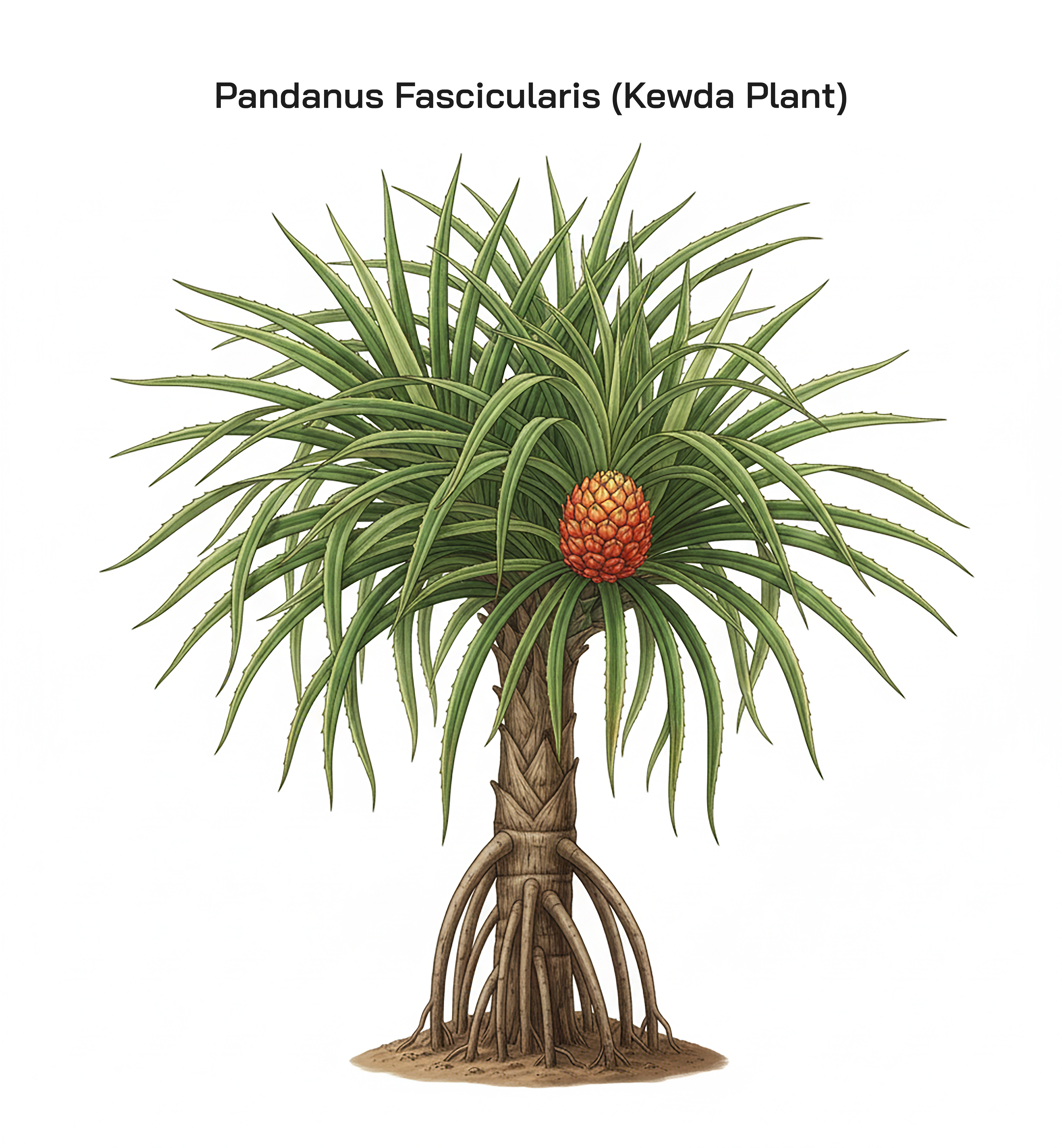
From a botanical perspective, Pandanus fascicularis is an evergreen shrub or small tree that belongs to the pandanus group of plants. It is easily recognized by its long, narrow, sword-like leaves that grow in dense spirals around the stem. These leaves are tough, leathery, and edged with small spines, which provide protection from grazing animals. The overall appearance of the plant is robust and architectural, making it suitable for both natural landscapes and cultivated gardens.
The plant often develops multiple stems and aerial roots, which help anchor it firmly in loose or sandy soil. These supporting roots enhance stability and allow the plant to survive in coastal regions where soil conditions can be unstable. This structural adaptation is one of the key features that enables Pandanus fascicularis to thrive in challenging environments, including areas with high salinity and strong winds.
The origin of Pandanus fascicularis is closely linked to tropical and subtropical regions of South Asia. It is believed to be native to the Indian subcontinent, particularly coastal regions where warm temperatures and humidity support its growth. Over time, the plant has become widely cultivated in parts of eastern and southern India, especially in areas known for aromatic plant farming. Its natural distribution and long history of cultivation highlight its importance in regional biodiversity and traditional agriculture.
One of the most remarkable features of Pandanus fascicularis is its flower. The male flowers are especially prized for their intense and pleasant fragrance. These flowers are small and clustered, producing a sweet, floral aroma that is both refreshing and long-lasting. The scent is strong enough to permeate surrounding areas, making the plant highly desirable for fragrance extraction. The female flowers are less fragrant and are primarily involved in seed production.
The scent of Pandanus fascicularis is unique and distinctive, often described as sweet, floral, and cooling. This aroma has been traditionally extracted to produce kewda water and kewda oil, both of which are widely used in perfumery, flavoring, and cultural practices. The fragrance is known for its calming effect and is often associated with feelings of freshness and relaxation. Unlike synthetic scents, the natural aroma of kewda is subtle yet persistent, making it highly valued in natural products.
In traditional medicine, Pandanus fascicularis has been used for various health-related purposes. The fragrant extracts are believed to have cooling properties that help soothe the body and mind. In some traditional systems, kewda water is used to relieve headaches, reduce stress, and promote mental relaxation. The scent is also thought to help improve mood and reduce anxiety, making it useful in aromatherapy practices.
The leaves of Pandanus fascicularis also have practical benefits. Due to their toughness and flexibility, they are sometimes used for weaving mats, baskets, and other utility items in rural communities. The spiny edges of the leaves require careful handling, but once processed, the material becomes durable and long-lasting. This traditional use highlights the plant’s role in supporting local livelihoods and sustainable resource utilization.
In skincare and hair care traditions, kewda extracts are sometimes used for their refreshing fragrance and perceived soothing effects. The natural scent is added to oils, creams, and water-based preparations to enhance sensory appeal. While primarily valued for aroma, the plant is also associated with mild cleansing and cooling sensations when used externally.
Culturally, Pandanus fascicularis holds significant importance. Its fragrance is often used during religious rituals, festivals, and ceremonial occasions. Kewda water is sprinkled in homes and places of worship to create a pleasant and purified atmosphere. The plant’s association with tradition and celebration has helped preserve its cultivation across generations.
From an agricultural standpoint, the cultivation of Pandanus fascicularis supports rural economies, particularly in regions known for aromatic crop production. Farmers grow the plant specifically for flower harvesting, which is carried out carefully to preserve fragrance quality. The flowers are usually collected early in the day when their aroma is strongest. Traditional distillation methods are then used to extract the scented products.
Ecologically, Pandanus fascicularis plays an important role in stabilizing soil and supporting coastal ecosystems. Its root system helps prevent erosion, while its dense foliage provides shelter for small animals and insects. The plant contributes to local biodiversity and supports ecological balance in areas where it grows naturally.
In modern times, the demand for natural fragrances has renewed interest in Pandanus fascicularis. As consumers seek plant-based and sustainable alternatives to synthetic products, kewda-derived fragrances are gaining recognition in perfumery and wellness industries. This renewed appreciation underscores the plant’s continued relevance in both traditional and contemporary contexts.
Pandanus fascicularis represents a fascinating example of how plants evolve not only to survive their environment but also to integrate deeply into human culture, economy, and sensory experience. Beyond its fragrance and traditional uses, this plant demonstrates a highly specialized growth strategy that reflects long-term adaptation to tropical coastal ecosystems. Its biology reveals a balance between resilience, reproduction, and human interaction that few aromatic plants achieve so completely.
One of the most distinctive yet lesser-discussed characteristics of Pandanus fascicularis is its growth pattern over time. Unlike many shrubs that grow uniformly, this plant develops in stages, gradually forming a complex structure of branching stems supported by aerial roots. These roots are not merely anchors but act as secondary nutrient absorbers, allowing the plant to draw moisture and minerals from surface layers of soil and organic debris. This adaptation is particularly valuable in sandy or nutrient-poor coastal soils where deep-root penetration is difficult.
The spiral arrangement of leaves in Pandanus fascicularis is another remarkable feature with functional significance. This phyllotaxy allows maximum exposure to sunlight while minimizing self-shading, which is crucial in dense tropical vegetation. The leaves’ waxy surface reduces water loss through evaporation, enabling the plant to tolerate high temperatures and salty winds. The spines along the leaf margins serve not only as physical protection but also as a deterrent to climbing animals that might damage flowers or developing fruit structures.
Flower biology in Pandanus fascicularis is highly specialized. The plant is dioecious, meaning male and female flowers grow on separate plants. This separation encourages cross-pollination, increasing genetic diversity and long-term population stability. Male plants are more valued agriculturally due to their fragrant flowers, which has led to selective cultivation practices over generations. Farmers often identify and propagate male plants early, shaping plantation structure and influencing the genetic makeup of cultivated populations.
The fragrance chemistry of Pandanus fascicularis is complex and unique. The scent compounds released by the flowers include a blend of volatile aromatic molecules that evaporate slowly, allowing the fragrance to linger in the air for extended periods. This slow-release quality explains why kewda scent is perceived as soft yet persistent rather than overpowering. Environmental factors such as temperature, humidity, and soil composition subtly influence fragrance intensity, making flowers from different regions slightly distinct in aroma profile.
Harvesting practices reflect a deep understanding of plant physiology. Flowers are typically collected during specific hours when aromatic compounds are at their peak. Improper timing can reduce fragrance quality significantly. Traditional harvesting methods emphasize gentle handling, as bruising the flowers can alter the scent. These practices demonstrate how agricultural knowledge has evolved alongside the plant, forming a sustainable relationship between humans and Pandanus fascicularis.
Beyond fragrance extraction, the plant has played a quiet role in traditional environmental management. Its dense growth and extensive root systems help bind loose soil, making it valuable in coastal stabilization efforts. In regions prone to erosion or seasonal flooding, Pandanus fascicularis acts as a natural barrier, reducing land degradation. Over time, organic matter trapped around its roots improves soil quality, allowing other plant species to establish themselves nearby.
The interaction between Pandanus fascicularis and wildlife is another subtle yet important aspect of its ecology. Insects are attracted to its flowers, while birds and small mammals use its dense foliage for shelter. Although not a primary food source, the plant contributes to habitat complexity, supporting micro-ecosystems within its immediate surroundings. This ecological role often goes unnoticed but is critical for maintaining biodiversity in coastal and semi-wild landscapes.
In traditional knowledge systems, Pandanus fascicularis is often associated with cooling and calming influences. This perception likely arises from both its fragrance and its natural habitat in breezy, coastal environments. The scent is traditionally believed to balance internal heat and emotional agitation, reflecting how sensory experiences shape cultural interpretations of plant properties. These beliefs have helped preserve the plant’s value even as modern medicine and synthetic fragrances emerged.
Economically, Pandanus fascicularis represents a low-impact, high-value crop. It requires relatively minimal chemical inputs and can be grown alongside other plants without intensive land modification. This makes it well-suited for small-scale farmers and sustainable agriculture models. The long lifespan of the plant also means that once established, it can produce flowers for many years, offering consistent income with limited environmental cost.
In contemporary research and wellness industries, Pandanus fascicularis is gaining attention for its potential role in natural fragrance therapy and sensory-based stress relief. Scientists and product developers are increasingly interested in how traditional aromatic plants influence mood and perception. The plant’s gentle yet enduring scent profile aligns well with modern preferences for subtle, nature-derived aromas rather than sharp synthetic fragrances.
Taken as a whole, Pandanus fascicularis is far more than a fragrant plant. It is a living intersection of ecology, culture, agriculture, and sensory science. Its continued relevance depends on preserving not just the plant itself, but the traditional knowledge, harvesting practices, and environmental conditions that allow it to thrive. In understanding this plant deeply, we gain insight into how human societies and plant life can coexist in ways that are mutually sustaining, enduring, and richly meaningful.
Pandanus fascicularis can be understood not only as an aromatic plant but as a long-lived biological system that integrates climate adaptation, human selection, and ecological resilience. One of its most distinctive qualities is its exceptional tolerance to environmental stress. This plant has evolved to survive prolonged heat, intense sunlight, saline air, and irregular water availability. Its cellular structure is adapted to reduce moisture loss, allowing it to remain physiologically active even during dry spells when many tropical plants experience growth suppression. This endurance has made Pandanus fascicularis a reliable species in marginal coastal lands where conventional crops struggle to survive.
The longevity of Pandanus fascicularis is another underappreciated feature. Once established, a single plant can live and remain productive for decades. Over time, it develops a complex architecture of stems and roots that strengthens rather than weakens with age. Older plants often produce flowers with deeper and more nuanced fragrance profiles, which is why mature plantations are especially valued by traditional cultivators. This long productive lifespan reduces the need for frequent replanting and contributes to sustainable land use practices.
The plant’s interaction with soil biology is also noteworthy. The root zone of Pandanus fascicularis supports diverse microbial communities that assist in nutrient cycling. Organic debris trapped by aerial roots decomposes gradually, enriching the surrounding soil with organic matter. This creates localized pockets of fertility in otherwise poor soils. As a result, surrounding vegetation often appears healthier near established pandanus plants, demonstrating its indirect role in improving land quality over time.
From a physiological standpoint, Pandanus fascicularis exhibits controlled growth rather than rapid expansion. This slow growth rate allows the plant to allocate energy efficiently toward structural strength and chemical production, including aromatic compounds. Unlike fast-growing plants that prioritize leaf expansion, this species invests heavily in flower chemistry. This trade-off explains why the plant does not appear lush in the conventional sense but remains highly valuable for fragrance production.
The fragrance itself plays an ecological role beyond human appreciation. In natural settings, the intense aroma of male flowers helps attract specific pollinating insects over long distances. The scent molecules are designed to disperse gradually, remaining detectable even in humid or windy coastal air. This ensures effective pollination despite the separation of male and female plants. The plant’s reliance on scent rather than visual cues reflects an evolutionary strategy adapted to dense vegetation and low-visibility environments.
Seasonal rhythm is deeply embedded in the life cycle of Pandanus fascicularis. Flowering periods are closely linked to temperature patterns, humidity, and day length. Farmers with generations of experience can predict flowering intensity based on subtle environmental signs such as wind direction, soil moisture, and night temperatures. This intimate knowledge reflects how closely human agricultural practices have adapted to the plant’s natural biological clock.
In traditional rural landscapes, Pandanus fascicularis often functions as a boundary plant. Its spiny leaves discourage intrusion by animals and humans alike, making it useful as a living fence. Unlike artificial barriers, these natural boundaries also provide ecological benefits such as wind buffering and microclimate regulation. Fields protected by pandanus hedges experience reduced soil erosion and moisture loss, indirectly supporting nearby crops.
The cultural transmission of knowledge surrounding Pandanus fascicularis is itself unique. Skills related to identifying male plants, optimal harvesting times, and fragrance preservation are often passed orally rather than through written records. This has created region-specific practices that vary subtly from place to place. As a result, kewda products from different regions possess distinct aromatic identities, shaped by both environment and tradition.
Modern scientific interest in Pandanus fascicularis is expanding beyond fragrance. Researchers are examining its adaptive traits to understand how plants cope with salinity and climate stress. These studies may contribute insights useful for developing resilient agricultural species in the face of climate change. The plant thus holds potential value not only as a cultural and economic resource but also as a model for environmental adaptation.
Another unique aspect is the emotional association people develop with the plant’s scent. Unlike many strong floral fragrances, kewda aroma is often linked to memory, calmness, and familiarity rather than intensity. This psychological response has contributed to its continued use in rituals, food flavoring, and personal spaces. The scent becomes a bridge between environment and emotion, reinforcing the plant’s cultural significance.
In the broader context of sustainability, Pandanus fascicularis represents a low-intervention crop that aligns naturally with ecological processes. It requires minimal chemical inputs, supports biodiversity, stabilizes fragile land, and provides long-term economic return. Its continued cultivation demonstrates how traditional plant knowledge can align with modern sustainability goals without sacrificing cultural identity.
Ultimately, Pandanus fascicularis stands as an example of harmony between nature and human use. Its value does not lie in rapid productivity or mass exploitation, but in consistency, resilience, and sensory richness. By understanding this plant beyond its fragrance, we gain insight into how slow-growing, environmentally adapted species can remain relevant across centuries, offering lessons in patience, balance, and sustainable coexistence with the natural world.
In summary, Pandanus fascicularis is a plant of exceptional value, combining unique physical features, rich fragrance, and diverse benefits. Its spiny leaves, aromatic flowers, and resilient growth habits reflect adaptation to tropical environments. Originating in the Indian subcontinent, it has become an integral part of cultural traditions, natural medicine, and fragrance industries. The scent of kewda offers relaxation and refreshment, while the plant’s uses extend from practical applications to spiritual significance. Understanding the features, origin, scent, benefits, and uses of Pandanus fascicularis highlights its importance as a botanical, cultural, and economic treasure.