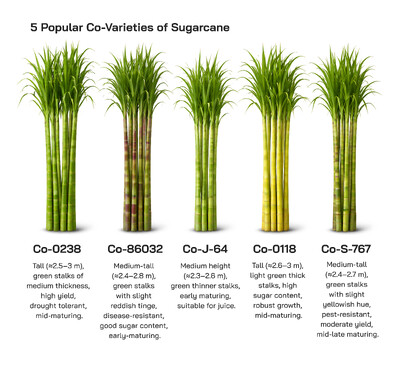
Sugarcane is a complex crop group rather than a single uniform plant, and its global cultivation is based primarily on four main species within the genus Saccharum. Each species differs in taste, physical appearance, stalk thickness, adaptability to soil and climate, and geographical distribution. Together, these four species form the biological foundation of modern sugarcane agriculture and breeding.
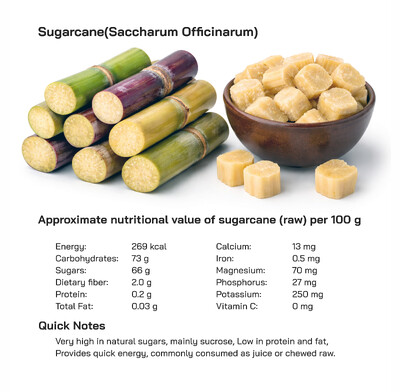
Saccharum officinarum, commonly known as noble cane, is the most widely recognized and commercially dominant species. It is characterized by thick, juicy stalks with high sucrose concentration. The taste of noble cane is notably sweet, clean, and mild, making it ideal for direct juice extraction and refined sugar production. Visually, the stalks are smooth, tall, and often exhibit green, yellow, or purplish coloration with a waxy surface. The internodes are long and cylindrical, contributing to high juice yield. This species prefers deep, fertile loamy soils rich in organic matter and performs best in tropical climates with warm temperatures and abundant rainfall. Noble cane is extensively cultivated across South Asia, Southeast Asia, parts of Africa, the Caribbean, and South America, forming the backbone of global sugar industries.
Saccharum barberi is an older cultivated species traditionally grown in northern parts of the Indian subcontinent. Compared to noble cane, its stalks are thinner and shorter, with moderate juice content. The taste is less intensely sweet, often slightly earthy, reflecting lower sucrose levels. The appearance is more fibrous, with harder rinds and shorter internodes. This species is valued for its adaptability to cooler subtropical conditions and shorter growing seasons. It tolerates a wider range of soil types, including lighter alluvial soils, and is more resistant to temperature variation. Saccharum barberi has historically played an important role in regional sugar production in northern India and surrounding areas, although its cultivation has declined with the spread of high-yielding hybrids.
Saccharum sinense represents another ancient cultivated form believed to have originated in southern China. It shows intermediate characteristics between noble cane and barberi types. The stalks are moderately thick with a balance of fiber and juice. The taste is mildly sweet with a slightly grassy undertone. In appearance, the canes are sturdy with visible nodes and a less glossy surface compared to noble cane. This species grows well in warm, humid subtropical climates and performs reliably in soils with good drainage and moderate fertility. Saccharum sinense has been traditionally cultivated in parts of East Asia and has contributed genetic traits to modern breeding programs due to its adaptability and disease tolerance.
Saccharum spontaneum is the wild ancestor of cultivated sugarcane and differs significantly from the other three species. It has very thin, hard, and highly fibrous stalks with low sugar content, making it unsuitable for direct sugar production. The taste is bland and grassy rather than sweet. Visually, it appears as tall, reed-like clumps with narrow stems and sharp-edged leaves. Despite its lack of commercial sweetness, this species is extremely important agriculturally because of its resilience. It thrives in poor soils, riverbanks, and disturbed lands, tolerating drought, flooding, and temperature extremes. Saccharum spontaneum is found naturally across South Asia, Southeast Asia, and parts of Africa and is widely used in breeding programs to improve disease resistance, stress tolerance, and root strength in cultivated sugarcane varieties.
From a farming perspective, these four species reflect different stages of domestication and adaptation. Noble cane prioritizes sweetness and yield, while barberi and sinense emphasize regional adaptability. Wild cane contributes survival traits essential for long-term crop resilience. Modern sugarcane varieties grown today are often hybrids derived from these species, combining high sucrose levels with environmental tolerance.
Climatically, sugarcane species as a group favor warm environments with long growing seasons. Tropical regions support maximum growth and sugar accumulation, while subtropical zones favor species adapted to seasonal variation. Well-drained, deep soils enhance root development and stalk thickness, directly influencing productivity.
Globally, sugarcane cultivation spans Asia, Africa, the Americas, and island regions, reflecting the adaptability of these species to diverse environments. Their combined genetic legacy supports one of the world’s most important agricultural industries, linking food, fuel, and rural economies.
Beyond their visible differences, the four principal sugarcane species vary significantly in their internal structure and physiological behavior, which directly influences their agricultural value. Noble cane exhibits a high proportion of parenchyma tissue within its internodes, allowing greater juice storage and easier extraction. In contrast, Saccharum barberi and Saccharum sinense contain a higher proportion of supportive fiber, which reduces juice volume but improves structural stability under cooler or variable climates. Wild Saccharum spontaneum is dominated by fibrous tissue, an adaptation that allows survival in harsh environments but limits sweetness.
Growth rhythm also differs markedly among these species. Noble cane follows a long, steady growth cycle that favors extended warm conditions, allowing gradual sucrose accumulation. Barberi types mature faster, making them suitable for regions with shorter growing seasons or early harvest needs. Sinense varieties balance growth duration and adaptability, while spontaneous wild cane prioritizes vegetative survival over sugar storage, producing vigorous shoots even under stress.
Root architecture represents another major point of divergence. Noble cane develops dense but relatively shallow roots that perform best in deep, fertile soils with consistent moisture. Barberi and sinense species form more adaptive root systems capable of functioning in lighter or variable soils. Saccharum spontaneum develops extremely aggressive and deep root networks, enabling it to anchor riverbanks, tolerate flooding, and regenerate rapidly after disturbance. These root traits are critical in breeding programs focused on stress tolerance.
Disease and pest response also varies across the four species. Noble cane, while productive, is more vulnerable to diseases and environmental stress without careful management. Barberi and sinense types possess moderate resistance due to their longer adaptation to regional conditions. Wild cane carries strong genetic resistance to many pests and diseases, making it invaluable for developing resilient hybrid varieties. This genetic diversity underpins the long-term stability of global sugarcane cultivation.
Water-use behavior differs among species as well. Noble cane consumes large amounts of water to sustain high biomass and juice content. Barberi and sinense species demonstrate more efficient water use, maintaining acceptable growth under moderate moisture stress. Saccharum spontaneum survives extreme fluctuations in water availability, from drought to waterlogging, reflecting its role as a survival species rather than a production crop.
In terms of landscape interaction, noble cane fields are typically intensively managed monocultures, while barberi and sinense have historically been grown in mixed farming systems. Wild cane often exists outside cultivated fields, forming natural stands that influence soil stabilization and ecological balance. This difference highlights how each species interacts differently with its surrounding environment.
Culturally, these species have shaped regional agricultural identities. Noble cane became synonymous with plantation agriculture and large-scale sugar industries. Barberi and sinense supported localized sugar traditions and regional sweetener production. Wild cane remained part of the natural landscape, valued indirectly through its contribution to crop improvement rather than direct consumption. Together, they represent different relationships between humans and sugarcane.
Modern sugarcane varieties rarely belong to a single species. Instead, they are complex hybrids that combine the sweetness of noble cane with the resilience of barberi, sinense, and spontaneum. This hybridization strategy reflects an understanding that no single species alone can meet the demands of productivity, adaptability, and sustainability. The four species therefore function collectively rather than competitively in modern agriculture.
Global distribution patterns of sugarcane species continue to evolve. Noble cane-derived hybrids dominate tropical and subtropical production zones. Traits from barberi and sinense support cultivation in marginal or transitional climates. Genetic input from spontaneum enables expansion into stress-prone environments. This layered genetic contribution allows sugarcane to remain productive across continents.
From a sustainability perspective, the coexistence of these species within breeding systems ensures long-term crop viability. Noble cane delivers economic output, while the other species safeguard adaptability and resilience. This balance is essential as climate variability, water stress, and disease pressure increase worldwide.
In essence, the four main sugarcane species represent distinct biological strategies rather than simple variations of the same crop. Each contributes unique traits related to taste, structure, climate response, and survival. Their combined legacy explains not only how sugarcane achieved global dominance, but also how it continues to adapt and thrive in an ever-changing agricultural landscape.
The evolutionary pathways of the four sugarcane species also differ in how they respond to human selection over time. Noble cane underwent intensive selection for sweetness, stalk girth, and juice clarity, traits favored by early sugar-producing societies. This focused selection narrowed its genetic base, increasing productivity but reducing adaptability. In contrast, barberi and sinense evolved under more diverse farming conditions, where survival across variable seasons mattered as much as sweetness. Wild spontaneum remained largely untouched by domestication, preserving a wide genetic spectrum that continues to be critical for crop improvement today.
Morphological plasticity further separates these species. Noble cane shows relatively uniform stalk shape and internode length under stable conditions, which benefits mechanized harvesting and industrial processing. Barberi and sinense display greater variability in internode length and stalk angle, allowing them to cope with uneven soils and fluctuating temperatures. Saccharum spontaneum exhibits extreme plasticity, altering culm height, leaf density, and tillering intensity depending on stress levels, a trait that ensures survival but complicates cultivation.
Photosynthetic efficiency and biomass allocation also vary. Noble cane channels a higher proportion of photosynthates into sucrose storage, while barberi and sinense allocate more toward structural tissues and leaf maintenance. Spontaneum prioritizes vegetative spread and root reinforcement over storage, enabling rapid colonization of disturbed habitats. These allocation strategies explain why sweetness peaks in noble cane while resilience peaks in wild types.
Harvest behavior and post-harvest physiology present additional contrasts. Noble cane deteriorates more rapidly after cutting, necessitating quick transport to mills to prevent sugar loss. Barberi and sinense can tolerate slightly longer intervals due to lower sucrose inversion rates. Wild cane, lacking commercial sugar levels, shows little concern for post-harvest changes, underscoring its role outside industrial systems. These differences shape regional harvesting logistics and processing infrastructure.
Soil interaction patterns further distinguish the species. Noble cane thrives in deep, well-managed soils where nutrients are readily available, but it performs poorly in compacted or nutrient-poor fields. Barberi and sinense tolerate variable soil textures and moderate fertility, making them suitable for traditional farming systems. Spontaneum improves soil structure over time through dense root penetration and organic matter contribution, often acting as a natural soil stabilizer in floodplains and degraded lands.
Climate sensitivity gradients are evident across the four species. Noble cane is optimized for consistently warm, humid conditions with minimal temperature stress. Barberi endures cooler winters and shorter summers, while sinense bridges tropical and subtropical zones with balanced tolerance. Spontaneum withstands extreme heat, cold snaps, drought, and flooding, traits that make it indispensable for breeding climate-resilient hybrids.
Regional breeding strategies reflect these inherent differences. In tropical regions, breeders emphasize noble cane sweetness while introducing spontaneum-derived resistance traits. In subtropical zones, barberi and sinense genetics help stabilize yields across seasons. This targeted use of species-specific strengths illustrates how the four species function as a coordinated genetic toolkit rather than isolated crops.
Cultural perceptions of sugarcane species also differ subtly. Noble cane is often associated with luxury, sweetness, and industrial scale, while barberi and sinense carry historical ties to regional sweeteners and local food traditions. Wild cane is respected for its toughness and is sometimes viewed as a symbol of endurance rather than consumption. These perceptions influence conservation priorities and farmer preferences across regions.
Looking ahead, the relevance of all four species is expected to increase as agriculture adapts to environmental uncertainty. Noble cane alone cannot meet future demands without the genetic reinforcement provided by the other species. Barberi and sinense contribute adaptability, while spontaneum offers a reservoir of survival traits. Together, they form a resilient framework for sustaining sugarcane production under changing climates.
In practical terms, modern sugarcane fields are living expressions of this combined heritage. Although they may appear uniform, their genetic makeup reflects centuries of selection and hybridization among these species. Each stalk carries traits shaped by sweetness, climate tolerance, disease resistance, and survival instincts inherited from different ancestors.
Ultimately, the four main sugarcane species represent complementary solutions to agricultural challenges rather than competing options. Their differences in taste, appearance, thickness, soil response, climate suitability, and geographic distribution explain not only past cultivation patterns but also future potential. By understanding and preserving the unique strengths of each species, global agriculture ensures that sugarcane remains productive, adaptable, and economically vital for generations to come.
In summary, the four main sugarcane species represent a balance between sweetness, strength, adaptability, and survival. Their differences in taste, appearance, thickness, soil preference, climate tolerance, and regional presence explain how sugarcane has become a globally successful crop and why these species remain essential to sustainable sugarcane cultivation worldwide.